At 9:00 p.m. sharp, the sound of rockets flying and grenades exploding brought a cop helicopter overhead with its searchlight a-glare.
Around this time of year, the ghost shopping center at Dunlap and the I-17 puts on a fireworks show on Friday nights. They used to do it every Friday night, all summer long, but now that there are hardly any stores left for people to shop in, they limit the gala celebrations to a couple weeks on either side of July 4.
With Sally’s tree gone, I had a great view from my backyard! They shot off some spectacular colored showers of pyrotechnic stars, skyrockets, fountains…it was quite a display.
My old house was practically underneath the fireworks show. But now, deeper in the neighborhood and further away from the hectic intersections of Dunlap and the freeway, the view is often obscured by the neighbors’ foliage. Before Sally cut the big Aleppo pine out of her front yard, it fully blocked any sight of the mall’s fireworks extravaganza.
LOL! They always kick off with some loud firecracker-like things that sound for all the world like gunfire. And invariably, the first night of the season that the fireworks start, some newbie resident calls the cops and reports shots fired. Hence, a cop copter fly-by.
Well, I’d rather have the tree all summer (and winter) than one or two, or even several, fireworks displays. But it was fun to see the show.
Image: San Diego Fireworks. PD Photo.org. Public domain.
This fall I’m teaching a fully online college course that will improve your skills as a blog writer and show you how to write winning articles for magazines and newspapers. Many people use professional-level writing skills to generate the sidestream income that we’ve seen is so important to paying off debt and building savings. And some have parlayed freelance writing experience into full-time jobs as magazine or newspaper editors.
In just eight weeks—October 18 through December 10—the course will explain how to structure, write, and market salable copy for commercial venues.
Here are some of the highlights:
• Types of feature articles • How to structure an effective article • Generating story ideas • Finding markets that will buy from you • Selling to magazines and newspapers • Finding sources • How to interview • Checking facts • The language and style of popular media • How to edit your own writing • Working with editors • Legal and business aspects of writing for pay
When you write a blog post, you’re often writing one of the several types of the feature article. This is why some of the most engaging bloggers around are former or continuing magazine or newspaper writers and editors, such as this one and this one. If content is king, writing skill is the prime minister.
The course is offered for three credits through Paradise Valley Community College, in Phoenix, Arizona. PVCC is a fully accredited campus of the Maricopa County Community College District, and the course, which comes out of the English department, should transfer to many university English, creative writing, and journalism programs.
So, I invite you to join me in this little adventure. It should be a lot of fun, and it’s a great way to learn more about the craft of writing. If your blog is monetized or you use writing in other aspects of employment, the cost should be deductible.
The easiest way to sign up is over the telephone. Dial 602-787-7000 and register for English 235, Magazine Article Writing, Section 58235. The class runs from October 18 through December 10, 2010.
Because of state and county budget cutbacks, the Registrar’s office is open during the summer from 8:30 a.m. to 1:30 p.m. and from 3:30 p.m. to 5:30 p.m. PDT, Monday through Thursday; it’s closed on Fridays. Sometimes there’s a wait to get through to a registration worker, but eventually you will reach a human being.
Tuition: A reader asks how much the course costs. According to the registrar’s office, for nonresidents it’s $147/credit hour; for those living in Arizona except for Apache, Santa Cruz, and Greenlee counties, it’s $71/credit hour; for those in Apache, Santa Cruz, and Greenlee counties, it’s $96/credit hour. The cost of tuition and materials may be tax deductible: Check this discussion and this site.
The course materials specify that you must have a computer and high-speed Internet connection, and so these costs may also be to some extent deductible; check with your tax advisor about that.
Images: Vogue Magazine, February 15, 1917. Public Domain. Sunset Magazine, February 1911. Public Domain.
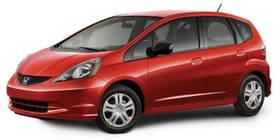
Isn’t that a sweet little car? A Honda Fit (turn off the sound before clicking on that link!). And isn’t 28 mpg ever so much sweeter than the 18 mpg the Dog Chariot makes when it’s in a good mood?
Want car.
At $15,0000 or $16,000, the price is pretty good. I could keep the Dog Chariot (or give it to my son, except he thinks it’s “gay”) and pay in cash from my car savings. But if the D.C. is really worth around five grand, as Kelly Blue Book says it is, then what I’d have to pay in cash would not deplete my car savings. Not by a long shot. If I paid myself back a couple hundred a month, or even just $100 a month, over the vehicle’s proposed ten-year lifetime, that would recharge the car savings and then some.
The fly in the ointment is the outrageous cost of car registration in Arizona. They really gouge you for new cars. The tax drops each year—the older your car is, the less you pay for registration—until by the time the junker gets to be as antiquated as the Dog Chariot, registration costs so little even someone like me can pay it out of pocket, without having to borrow or self-escrow for a year.
This flies in the face of reason. Why does Arizona have to do everything bass-ackwards? It would make sense to charge drivers more for each year the car ages. This would tend to get gas-guzzling, unsafe vehicles off the road, and it would gently stimulate sales of newer models. The truth is, the high annual cost of automobile registration is a significant motivator, for me at least, to keep the old junk running.
And of course, insurance would go up, too. Right now my car insurance is almost more than I can afford to pay. I’d have to drop the million-dollar umbrella, which (between you and me and the rest of the galaxy) insures this site against libel suits. Since companies have taken to suing bloggers for saying unkind things about their products and services (is there one among us who has not complained about the likes of Comcast, Qwest, or Chico’s?), it behooves one to have such a policy. Even without the extra coverage, insurance premiums on a new car would end up being around the same as I’m paying now, I expect.
So the savings on gasoline would be mooted, many times over.
But oh! Wouldn’t it be loverly to have such a pretty little, maneuverable little, gas-efficient little car?
So, taking a moment of rest late this morning to read news online, I checked Craig’s List for the third time, to see if anyone might have lost the Found Hound. Depressing, all these people with muttley pups and kittens from unspayed pets, trying to give them away for free…and while you’re at it, will you take the mother, too? Feeling overwhelmed, I was just about to click out of there when my eye was caught by this heading:
I have lost my dog (with a zip code right next to mine)
Click on that and find…
I lost my dog her name is Angel she is a cream colored German Shepperd and Chow mix she was not wearing a collar. She is 16yrs old and can’t hear very well and she decided to venture away from home. Please if you have seen her or have her I really miss her very much and would love for her to come home. If there is anything you know please call me at 888-765-4321 and please only call if your serious. Thank you Crystal
Holy mackerel! That fit Orphant Annie to a T! Called the number: no answer. E-mailed the Yahoo address, attaching a photo. A few hours later, phone rings. A young voice says the photo looks just like her dog. She says she was at the shelter Tuesday noon and didn’t see the dog; I said the guy showed up at my house to pick up the dog right about that time.
So she said she would try to retrieve her dog. Haven’t heard anything more from her. I hope she found her Angel/Orphant Annie and that they hadn’t put the dog down because of its extreme age.
Where she said she lived is about a mile and a half from the park, as the crow flies. But the road she lives on does not follow the crow’s route. It breaks for about a quarter mile between the canal and Central Avenue. To get to the park, the dog would have had to follow quite a circuitous route, and she would have had to cross over the canal. To get to a crossing, she would have had to go a half-mile north or south and a quarter mile west. Then she would have had to walk along and then cross over a seven-lane main drag, possibly in the middle of rush hour. She probably walked somewhere between two and three miles.
Think of that. A 16-year-old large-breed dog is about the equivalent of an 80-year-old human. Imagine your 80-year-old great-grandmother making her way across two or three miles of urban streets in 90-degree heat.
Must be one tough dog.
Update
Crystal just e-mailed to say she found Angel and now has her home with the family. So! A happy ending.
No one ever called to retrieve the stray dog. One guy called to see if I’d found a basset—a pair had escaped from his friends’ yard. That was it.
Pretty clearly she was dumped in the park, probably because the humans couldn’t abide having their carpets peed on every 10 to 20 minutes. Or couldn’t afford the vet bills to treat what may very well have been diabetes.
Neither, alas, can I. Even if her problem was only (!) a urinary tract infection, at this point I can’t afford a vet bill for that, either. Nor, with a possible long-term disability coming up the pike, can I care for a large dog…I may not even be able to care for the little dog.
When I called the Humane Society to see if they could scan her for a microchip, they refused to speak to me—as it develops, they don’t deal with stray animals. There’s actually a state law that forbids the Humane Society from taking in strays! The instant I said I’d found her in the park I was transferred to County Animal Control, with no further discussion. The county pound, it develops further, is now a no-kill shelter. That’s why they have 900 animals for which they can find no homes.
The County sent a guy out to pick up the pooch. To my surprise, he didn’t act like a comic-book dogcatcher. He was very kind, and it was obvious that he loved animals. He said they would examine and treat the dog for whatever ailed her, and that the first thing they’d do is scan her for a microchip and try to find her owners.
Here’s the question: Is it better to mound up your spending money in one big pile, or does it make more sense to divide it into “piggybanks” dedicated to one purpose or another? Is it an overcomplication to dedicate x or y amount to, say, groceries or eating out? Wouldn’t it be simpler to give yourself a set amount of money to spend for a given period, and not obsess over how it’s spent?
In the envelope system, for example, you convert your month’s income to cash and literally stuff chunks of it into various paper envelopes—this much for groceries, this much for gasoline, this much for entertainment, and the like. When you run out of cash in a given envelope, you quit spending on that category until you get another paycheck.
Many of us do this in a virtual environment. A program like Excel makes it easy. I certainly do: my discretionary budget allocates specific amounts to various categories such as groceries, gasoline, etc.
Click for a larger view
The greyed-out figures are charges and returns that have been posted in the “Left from $500” column.
The nondiscretionary budget does the same, only in a different format because I have little choice over how much will be spent:
In this case, the greyed-out figures represent bills that have yet to arrive. The $130 I’ll have to spend this morning on getting the hated palm trees trimmed will come out of last month’s black ink. Next month there won’t be any residual black ink: power and water probably will exceed the budget. But that’s neither here nor there. The issue is…
Discretionary budget? Nondiscretionary budget? The first contains 11 items. The second contains 10. That’s 21 items I’m tracking in two subbudgets. But in any given month, a specific amount of cash is available for spending—in the summertime it’s $1,745. Does it really matter where the money is spent, as long as no more than $1,745 goes out the door?
Sometimes I think the business of tracking ever penny that’s spent on this or that category is just obsessive. Personally, I worry that if I don’t keep a grip on expenditures, at the end of the month there won’t be enough to buy groceries or pay the utility bills.
But maybe that’s wrong. Maybe it would be simpler (and saner?) to regard the $1,745 as one big pile of dough from which little bread loaves are baked when needed. If instead you planned that all extraordinary expenses—anything other than recurring bills and bare subsistence—would be covered by savings and then stopped worrying about what you spent in any given category, would you be at any more risk of running out of money at the end of the month?
We know that last January J.D. over at Get Rich Slowly stopped tracking his spending altogether. The roof apparently hasn’t fallen in on him, because he’s still posting to his blog (unless he’s posting on his iPhone from debtor’s prison).* He compares the practice of tracking each transaction, which he had long advocated, to training wheels, and suggests that after habits of mindful spending become engrained, it’s no longer necessary to track every single penny.
I’m none too sure about that. In the first place, there have been a few times when a transaction came into question, and it sure was handy to be able to search a year’s records and find it instantly. And on occasion, various store clerks, managers, and bureaucrats have been mightily surprised when I came forth with a three- or four-month-old receipt. And third, sometimes it’s useful and convenient to be able to see at a glance how much I’ve spent and how much is left.
My thought is nowhere near as daring as JD’s. Rather than quit tracking altogether, I suggest that there may be no real reason to detail budgeting and spending. Maybe just establishing a puddle of money and staying aware of what you’ve spent overall, on everything, compared to the amount available, would suffice.
Is it enough for you simply to know you have $x,xxx this month to spend? Or do you want your budget organized into categories and subcategories?