Coffee heat rising

Working Smarter: Applying a few insights

Okay, so one train of thought that’s been going on here at Funny about Money has to do with the dawning realization that I’m spending too many hours on work that doesn’t pay a living wage and too few hours on actual…well, living.

In a good month, FaM returns about two hundred bucks, and that’s fine, because it’s exactly the amount I need to get out of one section of freshman comp a year. Or, more to the point, to make up for an assigned section that doesn’t gel.

And I normally make $200 or $250 a month reading detective novels (!) for my favorite client, Poisoned Pen Press. This amount covers a second freshman comp section each year, and of course it’s pay for play.

So, between them these two piddling sources of income either give me the option of teaching two and two (i.e., two courses a semester)  instead of three and three or provide a safety net should one of three assigned sections not gather enough students to fly.

For both these income streams, pay per hour is beneath laughable. FaM earns about $6.67 a day, on average; spending two hours on a post and another hour on blog-related web-surfing yields a pay rate of $2.19 an hour. Earnings for editing the novels are somewhat better: $12 an hour.

Usually, those novels serve as bed-time reading, so the work I do on them doesn’t occupy productive daytime hours.

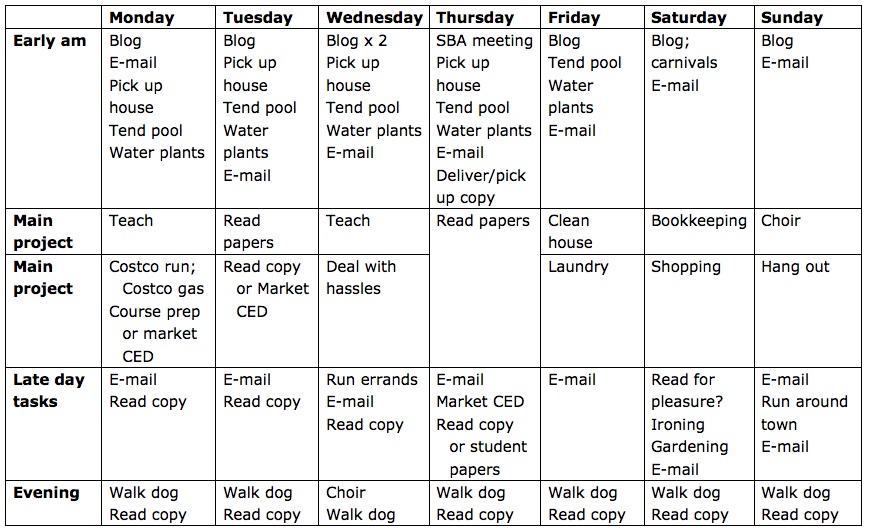
After a little experimentation, I’ve found that if I get up off my rear end in the morning and do some yardwork, housework, dog walking, or socializing before settling in to paying work, I can put off writing blog posts until the evening. It’s something that can be done, as it was in the beginning, from an overstuffed chair in front of the television. That strategy defuses the blogging work by moving it out of daytime hours that should be better paid or at least should provide some fun, exercise, or relaxation time.

Now. What about the teaching?

What, really, does it pay by the hour? And is there a way to manage time used in teaching to ensure a decent hourly wage?

Well, I did a little English-major math and made some interesting discoveries. First, I posited that a “decent” rate would be about $30 an hour, approximately what I was earning at GDU before the layoff. Second, I established that I should work no more than five days a week—I should get weekends off to sing in the choir, schmooze with my son, and do whatever I feel like doing. A community college course here in Maricopa County, Arizona, pays $2,400. With those as givens, let us ask…

How  many hours can you put into a community college course and still earn a decent wage?

Okay, so what we see here is that no matter how many weeks the course spans, the maximum number of hours you can work on the course to keep the pay rate at $30/hour or better is 80. Next area of inquiry: is that realistic?

To keep your rate at $30/hour, what is the maximum number of hours you could spend on a course working outside of class meeting time?

Well, if you add up the number of hours per period and multiply by the number of class meetings, you find that an eight-week course meets about 42 hours; a sixteen-week course meets 40 hours. Since the excessively long meeting time for the short-form course requires several breaks, you could (sort of) argue that class meeting time for the eight-week course is actually about 40 hours, too.

A fully online course, by definition, has no class meetings, but it requires a great deal more course preparation time.

To keep your pay rate at $30 an hour for an eight-week course, you could spend no more than five hours a week outside of class, giving you one hour a day of grading and interaction time.

With no face-to-face (F2F) time, an online course provides a full ten hours a week for grading and online interaction with students.

For a 16-week F2F course, you could spend no more than two and a half hours a week outside of class. That’s only a half an hour a day, five days a week.

On the face of it, this doesn’t look very practical; realistically, one spends many hours a week reading student papers and answering e-mails. However, it’s not as dire as the figures above suggest, because you can manipulate due dates so that some weeks pass with no incoming. So, let’s look at this from a slightly different perspective:

How many hours does it really take to grade student papers?

The community college district requires four papers for English 101 and three papers for English 102. A typical set of freshman comp papers takes four to six hours to grade.

Okay, an hour an a half is still not long enough to grade a set of papers. However, assuming one doesn’t have to grade a set of papers every single week, then what? In fact, with 40 hours of in-class time, you have another 40 hours, at $30/hour, available to read student papers. That provides plenty of leeway to perform 24 hours’ worth of grading!

This optimistic conclusion, alas, leaves out the untold numbers of hours one spends in course preparation.

How much time could you spend on course prep and still gross $30 an hour?

In reality, it takes about four or five full-time, eight-hour days to prep a composition course, especially in the semesters when a new edition of the overpriced textbook comes out.

Thus, to make this work, prep time would have to be cut to no more than sixteen to twenty-two hours. All scutwork—that is, all checking and scoring of in-class exercises, drafts, and homework—would have to be foisted on a teaching assistant, so that all the instructor had to read would be the required, final full-length papers. Assuming about 15 or 16 hours of scutwork, I could afford to pay a T.A. $10 an hour and still be left with enough to buy groceries.

If all one read were the required papers and a T.A. scored the other student activities, how many hours would you spend on a course and what would you earn per hour?

It works out. Of course, about fifteen of those hours would actually earn only $20/hour, but the $10/hour wage for one’s T.A. would be tax-deductible.

In its strange way, this perspective starts to make things look a little better. First, what we see is that teaching, even adjunct, is my best and steadiest source of income. And on inspection, we see that I’m actually grossing approximately what I earned, per hour, at GDU. It explains why I seem to have plenty of cash during the nine months of the school year, and it suggests that even one course over the summer would chase away the summertime budgetary doldrums.

What can be done to bring course preparation time under control?

There, too, I have a plan.

The base content (such as it is) of freshman composition has not changed since I started teaching the subject about 40 years ago. There are only so many ways you can explain what an essay is, what a research paper is, and how to write them. This means that every newly adopted textbook and every new edition of an existing textbook is just another rehash of the same material.

So, prep time could be cut by creating fungible modules that can be plugged in to each new semester’s sections to fit time available. We might call such modules “learning module templates.” These would key reading assignments to subject matter, and writing assignments to specific patterns of development, not to chapters in the current textbook. Thus if in a given week you want to teach students a specific mode of discourse, you simply take whatever textbook you’re handed and look for the chapters or passages that discuss that.

To avoid having to create new assignments for each new textbook edition, you would have to be sure never to key a writing assignment to a reading selection (i.e., a sample essay) printed in the text, since these tend to change as new editions are churned out. You could require students to use the book’s selections as source material for their essay citations; this wouldn’t stop plagiarism, but at least students would feel they were using the textbooks more fully.

Each module could contain the following

The module’s learning goals
Subject matter that should be addressed in reading
Homework, related to this subject matter but independent of specific reading matter
In-class lectures, discussions, and activities
Writing assignment, if any (depending on the number of weeks/course)

If you made the modules generic enough, it would be very easy to pick and choose to fit your timeframe, and quick to plug in new reading material and resources to make the broad choices specific.

It would take some time to create these things, but once they were in place, each semester’s prep time would drop to a few hours.

So what does it all mean for Working Smarter?

In the first place, sideline enterprises that earn less than a living wage should be relegated to the status of hobbies. They should not be permitted to consume time that could be spent more profitably, nor should they be allowed to morph into work.

Blogging, for example, should be as entertaining as reading detective novels. It should never be treated as a job. In other words, I should not be trudging in to my office every morning, there dutifully to crank out another post. I should not be checking e-mail every few hours to screen out spam and accept comments from real humans—instead, do this at the end of the day. Adsense? Alexis? Google Analytics? Awstats? Is there some point in tracking data whose significance is negligible, except as gratification for a hobby? Obviously not. These should be ignored; certainly never checked more than once a week.

In the second place, the number of hours put into decently paying work should be tightly controlled so that the per-hour wage never drops below a minimum threshold.

With teaching, it appears this is eminently possible. Medicare keeps overhead down so that, given enough sections, $30 an hour amounts to a middle-class wage. The only drawback to focusing solely on teaching as the “real” source of income is that it doesn’t pay enough to add to savings. However, next year I should be able to get some summer courses, and in that case, any editing and blogging income can be rolled into savings. That would fund my Roth each year, as long as I can dodder into a classroom or sit in front of computer to teach an online course.

And there really is no third place. It’s pretty simple.

Move the hobby income out of the center of one’s field of vision.
Focus on the endeavor that earns the most money.
Control time spent on that endeavor to maximize per-hour income.

And…get a life! 😀

w00t! Rain! And a moment to reflect

Another best-laid plan gone awry: I had determined not to post today, but instead to spend Sunday doing other things, most of which entailed getting some exercise and schmoozing with actual humans instead of hanging out with a small dog.

BUT… It’s almost 9:00 a.m., and it’s just 80 degrees here on the back porch! A light breeze is pushing fresh air through the house, and the hummingbirds are jousting over the sugar water ten feet from my table. The houseplants, sated with rainwater, are glorying in the morning sunlight filtered through a layer of pearlescent clouds.

Weather like this is too miraculous to waste sitting inside a church. God, I’m sure, meant us to appreciate Her creation in the experiencing of it.

Sometime around 5:30, Cassie and I awoke to a lovely steady rain. Last night 80 degrees was so damp and sticky as to be gummy; this morning, with the moisture finally dropping out of the sky, the air is fresh and delicious.

After stuffing the dog with leftover chicken, veggies, and quinoa, I realized the indoor plants needed to be watered today and so hauled them out into the rain, and also put the big old five-liter vinegar jugs now used for fertilizing plants under the eaves to collect runoff. (Did you realize it’s against the law to collect rainwater runoff in many Western states? Yesh. Usurps the water rights of downstream and water table users!) So now we have two and a half big jugs of illicit water, capped and stored for the next round of houseplant watering activities. Another jug and a half are empty, but the skies promise still more rain; no doubt those will soon fill, too.

So, it was breakfast on the back porch, for the first time in many a week. How can I express my joy? LOL…maybe this guy can:

You realize, this meant I managed to actually read part of today’s Times! Speaking of the which, did you read Virginia Heffernan’s “The Medium” this morning? She holds forth on the sad devolution of the ScienceBlogs network from its former Elysian eminence to what she describes as a culture of one-liners, and its break-up over a tacky blog, a creature of PepsiCo, that the administrators, for reasons comprehensible only to those who have worked for commercial print periodicals, decided to put on the site. Heffernan notes a break-down in civility that echoes, sadly given the expensive education and supposed sophistication of the scientists and science writers involved, the tone of far too many much lower-brow sites. She even grouses at GrrlScientist, one of my favorite science blogs, for a crack about the “hugely protruding bellies and jiggling posteriors” of the megafauna visible in any of America’s public places.

Alas, if you track down the quote and visit the post to check out what was really said, you get a blank page (or at least, you do at 9:30 Sunday, August 1, 2010); presumably, either the author has taken it down or traffic is maxing the page. However, it appears that Heffernan took GrrlScientist’s words out of context, or at least so says Kathy Gill at the Moderate Voice. She cites the protrusions and the jigglings along with the words around them. Said GrrlScientist:

It’s taken me a few hours to cool off enough to write coherently and without using (too much) profanity after I learned that ScienceBlogs added a corporate PR “blog” about nutrition written by PepsiCo. I think I’ve learned all I care to know about corporate “food” giants’ definition of what is “nutrition” by being confronted daily by a flock of hugely protruding bellies and jiggling posteriors everywhere I go (yes, even here in Germany).

LOL! B-a-a-a-d journalist, Ginnie. No treats for you today! Yea verily, we might even say “go to your crate and take your lawyer with you!”

Nevertheless, as GrrlScientist and many others report, the schism over Seed Media Group’s move to install a crassly commercial fake blog mounted by a crassly exploitive megamanufacturer of fake food is real, and the result is more than sad for the blogosphere. It may rise to the level of tragic: it represents the destruction of one of the most successful blog networks the Internet has seen, one that has worked to clear the cobwebs of error and fuzzy thinking out of the corners of our collective mind.

True: if many of us are to make a living as Internet writers, particularly on our own sites, some mechanism has must be invented to make blogging profitable. As I’ve observed before, AdSense, which runs a particularly annoying ad on this site displaying cartoon protruding bellies and jiggling posteriors, occasionally returns something in the six figures: if the figures represent fractional pennies. But it takes a month of the coldest days in Hell for FaM to reach that Olympian height. Most of the time it earns between two cents and three bucks a day.

But still. One wonders. To make a living, do we have to sell our souls?

Memo to self: figure out how to get rid of the animated fat lady diet ad.

Maybe we’re on the wrong track, most of us, when we think of blogging as a potentially profit-making enterprise. Maybe writing these things, which really are on the order of diaries or writer’s journals, should be regarded as a labor of love. Any money to be made off them should be generated from more highly developed spinoffs, in the form of print and electronic books. Or, if we’re Uncle Jay or Ramit, from mugs, T-shirts, and online courses.

Ahem. Would any of you like to buy a Funny about Money mug? How’s about a nice T-shirt?

FaM Logo Here! For just $2 extra, get your mug personalized with YOUR NAME in cheery acrylic craft paint!! (Not responsible for Pepsi Cola logos.)

Frugal Habits: When routine maintenance saves a bundle

Here’s a real simple way to save money on home repairs: maintain things according to instructions.

No-brainer, eh? Well, easier no-brained than not.

Recently the water has been draining out of the pool’s pump pot every time the system shut off. Nothing I could do seemed to fix it: no amount of cleaning, adjusting, or fiddling around stopped the pump and filter from sucking air whenever the timer turned the pump off.

This? Bad. You don’t want the pump to come on when the system is full of air. It can blow the lid off the pump pot, causing the expensive damage we all can imagine and inflicting serious bodily harm to anyone who might be standing nearby. If the pump runs dry for any length of time, it will burn out, another event that comes under the heading of “expensive damage.”

Argha! I figured this looked like another pricey visit from Leslie’s. For quite some time, there’s been a little seep from a connection between a large pipe and the pump. The Leslie’s guy has insisted it’s not worth fixing, because, he said, the plumbing job would be expensive. This tiny leak been going on for a while—as in “several years”—so I expected the time had come to repair it.

Figures. Every outlandish expense tumbles down on your head when you can least afford it.

But since the system was draining water only when it was off and seem to work fine while it was running, I’ve been turning it on and off with the breaker switch instead of letting it run on the timer. This way I can bleed the air out each morning when I turn the system on. The plan was to continue operating the system manually until this until fall, when I have an income again, and then hail the Leslie’s guy back over here as soon as my first paycheck hits the bank.

Early in the morning while I was contemplating this state of affairs, it occurred to me that it’s been a long time since I lubricated the O-ring that serves as a washer for the pump pot lid.

Hm. You don’t suppose… Could it be?

It’s been so long, as a matter of fact, I couldn’t even find the goop, which I normally keep out there by the pump. Probably Bob the Leslie’s Dude accidentally walked off with it, thinking it was part of his tool set.

This morning I had to join the choir to sing a at a funeral. So, this taking me out of the house, on the way home I dropped by the Ace Hardware and picked up a container of silicone grease. Pulled the pump pot lid off, cleaned everything well, smeared this sticky gunk on the O-ring, and put the thing back together again. Primed the pump, let it run for half an hour, and shut it off.

Very nice. The pump pot was full of water, with hardly a bubble of air visible.

Went away for an hour. Came back.

Hallelujah! The water hadn’t budged! The pot was still full, and there was no sign that even a drop  had drained out of it.

A six-dollar investment in silicone goop averted a $300 repair bill.

Or, we could put another way…

Several months of idle neglect almost caused a $300 repair bill.

Or even…

A stitch in time saves nine.

Translation: Get off your duff and take care of things around the house. Fix stuff before it’s ready to break, not when it’s on its last legs. Keep mechanical devices clean and maintained according to their manufacturers’ instructions. A small fix now saves a big, costly fix later!

Celebrating the Big Purchase

So Thursday M’hijito came over and helped wrestle the latest extravagant purchase out of the car, having agreed to do so in exchange for the opportunity to partake of the first meal cooked on the thing. He hauled the big charcoal grill off the pad I want to use for cooking and over to the ad hoc flagstone patio(?) I built some time back, and then positioned the new gas grill in the desired spot.

Naturally, it was raining. Monsoon season is finally here, driving temperatures into the 80s and 90s for the evenings…and driving a lot of wind, dust, and rain, too.

But so happy was I that he was coming over for dinner that I went a little overboard with the meal planning. At the better Costco outlet up on the I-17, I came across this incredible steak:

The cost was not unreasonable—about what I would expect to pay for a thick choice ribeye in the grocery store—and so I didn’t notice that it was prime until M’hijito arrived and pointed that out. Wow!

On the way home through the muggy heat (by midday it’s 105 or so, and still very wet), I stopped by the Safeway to pick up some frozen veggies for future reference, and there picked up some garlic, a yellow onion, and a bunch of little green onions. When I got here, I was so whipped I forgot about the fresh produce in the plastic grocery bag and, anxious to sit down, rest, and cool off, just dropped the whole thing in the freezer.

By the time M’hijito got here, the produce was frozen.

Rather than throw it out, I chopped it up and used it before it could turn to mush (which it was rapidly doing as it defrosted!). The result:

A tomato sauce containing a couple big cloves of garlic and the entire bunch of green onions…

Slowly, sweetly caramelized yellow onion to go over the steak…

…And an exuberantly garlicky lemon vinaigrette that we used for cooking. M’hijito carved out the stems and seeds of a couple of red peppers and then poured some of the vinaigrette into the interior. These went onto the grill along with a small eggplant (also basted with the garlic vinaigrette) and a couple cobs of corn.

OMG, what an awe-inspiring dinner this made. The frozen garlic and green onions dissolved into the gently simmered tomatoes, which we used to smother the sliced eggplant, and the onion cooked down to make an intense kind of compote for the grilled ribeye. Eat your heart out, Ruth’s Chris Steak House! With the moderately priced Merlot I picked up at Costco and a very nice salad, we couldn’t have had a more wonderful feast in the fanciest eaterie in town.

So this bodes well for the plan to eat better. Yesterday evening, still craving red meat, I defrosted a smaller, lesser piece of beef and grilled that along with some more corn. Some leftover salad filled out the menu. I still have some shellfish that can go on the grill, and there may even be a piece or two of salmon or mahi-mahi in the freezer, along with a lifetime supply of chicken thighs.

Thanks to the rainstorms, we had another amazing sunset. You really can’t get the full effect in this snapshot—the entire western sky was suffused with neon peach light. The lower the sun dropped, the brighter the light grew, until finally at the end the heavens slipped through coral red into darkness.

It was a great way to launch the new ’cue. And so, to get on with life. A happy Sunday to you all.

😀

Changes in Your Credit Card Statement

The other day Five-Cent Nickel sent an alert to the effect that he was posting a very interesting graphic on the changes you’ll be seeing in your credit-card statements now that the new law has gone into effect. It’s quite a creation, built on information from the federal government.

My AMEX bill came a few days ago. It took me a minute to figure it out—Nickel’s graphic with its mouse-over captions could be very helpful to the complication-impaired among us. But right up at the top is the “Minimum Payment Warning,” explaining in no uncertain terms what will happen if you just let your balance float.

If I made only the minimum payment on the $864.17 due and never charged up another penny, it would take eight years to pay this month’s bill! And the privilege would cost me about $1,456 in interest. The annual percentage rate for this loan is a  usurious 15.24%, and an even more criminal 25.24% for a cash advance.

Well, if that doesn’t get your attention, nothing will.

Those of us who are long in the tooth have known these factoids for a long time. But maybe forcing the credit companies to explain, quite literally up front, what a credit-card balance really means will forestall having so many young people end up in debt they can’t handle.

Because I pay my bill in full every month, not only do I not owe AMEX anything, it owes me $77.17 toward this year’s annual rebate.

Interestingly, the busy design of the statement makes it difficult to follow. AMEX has installed a ditzy, squirrelly background inside textboxes that present this information. The account summary, for example, is typed directly against this hectic pattern, small black figures against a dizzying gray background. The law must require credit-card issuers to print the minimum payment warning clearly, because that section lacks the eyeball-spinning textbox fill. But many other key pieces of information are obscured by this graphic device: the amount of the late fee, the account summary,  the credit limit, available credit, cash advance limit and available credit, the days in the billing period. And, most tellingly, the customer service number.

At least now the customer service number, hard to read though it may be, is on the front page of the darned statement. Before this you had to sift through the fine print on the backs of several pages to find a number to call.

This is an improvement. The fact that the credit card company is doing its best to make it difficult to figure out suggests just how big an improvement it is for me and you.

A Dollar a Mile?

So this afternoon I drove up to Home Depot to pick up the gas grill, which that worthy big-box store had assembled for free.

M’hijito allowed himself to be put up to helping me wrestle it out of the van and set it up in the backyard, in exchange for a share of the first dinner cooked on it. Yesterday I’d picked up some steaks at Costco, but today I wanted to acquire a few salad items and also some frozen veggies, to fit into the new scheme to eat better and live better.

My fevered little brain thought I could go up to the HD at Cave Creek and Cactus and then double back down to the Safeway at 7th Street and Glendale, it being far too hot to leave food in the car for the indefinite period required to stand at the service desk and then wait for someone to come forward with the grill. (You can tell I’ve done business with HD before, eh?)

But then I realize, nooooo. I bought the darn thing at the HD at Thunderbird and the I-17. Damn.

Drive across Thunderbird to the I-17, an extra two-mile drive. No problem (quite) getting the grill. But this left me a long, long, long way from a decent grocery store. Or, as far as I could tell, from any grocery store. Truly I didn’t want to drive all the way back down to the Safeway at 7th Street and Glendale, seven miles out of my way, as the crow doesn’t fly.

Cruising back toward 7th Street from the HD on the I-17, I decided to drop into the AJ’s at 7th Street and Thunderbird. How overpriced could they be, anyway? This was directly on my way and would obviate having to drive an extra 5.8 miles to the south. A dollar or two to avoid having to fight my way through more of the homicidal traffic…so worth it!

Once inside the store, though, I could not believe the prices of the most ordinary vegetables: $3.69 for a small package of plain peas or corn. Holy mackerel! I could grow the stuff myself for less than that!

Moving on…and on, and on, and on.  At the Safeway, the same veggies—and even some so-called “organic” varieties of the same—were selling for $1.59 a package!

LOL! I was glad I’d made the extra drive. At a savings of $1.86 a package, the three bags of frozen veggetables cost something over $6 at AJ’s than at Safeway. Almost a dollar a mile! That’s how much the extra trip out of my way saved me today.

🙂


Sometimes it’s worth it to go the extra mile (or seven) to save a few pennies.