
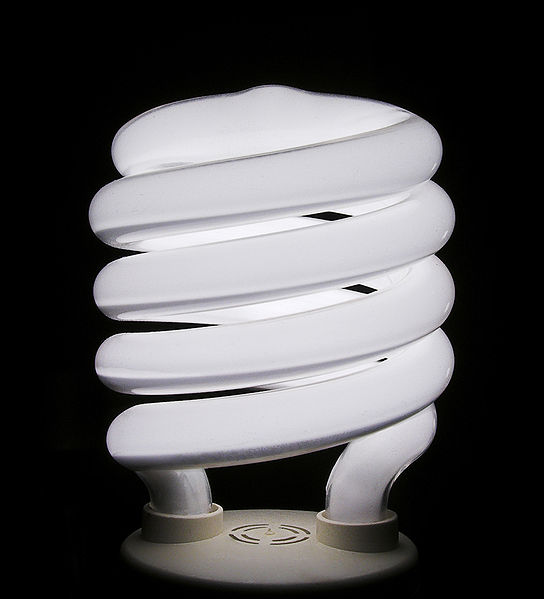
 Am I the only person who has developed a certain jaundiced skepticism about compact flourescent bulbs (CFLs)? Or is that yellowish tinge around the eyes just the result of the dim and ugly light the dratted things throw off?
In the first blush of enthusiasm over CFLs, I went out and bought a boatload of them. Replaced all the incandescent lights in the house, except in a couple of lamps that cheerfully blew the contraptions out every time I stuck one in the socket.
Some inanimate objects have better sense than the rest of us.
Time passed. I saw exactly zero difference in the power bill. As far as I can tell, CFLs do little or nothing to lower your electric bill, at least if you’re the sort of person who turns the lights off when you leave a room and who opens the blinds during the day so as to navigate by natural light.
As it develops, there’s an explanation for that. Whether it’s the correct explanation and whether CFLs have as their unintended consequence increased greenhouse gas emissions, I do not know, but I certainly would agree with Sudden Disruption that these devices have been oversold. And removing all incandescent bulbs from the market to replace them with the things is Big Brother at his Draconian best.
Other unintended consequences wait in the wings. For example, studies have shown that CFLs may induce or aggravate migraines, may be harmful to people with retinal disease, and may aggravate certain skin ailments. The flicker and hum, unnoticeable to all but a few humans, are audible to and may be harmful to cats, dogs, and other household pets.
It could be, of course, that you can’t see much difference in your electric bill because you can’t see the bill at all. You can’t see much of anything by the light of a CFL. No matter what the equivalent wattage, they cast a murky glow, indeed. They muddy the colors in your room and require you to break out the reading glasses for copy you could decipher easily under a brighter light..
Especially annoying is the dim half-glow they emit when first turned on. Flick on the switch in my bedroom and you feel like you’re inside a cave lit by the bioluminscent mildew on the walls. The older a bulb gets, the more time it requires to come up to speed. It takes quite a while, now, for the lights in my house to reach their maximum brightness. Not a very maximum, we might add.
I’ve already bought a bunch of incandescent bulbs and cached them in the storage room. Thanks to the Selling of the CFL, old fashioned lightbulbs are now pretty cheap. I think I’m going to buy another couple of pallets before they go off the market!
It doesn’t happen often, but I disagree with you on this one.
I love CFLs. I bought my first in 1999 and it’s still going strong. In most cases, changing bulbs is a minor nuisance, but when you have high ceilings with a whole lotta cans, bulb changes are much more inconvenient. CFLs have saved me many trips up the ladder.
I appear to be among those with a low sensitivity to the quality of light in that I just can’t tell the difference between fluorescent and incandescent. Then again, I don’t suffer from migraines. Occasionally I do notice a very small delay in a bulb achieving full brightness, but given my perception of the other positives of CFLs, that doesn’t register as a concern at all.
I am concerned about the use of mercury in CFLs and will be delighted when LEDs are affordable for that reason. But in the interim, I can’t imagine going back to incandescents.
To each his own!
@ Robin: At first the color didn’t bother me, either; at least, not especially. Over time, though, it’s come to seem less appealing. It may be just that the lights are aging and so losing luminosity.
But…if one of the benefits of CFLs is supposed to be that they’re longer-lived than incandescents, the fact that they slowly grow dimmer as time passes seems to negate that. I mean, if you’re having to replace them before they burn out because after a few months they give out unsatisfactory light, even though they’re still working…??? It means you’re replacing them, basically, just as often as you replace your incandescent bulbs.
That’s just it, I haven’t had to replace them at all. As I said, my oldest CFL is 11 years old, and I’ve installed at least three dozen more in cans and fixtures since 2001, so we’re talking years of use, not months.
I will keep an eye out for deterioration in the strength/quality of light as they continue aging based on your experience, but so far so good.
I’m with you on this one. We have several sockets in our house that routinely blow out the CFL bulbs but an incandescent works just fine. And yes, their light is mediocre at best and I find that i have to buy one with a much higher equal wattage in order to get the same amount of light. Still a supposed wattage savings, but I really am beginning to wonder if they aren’t more trouble than they are worth.
I find the CFLs are just not as bright, and hurt my eyes when I’m reading or on the computer. I’m trying to learn to live with them, but I also haven’t seen a difference in our electric bill.
The fact that you can’t just throw them in the trash was the biggest concern for me. in the first blush of enthusiasm over CFL bulbs I don’t remember anyone mentioning the difficulty recycling them. I worry about all that mercury in the landfill from people who can’t recycle them or didn’t know you weren’t supposed to throw them away. I wonder how many other things we jumped on the bandwagon about that are going to bite us down the road.
@ SimplyForties: Ditto that! I was especially unthrilled when I learned about the mercury several weeks AFTER two of the darned things dropped on the floor and exploded all over the inside of the hall closet.
We just remodeled our ceilings in Kitchen, 2 Baths and Bar with Dimmable CFL’s. We used the Skylark dimmers by Lutron to control four different circuits of recessed lighting. I think after a couple/three weeks of living with these r40’s, im wondering if I did the right thing. I have been playing “musical chairs” with the bulbs to eliminate their infernal humming. At full power they are great. Unfortunately we installed more lumens than we took out with our incandescants thinking we could use dimmer and save power and have a good range of light. So dimming is a constant thus, the humming. Replacement with new bulbs only protracted the futile efforts. In the process of replacing the bulbs it came appearent that these bulbs are just glued together with silicone as the bulbs began separating from the ceramic base. In time I believe that these would be “little time bombs” dropping from the ceiling in unannounced fashion. On a good note, I do like the light better than the incandescants as it is a more accurate color. I have now pulled all the CFL’s out and have replaced with “icky” incandescants while the CfL manufacturer tries to figure out how they plan to resolve or gloss over the problem. I wont hold my breath but will cross my fingers……..
@ luvcflbut: Wow! What an amazing and frustrating story! It’s especially frustrating considering how much those dimmable CFLs cost.
I think they are still working on the CFL technology. Wouldn’t be surprised but what better bulbs will come on the market in due time, just as low-flow toilets that actually flush eventually appeared.
Part two of my “Great Adventure” consists of my experiences with the dimmers. After contacting Philips about the humming light problem, they provided me “the secret list” of compatible dimmers. According to the information printed on the bulb package, “Compatible with most household dimmer switches” The electrician installed new Lutron dimmers circa 2009 edition which should have been appropriate controllers. Wanting desperately to resolve the problem I went to the local Home Depot to pick from Philips list of 20 or so approved dimmers…….but alas!! not only do they not carry any of the listed “secret controllers”, no one else does either. Lowes, Orchard, Ace, local electrical supply houses not a soul in the entire SF Bay Area. has privy to this booty. I had to eventually break down and go on line and order the only approved switch I could find, a Lutron Skylark at $26 apiece. No wonder they are on a secret list, they must be made of gold!! After a week they finally arrived and with anticipation I immediately embarked to the garage and fetched my tools. I quickly removed the “old” controllers and installed the NEW “Golden” ones….And guess what!! They hummed louder than the CFL’s. when actuated to a dimming position. Oh for Petes’ sake!! I called Lutron……they asked me a plethora of questions and were not the slightest bit happy with the whole CFL debacle. They are thinking the CFL’s are the problem but are send replacement switches to zero in on the problem. In the interim, I noticed that Leviton (Lutron’s competitor) has set up a display of “Hot off the presses” CFL dimmers. They are only $20 bucks apiece so I bought one to try it out. I once again embarked out into the garage and fetched my tools. With a quick swap of the controllers, PRESTO the new Leviton was in place. After a moment of silent prayer, I turned the switch to full on. Did you know that a dimmable CFL will flutter at full on?? With the Levitons they will!. I slowly maneuvered the controller to the full dimmed position. Low and behold, the dimmer itself did not hum and… the humming CFL’s did quiet down some (but not silent). There was a price to be paid for this though, the dimming range was extremely short and of course the flutter on the high end. I called Leviton……………………………….
Following a domestic argument on the wisdom of replacing all household lighting with CFLs, I went on the net and luckily ran into this post. I have observed over the last few years that CFLs deteriorate in brightness, coming down noticeably(almost half) in 6-8 months and reduces further although at a slower pace over the next 2 years. Twin 20 watt bulbs in a room,which appeared adequate 2 yrs ago, are now now depressingly dim. Further the relative observed brightness appears to be a max of 3x compared to tubelights of same wattage- half that claimed by manufacturers.
They don’t last as long as the price suggests. A 35 W bulb blew in 6 mths . The warranty period has also now dropped from 1 yr to 6mths. This sounds like an admission of the above. The exorbitant price is simply not justified. This is apart from the serious health hazard from breakages-something the public is not aware of.
Overall CFLs are overhyped and I would suggest caution before wholesale conversion.
@ DevDas: Yup. I now use them in selected fixtures, but not in every light in the house.