
So Gerardo, at my behest, pulled out the two struggling roses that have just barely stayed alive in the hot, deep shade that is the north side of the wall between the front and back yards on the westside of the house. For lo! these eight or ten years I’ve poured water and fertilizer on the things, to no avail. It’s just too broiling hot and too dark up against that wall for roses to thrive. In fact, it’s amazing they’ve even managed to hang on as the half-naked sticks that they were.
I conceived the idea of putting a little rock garden in there, mostly cobbled together with cuttings from plants around the yard or from $1.99 succulents from Home Depot.
From a large and fierce agave that graces the south side of said wall, I pulled off a pup and stuck it in a big pot:

(Click on the images for larger, higher-resolution versions.)
This flowerbed, such as it is, houses the valves for the watering system. Sooner or later, these will need maintenance and repair, and so, in a rare moment of clarity, it occurred to me that planting a large, sculptural agave with barbed, sword-sharp leaves next to the valve boxes might not be the brightest move in the history of gardening. In a pot, it’ll be (relatively) easy to move when the time comes to work on the irrigation system.
On the way home from the college, I stopped by a down-at-the-heels Mexican import shop, not visited since the time its erstwhile owner put up signs saying it was going out of business. Either someone bought it or the guy changed his mind, because it’s still there. And it still sells these pretty wall pots:
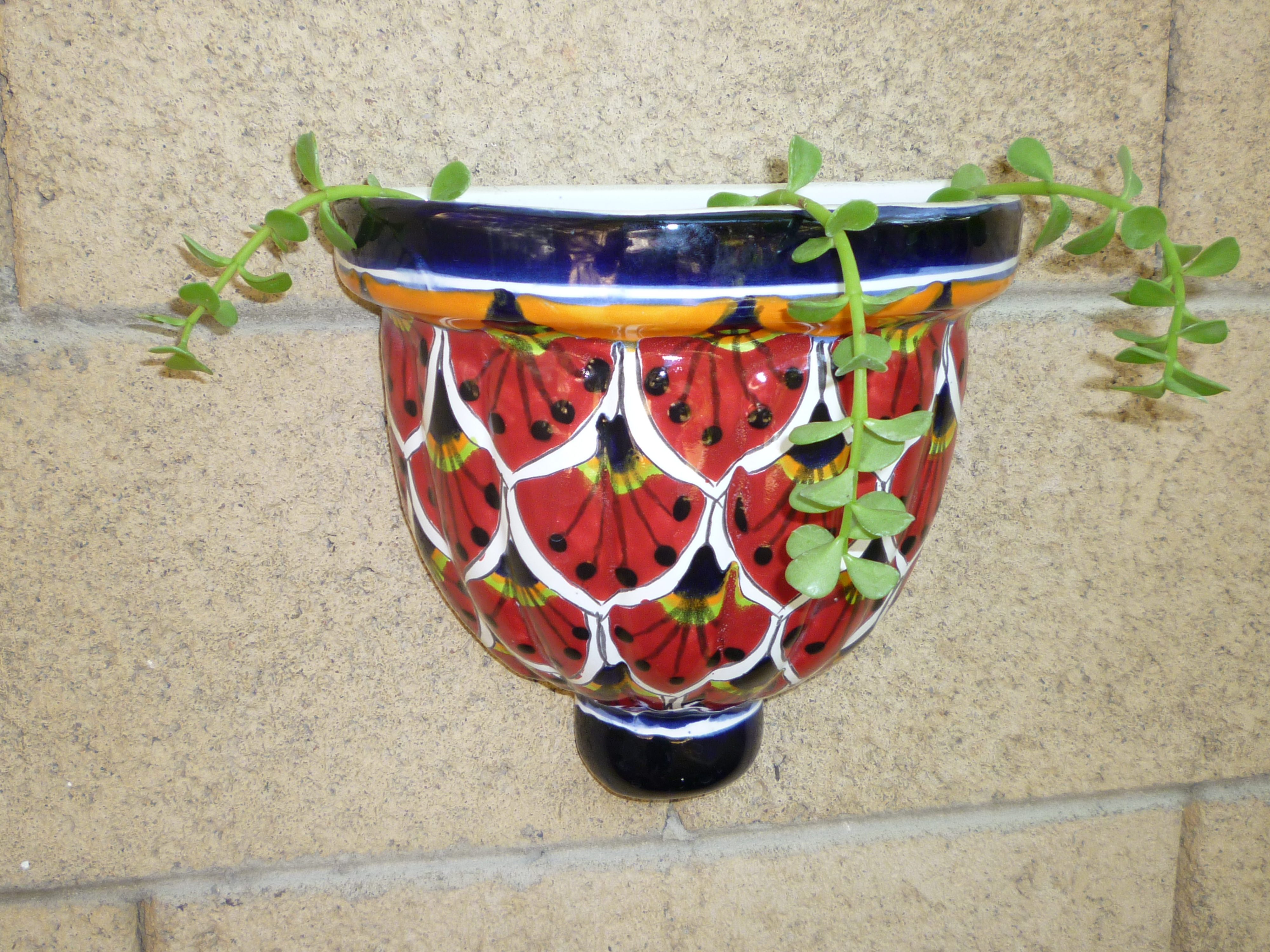
Those sprigs are cuttings of elephant’s-food plant, which grows in abundance around here. Eventually I hope it will look like this plant, growing in a pot nabbed from the same seedy store some years ago:

It’s growing on the east face of the west wall, mostly in the shade. I think the red pot’s cuttings will grow up to be rangier and leggier, because that corner by the front wall is really very dim.
The day’s extravagance was this sweet little Talavera-style sun face, spotted at an upscale local nursery where everything costs about three times what it’s worth:

Overpriced, without a doubt. But who could resist her?
The cactus in the Talavera frog was dragged around from the back yard, as was the stuff in the blue pot, which had become submerged in a sea of overgrown spider plants:

The blue pot has been colonized by a society garlic and a volunteer spider plant, which I may (or may not) pull out. The flat pots holding the hens-&-chicks and the baby cacti were laying around the potting shelves. The little cactus buds are from magenta and pink Easter lily cacti in the yard. Doubt if they’ll grow, because it may be too wet there, but nothing ventured… Can you believe coleus (those red things) will actually grow in Arizona? I doubt if they’ll last long, especially if we get a freeze this winter. But they’re kind of pretty for the nonce.
Here’s another old pot, this one stuffed with spider plant cuttings.

Three is probably overkill. But I’ve found that only about one in three baby spiders takes root and grows, so this is an attempt to get at least one of them to take ahold.
I stacked that pot into an old plant stand that’s been sitting empty in that corner for years—mysteriously not rusting. The plan is that once the spider plant(s) get growing, they’ll cascade down over the sides to add a dramatic touch to the garden. So, here we are in our nascent splendor:

The grassy-looking thing is an African iris or fortnight lily, which makes a pretty little flower now and again. It’s a bulb-like plant. Next to it is a real bulb, an amaryllis that I couldn’t resist grabbing out of a Home Depot bin. I kind of doubt that the African iris is gonna like it there—probably too shady. But one never knows. If it seems to hate it too much, I’ll try to transplant it.
Those metal spikes are there to support a length of nylon mesh cloth, thrown over the plants to protect the infant succulents from The Yanker, who loves to pull up the things. The plants are usually OK after they’ve established themselves, but until they get well set in the ground, The Yanker will yank them out.
The Yanker is a curved-bill thrasher. If you’re an insect, this orange-eyed little winged dinosaur is meaner than a junkyard dog. It’s a fine, insectivorous critter, about the size of a mockingbird and, I think, a distant relative.

Yankers are good to have around the yard, because they eat ants in vast quantities. Very good for holding the Armies of the Ant Queen at bay. I expect they pull up little succulents in search of bugs. Or…who knows? Maybe they just like to chew on juicy green leaves.
So, we shall see. It’s probably not the best time of year to plant a rock garden. But it may be no worse than any other season.
Image: Curve-billed thrasher. Peter Wallack. Creative Commons Attribution-Share Alike 3.0 Unported license.
I love your idea! And potted plants are so much easier to move around when the mood strikes. My most recent plant ad ventures are the 3 one-year old crape myrtles I just bought for $30 total. It will be awesome if all 3 of them thrive along our property line as hoped for…
They’re a pretty plant! I wonder how fast they grow in Texas. There’s a variety that grows here, but as far as I can tell they succeed here only in parts of town where there’s flood irrigation. You don’t see many in the Southwestern deserts.