So I cruise into the neighborhood just in time to spot a perky-looking Realtor setting up a couple of open-house signs pointing up into a little enclave I happen to covet (unrealistically). Naturally, nothing will do but what I have to take a side-trip to view that thing.
It’s at the end of a pretty, quiet cul-de-sac…and it’s a place I’ve seen before. It was on the market last fall for $290,000; sold in September. At the time, it defined “dump.” I couldn’t believe such a wreck was standing on such a sweet little street, but then had to acknowledge that our big, sprawling classic 1950s North Central ranch houses are getting old. Very old.
So I thought, well, what the heck. If they couldn’t unload it, maybe it’ll be on the market for something close to what I can afford, and for a modest 100 grand or so I could renovate it and dwell in genteel splendor until they cart me off to the old-folkerie.
HOLY mackerel! Take a look at what they’ve done to the thing:
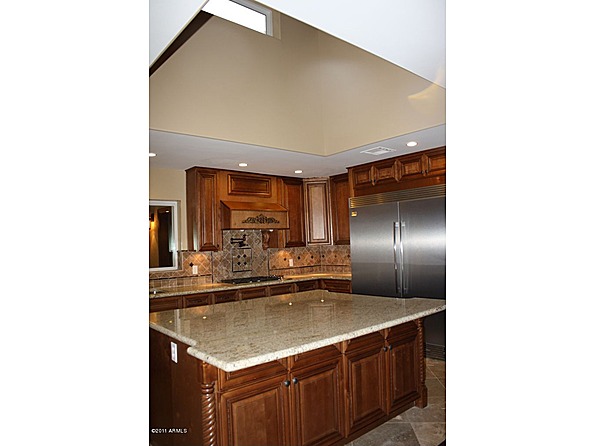 See that refrigerator? It’s bigger than my master bedroom closet!
 These photos of the kitchen do not do justice to what the fix&flippers have done. Everything in there is absolutely primo, and it is GORGEOUS! Too, you have to have seen what a disaster area the place was to appreciate what they’ve accomplished.
I want this bathroom. I don’t want to clean it, but I want it:
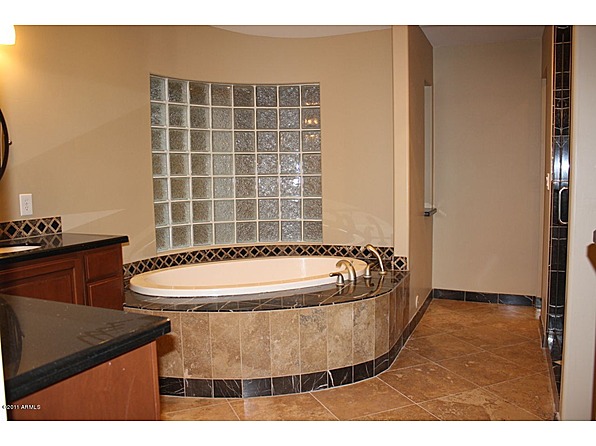 You, too, can wipe down the shower from ceiling to floor and clean the inside of those glass doors every time you bathe:
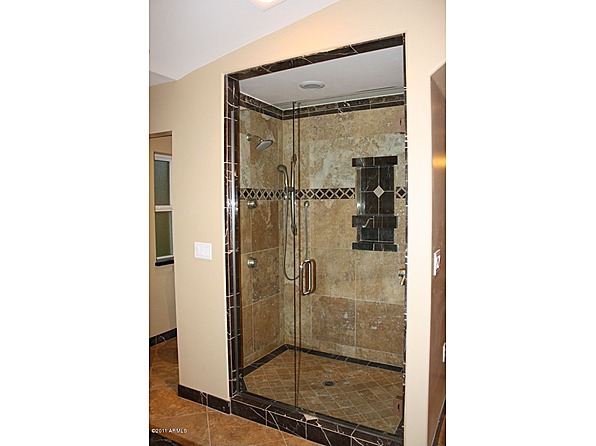
Only a person who enjoys supervising servants could covet living in this house. But…it really is quite beautiful. They’ve done an awesome renovation job.
For 3,254 square feet of this, they want a mere $545,000.
And that is a good sign. About $500,000 is what an updated North Central ranch house a block off a large, green park is worth. Or rather, what it was worth before the bubble inflated. While prices were insane, places like this in the neighborhood were selling for between $750,000 and $1 million. In the ensuing bust, you could have scored a comparable shack for $350,000. Or less, if it needed serious renovation. I came very near to buying one on an irrigated half-acre for $250,000, but backed off after contemplating the sheer amount of work required to modernize it. Someone else bought it and turned it into a palace.
That prices are returning to their pre-bubble state bodes well for M’hijito and me, who are still upside-down on a house we bought as prices were falling and (falsely) appeared to be about to bottom out. La Maya noted that an identical house on the next street north of M’hijito’s place was on the market for $225,000. We don’t yet know what it sold for, but since it moved quickly, we figure they probably got around $200,000. That is in the ball park of what we owe, suggesting that within another five years we should be more or less OK on the mortgage.
Four factors are working in our favor:
• First, residential inventories are reaching historic lows. The Valley now has slightly less than a two-month supply of houses for sale on the market.
• Second, people who defaulted or did short-sales two or three years ago are starting to recover and become eligible to take out home loans again. This means a lot of folks who have been paying off debt while living in miserable rentals are anxious to get back into homes of their own.
• Third, mortgage rates are in the sub-subbasement.
• And fourth—this is huge!—appraisers and lenders are beginning to provide two appraisals: one comparing a property with all other recent sales in the vicinity, and the other using only “regular” sales (not short sales; not foreclosures) as comparables. That strategy produces a valuation considerably higher (and IMHO more realistic) than the likes of Zillow are tossing out there.
I think we’ve got a good shot at seeing values return to where they should be, which is where they were before the crazed frenzy took hold.
First to recover will be central areas like mine and M’hijito’s. His neighborhood is just as ripe for gentrification as it was before the crash of the Bush economy, and as a matter of fact houses up and down his street are already beginning to look a lot better maintained.
My neighborhood at least is holding up; we were really thumped when the city ripped out an entire row of nice homes along 19th for the construction of the damn train that now is never going to be built. It’s not outside the realm of possibility the houses that were blighted by this moment of bureaucratic idiocy will recover someday. It’ll be quite a while, but it could happen. As gasoline prices rise (and they certainly will), the houses here and in M’hijito’s even more centrally located neighborhood will grow more and more desirable.
At any rate, it looks like we may be seeing the beginning of the end of the housing crisis, at least in the central parts of Phoenix, Arizona.