Coffee heat rising

MORE Money Happens!

It gets better and better. Yesterday afternoon the division chair’s redoubtable admin called and asked if I’d take on another course this fall! He’d already given me the maximum allowable number of courses—though the magazine writing course doesn’t start till mid-October and right now has only three students—and so this in theory makes four sections.

I’ll be surprised if the magazine writing thing makes—but then, so far I’ve been surprised every semester. It’s akin to taking a course in buggy-whip design. Wish they’d build a course in blog writing and management into their course bank. Since some punkins we know are actually making a living at this, it seems to me to fit right into the community-college mandate: pragmatic education that fosters life-long learning and serves nontraditional students.

Oh well. With or without Buggy Whip Design 201, three sections of composition will save my bedraggled tailfeathers again! 🙂

Though it’s been a busy summer, I’ve really enjoyed teaching the two comp sections that came my way in the second session. Both were really good classes, but the 102 class was one of the best bunches I’ve ever had the privilege of pretending to teach. Smart, highly motivated, and focused, they worked together well and almost all of them responded to the assignments with a high degree of success. It’s been quite a pleasure to work with them.

I think these short courses attract students who are already pretty confident in their abilities, usually with good reason. It would make sense for a student who worries about her or his English skills to enroll in a 16-week course, providing more time to wrestle with the assignments and more chances to get help at the learning center. So apparently the five- and eight-week courses self-select into pools of fluent writers with good study skills. The only serious exception was a lovely young woman who had to deal with some ESL issues in her written (not spoken) English, and she, too, had good reason to expect to succeed: she’s only 16 and is enrolled this fall in AP calculus. Math and science are her strong fields, and she’s evidently so good at them that a grade below an “A” doesn’t register in her consciousness.

Well, back to the subject at hand, our favorite topic, money. This development will make it possible for me to revamp the cash flow scheme along the lines that Frugal Scholar has suggested in many of her comments here: simplifying toward minimalism.

The issue is how to survive on a variable income, one that can produce some paychecks as low as a couple hundred bucks and some upwards of seventeen hundred dollah. For the staid at heart, this does nothing to foster a state of zen calm.

My plan now is to make Survival Savings a kind of “pool” account. All money other than Social Security will go into this fund, whether it’s teaching income, RASL, income tax refunds, insurance reimbursements, or the annual Costco AMEX rebate.

Social Security lands in my checking account whenever the government feels like sending it—deposit dates this year have ranged from  the 7th to the 13th of the month. So that plug of income will form the base income for the month. On the first of each month I’ll transfer the rest of what I need to pay the bills from Survival Savings, which will now hold every penny of income other than Social Security. The first-of-the-month transfer will tide me over until Social Security is finally deposited. Because Social Security is a fixed payment, the amount I need to come up with from other sources is pretty much the same from month to month: about $1300, up from $1100 because of the not-really-inflationary increases in grocery and power costs.

Unfortunately, I’ll have to keep the self-escrow account to hold each month’s dribbles toward the annual property tax, homeowner’s insurance, car insurance, and Medigap insurance. Given my colorful arithmetic skills, I can’t afford to take a chance of accidentally spending so much that I can’t cover one or more of those costs. So there’s a bookkeeping complication that, alas, can’t go away.

And I’ll keep the emergency/diddle-it-away savings account, which helped a great deal with this summer’s dental and automotive exploits. It gets $200 a month.

Because of the rules about the number of transfers you can make from a money market or savings account, I guess those automatic transfers (for tax & insurance self-escrow and for the extraneous spending) will still have to come out of checking, rather than going direct from Survival Savings, which resides in the money market. To be safe, I think it would be better to make one transfer a month from that and then disburse the monthly self-escrow transfers from checking, which has no limit on the number of withdrawals one can make. That way, if a really big expense comes up, there’ll still be a few allowable transfers left on the money market account.

Burdensome banking rules notwithstanding, though, this scheme will fill in the potholes on the road to solvency. Despite the irregular income, the fact is if I’m teaching three & three plus anything else that comes my way, enough comes in over the course of a year to cover the bills—it’s just that in some months nothing comes in, and given my peculiar psychology, I find that unnerving. In a way, turning Survival Savings into a pool that collects the springwater of my on-again off-again income will make the variability of the income irrelevant. As long as Survival Savings lasts (probably another 18 months to two years), I’ll withdraw a steady, unchanging figure from it.

When it’s gone…well, then I’ll just have to come up with some new scheme.

Susan-B.-Anthony-Dollar


Whoa! Money happens!!

Criminey, I go from feeling poor as a church mouse to rich as Croesus. My life is a symphony of clichés.

My precious....

The community college district extruded a paycheck today: $1348.75 that I don’t need to live on this month or next  month. According to my excruciating calculations, all the bills for this month are now covered, barring another colorful exploit by the Gods of Summer Expenses. If nothing else goes wrong, every penny of that 13.5 hundred dollah is mine, all mine!

ohhhh cash it out in one-dollar bills, strew it across the floor, and roll around in it!

Well, actually: Transfer it over to long-term survival savings. Hot dang! That’s over a month of living expense money.

Last December, acting on the advice of financial counsel, I made the decision to use the rest of the post-tax emergency savings that, on Canning Day, resided in my bank account to defer the need to draw down from pre-tax brokerage and IRA accounts. According to this logic, the longer I could avoid drawing from the pre-tax funds, which represent  my true retirement savings, the better. At the time, enough remained in what’s now dubbed the Survival Savings account to cover about ten months. This September was the tenth month. Last December, I figured that fund would run out on September 1.

But nay!

With today’s transfer, the fund contains enough to last for another eight and a half months! A miracle!

So, thanks to my having stashed every windfall and every snowflake into Survival Savings, this means a fund I thought would help support me for ten months is actually going to do the job for eighteen months.

In fact, it very probably will last longer than that. Because…

Until the end of spring semester, I was dumping my entire paycheck into M’hijito’s and my joint account for paying the underwater mortgage. This was significantly more than my share in any given month, but I wanted to be sure we had enough to cover the summer, when I needed to use my pay to cover the higher cost of living. In September, I’ll begin paying back into that kitty, but instead of forking over every penny, I’ll deposit only my share—$717. About eight months out of twelve, that’s less than I actually earn.

I’d originally thought, well, I’ll just spend the leftover on myself, since I do tend to feel pretty pinched, especially when unplanned expenses arise. However, I’ve now decided that instead of doing that, I’ll shovel every extra dollar into the Survival Savings account and then, from that kitty, dole out a slightly larger amount than I’ve been giving myself. This will provide a few extra dollars for small indulgences but still slow the depletion of that account to some extent.

So, it looks like…I think…that fund will end up lasting even longer than another eight months, because I’ll be adding two or three hundred dollars a month to it, offsetting the $1,100 a month drawdown that helps cover living expenses. Plus next February’s RASL payment (about four grand) and any tax refund will go into the survival fund, too.

That’s reassuring. Makes me feel a lot better than I did two days ago, when I wrote the post that went live earlier this morning!

Image: Graffiti depiction of Gollum on the East Side Gallery of the Berlin Wall. Gorgalore. Creative Commons Attribution-Share Alike 3.0 Unported license.


Summer Budget Overruns: When that sneaking feeling is right…

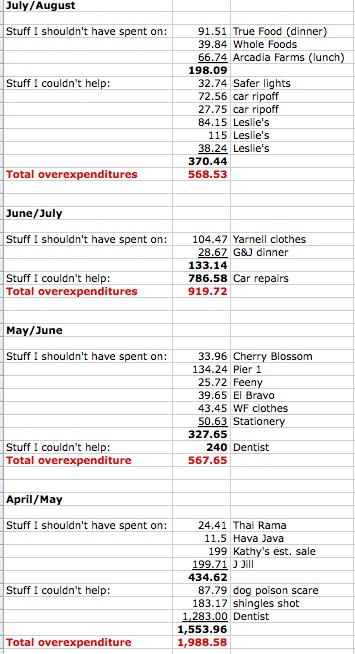
This summer I’ve had the same feeling that I had last summer: as soon as the weather gets ultrahot and the power and water bills head for the stratosphere, that’s when everything goes expensively wrong and you get a hailstorm of unplanned bills.

Last summer I spend $3,348 on unexpected costs after all was said and done—not counting indulgences, of which there were precious few. In fact, there was only one: about $230 worth of artsy-looking clothes at the Yarnell Emporium, outfits that I’m still wearing this summer. So total unplanned and unnecessary expenditures last summer came to about $3,580.

I’ve felt a little more flush this summer, what with the summer classes, and so have imagined I could go out to eat now and again and also buy some clothing and shoes. Over the same span of months, I’ve coughed up $2,951 to cover surprise expenses—virtually all dental and medical bills, car repair bills, and pool maintenance and repair costs. Because getting two summer courses to teach made me feel more confident, I lost control in the self-indulgence department, going out to eat with friends and blithely spending on clothing, jewelry (well…street fair craft jewelry, but still: baubles), and shoes. These extravagances have added up to $1,094 so far, for a total of $4,684 in unplanned and unnecessary spending over the summer.

No wonder I feel broke!

This slide toward ruin started in the late spring, when during the March/April budget cycle I dropped $120 on the amber craft-fair jewelry and $201 on pain-free shoes. It went downhill from then on.

It appears that the reason I don’t run in the red in the winter is because my bills are so low I can afford to eat out two or three times a month and even indulge some other whims. In the winter, there’s about $300 of play in the budget, because year-round the budget assumes summer-level utility expenses. But it also appears that in the winter, nothing happens! The pool does not crap out (it’s not working very hard). The car runs like a top. The dog would never think of ingesting any suspect substances. The teeth wait until the weather warms before they crumble out of my mouth.

Come the summer, though…

This summer, overspending on optional things, like socializing with friends in restaurants and buying clothing, shoes, and baubles, has averaged $283 a month. Average forced overspending on things that can’t be put off, such as dental procedures and car repairs, has been $622  a month. Think of that: on average, I’ve run $905 over budget, all summer long.

{ugh}

Welp, I think the twin messages are

a) during the summer, I must—absolutely must—stay out of restaurants; and
b) I simply can not buy clothes during the summer sales, or under any other circumstances between April and the end of September.

It doesn’t seem to matter whether I’m earning a few pennies extra by slaving away in the classroom all through the 115-degree summer: I certainly am not netting $900 a month!

I’ve had to make up the difference by raiding various cookie-jar savings accounts: monthly savings slated for indulgences like clothing; tax & insurance savings;…and then the base survival savings account, from which I’ve now drawn two months’ worth of living expenses to pay the dentist. There’s no way to replenish that account, and so thanks to my teeth falling apart, I’m short the money planned to support me for two months in 2011/12. Instead of running out in November, I’ll run out of cash at the end of August…just, as we know, when expenses will be highest. 🙄

Gotta quit spending!

w00t! Over the Blackboard Wall and Free at Last with WordPress!

Wow! This is too good to be true! With the English 101 students out the door, I thought I’d take a few hours to at least get a start on preparing my wildcat WordPress website for the fall semester. This would mean discarding the summer session’s blog comments and replies (hundreds and hundreds of them!), updating or rewriting out-of-date posts, and uploading all new course materials.

I sat down one evening earlier this week to start what I expected to be the usual long and tedious process. Within an hour or two, I was done with everything except posting the fall syllabus, calendar, and assignments and rebuilding the grade sheet.

Whoa! That defies belief.

In Blackboard, you can expect to spend hours—many hours!—on converting a previous semester’s course for the new semester. Some of these eye-glazing chores are incredibly time-consuming. I would normally figure two to four days to convert each course.

But thanks to the vastly simpler and cleaner software that is WordPress, the do-it-yourself CMS sites I built convert quickly and easily.

Unload the blog comments (in which students deposited their essay drafts and then wrote comments on each others’ drafts):

Manage Comments > Select All > Move to Trash

Remove the posted 5-week modules:

Posts > Categories > Five-week Modules > Filter
Select Post > Quickedit > “Unpublish” x 5

The modules for the 16-week course were already scheduled, so I didn’t have to fool with setting the dates for those to go live.

Reset the dates for Group Assignments:

Posts > Categories > Group Assignments > Filter
Quick edit > Date > Update x 12

Beside myself with joy! No sitting there staring at the damn system grinding away, no tooth-clenching frustration, no crashes, no error messages…Wordpress just works! It works fast and efficiently, unlike the detestable Blackboard.

Speaking of the which, this charming little message came in today from the school’s Blackboard administrator:

FYI

If you are copying a previous course into your new course shell, copy the course first and then modify it. If you delete all content buttons from the new course shell you will lose the entry point to the course and will be unable to access it. Another alternative is to modify the new course shell, but DO NOT delete the “Announcement Button”. Leave the Announcement Button as your Entry Point. Please let me know if you have any questions.

You know…I want to teach; I don’t want to do an IT tech’s work. That notice up there: that is just the first in a flurry of similarly inscrutable and frustrating warnings and announcements that will come peppering down on us over the next two or three weeks.

WordPress doesn’t try to turn writers or teachers into something they’re not. WordPress lets you teach. Or write, as most of us prefer. Just teach. Just write.

This evening I finished off the conversion for Fall 2011. Started around 5:30 or so. By 7:00 p.m. I was done. DONE! That’s COMPLETELY FINISHED! With zero, nought, NO MORE fiddling around to have to do. The course is up and ready to go for the fall students.

This is so amazing.

Even more pleasing, one of the summer students remarked in passing that she really liked having the course materials and projects online through WordPress—that it was a lot easier than trying to work in Blackboard.

I should hire myself out to faculty who’d like to break free from Blackboard. I wonder what people would pay to get out from underneath that thing?

Could I persuade you to hire me to build something like this for you?

Life before Lemon Laws

Sooo… After extracting some success from Adsense by lacing a post with a high-ranking keyword, I thought I’d try again, this time with the term “lemon law.” That, apparently, is hot just now.

As I was wondering how to decoct a few not-too-eyeglazing words on the subject, it occurred to me that I actually have a real lemon-law story, one that casts some light on why legislators came up with lemon rules in the first place.

Back in the Dark Ages, something over four decades ago, my then young husband and I were wedded by gaslight. We took up residence in an apartment that we furnished with the bribe my father gave the groom for eloping with me, thereby cutting short my mother’s grand plans for an elaborate wedding ceremony and reception. We each brought various items to the marriage, and one of them was a 1967 Ford Fairlane. It had been my parents’ graduation gift to me.

It was a very pretty car, with a custom two-tone paint job—a white top and turquoise body—and a swell tan fake leather interior. This being the first car I’d ever owned, and brand-new, I was very proud of it.

Well.

It was a good thing my husband found the apartment that he did: directly behind a Ford dealership. Why? Because this fine vehicle soon proved the old adage that FORD stands for “Fix or Repair Daily.”

That was almost literally true. The damn thing spent more time in Ford’s repair shop than it did in our carport. Fortunately, I could walk back and forth from our apartment to the dealership, because I made that trek about every second or third day for the year and a half we lived there.

Whatever could go wrong with that piece of junk did go wrong. I eventually came to suspect the mechanics were deliberately breaking things—jimmying parts so they would crap out within a day or so after I drove the car home from its latest repair. “Piece of junk” is far too kind a word to describe the clunk.

The car was only a year or so old—we were married in December 1967—but by the time we moved out of the apartment, the paint was chalking and wearing away. One day when I waxed it with a mild liquid polish, it actually rubbed the paint off down to the metal!

Once we no longer lived within walking distance of the auto lot, we traded the junk in on a cute little Toyota Corona, which ran and ran and ran. The Toyota never gave us a moment’s trouble; never needed any care beyond the routine maintenance. And that, my friend, is the specific reason I haven’t bought an American car in years. Even though we’re told Ford and Chevrolet have cleaned up their acts, I still don’t trust them, almost half a century later: that’s how badly we were burned by Ford’s unsafe-at-any-speed lemon.

There were no lemon laws in those days. If you got a piece of junk…well, you just had a piece of junk. The car manufacturer and its dealer had your money, and they were under no obligation to do anything to fix or replace the junk. It wasn’t until 1975 that the U.S. Congress enacted the Magnuson-Moss Warranty Act, whose purpose was to force auto manufacturers to abide by their warranties and to explain warranty terms in plain English.

Over time, states enacted their own lemon laws. These vary from state to state. The Wisconsin lemon law, for example, doesn’t cover mopeds, semitrailers, or trailers designed for use in combination with a truck or truck tractor, nor does it cover previously owned vehicles. The Michigan lemon law and the Colorado lemon law do not cover motor homes, although Colorado apparently does cover leased vehicles. But California’s lemon law covers new motor vehicles including such items as the chassis cab of a motor home, or a demonstrator, a dealer-owned vehicle, or other rolling stock sold with a warranty, including some vehicles bought primarily for business purposes.

Georgia’s lemon law, like most, excludes used cars. However, laws in Connecticut, Massachusetts, Minnesota, New Jersey, New Mexico and New York do provide statutory used-car warranties.

The Better Business Bureau has a page listing all the state lemon laws, with links to detailed summaries of each, plus a link that allows you to file a complaint with the BBB about your junker. Edmunds describes the recourse you have (in some states) if you buy a defective used car.

Wish we’d had a lemon law when we owned that shiny new Fairlane—I’m sure we could have collected.

Images:

1967 Ford Fairlane. Bill Wrigley. Creative Commons Attribution-Share Alike 2.5 Generic, 2.0 Generic and 1.0 Generic license.

Toyota Corona. Mytho88. GNU Free Documentation License.

The Markets of 2011: 2008 déjà vu?

A few words from one of my financial managers…

The events of the past few weeks have unfolded in a most unflattering way for the financial markets.  Outside of gold and U.S. Treasuries, investments have lost a significant amount of value recently, giving back some of the gains garnered during the rebound of the last few years.  While today’s global stock market reaction today came on the heels of a downgrade to the United States credit rating from AAA to AA+ (negative outlook), the continuation of the market slide is more likely related to expectations about global economic growth, the impact of government belt-tightening, and lack of leadership from the world’s largest economy, than it is from a rating agency’s downgrade of the credit worthiness for the world’s reserve currency.

Investments typically have two components: income and appreciation.  For the last few years, the risk-free rate of return (typically defined as the three month U.S. Treasury) has been incredibly low, forcing investors to take some level of risk to obtain a reasonable level of income.  Currently, U.S. Treasury yields out to 10 years in maturity are producing a negative real rate (after inflation) of return, with no expectation of appreciation, since bonds mature at a predetermined value.  A situation like that is well outside the norm and cannot continue indefinitely.

The last few years have been some of the most challenging times I’ve experienced as an investment manager, and I know that it is troubling to many investors that are not immersed in the investment business on a day-to-day basis.  Over the years we have made considerable efforts to measure the investment needs of our clientele, and have deployed client assets in a manner consistent with our understanding of those goals and objectives.  With objectives ranging from the extremes of low-risk to high-return, each objective requires periodic portfolio adjustments specific to each objective to maintain the appropriate longer-term risk/reward profile.

To that point, while we believe that 2011 will not go the way of 2008, there may be continued market turbulence to contend with in the short run.  We focus on a three- to five-year investment horizon, because the portfolios we manage have objectives based on income, growth, or a combination of the two, but not liquidation based on short-term developments.  We have, and will continue to make adjustments to improve the long-term position of the portfolios we manage with respect to our client’s specific longer-term investment objectives.

Steve Taddie
Managing Member
Stellar Capital Management
Phoenix, Arizona
August 8, 2011

Published by permission.