Coffee heat rising

Decluttering Hell: File Cabinets

Lookit this…

P1020418

And this…

P1020419

And this!!!

P1020420

This weekend I spent seven hours shoveling out file cabinets!

The accountant, who’s also doing my bookkeeping, would like to get file folders that contain only a few months’ worth of statements and receipts, rather than a pile that requires me to rent a llama to get the junk to her office. These are records that need to be saved for seven years, and so to accommodate her wish, I had to break free some space in the file cabinets in the office and the garage. The current bank account and charge card records reside in my desk file drawers, which have just enough room to hold them. Having to create duplicate files and add them to yet more hanging file folders ain’t gonna work.

The four-drawer garage file cabinet was jammed, and the two-drawer model in the office was also about maxed.

Problem is, I never know what to keep and what is safe to throw out. The ex- (the corporate lawyer, who presumably should know) kept every scrap of paper having to do with finances, jobs, etc. all the way back to before the beginning of our 25-year-long marriage. He kept every check he ever wrote — and in those days that was quite a few. I expect to this day he has some set of bureau drawers packed full of that kind of stuff.

That sort of imprinted me with the importance of keeping anything for which, by the remotest chance, you might be called to account.

All right…so, it was off to the Accountant from Nirvana to get the facts on record storage. Via e-mail, the Q&A:

•  What about statements and paperwork for homeowner’s and auto insurance, dating back to the mid-1990s? Can that stuff go? I have a new insurance company. Is there any reason I might be asked to prove that I had a car or house covered in the past? If I have to keep some of it, how much to I need to keep?

Keep for 3 years.

Statements from old, long-closed investment management accounts? Statements from the 403(b) at GDU, which has now been rolled into my big IRA? Statements for mutual funds that I no longer own? These go back 15 or 20 years. At one point Reimer (investment manager) asked me to come up with evidence for the “cost basis” of some Vanguard account. I don’t even know what a cost basis is, much less how to find it in that mountain of paper. Apparently he wanted to know how much I had originally invested, back in the 1980s. I managed to unearth what I thought was the first statement from Vanguard, but he said that wasn’t it. Do I have to keep all these stacks of old statements? 

Keep the December statement only (or whatever month shows a good summary for the entire year).

Bank and credit union statements for accounts that have been closed? Some date back to the 1990s. Some are more recent. 

Save for 7 years.

How about pay stubs dating back to my first pay period on the job at GDU? At one point my first paycheck came in handy…at retirement, GDU tried to claim I’d started a year later than I really had, thereby trying to screw me out of a year’s worth of RASL credit, to the tune of several thousand dollah (yeah, i know it’s a huge faceless mindless institution, but in my paranoia i do not believe for a minute that there’s no agency behind that kind of thing). Should all those job records be kept? Some of them? Which ones, if only a portion?

Toss them all once you receive your W-2 for that year.

How about records of annual reviews, student evaluations, CYA notes on formal proceedings with a particularly nasty colleague that could have led to a lawsuit? Don’t know if anything could still come out of it — the student involved has since moved on, and there surely must be some kind of statute of limitations. What on earth to do with THAT pile of paper???? 

I don’t know about those types of professional issues.

 Evidence of malfeasance on the part of a former chair, notoriously incompetent but now retired? Is there a statute of limitations that might apply to colleagues and former ASU employees who might have a grievance against this woman?  

Again, I don’t know about how  long you would save these items as they relate to standards that are part of the education profession.

Well, this was all very informative. Also very work-making. It meant I had to go through yards of hanging files, sifting out the December statements for many more investment accounts than I can add on my fingers. The ex- and I divorced in 1992. Over twenty years of obsessive document-filing resided in those cabinets! Two of the banks that issued scores of monthly statements no longer exist. Neither do two or three of the investment firms that managed my money before Stellar came on the scene.

I threw out 18 or 19 years’ worth of home and auto insurance paper, 11/12ths of 21 years’ worth of old investment statements, 14 years’ worth of old bank and credit-card statements, five credit cards from long-defunct accounts, and any number of miscellaneous archaeological finds.

An Internet search brought up the specifics of Arizona’s statutes of limitations. For most civil cases, it’s one year. The litigious student who got into the fight with my scoundrelish former colleague is now a successful real estate agent, so she’s unlikely to file a lawsuit even if she could. Other former colleagues who still have gripes against GDU have missed their chance to include the noxious chair in their complaints. My former secretary, La Morona, whom I managed to force out by riding her to do the job right until she finally gave up and quit, also has missed the boat, which sailed four years ago.

So I threw out everything that had to do with GDU.

Then it was into the house to clear out the office file cabinet.

This thing has fast become overwhelmed by the constant flood of dead trees from Medicare’s ancillary insurance companies. Medigap carriers AND Part D drug plan carriers, it develops, send you a three-page (minimum) document called an “Explanation of Benefits.” These things list Every. Single. Doctor’s appointment; Every. Single. Test you take; Every. Single. Procedure that is done on you; Every. Single. Prescription you fill… every goddamn thing any medico or para-medico can think of to charge you for, world without end, amen.

These documents are well-nigh incomprehensible. Without training in the intricacies of the medical bureaucracy, the only way you could figure out what the things mean is to spend several hours poring over each one, studying every entry, looking up the mysteries on the Internet, and trying to relate the mess to reality. Such as it is.

Look up a question like “how long to save EOBs” and you discover nothing is said about when to dispose with this tsunami of paper. Indeed, at least one federal site implies that you should keep the litter forever by remarking that you can use past EOBs to reconstruct your health history, in the event of some question or catastrophic illness.

Another site states that insurance companies are required to store EOBs electronically and can disgorge copies on demand. Uh huh. So, in theory, you should be able to discard them as soon as you’re sure your medical provider has actually been reimbursed.

But yet another source (sorry, didn’t have time to save URLs while heaving paper) tells you that you should match each EOB with the medical provider’s corresponding bill, checking to be sure that the correct procedures were charged (it’s your job, as it develops, to ride herd on Medicare fraud) and searching for reasons to challenge any denials of coverage. Then you are to clip each EOB to each statement and save them until tax time. If you’ve been sick enough that you might be able to claim a medical deduction, then you have to haul all this stuff out, revisit it, and use it to document your deduction. If not, then you should save it for at least a year.

Why not? Who has anything else to do with their time, eh?

By the way, each EOB conveniently includes your name, address, birth date, and Social Security number. 🙂 Ain’t that grand? So all of those things have to be shredded or burned.

They’re not the only offenders. Bank One and Chase Bank print your credit-card number (!) on their statements along with your name and address; American Express does not.

Shoveling all this crap out resulted in a mountain of paper  that completely filled the 18-cubic-foot recycling barrel.

P1020422

And that was just the stuff that didn’t need to be obliterated.  The pile of paper spread all over the floor around a trash can and the dining-room chairs, pictured in the third image above, is all stuff that has to be shredded or burned. Then there’s this stack of paper from a prior, half-baked file-drawer purge, which I just haven’t had time or energy to figure out what to do with:

P1020421

I was going to burn those five (!) folders full of defunct documents over the winter, but we had no-burn regimes every night when it was cold enough to use the fireplace. And besides, burning paper in the fireplace results in a godawful mess to clean up. And it stinks.

My shredder is already on its last legs. So the options are

a) to pay someone to shred the stuff, which I’m just too ornery to do;
b) to go buy a new shredder (which I probably ought to do, since mine has to be coaxed); or
c) burn the whole pile in the backyard charcoal barbecue.

Undoubtedly, c) is the cheapest option. However, as we scribble it is 105 degrees in the shade. The barbecue is  parked in the full sun. Outdoor stuff around the neighborhood is, as you can imagine, quite dry, and that raises a concern about hot ashes floating around.

So, I suppose I’m going to have to get up off my duff and drive to OfficeMax or Costco to get a goddamn shredder.

Lord, how I hate this kind of thing! No wonder my blood pressure is through the freaking roof. Whose isn’t?

Enough with the Pieces of Paper, Already!

Over the weekend I was once again reduced to having to enter the month’s myriad charges into Quickbooks. Wonder-Accountant has suggested that instead of wadding receipts into a file folder and forgetting them, I should organize them and staple them to the relevant month’s statement, a strategy conducive to her reconciling the books.

For a person with English-major math skills, doing the bookkeeping is a monthly exercise in self-torment. I just hate fiddling with dozens and dozens of nuisancey little pieces of paper, no two of which have the date in the same place. The accursed Safeway receipts show you how much you supposedly “saved” by presenting your fraudulent red card, thereby getting them to refrain from charging more than the actual retail price for groceries and household goods. So you have to sit there and study the things to figure out which figure represents the amount that actually was charged to your card. The pieces of paper get lost, and so every month SOMETHING doesn’t show up in Quicken, so then you have to kill more time trying to figure out what the charge on the statement means.

This weekend I finally lost patience with that routine.

I’ve decided to go back to the antediluvian process of paying routine bills with checks. It costs more—you have to buy the damn checks. But it creates a paper trail (which cash does not), and you don’t have to fiddle with a thousand little pieces of paper to pay a monthly bill. The bill is paid when you make the buy.

My plan now is to use the charge card only for tax-related purchases that require me to have a receipt and for big-ticket items like appliances and major repair bills. All the rest of the little pieces of paper will go straight into the trash. The small, routine stuff will be strictly pay as you go. Since I’m pretty well behaved about entering my checks in the register, to put those expenses into Quickbooks all I’ll have to do is copy them out of the list in the register. The credit union has upgraded its online banking software so I can view my checks without having to switch from Firefox to Safari, and I can download them to disk with a simple right-click. When the statements come in, I’ll just copy every check to disk. Time Machine will back them up to a hard drive, and voila! A virtual paper trail.

And if that turns out to be too much of a nuisance? Then once or twice a month I’ll go to the credit union and withdraw $500 or $1,000 in cash to use for discretionary spending. Rather not: cash does flow through my fingers like water. But  I have had it with the little pieces of paper.

Regressive? Probably. We’ll see if it makes life better.

Is there any modern convenience in your life that you’ve decided to abandon in favor of regressing to an older way of doing things? Why?

Moment of Fame

The Festival of Frugality appears at This That and the MBA, where the overpackaging rant was included.

Decluttering: Books

Here’s today’s $64 question: ?

The academic’s standard gigantic home library (usually spilling over into the office, too) could, we must admit, be regarded as just another manifestation of hoarding. Wouldn’t a Kindle or an iPad be better be better than shelf on shelf of dust-catchers?

There are some reasons to think not. Visit Adjunctorium for that line of thought. Meanwhile, I’ve got to go winnow out those bookshelves. First, though, I need to shovel out two closets, a couple of file drawers, and a set of storage shelves.

Later!

Thinking about Sustainability

On the way home from yesterday’s interminable visit to the Mayo, I dropped by a friend’s shop in mid-town Phoenix, a serendipitous little brainchild that morphed from a nonprofit thrift store to a wonderful design, clothing, art, and gift store featuring nothing but sustainable crafts and products. More about my friend Loral later: I’d like to feature her in Funny’s “Entrepreneurs” series.

Meanwhile, check out what she sold me!

This gorgeous purse is made of a 1970s leather skirt. Remember how we used to make purses out of jeans and denim skirts? Well, the crafter who designed this, Shannon Wallace, came across a buttery-soft purple (love!) leather skirt and used it to build this wonderful, incredibly lightweight bag. It has a silken lining, and the skirt’s pockets morph into handy exterior pouches for the bag. It’s actually reversible—you can turn it inside out and have the wild fabric lining on the outside. But being a sucker for purple, I’ll probably keep it this way. The gaudy flower is detachable; I’m thinking I may move it to one of the handles.

KJG and I came across it while we were doing the Willo Neighborhood Tour–my friend’s shop is in darkest Willo, and so of course she had a booth for the tour. I was going to pick it up when we finished the tour, but we both pooped out a distance from the booths. Hence, the visit to retrieve the purse, not quite on the way home from the Mayo, which from downtown Phoenix is halfway to Payson.

So while I was exploring Loral’s shop, she showed me this amazing patch of wood cellulose and cotton, called a Skoy cloth.

It is said to substitute for not one, not two, but 15 rolls of paper towels! You get it wet and use it as a kitchen rag/sponge, and supposedly you’ll never have to use another paper towel as long as you live. Loral said she tried one and was convinced. Well…nothing would do, of course, but what I had to have one of those.

Amazingly, the thing actually works as advertised! Maybe better than advertised. I just tried it on the kitchen counter, which once again had acquired a fine haze of olive oil and dirt, and by golly, the tiles are shining. It also cleaned the brightwork around the sink better than I’ve managed in many a moon—with no special products.

Visiting Loral’s shop and imbibing her enthusiasm for sustainability left me thinking about ways that I might waste less paper, use less gasoline, spread fewer chemicals around, live a little lighter on the asphalt-covered land.

Pretty soon the City is going to stop picking up the garbage in the alleys, instead inflicting yet another barrel on residents to roll out to the front curb and requiring everyone to dump their bulk trash in their front yards. My plan is to get rid of the blue recycling barrel at that time, since I don’t have room to store two big barrels in the garage and there’s noplace in the yard I wish to grace with an extra garbage bin.

To accomplish that, I hope to start producing a lot less recyclable trash than I’ve been doing. So…have begun thinking about how to live a less trash-intensive lifestyle. The trick would be to avoid bringing stuff into the house that has to be thrown out or recycled. Among the strategies that come to mind:

Use cloth bags or reuse plastic bags for grocery shopping and small sundries from hardware stores, drugstores, and the like.

Buy products in bulk. Even if something comes in plastic and cardboard, obviously if you can buy a larger store of the product, one package is better than a half-dozen.

Get off mailing lists.

Buy food at farmer’s markets and other local merchants who use minimal packaging.

Cancel newspapers; read news online instead.

Read books on a Kindle or similar hardware.

Substitute ordinary household products such as vinegar and baking soda, often available in bulk, for commercial chemicals. Package them in your own reusable squirt bottles.

Use steam, not a mop and harsh chemicals, to clean.

That’s just a few ideas. Many folks have made an art of low-impact living and can offer more and better strategies. But it’s a start.

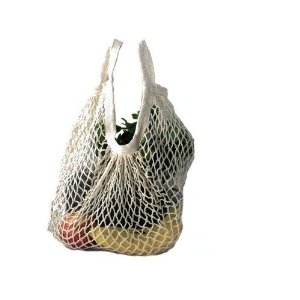
With Trader Joe’s and now even Safeway peddling “green” reusable shopping bags, it’s surprising that Americans haven’t discovered the wonderful string bags we used to see in England. I had a couple of them, which would roll up and hide in a tiny corner of a bag, briefcase, or pocket. None of the shopkeepers up and down the streets, to whom one repaired every day or two because one’s flat didn’t have a refrigerator large enough to hold a week’s worth of groceries (nor did one have a car to carry that much stuff in, anyway), ever imagined handing out paper or plastic bags to customers. That you would bring your own bags was a given.

The beauty of the string bag is that it expands almost indefinitely. I could easily fit two or three days’ worth of goods in just one of them. Two would hold a lot of food.

Amazon offers a couple that resemble the version the English carried around: This one from EuroSac

And one from Simple Ecology that comes in colors and costs two and a half bucks less.

And there’s a variant designed with a shoulder sling, also from Eurosac…

Any of these will hold a lot of stuff and take up hardly any space in your purse, briefcase, or car trunk.

Costco, my primary source of groceries, household products, and casual clothing, already eschews bags. But they pack your stuff in cardboard boxes, which take up a lot of space in the trash bin and are a nuisance. They’re too heavy to lift out of the cart, so I have to unpack each one, repack it into the plastic bins in the back of the van, and then once home unpack and carry the stuff indoors one, two, or three pieces at a time. My plan, then, is to get a bunch of string or fabric shopping bags, ask the Costco staff to pack the junk in those, and let Costco keep the cardboard. Maybe if enough of us do that, Costco will ask their suppliers to ship in less wasteful containers.

Maybe we can all use less wasteful containers!

Late Tuesday Evening

Listen to a nice video:

This lovely Brazilian musician, Rossine Parucci, sings with our choir. He’s finishing his advanced studies at the Great Desert University and soon will return to his family, home, and promising career in Brazil. He has a fantastic tenor voice, a talented man all the way around. We’re going to miss him a lot, all of us having come to love him during his time here.

So it goes.

This morning I got a bug in my proverbial bonnet: MUST CLEAR OFF DESKTOP. MUST GET  SIX-FOOT SHELF OF BOOKS OFF DESKTOP!

For as long as I’ve worked off a small conference table elled against a big old six-drawer desk, I’ve kept a row of reference works atop the desk, within arm’s reach: Chicago, APA, MLA, CSE, and AP manuals, Webster’s, Roget’s, Larousse, Harper-Collins’s Spanish dictionary, plus a three-ring binder holding a printout of my rolodex.doc file. And assorted miscellaney.

All very handy…except when they flop over and threaten to slide to the floor, which they do several times a day.

I tried to keep them in place by gluing some of that sponge-rubbery shelf liner, the stuff that looks like one of those anti-slide mats you put under an area rug, to the bottoms of a couple of metal bookends. This worked for, oh…about thirty minutes. Soon the whole lash-up was again flopping over to the east or the west, depending on which book I pulled out.

Today they flopped their last flop.

In a decluttering frenzy, I pulled everything out of the three-shelf bookcase across the room, damn near choked on the clouds of dust, moved the case goods, vacuumed up the heretofore hidden dog dunes and dust bunnies, rescued part of a picture frame that fell off the wall and slid under there months ago, cleaned the shelving, and shoved the thing back in place. Piled up books into mounds: some for M’hijito, some too precious to toss (why?), and some that have gotta go.

I find it difficult even to contemplate throwing out a book, let alone actually doing the deed. What is a book, other than an icon of our culture, a capsule of human intellect to be cherished and preserved and handed down to the next generation?

Okay, well, what indeed? A dust-catcher, that’s what.

My lifetime book collection, which fills walls in three rooms, used to be a working library. When I was writing actively, early in the Internet’s dawn as a cultural icon of its own, I used my reference works, my nonfiction, even the novels and short-story collections, all the time—every day. Now, though, I hardly ever crack a book. When I need to look something up—which is still all the time—I google it or go to one trusted site or another. On the rare occasions when I do have to search out something in hard copy, I barely have the patience to sift through an index and scan my eyes over pages of print to find what I’m looking for. It seems so clumsy. So…tedious.

All right: the decision made. Some of the stuff has gotta go, to make room for the occupants of my desktop.

What to throw out, what to keep?

The Paul Mace Guide to Data Recovery. Out

Frederick Turner’s Of Chiles, Cacti, and Fighting Cocks. Seminal, without a doubt. Out

Judy Jones and William Wilson, An Incomplete Education. (Barnes and Noble 10% OFF!!!!). Fine bathroom reading (why hasn’t it been in there?). In.

Elementary Basic. Out

Turabian’s Manual for Writers…4th edition! 1973. Out

Andrei Codrescu and Laura Rosenthal, eds., Thus Spake the Corpse. Just the thing for my son’s library. To M’jihito.

Jacques Barzun, The House of Intellect. Dare I throw out a seminal postmodernist? I dare. Out

Jacques Derrida, Acts of Literature. {grumble} There’s a limit, I guess. In

Chicago Manual of Style, 14 edition. The 15th resides on the desktop, and it’s out of date! Out

Howard M. Zachar’s A History of Israel from the Rise of Zionism to Our Time. Why haven’t I read this?… Hm. Eight hundred and eighty-three pages of ten-point type, that’s why. Possibly of interest to M’hijito? Possibly not. In, provisionally

Land of Enchantment: Memoirs of Marian Russell along the Santa Fe Trail. Hm. Liberated from the Arizona Highways library that time when its finest editor, Merrill Windsor, decided to do a little decluttering of his own. Never got around to reading it. I should read this. In

Even with more In than Out, at the end of an hour two and a half shelves were completely cleared. And clean. This created plenty of room for the desktop collection, and then some: enough space to stash the laptop, too! And to move the big Spanish, French, and Italian dictionaries out of the closet (to be replaced therein by the Anglo-Saxon and Latin dictionaries) and into the little bookcase. Hot dang!

The desk still isn’t free of all clutter. Several piles of paper remain for me to plow through. The stuff grows like some sort of vertical, leafy fungus. Two file folders full of paper are sitting on the desk while the negotiations with the insurance company continue—today I had to dig out the deed to prove to the guy that I actually own the house free and clear…he was about to write a check to me and to First Horizon, a long, long-ago lender.

Tomorrow, though, I’ll get it shoveled off. For the time being, though, it’s 10:30 at night, and I’m going to bed.

Running low on music? There’s more!

And check out this pair:

Never found this stuff in my library. 😉

Can Minimizing Go Too Far?

This is a guest post from Crystal of Budgeting in the Fun Stuff: A Personal Financial Blog about the Next Financial Step. It’s an open fiscal diary and a personal finance blog rolled into one that is looking to get as many people involved as possible.

Minimizing is in. I’ve seen three different articles in two weeks about getting rid of clutter and minimizing your junk. I am personally trying to declutter our home this month as well. BUT, I do have my limits.

I want my house to be rid of the actual junk…the stuff that just takes up space that I just haven’t Craigslisted yet. For example, I want to get rid of our old GPS, cell phones, my wedding dress and petticoat, and two boxes of Nintendo games and White Wolf magazines that we were unable to sell for a friend. I’ve already successfully sold a few things and am working on the rest.

I don’t want to get rid of our books, DVDs, board games, or Magic: The Gathering cards. Those are things that we enjoy or will enjoy again in the future. Do we read our books every year? Nope. Do we frequently watch our DVDs? Nope. But when I want to read the whole Harry Potter series again, I know where they are. When I want to bring The Princess Bride, Paranormal Activity, or Terminator 2 to someone’s house, I can easily pluck them off the shelf.

We own the board games and Magic cards for much the same reasons. Some games get played all the time (like Power Grid), but others only come up once in a while (like Merchants of Venus). That doesn’t mean we want to get rid of Merchants of Venus…we’ll just hold on to it until it’s requested again.

In short, I want to own these things for the ease factor and because I enjoyed them enough to want to have them as part of my life.

I just hope that the true minimalists (like these people) will not accidentally cause a bunch of people to go on a crazy cleaning spree and regret it a month later when they are re-buying the hobby gear they just sold or the clothes they just donated.

Enjoy these other posts at Budgeting in the Fun Stuff:

How We Chose to Buy Our Home
Diminishing Inheritance Returns
Let’s Get Controversial: Hiring Help