Coffee heat rising

Check Out My New Blog!

As if I didn’t have enough on my plate, I decided it would be fun (and maybe someday profitable) to start a new blog in which to vent and rave about my teaching adventures. Called Adjunctorium, it just went live in WordPress.com.

This’ll be the beta version. If it goes over reasonably well after, say, three or four months, then I’ll move it over to BlueHost so as to monetize it a bit.

Go on over and check it out! Lemme know if it looks promising.
Accursed Computers, Bizarre Lesson Plans

I have GOT to buy a new desktop!!!!!!!!!!!

The iMac has virtually ground to a stop, so antiquated is it and so clogged with whatever built-in obsolescence bugs cause old computers to slide toward entropy. I’ll bet I’ve sat here watching it choke and struggle as it trudges along for a good hour. And god how i hate having my time wasted this way!

One mistake, and you’ve got to do it all over again, and it takes ten minutes just to get the program you need to reload. I’ve been trying to build this semester’s course packet from a number of PDFs for the past goddamn HOUR—the job should have taken all of ten minutes at the outside.

I may just have to give up. Now I can’t get the damn computer to respond at all.

Spent the entire day yesterday, yea verily until 12:30 this morning, revamping the website and rewriting course materials, using the much zippier MacBook. Along the way, I learned that the newer versions of Apple’s “Preview” program will manipulate PDFs with as much or more panache than my decrepit version of Acrobat Professional. This is good: it means I don’t need to buy a new version anytime soon. Acrobat is an expensive piece of software for people who earn $2400 a semester.

However, the data I need—and there’s a lot of it—is on the old computer, which is the only one that will speak to the printer. And that terminal is too old to support any fancy new Mac operating systems.

Welp, the actual work of this semester’s 102 sections is hugely simplified. When it comes to serious grading, I’ve about halved the workload:

Eliminated all but one draft
Killed off all peer reviews
Thereby quashed the need to have students interact online through blog comments or forums
Found videos to substitute for lectures
Assigned oral progress reports at three points during the semester
Gave students deadlines for the library labs, after which they get no credit for attending
Required one-on-one conferences at the end of the semester, for the 2,500-word research paper that’s such a monster for most of them

In fact, I’ll only have to grade three sets of papers and one draft. The rest of the stuff will entail my sitting back and watching them perform.

The result of assigning rafts of busywork is, as usual, that a student would have to be brain-dead or AWOL all semester to fail the course. If you scored 50% on each of the three actual papers but religiously performed all the busywork and extra credit, you’d end up with a final score of 69%. This means a student could get a D (60% to 69%) on any of the three real assignments, fail the other two, and still potentially pass the course with a C.

As a practical matter, students who fail the essays don’t do all the other assignments. But in theory it could happen.

I don’t know how to interpret that. On the one hand, it’s deeply demoralizing: to get our students to pass a dumb-bell course like freshman comp (which should be, shall we say, minimally challenging no matter what the instructor chose to do with it), we have to pack the thing with mickeymouse bullshit. But if we choose not to do that, at least half the students will fail or drop, and that seems counterproductive, too.

Truth to tell, I have tried to build some rigor into this semester’s course. They’re going to be terrified when they learn they have to write on topics of my choice on a subject of my choice: Prohibition & the Great Depression. Their paper topics are already assigned (I’ve dreamed up  more than enough to cover all three papers for all 50 students), and they will hate it, hate it, hate it that they can’t recycle the sappy post-adolescent maunderings that got them As and Bs in their high-school social studies and English classes.

The semester will begin with the proposition that writing is a tool for learning: that we write research papers so we can learn things and communicate what we learn to others. And this semester we’re going to learn about a period in American history that has great relevance to our own times.

In addition to writing three researched and documented papers on some pretty bracing topics, they will also make three oral presentations (one of them 15 to 20 minutes long) describing what they have learned along the way. This, I hope, will force at least some of them to reflect on and synthesize some of the stuff they encounter as they wade their way through the shoals of early twentieth-century history.

Exterminating the drafts and peer review works to a secondary advantage: now exactly zero student interaction will happen on my external website. All that will appear there will be the course materials, weekly learning modules, and an interminable list of links. This should overcome any objection the District may have to off-network sites. There’s no way any interchange (licit or illicit) between student and faculty can occur; nothing that is graded appears there; and nothing that could even remotely offend FERPA can happen there.

God. It’s after noon. I’ve spent half the morning watching stupid little mandalas spin. WordPress.com kicked me off and now I can’t get back in. DamNATION!

And now that it’s finally let me back online after three tries, the damn thing has lost page content I entered and saved earlier this morning. Now I have to do that ALL OVER AGAIN!!!!!!! What ELSE has it deleted?

Time to feed the dog and then drive down to the Safeway and pick up a bottle of bourbon. This wagon isn’t goin’ where I wanna go!


Higher Education in America: A Modest Proposal

Over at Thousandaire, proprietor Kevin McKee argues that college students need to develop salable skills rather than focusing on grades. He suggests young people avoid  majoring in subjects that won’t result in high-paying jobs (such as general business) and instead focus on majors such as those among CBS Money Watch’s 20 Best-Paying College Degrees.

One of the problems with this point of view is that it conflates education with vocational training. Both are important, but they’re not the same thing.

Personally, I’d like to see my college students have some skills: I’d like them to be able to write an idiomatic sentence and cobble together several comprehensible sentences into a coherent paragraph and then build an adequately researched, well organized document from a bunch of such paragraphs. About 60 percent of them cannot.

I wish they could all read at an eleventh-grade level, the level for which the Wall Street Journal writes. At least 40 percent of them cannot.

And it would be wonderful if they could think logically and clearly, without falling into error, fallacy and confusion. A good 70 to 80 percent cannot.

It would be astonishing if they understood something about the history, sociology, and literature of their native culture. The ignorance displayed by the typical lower-division student takes your breath away. Among other things, students ranging from freshmen to seniors have told me that nothing of importance happened during the 19th century except the Industrial Revolution, that Wisconsin is a Rocky Mountain State, that the word “urbanization” is incomprehensible, that Arizona is a Great Plans (sic!) state, that all African-American children are ipso facto children at risk, and that the Dust Bowl occurred in the Southwest. One graduating senior majoring in English (not the university’s dumbed-down English Ed program) raised his hand in a second-semester advanced editing course to ask what a noun is.

Interestingly, a large proportion of CEOs and successful business owners have undergraduate degrees not in business or accountancy but in the liberal arts. This is because liberal-arts training teaches critical thinking skills and communication skills, as well as furnishing the mind with a broad understanding of history, culture, science, language, and math.

Kevin is right in saying that GPA doesn’t matter once you get past that initial job. But stump-dumb ignorance sure does.

On the other hand, for all but the best and the brightest, our business culture devalues true education and instead seeks worker bees. As it stands, the average college student’s stump-dumb ignorance doesn’t matter much, and so he or she might as well be using the four-year college education period for vocational training. This state of affairs, unfortunately, does little to make our children’s lives better and over the long run performs a disservice to America’s businesses and industry.

So, here’s the modest proposal…

With a small change to our educational system, we could do something to fix that predicament. We could make college-level education a great deal more efficient and provide our young people with a future that is far more secure than what they now can look forward to. It goes like this:

Instead of going straight into a four-year bachelor’s program, American college students should be required to start with a two-year vocational program.

Pick a job. Any job. In the first two years of school, you will take courses and apprenticeship training (i.e., internships, preferably paid) related to that job. For example, you’re interested in medicine (say you want to be a nurse, a P.A., or a doctor), that first two years will be spent learning an entry-level occupation in that field, such as EMT, respiratory therapist, or medical office skills. If you want to be a business executive, you would first learn bookkeeping, office skills, marketing, and human resources. During this period, you would also take lower-division core courses around the voc-ed training. Some jobs require rudimentary math, science, and communication skills, for example, and so you could take your lower-division math, science, and composition courses during the voc-ed phase. Time might remain for you to complete a few other lower-division core courses that fulfill B.A. requirements, too.

At the end of this first two years, you will be qualified for a job. If you chose wisely, you might even be qualified for a job that pays a living wage.

Now you can complete the bachelor’s degree or take college classes online in any subject you please.

If you took enough core courses during the voc-ed segment of your higher education, you could finish the bachelor’s in two or three years, allowing you to proceed to the master’s rather quickly. Bright students could accelerate their graduate-level training in the same way they could accelerate their undergraduate degrees, by taking certain key courses (such as research methods) before they officially move up to the next level. So, it might be possible to complete an 18-month graduate program (an MBA or an MMS, for example) in a year.

Students would spend five or six years completing the B.A. (many already do that, as they struggle to hold minimum-wage jobs while triaging their college courses), but by the time they finish, they absolutely will be qualified for a job that will put food on the table. And because that first two years will guarantee a living wage, a student who suffers from intellectual curiosity actually could major in the liberal arts, anthropology, or whatever other course of study appeals to her or his bliss. A bachelor’s degree in general business on top of a voc-ed certificate plus some summer work would indeed qualify a graduate for something other than stocking the bookshelves at Barnes & Noble.

Meanwhile, since American k-12 schools do little or nothing to qualify students for real college-level work, those who can’t or don’t want to jump through the hoops to get a bachelor’s degree could stop at the end of two years and go to work at a job that will let them move out of Mom and Dad’s house.

Proportionately fewer students would go into bachelor’s programs, but universities would lose little in tuition, because they’d be clipping it from 18- and 19-year-olds in the first two years of voc-ed. Actually, this scheme could increase university enrollment: young people who would ordinarily go to community colleges might be drawn to four-year campuses, when offered a vocational degree or certificate with a university’s name attached to it. And with momentum and two years of maturity under their belts, many students who would have stopped at a junior-college A.A. might move into the B.A. path.

Colleges and universities already offer the coursework that would make up these two-year programs, and so rather little adjustment would have to be made. For not much expense and rejiggering, universities could educate and train…and a bachelor’s degree would get a young person a decent job.

Moment of Fame

Speaking of the vagaries of American higher education, Funny’s post on building an academic career off the tenure track was included in this week’s Carnival of Personal Finance, hosted by Money Cactus.

When DO i get my life back?

Finally sent the Eng. 102 and Eng. 235 syllabi off to the chair and his redoubtable admin, along about 12:30 a.m. That would be, yes, this morning.

Though I’m pleased with what I came up with, my God it was a lot of work! It took the better part of a week of the usual 12-hour days to rewrite the 102 course. And the desktop, because it’s so antiquated, runs with the speed of a stumbling snail. So last night it took a full half-hour to e-mail the 235 syllabus and calendar (which, thanks to the MacBook, I wrote while sitting on the sofa) over to the desktop, watch it grind away and grind away trying to open MacMail, watch it grind some more trying to open the files in Word, watch it grind more and more trying to open Acrobat Professional, watch it gasp and wheeze and grind some more at saving the files from Word to PDF, watch it grind and grind and grind merging the PDFs into a single document, watch it slooooooowwwwwwllllllllllyyyyyyyyyy upload the 102 and then the 235 syllabus-calendar lash-ups, and finally, and at half-past twelve, manage to send the damn things into the ether.

Still have to save the stuff down to the backup drive, but since the files now reside safely in MacMail’s “sent” folder, I gave up and went to bed.

The chair has decided he wants to see detailed week-by-week calendars with learning goals and activities for each section. This stuff would normally be on my websites—posts outlining learning goals and assignments go up automatically on Saturday mornings. To convert from WordPress posts to something that can fit in a table set up as a calendar takes freaking HOURS, even though I don’t have to write all new stuff.

Except…I did write all new stuff for the 102s.

{cackle!}

This is so cruel! I just love it. Half the students will flee to other sections when they see what the course will entail this spring. Then I’ll only have about 20 papers to grade.

The idea is to give them specific subject  matter to write about. Last semester I did this by coming up with three general topics (the Great Depression in Arizona; communities [ethnic and otherwise] in Arizona; and urbanization and the environment, pertaining to Arizona).

They hated this, because it precludes recycling the puerile ramblings they’ve already written for other courses. And while the approach worked in the short summer term, which attracts brighter students, the fall bunch struggled (three of them confessed to not knowing what the word “urbanization” means, and one of them never did figure it out). The library’s resources are rather limited when it comes to local issues (electronic databases focus on national and international scholarship). And because most American students know so little about their country’s history and don’t want to know (some people are utterly lacking in intellectual curiosity), many failed to come up with workable paper topics. This, despite days of in-class brainstorming and coaching.

So, this semester they will have one large topic—Prohibition and the Great Depression—and instead of having to craft their own topics, they will choose topics of my devising.

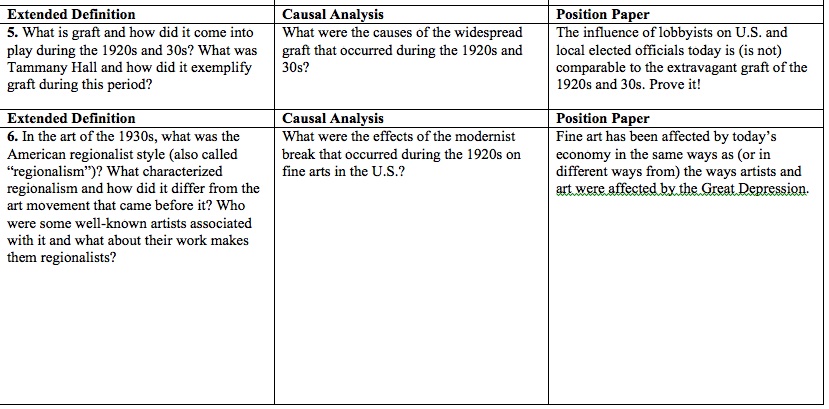
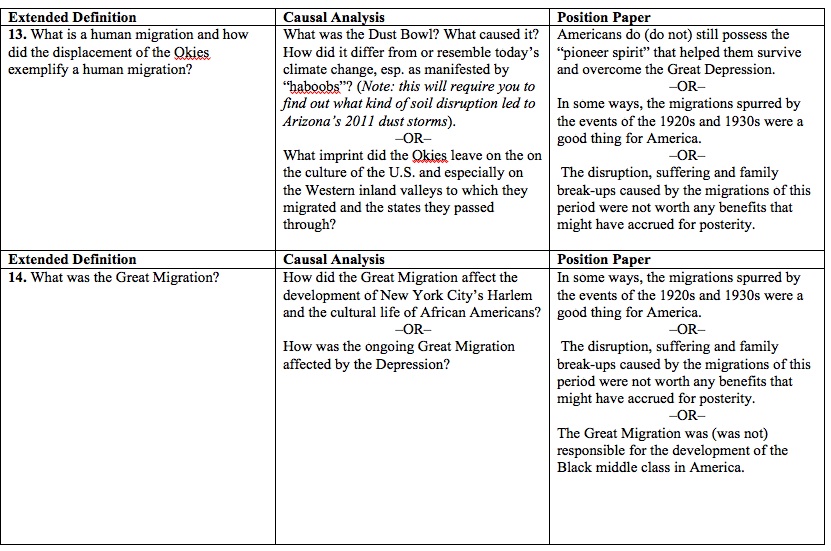
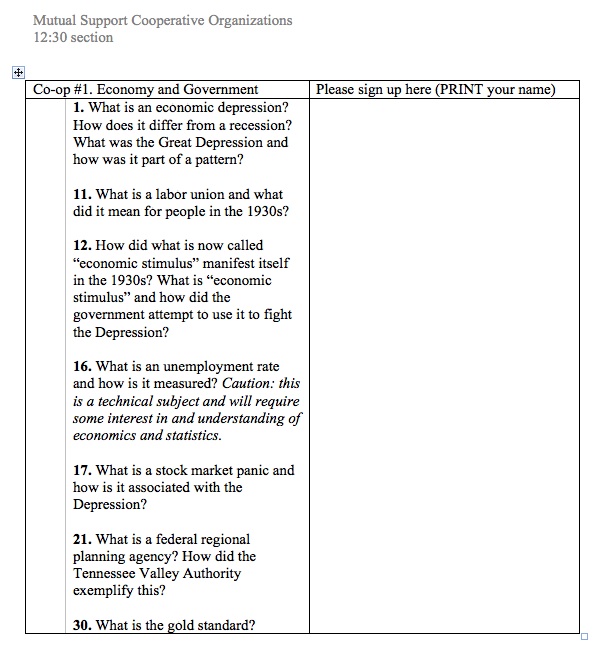
What took so long to rebuild the 102 course, then, was coming up with 90 workable paper topics about U.S. and international history of that period. Make that 90 linked paper topics, so that each student can write three papers on roughly the same subject, the issue being that unless they’ve done some of their research for the 2,500-word position paper early in the semester, they don’t have a chance of coping with a ten-page end-of-term paper. Videlicet:

Click on the image to get a readable view.

Mwa ha hah!!!!  I ended up with four pages of this stuff, which I printed out and scissored apart, horizontally across the landscape page. Come the first week of class, I’m going to hand out the sliced-apart topics and each student will get to pick one. With that in hand, she’ll have topics for all three papers assigned before the end of Week 1. They’ll have a sign-up sheet on which to record which set of topics they reeled in, so I also will know what they will be writing about all semester long.

Will they hate this? Ohhh, you have no idea how much they will hate it.

Will it mean I don’t have to read any post-adolescent ramblings about how the drinking age should be lowered to 18, how beauty is an internal thing, how medical marijuana should be made legal with no questions asked, how we should build an electrified fence along the entire US-Mexico border? Oh, yes.

Will they do a half-baked job on these papers? Of course. They’re just kids. But at least they’ll try. Some of them may actually learn something.

Better they should do a half-baked job on a paper that requires them to do some research, learn something about the world, and actually think about it than that they should barf out still more uninformed teenage drivel based on breathtaking ignorance and eye-glazing clichés. Or turn in their senior social studies paper for credit, for the eleventh time.

The drafts, comments upon which they ignore, are going away. They will have just one draft, for the first paper. Since even fewer of them have ever written an extended definition than have ever written a sourced paper (no joke!), the first paper of the semester is actually the most difficult for them, even though it’s only 750 words.

So we’ll do a draft on the first paper—no peer review, a pointless waste of time. This draft will be graded according to the same rubrics that will be applied to the final version, but since it will be worth only 50 points, a failing grade will have less effect on their final semester score than a flunking grade on a regular paper. I will then tell them that they now see what the standards are and how the papers will be assessed, and so henceforth it will be their responsibility, not mine, to put together a decent paper.

And that will bring a stop to the frustration of spending hours trying to help them succeed, only to have them paste the original clumsy draft into a Word file and turn it in unedited. It also will cut the grading workload in half.

Collaborative groups will go away (another waste of time!), except insofar as we’ll set up informal groups of people with roughly similar topics to function as mutual support groups. In keeping with the Depression-era theme, I’m calling them “co-ops.” They can commiserate with each other, help each other with research (to the extent that they figure out how to do research), and ask each other out on dates.

So. That was a bitch to design and write.

Naturally, I created some extra work for myself in the Eng. 235 department, too. Ruminating over the course schedule, I realized the order of the assignments was kind of self-defeating. It should go from the easiest-to-write type of magazine feature to the toughest, ending with something short that I can handle while coping with fifty 2,500-word research papers from the 102s. In fact it went from middling easy to difficult to simple to middling easy to the shortie. Reorganizing the order in which those papers occur entails rewriting the entire course. That didn’t take anywhere near as many hours, but it still ate up an entire day.

And now I still have to redo both courses’ websites. That probably will consume another three days. You understand, all of this work is done off the clock. The semester is over, and whatever I do for the college when class is not actually in session amounts to free labor.

Before I get to that, though, I’ve got to shovel the mountain of incoming paperwork off my desk and catch up with the bookkeeping I’ve neglected for the past month.

Is there a question as to why I never get around to writing the e-books I’d like to spin off this site?

Personal Finance, Academics, and the Perpetual Recession

Yesterday I came across a shiny new blog over at WordPress.com by a young academic working in the South. She calls it Budget Glamorous: Living Well on Less. (hmmm… What is it about academia that leads its denizens to write personal finance blogs?)

BG, it develops, is presently working in exactly the same position at her university where I started at the Great Desert University: as a full-time non-tenure-track lecturer.  Apparently the idea is considered relatively innovative in Appalachia, as it was here (more or less) when I hired on at GDU, said idea being that the school would hire a small cadre of moderately paid Ph.D.’s and M.A.’s to teach four-and-four or five-and-five, with no research & publishing expectation.

These jobs are paid one helluva lot better than ordinary adjunct gigs: you get a full year’s contract at pay that would be laughable in the corporate world but that looks pretty darned good to an unemployed wretch fresh out of six years in graduate school. I started at the same figure as the assistant professors in my cohort. By the time I left to found and direct the editorial office on the main campus, I was earning the median annual salary for Arizonans—not very much, but as a lecturer I was paid for only nine months of work. My pay, however, most certainly did not keep up with my cohort’s, by then at the associate level.

GDU already had a full-time non-tenurable position, which they called “instructor” and for which they paid shamefully. These were held mostly by ABDs and by women hangers-on, academic groupies who were having affairs with faculty members or who simply wanted a career on a university campus but for one reason or another could not get a position elsewhere. Once an incumbent finished the Ph.D., he or she was out of a job. So in effect, accepting such a position brought your academic career to a halt, in real terms.

The lecturership, by contrast, may be held indefinitely—one colleague at the West campus retired after about 20 years on the job. It has no future: you are not going to get a promotion, you are never going to get a shot at a tenurable position, and the only raises you will get will be COLAs, except that when times are tough (which is most of the time) there are no COLA increases. GDU lecturers earn about half of what a community college instructor here earns, with a comparable course load and much larger classes. To frost the cookies, you have no job security whatsoever: annoy a dean, and you’re canned with no appeal. The university can refuse to renew your contract and does not have to give a reason. No joke: this happened to a friend who got crosswise with a dean.

The advantages for the university are obvious: One lecturer can be made to teach two or two-and-a-half times the number of lower-division students that can be foisted on a tenure-track faculty member. Accrediting agencies look askance at large numbers of undergraduate courses taught by part-time adjuncts, and so hiring anyone at “full-time” status helps hugely at accreditation time. This handles the scut-work courses at a little higher cost than hiring adjuncts who will work for sweat-shop wages and no benefits, but the crucial importance of accreditation overrides that added cost. A lecturer in a non-tenure-track position can be canned at will, giving administrators a little more control over department, division, and college budgets…and a convenient political shilelagh. This came in handy at GDU when, as the current economic depression reached its height, some 550 employees were laid off, and as the layoffs continue to this day.

The advantage to the budding academic? A job. Even before higher education was pinched by the fall of the Bush economy, graduate schools were turning out many more Ph.D.’s in the humanities than there were jobs to accommodate them. There simply are not enough jobs to go around. A full-time junior-college opening can attract two or three hundred qualified candidates. So, obviously, unless you enjoy waiting tables or cleaning house, it’s much to your benefit to grab whatever academic job you can get, if it pays anything like a living wage.

Like BG, I enjoyed teaching as a full-time nontenurable lecturer, at first. I like students and in time found ways to mitigate the obscene workload. It was great for the first seven years. After that, political infighting led to the disintegration of our department and morale went south, fast. I started looking for other work, in and out of academe; it was three years before I managed to get myself into an administrative position on the Main campus.

The question is, if you know what you’re getting into, can one of these exploitive jobs be made to work to your advantage?

Possibly so.

If I were starting that position now, knowing what I know today, I would use the job as a springboard to another job, and I would work as hard and as fast as I could to find that other job. I would not delay just because I liked the teaching or felt grateful to have broken into academia.

If I wanted to stay in the university environment, I’d be angling for an administrative position, even it it meant getting another degree. The Ph.D. in an academic subject may or may not help you get into administration, but certain vocational doctorates indeed will.

You can get these degrees online or in low-residency programs. At GDU, I watched people move from underpaid nontenurable jobs to administrative positions after obtaining advanced degrees in educational administration or online course design. Most of the coursework was done online. An Ed.D., it develops, is as good as a Ph.D. in the job market—maybe better, if it has something to do with administration or marketing.

Meanwhile, I would apply for every tenure-track position advertised in the Chronicle, no matter where it is. I also would not be too proud to apply in the community colleges, where the same workload is rewarded with better pay and job security.

If I wanted to work in the real world, I would be looking all the time for any job I could convince an employer I could do. And classroom skills translate magnificently to the real world:

Communications
Publications
Management
Human resources (here, too, think online courses: get an online degree in human resources or management)
Personnel training
Online personnel training course design (where do you think they get people to build those see-Dick-run employee tutorials—and those annoying courses for traffic schools?)
Translator jobs (if you’re fluent in a second language)
Executive director of nonprofit
Development officer for nonprofit

Some industries that seem far afield of academia welcome academics as they welcome any smart, self-starting, ambitious individual. A friend of mine went into real estate as she neared the end of the doctoral program. She had a long and lucrative career selling spectacular high-end houses to the ridiculously rich. Another went to work for Peter Bogdanovich and became an executive vice president of Paramount Pictures. Two others went to law school—today one is a prominent immigration lawyer; the other went to work in the AG’s office. Another left a tenured associate professorship in communication to found a very successful personnel training business, for which she simply transferred what she had been teaching in the classroom into the corporate workplace.

And if getting a real-world job meant I had to walk from a nontenurable academic contract in mid-semester, that’s exactly what I’d do. A university feels no loyalty to its NTTT faculty (it’s an institution: it feels nothing), and so there’s no rational or moral reason not to move on when a less exploitive opportunity comes your way.

I Love My Students, but….

{sigh} It’s 5:30. For the third time today, I think I’m done reading the current raft of travesties student papers that are pouring in as the semester ends. Most are still in the draft stage, so I will have the privilege of reading it all over again in the next week—much of it unchanged from the so-called draft.

You know, I really do enjoy students. They’re invariably interesting human beings. Most of them seem to be fairly bright. Some are funny, some are sweet, some are teeny-bopper obnoxious, some are scared, some are bold, some are earnest, some are full of beans. As a group, they possess a great deal of charm.

There’s that about teaching.

And I really do hate wasting my time. Few things annoy me more than feeling that I’ve devoted a great deal of time and effort to something for naught.

There’s that about teaching.

And therein lies the fundamental conflict. Few activities can delight an instructor more than dealing with students, and few things can waste more of an instructor’s time than dealing with students. It is a pursuit that at once pleases and infuriates.

A bouquet of comments (in blue, so as not to evoke blood by writing in red ink) from today’s readings:

Mr. Boxankle:

A college-level paper is organized into blocks of copy called “paragraphs.” Each paragraph treats one and only one topic. In the block above [which comprised the entire jumbled 750-word essay, except for a couple of sentences], you’re trying to deal with a bunch of different topics. Try making a topic outline. A “topic outline” is organized like this:

A. Thesis

1. A paragraph discussing a topic related to the thesis, containing the thesis statement.

a. Detail supporting or developing this point
b. Another detail supporting or developing this point
c. And so on, for as many details as are needed

2. A second paragraph discussing a topic related to the thesis

a. Detail supporting or developing this point
b. Another detail supporting or developing this point
c. And so on, for as many details as are needed

3. A paragraph discussing a closely related issue, and so on, to accommodate as many points as needed

B. A major issue to discuss relevant to the subject

1. A paragraph discussing a topic related to the issue

a. Detail supporting or developing this point
b. Another detail supporting or developing this point
c. And so on, for as many details as are needed

2. A second paragraph discussing a topic related to the issue

a. Detail supporting or developing this point
b. Another detail supporting or developing this point
c. And so on, for as many details as are needed

3. A paragraph discussing a closely related issue, and so on, to accommodate as many points as needed

C. Another major issue relevant to the subject

1. A paragraph discussing a topic related to the issue

a. Detail supporting or developing this point
b. Another detail supporting or developing this point
c. And so on, for as many details as are needed

2. A second paragraph discussing a topic related to the issue

a. Detail supporting or developing this point
b. Another detail supporting or developing this point
c. And so on, for as many details as are needed

3. Another paragraph discussing a closely related issue, and so on, to accommodate as many points as needed

 The items marked with capital letters (A, B, C) represent major sections of your paper. In some instances the items marked with capital letters might also represent single paragraphs; items marked with Arabic numerals (1, 2, 3) would always represent paragraphs.

So, let’s see how this might look as applied to your subject:

 A. Thesis: Public high schools should provide condoms to students, by way of preventing the spread of disease, forestalling unwanted pregnancies, and lowering drop-out rates. [PARAGRAPH]

1. Need for condom distribution

a. About 10% of girls aged 15 to 19 become pregnant
b. Many such children drop out of high school or perform poorly in school.

2. Acknowledgement of & summary of response to controversy

a. Even though the issue is controversial, more harm is done to teenagers by ignorance of safe sex and by unwanted pregnancy than by exposure to sex education and availability of contraceptives.

 B. Condoms protect their users from sexually transmitted diseases [PARAGRAPH]

1. These diseases include (name them)

2. Rates of STD among teens are (find out what these are, discuss)…

a. Syphilis
b. Gonorrhea
c. Chlamydia
d. HPV
e. HIV

3. Condoms have proven effective at preventing the spread of these diseases

a. Studies show that condom use cuts disease rates by x, y, z (look it up!)

 C. Condoms protect against pregnancy [PARAGRAPH]

1. Success rate is comparable to hormonal pills

a. Pills fail at XXX rate (look it up)
b. Condoms fail at YYY rate (look it up)

 D. Clearly young women who avoid pregnancy have a brighter future than those who give birth at an early age [PARAGRAPH]

1. XXX % of teen mothers do not complete schooling

2. High rate of pregnancy childbirth complications among teen mothers (get figures)

3. High rate of health problems for infants of teen mothers (get figures)

 E. Objections to condom distribution: Moral  

1. Some religions forbid use of contraceptives [PARAGRAPH]

a. Catholicism
b. Judaism (particular concern about condoms, as opposed to pills)
c. Extreme conservative Muslims

2.  Rebuttal: not all followers of these faiths agree with this [PARAGRAPH]

a. Percentage of Catholics who practice birth control (it’s something like 90% — look it up)
b. Exceptions in Judaism
c. Islamic thinking (http://www.bbc.co.uk/religion/religions/islam/islamethics/contraception.shtml)

3. Rebuttal: The U.S. Constitution strictly separates religion and secular government institutions, including schools; thus religious dogma should be kept out of public school policy. [PARAGRAPH]

 F. Objections to condom distribution: Practical

1. Some secular conservatives believe making condoms available will promote promiscuity. [PARAGRAPH]

a, b. Quote a couple of pundits holding forth on this idea

2. Rebuttal: a large percentage of teenagers are already sexually active, whether or not condoms are easily available [PARAGRAPH]

a. Show statistics proving this
b. Try to find stats showing that the absence of condoms has little effect on teen sexual activity

 G. Objections to condom distribution: educational

1. Many secular and religious conservatives believe teenagers should be taught abstinence, not informed about sexuality or given tools to control the consequences of sexual activity. [PARAGRAPH]

a. Explain their point of view; provide a quote or two from these people

2. Rebuttal: abstinence-only has been proven ineffective [PARAGRAPH]

a. Provide statistics (look it up!) to show this.

 H. Conclusion [PARAGRAPH]

1. Summarize pro’s and cons

2. Reiterate or emphasize your point of view

This is why outlining your ideas and facts is important! Whether you do so before you start to draft or after you’ve barfed out a draft on paper, you should always outline your material, so that you can organize it into coherent paragraphs.

Can you believe this? A graduate of 13 years of Arizona’s fine public schools does not know how to organize a three- or four-page essay into paragraphs. Or maybe,  like Bartleby, he prefers not.

Poor little guy doesn’t stop  there, though:

Works Cited

“Condom Conumdrum: Should condoms be available in schools.” Health Psychology Home Page. N.p., n.d. Web. 30 Nov. 2011. <http://healthpsych.psy.vanderbilt.edu/condomConumdrum.htm>.

Why do you think there’s no date on this? When I go to the page, I see this, right at the top:

Condom Conundrum:  Should Condoms be Available in Schools?

Michelle Reising

Date: 11/16/2005

Note that this information includes the author, the date, and the title, correctly set in caps & lower case (In MLA style, we don’t type titles in all lower-case).  Another glance at this page reveals that there is indeed a publisher: Vanderbilt University. Please look up MLA style at the Purdue web page. This is another issue that a writing coach at the Learning Center can help you with.

Emihovich, Catherine. “Condoms in Schools: Debatabase – Debate Topics and Debate Motions.” IDEA: International Debate Education Association – Debate Resources & Debate Tools. N.p., n.d. Web. 30 Nov. 2011. <http://www.idebate.org/debatabase/topic_details.php?topicID=235>. What’s this? No reference to it appears in-text.

FOR REVISION: Organize the paper into paragraphs; get enough research data to support the points you want to make.

FOR REVISION: Make sure all in-text references appear in the Works Cited and that the only things that appear in Works Cited are items to which reference has been made in the text.

FOR REVISION: Get MLA style right for both in-text citation and Works Cited.

FOR REVISION: Check facts; be sure your assertions are accurate.

Moving on… Ms. Wallbanger submits a paper advocating euthanasia. She neglects to mention that some people might object to practice.

Ms. Wallbanger:

Okay, now you need to add to this a consideration of THE OTHER point of view. And there are some good reasons to oppose euthanasia. The one that makes the most sense, if you’re not the religious type, is that some people are suicidal not because their ailment couldn’t be treated and made bearable but because they are pathologically depressed. In these cases, when the depression is treated, the patient often changes her or his mind.

For people who are religious, suicide (assisted or not) is a mortal sin. It condemns you to eternity in Hell. Thus we are morally obliged to discourage our fellow human beings from committing suicide, even if the person doesn’t subscribe to our religion (which we know to be the revealed truth).

Another issue you could address is the question of whether assisting a person to commit suicide makes the person who does the assisting a murderer. Under our present laws, it does. How exactly are the laws of 50 states and the U.S. government to be rewritten? Or should they be? There’s always the possibility that someone who stands to profit from a sick or elderly person’s death will choose to hasten things along. Same could be true of people who simply don’t like a relative.

 [Peer Reviewer A] and [Peer Reviewer B] question the strength of the thesis statement (or even what it is). I see it as this: “Not practicing euthanasia at the request of the dying person is violating a person’s rights, creating an economic burden, interfering with a doctor’s job, and increasing suffering.” It’s OK for a thesis statement, I think, tho’ the wording is a little clumsy & verbose. Try something like “Denying a dying person’s request for euthanasia violates the person’s rights, creates…, interferes with…, and increases….” Whenever possible, use strong verbs and write tight.

 FOR REVISION: about a third of your essay needs to respond to the thinking of people who have a different point of view. You can accomplish that by cutting some of the polemic, presenting the points in favor of euthanasia in an objective way, considering the other point of view and responding to it in a reasonable way, and then winding up with a satisfactory conclusion.

Heh heh heh heh… See, this is why we call it an “argument”…

And of course, this is why we call them “students”: They’re still learning.

🙂

It would be nice if they would learn from some of the things we’ve discussed in class.

Every now and again, a surprisingly good piece of writing surfaces from these characters. One young man has written an essay that verges on publishable. The topic is powerful, the content is well organized and well researched, the style is excellent for a writer at this level…or for any writer.

The thing that’s amazing about these community college classes is the enormous variety of skill and preparation among a student body that mostly consists of alert, bright, and motivated people. I would be very surprised if the author of the paper that shows no sign of instruction in basic organization were dyslexic, learning-disabled, or at all stupid. The author of the second effort is not unthoughtful. And the writer of the startlingly excellent paper is really no brighter than his classmates.

What is the explanation?

Some are numbed by boredom. Some have managed to slide through 12 years of Arizona’s version of K-12 education without having to develop any study skills (an IQ in the very low triple digits will allow that), and so they don’t know how to read effectively, they don’t know how to take notes, and they have no clue how to base a piece of writing on even the simplest research. Some spend so many hours working that they have neither energy nor time to do more than triage their classes. Some are immature and are simply goofing off.

About 80 percent of them have been shortchanged at the education check-out counter. Maybe 10 to 15 percent of them shortchange themselves. And another 5 to 10 percent arrive fully prepared and fully engaged.

I don’t know…maybe that just reflects human nature.