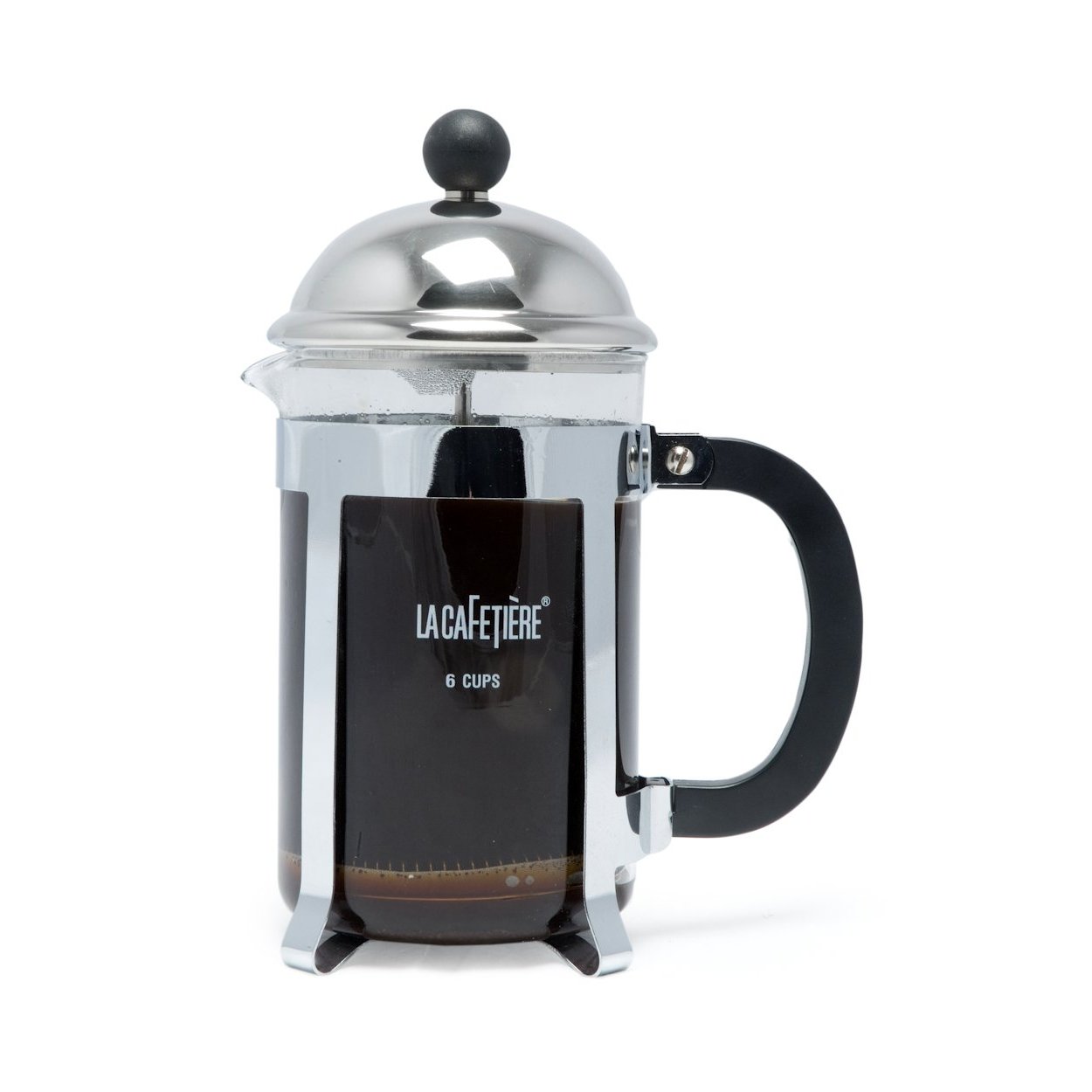
Coffee heat rising

Real Retro: The frugal virtues of never throwing stuff away (+ how to percolate coffee)

Retro is so in. The other day a Crate & Barrel catalog arrive in the mail. The stuff on the front cover and most of the furniture and tchochkies it advertised looked just like what my friends and I used to covet along about 1972. Couldn’t believe it: avocado green,  Hallowe’en orange, harvest gold, dirt brown and Marimekko are b-a-a-a-c-k! My mother used to say that if you wait long enough, sooner or later your old clothes and stuff you don’t want to throw away will come back into style. Guess she was right: not throwing stuff away turns out to be a frugal virtue.
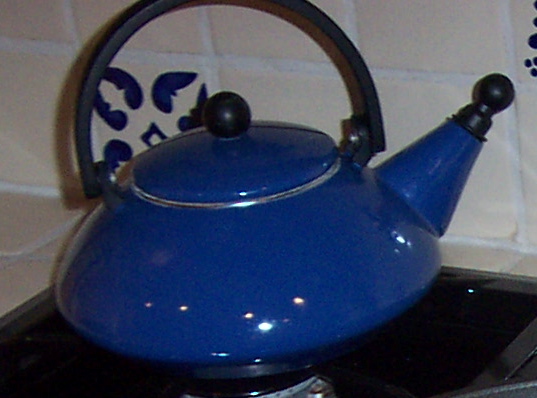
Case in point: my favorite tea kettle gave up the ghost last week. Our fine city water finally ate through its enameled surface and it started barfing flakes of rust into the French press coffeemaker.

I loved that kettle. It was bright blue and pretty and it had a LOUD whistle that would call me back to the kitchen no matter how absorbed I was at the computer or how distracted with some hassle out in the yard. It was perfectly balanced so it was easy to pour even if it was overfilled, and its handle and the strange little whistle stayed cool even if it had been left on the stove a little overlong.

They don’t make them anymore, of course. Manufacturers know when I like things. They have a radar system that picks up my “like it” vibes, and when they find out, they instantly take the item off the market. It’s true. Magic. This one came from (where else?) Crate & Barrel, purchased back in the day when I could afford to shop there. C&B doesn’t carry anything like it today.

Target has a few that are similar, but they’re too small and the colors aren’t as pretty. So I got onto Amazon and searched for tea kettles. Same deal: this thing is no longer being made, it appears.

However, at Amazon I happened to notice that people are buying a type of heat-resistant glass tea “kettle” that works on those accursed glass-top stoves and will also function on a gas stove. Hm. Customers don’t universally hate them, but some complain that they break, because their construction is rather thin. One of them is described, in the sales pitch, as “retro” in style. By that they mean “somewhat clunky.”

“Retro”? Glass? Glass pot?

Hey! I have one of those!

Matter of fact, I have two of them.
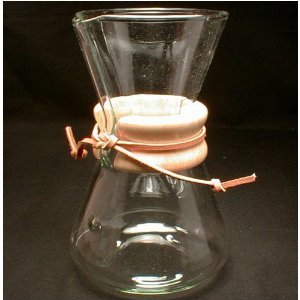
Back in the day—OMG, so far back that dinosaurs roamed the earth—I used to make coffee in a percolator. No one in this country had ever heard of a French press. You had three choices for making decent coffee: a Chemex drip coffeemaker (what a lash-up! literally—you tied a wooden collar around it with a length of rawhide so you could pick it up without burning your hand), a plastic cone that held a drip filter you set on top of a pot, or a stove-top percolator. The ubiquitous electric percolator didn’t make coffee—it made battery acid. And the early electric drip coffeemakers made roadside restaurant “coffee”…ugh!

I would percolate coffee, on the stove. And I was very, very good at it: I could make perc’ed coffee that was every bit as delicious as French press coffee. We’ll see how in a moment. First, though, the point: to do this, I used glass percolators made by Corning. I had two of them, a small one that held about four cups and a large one that would make enough for a dinner party.

At some point along the line, my ex and I started making coffee in a drip machine. They’d improved enough to make OK coffee, and with a kid and two dogs in the house, I didn’t have time to fiddle with elaborate coffee preparations. The glass percolators went into the back of some cabinet. And strangely, when I ran off with the harmonica player I chose to take those things with me.

Well. They make fine tea kettles, absent their percolator innards. Those can simply be lifted out and left in the cabinet. Check out the little one:
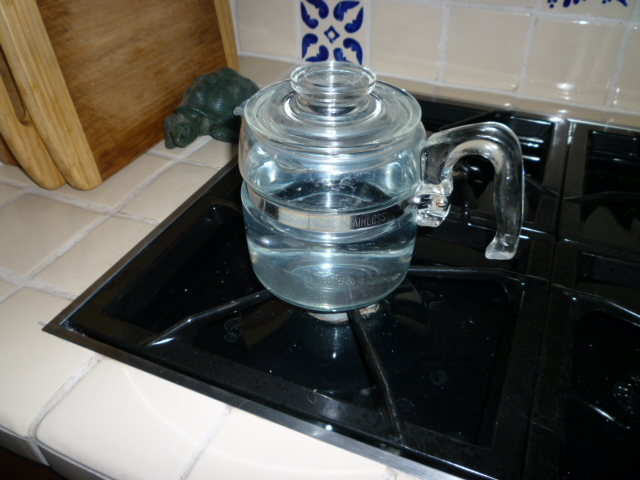
Retro? That is so retro it’s the real thing. And its sides are thick, solid Corningware glass. The only way you could break it would be to stuff it with ice cubes and then stick it over a burner turned to “blow-torch.” And see that handle that looks like glass? It’s some sort of clear plastic. It stays cool even when the pot’s contents are at a full boil.

Hot dang! I’m back in style again. And it’s not costing me a penny.

😀

Here’s a warning, however: Do not use Corningware and Pyrex cookware that is of recent vintage. To be safe, the product should be at least 30 years old, or sold in Europe. The stuff made in China for the U.S., Australian, and Canadian markets is prone to exploding, because they add soda lime to the glass, which develops tiny cracks when exposed to heat. Smart, huh? If they’re not trying to kill your dog, they’re trying to kill you. 😉

* * *

So…how do you make percolator coffee that doesn’t taste like battery acid? Well, there’s a trick to it. Goes like this:

Never, ever let a stovetop percolator come to a full boil. The water does not have to boil for the percolator to perc. It only needs to come to a rather slow simmer. If you let it boil, you get battery acid. That’s why electric percolators make such horrid coffee. If you keep the heat low, you get incredible coffee.

Fill the pot with enough water to come no higher than just below the percolator basket. It should not touch the percolator basket. You can use less if you’re making less coffee, but don’t overfill.

Put about a tablespoon of ground coffee per serving in the percolator basket. If you grind your own, it shouldn’t be too fine. Note that the percolator basket’s little holes are not all that little; finely ground coffee will fall through those holes.

Place the percolator on the stove over medium to medium-high heat. And now here’s the hard part, for us moderns:

Do not leave the kitchen. This is not something you can do while frenetically multitasking. You can cook the bacon and eggs, but you can’t wander off and get distracted.

Pay attention to what’s happening on the stove. Watch and, if the pot is opaque, listen. The minute the water starts to bubble up into the percolator’s little glass top, turn the heat down. Regulate the heat so that the water continues to perc, but just perc. If it stops percing, turn the heat up a little; if it percs very fast, turn it down. You’ll get the hang of it.

This is much easier on a gas stove. If you have to use an electric stove, you may need two burners, one turned quite low and another set to medium or medium-high to bring the water just to the percing point; move the pot to the low-heat burner the minute it starts to perc.

I don’t recall how long the process took. The number that sticks in my mind is four minutes. But it probably was longer than that…eight, maybe. Test it after four minutes, and if it’s too weak, let it perc another few minutes. I don’t think it takes very long once the water starts to perc. You can tell how strong the coffee is by the color of the brew that’s bubbling into the little glass thing on the top of the percolator’s lid

* * *

LOL! The Corningware glass pot heats very fast. Because it’s glass, it doesn’t impart any metallic flavor to the water for your French press coffee. If you can find one (a couple are available on Amazon right now), this gadget will put you at the height of style (again…). Just be sure they predate 1998.

I WANNA SPEND!!!!!

Spend, spend, SPEND! That’s what I wanna do.

Actually, it’s not quite that petulantly tantrumish. I’m coming to think that all work and no play is making Funny a very dull girl. One needs to have a little bit of a life. All I do now is sit in front of the computer, clean house, do the laundry, meet students, read copy, shop for food, and tend to dogs. I’ve become so tight with my money that I don’t drive unless I absolutely have to, I rarely go anywhere outside the immediate environs of my neighborhood and job, I don’t go to movies, I hardly ever go out to eat and certainly  not during the more expensive dinner hour. If it costs anything, I don’t do it.

My life has become cramped and crabbed.

It’s not like I’m THAT broke. I do put $200 a month aside in a savings account specifically for so-called “extraordinary” expenses: costs that fall outside my routine budget. And in fact, during the winter I never spend all the money budgeted for nondiscretionary expenses, so there’s always a one or two hundred bucks left over between November and April. Why am I clinging to every little penny? What is it about gazing at a number at the bottom of a Quickbooks column that’s so mesmerizing that it keeps me from doing anything else?

Comes in today’s New York Times an ad for this fall’s Chamber Music Society season. For $200, you get six concerts featuring nationally and internationally respected groups. OMG, here’s Chanticleer (!!!) and the Academy of St. Martin in the Fields Octet amd the Harlem Quartet and…Midori is coming here! That’s just $33 a concert, quite a bargain for any of these groups. And their venue is in a lovely little concert hall not far from my house, not way to heck and gone out at the Scottsdale Center for the Performing Arts, where they used to play back in the day when my ex- and I had season tickets every year.

Hmmm… For $75, you can go to an extra concert at the Desert Botanical Garden, which would be lovely.

However…the DBG itself has a series called “Music in the Garden,” which features performers in many musical genres. For $65, you can get a Garden membership and admission to those concerts for $15. You also get free admission whenever you want to walk around, free admission to the flashlight tours, 20% discounts on classes and gift shop purchases, 10% off on the annual plant sale, and reciprocal admission to a whole slew of other botanical gardens around the country, including—within driving distance—the charming Tohono Chul park in Tucson and the Arboretum at Flagstaff.

So, there you go: Get a season ticket to chamber music and combine it with a single-person Desert Botanical Garden membership and be entertained for a year.

Why not?

The Beside-the-Dumpster Exchange

Donna Freedman recently posted a fun article about rescuing various goods from dumpster oblivion. A horde of readers commented on everything from the riches to be had to the ick factor to ecological correctness. The impulse for discovering hidden treasures in the trash is strong!

Here in the neighborhood, we have what can best be called a “beside the dumpster exchange.” Got something you wanna get rid of but it’s too big to easily haul to the Goodwill? Drag it out to the alley and let it sit by the dumpster. By nightfall, it’ll be gone.

Especially if it contains metal: metal scavengers patrol the alleys here and will take anything you leave out for them.

But it’s not just down-at-the-heels guys trying to crank a few bucks to buy some more crank. The neighbors take the stuff.

I know which neighbor took the barbecue I left out one time, because it was easy to track the trail left down by the wheels as he dragged it to his yard. It needed a HUGE cleaning job…but if a person was willing to take a lot of time and plow through a gigantic mess, it was a pretty nice ’cue. Later, I found a cool framed print beside a dumpster, still in its packaging.

It’s become a kind of ad hoc Freecycle: We don’t want it—please take it! You don’t want it—we’ll take it.

For years, my neighbors across the street had a yard sale business. About every three or four months, they would drag out piles and piles and piles of stuff. Put a couple of signs at the main drags, and hordes of folks from the surrounding barrios and slums would descend on our street. Each sale brought in hundreds of under-the-table dollars.

They built their stock in two ways: by haunting yard sales, where they haggled prices way, way down; and by scavenging in the alleys. They found some pretty nice stuff in the alleys, some of which they sold for decent prices.

When you visited their home, you discovered they’d scored quite a few nifty decor items. Under the back patio cover, they created very pleasant outdoor room with yard-sale furniture and an old TV set—she told me it didn’t matter if rain got on the stuff, because they didn’t pay anything for it.

Moments of Fame

Squirrelers hosts this week’s Festival of Frugality, and kindly includes Funny’s squib on signs of life in the local real estate market.

Veggie Cook-a-thon!

Don’t know where I stumbled across this idea—Atlantic online, maybe? NY Times cookery sections? Somebody’s blog??but it stuck with me: when you find yourself with a bunch of veggies, whether because you got a lifetime supply from some warehouse store or because your garden produced a bumper crop or because some friend showed up at the door with armloads of produce from his own garden, COOK IT NOW.

And the easy way to cook it?

Roast it.

During the holidays when I fell heir to branch after branch of wonderful fresh Brussels sprouts from the All Saints Silent Auction, whereinat we submitted a fine donation of The Copyeditor’s Desk’s time, I overhead other partiers remark that they would roast their veggie loot and it would be wonderful. So indeed I did cook the sprouts in the oven. The result was pleasing enough.

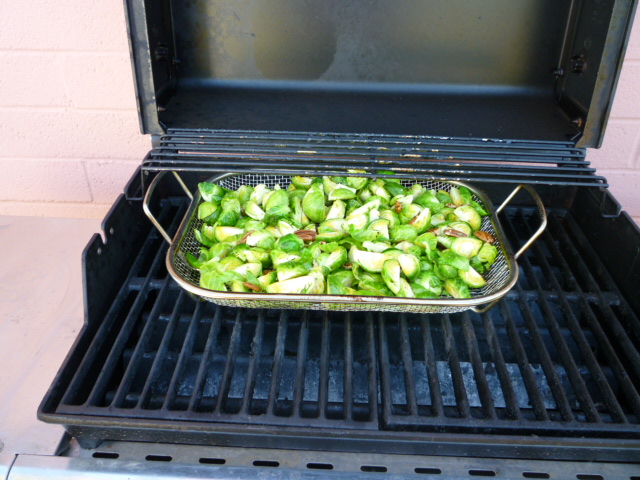
Weather being somewhat nicer just now, I decided to try cooking a Costco Lifetime Supply of bagged Brussels sprouts in the propane grill.

Dumped them out of the bag into a mixing bowl; added some pecans. Then sprinkled a little olive oil over the mound, tossed well to coat, and spread everything in a wire grilling basket.

Preheated the grill to about 400 degrees; then turned the heat down to “medium.” Set the veggie/pecan mix in; let it cook a few minutes; tossed them around and then let it roast until done. The result is a kind of barbecue al dente. Very tasty on its own. Even better when you add other items, such as chopped roasted peppers or fresh herbs or minced green onions.

The logical thing to do here is to divide the cooked veggies into  meal-sized portions, pack them in Ziplock bags, and freeze. Then when you need a serving of (fill in the blank: sprouts, asparagus, carrots, broccoli, cauliflower, squash…etc.), pull it out, add whatever blandishments you please, and enjoy!

Strange Little Money Habits

Yesterday at the weekly networking meeting, I sat next to one of the younger members. Every week we have a drawing: we all put in a dollar and take a ticket. If your number is picked, you get the pot.

All I had was four quarters (one of them turned out to be a 100 yen piece…), which I tossed into the basket. The young man next to me abstained, saying he had no cash. I remarked that I never carry cash, and he said he didn’t, either.

If I don’t win the pot (which I didn’t) I will have no cash for the next week, unless I go out to lunch with a friend, put both meals on my credit card, and get the friend to reimburse me in dollars. He said that was true for him, too.

LOL! I was surprised to run into a young person who doesn’t haunt ATMs. I refuse to use the things, largely because I don’t care to pay for the privilege of taking my money out of the bank.

But the real reason for this odd habit is that cash sifts through my fingers like sand. Back when I did use ATMs, I’d take $50 out in the morning and by evening it would be gone! And I would have no idea where it had gone. It would just disappear.

Having to go to the trouble of taking out a credit card (breaking a fingernail in the process), swiping, and signing is just aversive enough to make me think twice about purchases. Buying in cash is just too, too easy, I guess.

So, for me, not carrying cash is a frugal habit.

Well…there’s also a bit of self-defense there. The ATM I used to habituate was located behind a sky-scraping bank building, facing an open multi-story parking structure. Often I would go there after hours and on the weekends, when there was no one around. It wasn’t all that long after ATMs were introduced, and people were only just beginning to realize that when you went up to an ATM and took out money, you made yourself an obvious mark for muggers. It occurred to me that anyone could stand inside that parking garage, watch for people to drive up, and then approach you from behind as you focused on trying to make the machine work.

So I quit doing that.

My friends and son think I’m nuts for not having cash on me at all times. What seems to me to be a “frugal habit” strikes them as a “strange habit.”

What strange little money habits do you indulge?

Do You Really NEED It?…

…Or can you use what you have, wear it out, make it do, or do without? Have you noticed that we’re surrounded by things that we think we need, but that we could easily live without? Some of those are expensive don’t-needs.

The example that comes to mind is my clothes dryer. The thing has been on the fritz for at least a couple of years now. Its thermostat apparently died: on any of the heated cycles, the machine gets so hot it will burn your hand, clearly creating a fire risk. I’ve never replaced it, mostly because I can’t justify a $300 to $600 hit for a new dryer.

Instead, I strung a few clotheslines from the rafters under the patios, and on laundry day I simply hang my clothes outdoors. Not long after I started doing this, I realized I much prefer drying clothes on the line.

It frees you from the nagging b-l-a-a-t of a dryer buzzer going off every twenty minutes.
You get to put your clothes away at your convenience, not at the dryer’s.
It saves on electricity.
It’s better for the environment.
And line-dried sheets smell wonderful!

And it saves the expense of having to buy a big-ticket appliance.

The dryer still works on air-dry, so I occasionally use it to tumble dog hair out of Cassie’s blanket or to whack out the wrinkles in my jeans. But otherwise…it turns out I don’t really need a dryer! All the laundry has to be taken out, hung up, folded up, and put away anyway. So why not take it off a clothesline at my convenience, rather than hurry to haul it out of a machine every time a buzzer goes off?

Not too long ago, Sierra Black ruminated on the same topic at Get Rich Slowly, when she reported that instead of fixing a showerhead whose temperature control device quit working, she simply turned down the thermostat on the water heater. She reflects that frugality is about making choices—in this case, between taking weekend time to fix the plumbing instead of spending the time with the kids, or between paying a plumber to fix it instead of using the money on yoga classes or a family camping trip.

I wonder how many amenities that we’ve come to take for granted are really things we could do without? And to what extent do some of those “conveniences” actually represent more hassle than we realize?