By dawn’s early light
A magenta trumpet blares
Springtime cactus bloom

The only thing necessary for the triumph of evil is for good men to do nothing. ―Edmund Burke

By dawn’s early light
A magenta trumpet blares
Springtime cactus bloom
Good grief! This winter’s El Niño rains have so over-excited the cat’s claw that it’s decided to take over the swimming pool.
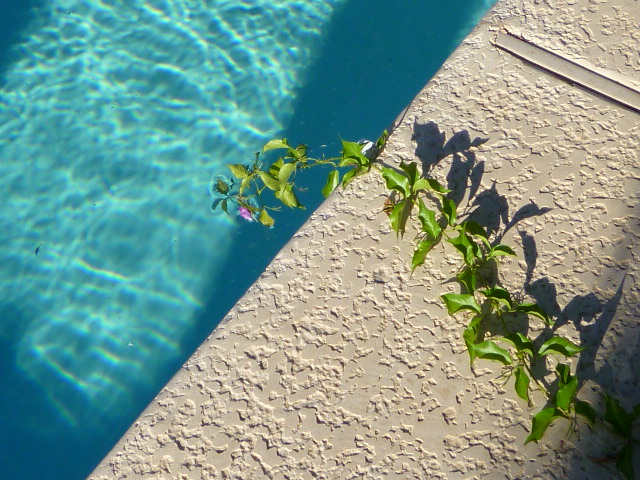
The hanging garden that inhabits the back wall and adds about three feet to its height—quite spectacular at certain times of the year—has sent out a battalion of tendrils, which are marching steadily toward the pool. This one is especially bodacious. It’s grown about an inch a day, and today it made it into the water.
Amazingly, the chlorine doesn’t seem to be harming its growing end. It has a certain weird charm, but it can’t be allowed to keep that up. Besides not being very good for the pool’s chemical balance, cat’s claw is named for its sharp claw-like appendages with which it grips rock and masonry. It can do a fair amount of damage to masonry, and so one would not like to have it residing on the CoolDeck, which is porous, fragile, and prone to staining. As soon as I crawl out from under the avalanche of work that’s landed on my head, I’ll have to get out there with a pair of scissors and cut the plant back.
Meanwhile, it’s mildly entertaining just to let it grow and see what it’ll do.
Uh-oh…

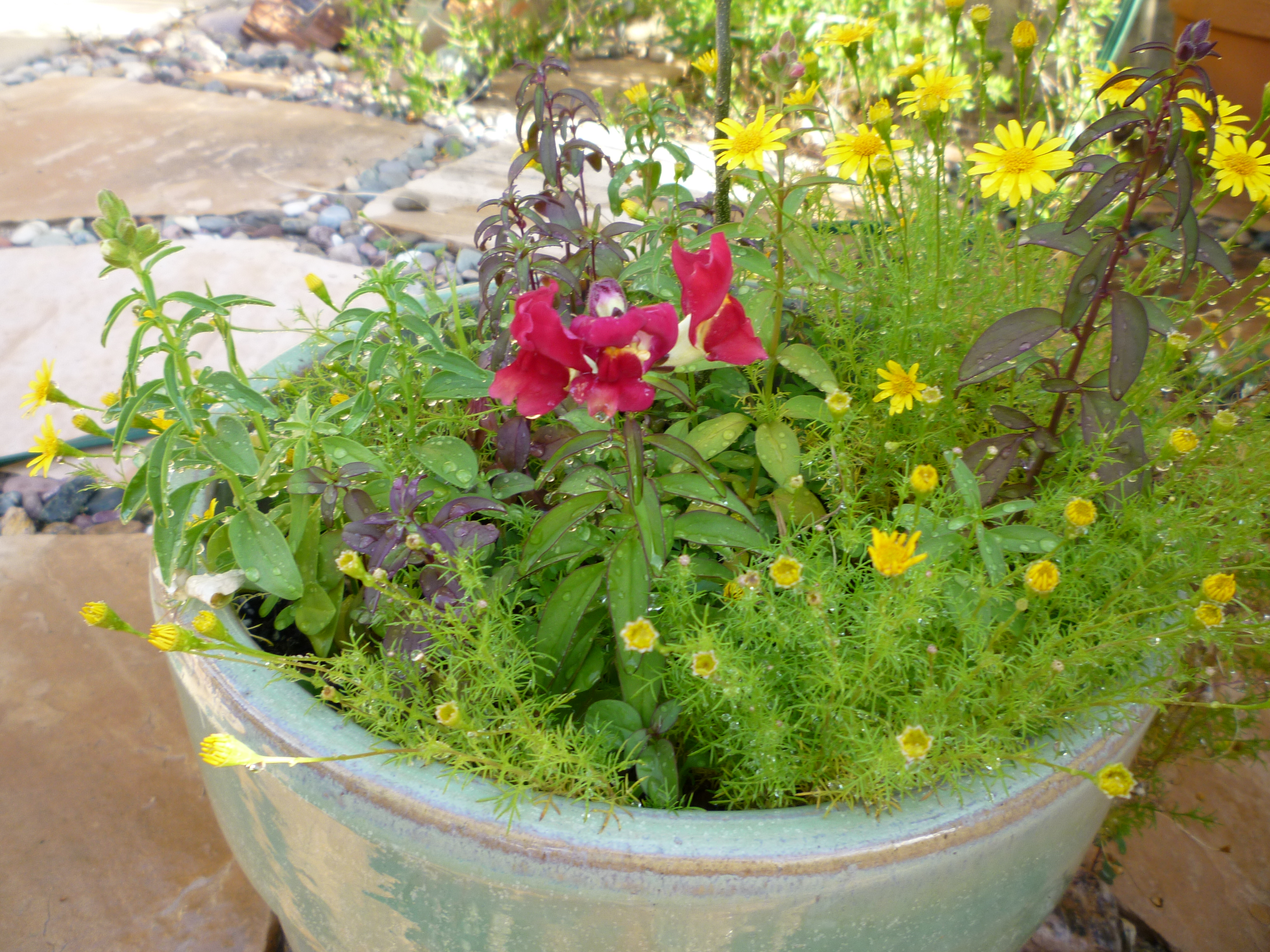
Does anyone know what this pretty little plant is?
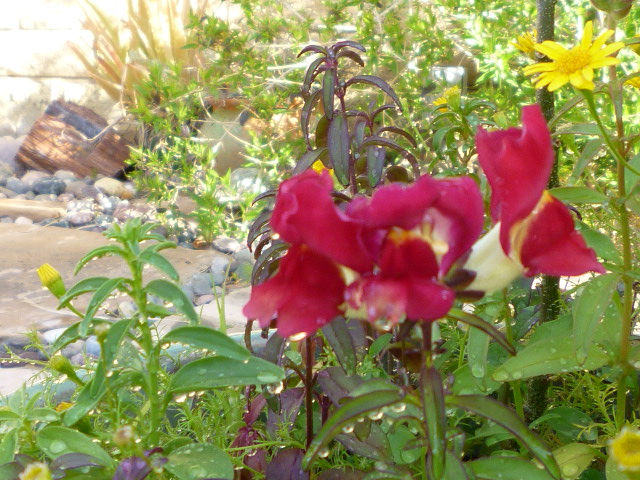
Here’s a better picture of it, in the pot where it volunteered. Click on the image for a larger view.
A flurry of these things popped up in the El Niño rains this spring. I thought they were weeds and was about to extirpate them, but the seedlings are so pretty I relented and decided to see what they’d do. As fresh young babes, they have striking foliage: deep green trimmed in red. Here’s some that volunteered between the flags in the courtyard.
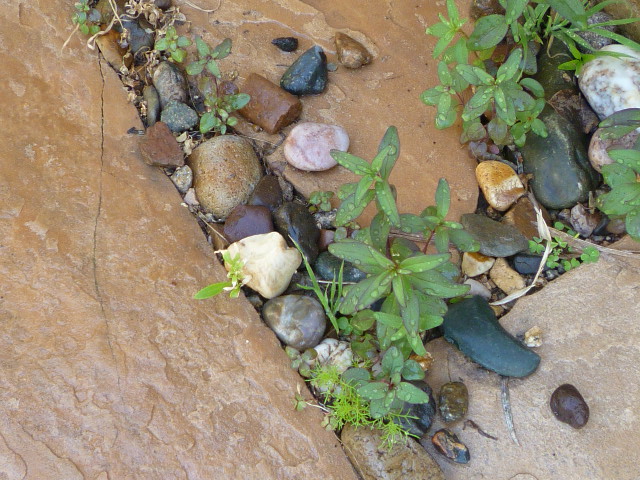
When they were younger, they had more red on them. It’s hard to see, in this picture, just how much red they have around the outside of the leaves and the stems.
Anybody know what it is?
After this morning’s inauspicious start, I ended the day feeling pretty good. Mighty good, as a matter of fact.
The roses have been looking peakèd, mostly because I’ve neglected them shamefully. They’ve hardly blossomed at all over the past couple of years. The ones in front are planted in rock-hard caliche, and even though they’re somewhat protected and have drip irrigators, they don’t get enough water. They suffered terribly through last summer’s endless spate of 118-degree days. The ones in back get either too little sun or too much sun, and they also haven’t been watered adequately.
The other day I happened to look over the vast collection of old pix in iPhoto, most of which feature the beautiful little flowers that have grown around my house in the past. Where have all the flowers gone? I wondered. Aside from a couple of cacti, no flowers have blossomed in the yard for a good year. On reflection, I realized I’ve been so depressed I haven’t felt like fooling with them. I pulled up the last of them when they ran out of juice, and that was that.
Also deceased: the vegetable garden, which was planted in large pots full of potting soil and compost.
It occurred to me that while I was pruning the roses, I could scrape back the gravel that sort of serves as mulch (and also covers the ground with stuff that doesn’t have to be watered), mix some fertilizer into all that dried-out potting soil/compost, and dig it in around each plant. This would serve to loosen up the hard soil at the same time as it would feed the roses.
This was quite the project: there are five rose plants in front, one of them with a cane as high as the eaves. Every summer a cactus wren builds a nest in this resurgent cane, and I so always feel bad about pruning it back. She doesn’t seem to mind, though: she just brings new twigs and weeds and rebuilds.
After I finished digging the fresh soil in around the four plants closest to the house, I realized that they reside along a slightly inclined plane…and that if I were to dig small trenches connecting their watering basins, I just might manage to water more than one of them with a single hose-drag. Maybe several of them. Hm…maybe even all four of them.
So, with great shoveling, dragging, and mounding of gravel, I finally got these little ditches built.

Because I got such a late start, it was about dusk by the time I reached this stage. That rose on the far right probably can stand some more pruning, but not today… When I put the hose on that plant and turned on the water, what should happen to my delight but within ten or twelve minutes, the water flooded all four rose basins!

What started out as an exercise in laziness—I didn’t want to have to move the hose four times to water the plants—turned into a nice little coup de frugalité. Not only does this require only one hose drag, it deep-waters all four plants in under fifteen minutes, with the spigot barely running. Ordinarily, to water these four plants, I have to move the hose to each basin and let it run about fifteen minutes per plant.
This will represent a significant saving, not only in hassle factor but more importantly in water! So, it was a nice discovery to stumble upon.
Yes, the roses do have drip irrigation, but for that system to work, you have to let it run six to eight hours a day, several times a week. Think of that! It’s like having four faucets leak, all day long, every two or three days. Experience shows that, ballyhooing be damned, drip irrigation saves nothing on the water bill and in fact often runs it up. It’s arguably more economical to take the hose out and water the plants by hand.
Now, it must be allowed that this arrangement leaves something to be desired in the aesthetics department. However, I have a plan.
First, move the hose pot that’s outside the courtyard wall out of sight, to the other side of the wall’s wrought-iron “window.” Then shovel out the gravel behind the plants, between the rose basins and the wall. Use that to fill areas where the gravel is thin, in other parts of the yard. Dig up the hard-pack soil, turning some more compost into it.
Then line the curvilinear border along the front edge with river rocks, easily obtained by walking up and down the neighborhood alleys. This will help to keep the gravel from working its way back into the planting bed. Possibly mulch with forest bark, creating a delineated planting bed that looks like I actually intended it to be there.
A friend gave me some seeds from her hollyhocks for Christmas. I’m thinking it would be neat to sow those in behind the roses, something that will be made possible by shoveling out the gravel. Hollyhocks don’t last long in the low desert, but they will grow here and blossom in the spring. Some bulbs would be nice there, too. Anemones, lots of anemones…
The sum total of the rose crop this fall filled three old bottles pressed into service as bud vases, shown here with Rosie the Dancing Rat, who resides on the dining-room table…

and one impromptu bud vase in the bathroom…

I hope there’ll be lots more in the spring.
How does the Devil-Pod Tree add work to my life? Let me count the hours…
The late great shamal made a fine mess of the pool. Yesterday I spent several hours shoveling out leaves, pods, pollen, and dirt, another hour running to the pool store and dropping $30 on shock treatment and a new skimmer basket (the old one having cracked under the weight of all the gunk it collected!), more time applying said chemicals. Tomorrow I’ll have to backwash and recharge the filter, now that the dirt, dust, and pollen have lodged themselves in the filter.
Ah, yes, the Devil-Pod Tree, named in honor of the house’s feckless previous owner, Satan.
Satan and his fabled wife Proserpine betook themselves to Moon Valley Nursery, the used-car lot of the arborist bidness, where they succumbed to that worthy organization’s time-honored move-it-off-the-lot package: six trees at a stupidly low per-tree cost. Or so it seems. “Stupid” is the term best suited, however, to the buyer. Five of the six trees were totally unsuited for the places where S & P wanted to plant them. A ten-minute Google search would have revealed this, had our happy homeowners been gifted with the faintest intellectual curiosity.
Moon Valley fibbed baroquely to Satan and Proserpine; either that, or those two lied hilariously to me. Whatever. Doesn’t matter. The result was the same: someone (read “moi”) had to get rid of the junk shrubbery.
A few months before they put their house on the market, Satan and the lovely Proserpine purchased two young sissoo trees. They believed, or said they believed, that these monsters would never grow much larger than the ten feet or so to which they had aspired by the time I came on the scene.
Sissoo trees can reach 60 feet in height. The canopy grows to 40 feet in diameter. It is a thirsty plant, requiring weekly deep-watering. Its roots will lift sidewalks and heave foundations. It propagates by root suckers. Satan and Proserpine, apparently believing the fiction that these were modest little things, planted two of them side-by-side in the front yard.
Good move. Better move: I had these pulled out when I relandscaped the front yard.
Then they had Moon Valley’s barely paid crew plant an exotic pine tree, which they believed to be petite and noninvasive, directly next to the eastside wall. Another good move: this thing rises to a good 40 or 50 feet and gets far too large to fit into the space between the house’s east wall and the public sidewalk. I had that critter removed, too. Replaced it with a Texas ebony. It bites, but it doesn’t heave the foundation.
Then they planted two willow acacias, an unbeautiful import from Australia described by the most recent arborist to visit the property as “not recommended.” This is the plant that has richly earned the name “Devil-Pod Tree.” Satan calculated the direction and velocity of the Sonoran desert’s prevailing monsoon gales and then planted one of the damned things directly upwind of the pool.
The Devil-Pod Tree drops seeds that deposit yellow stains on the pool’s plaster. Its long, strappy leaves clog the pool cleaner. And its UNHOLY yellow fuzzballs fly into the pool, where they demonstrate that they are heavier than water by sinking to the bottom, there to be lapped up by Harvey the Hayward Pool Cleaner, who straightaway delivers them to the pump pot.
Dare to try to collect them in the water-driven hose bonnet, and you shiver them apart into zillions of tiny pieces, which explode into the water like dust in the air only to settle back on the bottom in multizillions of tiny particles. Either way, when these things are sucked into the skimmer basket and the pump strainer, they clog the system with a vengeance. Let them get through those two barriers, and they fill up the filter medium, presenting the homeowner with the immediate pleasure of a backwash job.
It is, in short, a nasty tree.
Satan and Proserpine planted two of them, one next to the pool and the other over on the west side, where it could threaten to crash down on the house whenever a stiff breeze comes out of the setting sun. These trees are as brittle as eucalyptus, and every bit as capable of shedding large, roof-shattering chunks.
The tree that has grown by the pool is actually not unaesthetic, as willow acacias go. It’s relatively shapely and it casts some nice shade on the patio. None on the house, alas, but some on the concrete. That’s not bad, because a slab of concrete accentuates the effect of a 115-degree day by radiating heat into the adjacent foundation and onto the wall of your house, jacking up your air-conditioning bills commensurately.
Nevertheless. Every time I have to spend upwards of an hour cleaning its mess out of the pool, I think it needs to go.
Then there are the damnable palm trees.
What on earth possesses people to plant palm trees???? What is the appeal to these hideous, filthy, roach-ridden, termite-attracting sticks? They are the filthiest goddamn things! And they require annual trimming, to the tune of $50 to $100 apiece, depending on whether you can find an undocumented immigrant to do the job or whether you’re forced to hire a recently released American ex-convict.
These little gems drop rock-like seeds into the pool, there to break your pool cleaner. This happens after they have released several million sharp-edged nasty little flower things to clog the filter. The tree trimming guys hack this stuff off in the late spring, along with enough of the canopy to totally eradicate what little shade the ghastly things might have cast over your pool and yard. Soon enough, they shoot up some more flowering rods, which drop some more razor-edged blossoms and rock-like seeds into the pool. In the course of trimming off fronds, the tree guys leave behind large, shield-shaped attachments, which sit on the trunk and dry up. Comes the next stiff breeze, these huge, dirty, thorned nuisances blow off and alight in your pool and all over the street. You as the homeowner get to pick up all this filthy debris.
Cockroaches adore palm trees. If you have a palm tree or two, you will have roaches. That’s why you’ll observe handsome and active Gila woodpeckers working the trunks and canopies: they’re gorging themselves on fat little snacks.
Desert termites like palm trees, too. Late in the summer these charming creatures swarm, much like their cousins the ants. They build mud nests on the sides of these palm trees, temporary homes where they reside while deciding which human shack to settle into.
The various previous owners of the House from Hell have planted not one, not two, not three, but FIVE palm trees around that pool.
So. What we have here are six exceptionally messy trees discharging trash into the already plenty workful pool.
My desire, if not my plan (only because I can’t afford my desire), is to uproot all six of them. Replace the hated acacia with an emerald paloverde, itself a moderately messy creature but as nothing compared with the incumbent. The two palm trees might be replaced by a Swan Hill olive, if there’s a way to determine how aggressive its roots are around an underground pool.
All trees, of course, drop one thing or another, and usually several things. But palm trees as poolside foliage are a mystification. And the willow acacia: nonstop horror show!
Removing them? $$$$$$$
Daytime temps are still in the nineties and hundreds here in lovely downtown Phoenix, but evenings and mornings are delightfully cool. It’s time to get ready for winter gardening, lhudly sing huzzah!

Accordingly, I spent large swaths of Friday and Saturday pulling out dead plants (quite a few fricasseed during this summer’s unrelenting heat) and then digging compost into the flowerbed by the pool. The only two survivors there are a venerable thyme plant and the rose. A blue plumbago volunteered just on the other side of the planter’s border, and since it’s a pretty plant, I’ve let it grow. It made it through the summer, singed but unbowed. To some degree, it may have protected the rose by growing into and over it. I had to cut back a fair amount of plumbago to disentangle the rose plant.
For this fall, I decided to dispense with most of the pots. The whole idea of gardening in pots has morphed into a gigantic hassle, one that had me dragging water hoses around a third of an acre every single day, allllll summer long! Enough with that! I’m going to keep one pot for some bush peas, but otherwise, no more misguided efforts to grow vegetables in pots.
The magnificent, hardy Swiss chard I grew last winter, which didn’t bolt to seed until well after the hot weather arrived, was an heirloom variety that I’d picked up on a whim at Whole Foods. It’s way up there among the most successful veggie crops I’ve every tried to grow. So, as unlikely as Whole Foods seems as a gardening supply shop, I decided to drive back up there in search of more chard seeds and this time to look more seriously at their offerings.

They had a lot of interesting seeds. Some of the most intriguing were sold out. Fortunately, I did manage to find the beloved chard and so bought a couple of packets. I found some red romaine, which looks very pretty but which may be frost-sensitive. We’ll find out, come December. They also had some radicchio, which I enjoy but usually can’t afford at the grocery store.
The peas are an heirloom variety. The packet says they need no staking and that you’re supposed to plant them two inches apart…and “do not thin.” That’s rather amazing. Because the planting bed is so tiny and the soil isn’t very good, my plan is to salvage one of the large pots from this summer’s failed experiment, put it next to the poolside bed where I can easily reach it with the hose, and use that for the peas. And probably put a few seeds in the ground, too.
There’s still so much gravel in that flowerbed that I decided to forego the root crops this year. Much as I enjoy beets (especially) and carrots, the dirt is so rocky and poor they just don’t grow very well. And they don’t seem to like growing in pots, either. Every time I try to cultivate that garden, I dig out more of the damned stones that Satan and Proserpine dumped in there, but every year more of them work their way to the surface. Leafy plants seem to do OK there, but anything that needs to grow plump underground…forget it!
Much work remains to be done. I need to find a way to prop up the Meyer lemon’s limbs, which once again are so laden with fruit they bend to the ground. Realized this could be done with lashed-together tripods made of wood scraps; this will require me to disassemble an aging trellis and saw the sticks to size. Good exercise…
Then I need to get rid of the two roses that have never thrived in their place on the north side of the backyard wall. It’s too shady there for them in the winter and too hot in the summer. A hibiscus presently occupying a pot can go there…one more pot disappeared!
Yes. The pots are going to get gone. The little westside deck is overrun with potted plants, all of which also have to be watered every single day, all summer long. What I think I’d like to do is make a single arrangement around one especially nice plant, sort of a set piece, and then get rid of all the rest of them. Same for the tangle of plants outside the back door.
That’s not all that needs to exit.
Then I’ve got to get an arborist in here. The trees in front have run amok, despite my determination not to put much water on the xeric numbers. They need to be pruned by someone who knows what he’s doing. Most of the yard guys want to turn them into basketballs, which ruins them.
The big palo brea, in its drive to take over the planet, has become a menace to navigation. Some woman showed up at my door a few weeks ago offering to trim it herself and drag the cuttings into the alley. She said her dog had pulled her into the thorny overhanging brush and scratched up her face. So I had to get Gerardo to try to cut it back, in the process of which he gouged off a big limb and left a huge open wound on the even bigger limb to which it was attached. I’m sure it’s weakened that part of the tree, leaving about a quarter of the canopy vulnerable to snapping off in next summer’s monsoon winds.
Even though it’s a beautiful tree, I may have to have it removed. In the effort to build a screen between my front window and Dave’s Used Car Lot, Marina, and Weed Arboretum, Richard (landscaper) planted way too many trees and bushes that have grown way too large. Inside the courtyard, the Swan Hill olive tree has now grown plenty big enough to suffice for a frontyard specimen tree. Without the palo brea, the huge vitex could fill out better and be just fine for the area outside the wall. It makes beautiful blue flowers, and it has no thorns with which to take out the eyes of passing dog walkers.
Richard said he would remove the dead ash tree at large expense, but so far no sign of the guy. He wants a thousand bucks to do that and relandscape the area that will be destroyed by the loss of the tree. I really can’t afford that at this juncture, but neither can I leave a dead tree snag out there. Besides looking awful, sooner or later it’s likely to break and fall onto the house. If the neighbors don’t get the city after me first.
So these projects are really going to eat into my survival fund, damn it. I don’t know what I can do myself, though. The pruning is a bigger job than I can even begin to do, and the front is hideously overgrown. I can’t afford a lawsuit from some passerby who gets poked in the face by that palo brea, nor the increase in homeowner’s insurance if the dead ash tree breaks off and trashes the house. Ugh! The joys of homeownership.
Well… If I sold the house I’d net about $250,000 (if I’m lucky…one of La Maya’s neighbors has put his house on the market for about $100 a square foot, which would depress the sale value of my house to about $186,000—or less, since she’s in a higher-priced part of the neighborhood). Investing $250,000 and taking a 4 percent drawdown would give me a munificent $833 a month to cover rent payments. And that sure wouldn’t buy much! Eight hundred bucks will buy you a hole in a rabbit warren around here, so solidly built that you can hear the upstairs neighbor widdle every time he goes to the bathroom. Amazingly, apartment buildings around here don’t even have fire walls—recently a fire started in one upscale Scottsdale rabbit hutch and gutted eight adjoining apartments.
Probably having the palo brea removed, as painful as that would be, is the better part of valor: one fewer thing to have to take care of. The vitex can run amok without doing much harm, and with just the olive, the desert willow, the Texas ebony, the two weeping acacias, and the paloverde to get pruned… Uhm… “Just”? How on earth am I ever going to afford to live in this place without a $65,000 income? Social Security just isn’t going to cut it. LOL! Literally!!
Ohh well. At least this winter the backyard will be full of oranges and lemons, and there’ll be so much chard by the pool I won’t have to buy groceries.