
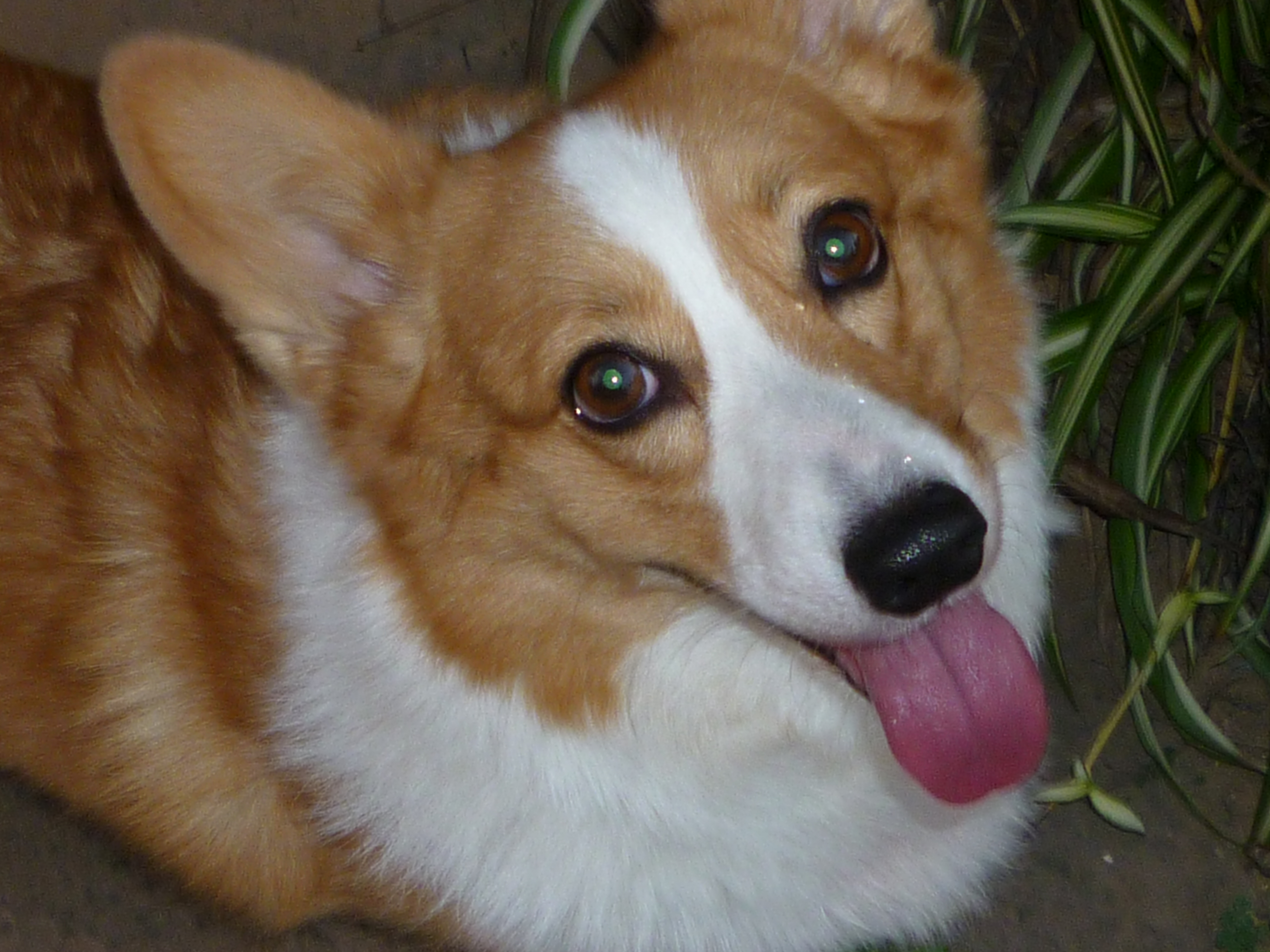
 Her Holy Highness The Queen of the Universe has been more than usually imperious of late. She’s developed a limp, and because she desires not to walk around the Castle, she barks at the Slave to come to wherever she happens to be. Usually the command is to pick up a ball and toss it (gently) for her delectation. Sometimes, however, the desired behavior is unclear.
The Slave, a.k.a. the Human, a.k.a. the Queen of Sheba, undoubtedly communicated the wrong message to Her Holy Highness today, elevating her beyond the level of mere Queen of the Universe to Empress of All Time, Eternity, and Hyperspace.
Yesterday the Slave slow-cooked a mound of pork for Her Highness’s delectation. It was too hot to food-process into manageable choppings, and so it was spread out upon a dinner plate, covered, and set inside the fridge for future reference. This evening, having presented the last of the chicken to the Queen of the Universe in the morning, the Slave ran the chilled, exceptionally greasy meat (dogs Queens like grease. A lot!) through the food processor. This left a special treat: a lovely plate smeared in grease and meat leavings, something Her Highness regards as quite the delicacy.
So the Slave piled up Her Highness’s dinner on said plate, so as to present both the Royal Dinner and the Royal Delicacy in one fell swoop. A rather silly exchange ensued:
Slave: “Here’s your dinner, Cassie…”
Majesty: [wag!]
Slave: “You good dog, you!”
Majesty, internal monologue: “Now what brought that on? Must have been the imperious barking at the miserable, lazy creature. Interesting. It likes to be barked at. After this, lots more barking!”
{sigh}
The Slave has been eating like the Queen of Sheba, and so it deludes itself that it is the Q of S.
I picked up a pound of spectacular wild-caught salmon at Sprouts yesterday — four meals’ worth! — and this evening decided to grill a piece deliciously over the backyard BBQ. Dinner was simple: the magnificent salmon with a lush salad of crisp greens, crunchy carrot, lovely blueberries, zingy scallions, buttery avocado, and tasty walnuts. And it was marvelously luxurious in its simplicity.
Diet? What diet?
In all this disappearing of 25 pounds over the past few weeks, the Queen of Sheba has never gone hungry. And most of the time what I’ve had to eat has ranged from very nice to incredibly delicious. Tonight’s dinner fell into the latter category, thanks (I believe) to the “less meat but LOTS better meat” strategy.
Meanwhile, the Queen of the Universe and Empress of All Existence beckoned.
The Queen of Sheba Slave parked itself in front of the television to scarf down its chow in front of Antiques Roadshow, something it apparently favors because it itself is an antique.
Her Majesty deigned to carry Ball into the room, by way of getting the creature’s attention.
That’s when I noticed that for the second night in a row, Her Highness is limping badly.
Last night I thought she must have pulled a muscle chasing Charley the Golden Retriever around. Or trying to protect him: believe it or not, she FAKED A BITE at my son when he was hauling Charley into the pool.
Charley doesn’t exactly like going into the drink but he will try, unhappily, to climb onto the steps when the humans are in the pool. Also we discovered that the only time he’ll hold still to have his tail combed is when he’s petrified in the water.
 While he and his human were camping, he managed to build a large mat in the beautiful flag-like fringe that is his tail fur. M’hijito didn’t know what else to do but take a pair of scissors and cut it out, thereby destroying some of Charley’s roguish beauty. The Slave, having been a young girl with long hair and a fierce mother sometime in her remote past, realized that the mat could probably be teased out with a hair pick and a comb, if the hound could be made to sit still long enough. Hence: the Hair Salon on the Pool Steps.
As M’hijito was lifting Charley into the pool for a second or third dip and he was trying to make himself heavy by way of resistance, Her Highness took a running whack at the offending human. That was a surprise!
It took about an hour to tease the tangles out, but eventually it worked. And it really, really, REALLY annoyed the Queen of the Universe. Mercifully, she didn’t break skin (only because she apparently didn’t intend to). But she certainly got the attention of the Slave and Charley’s Human.
At any rate, while Charley wasn’t being groomed in the pool, Her Highness was chasing him around the yard. Hence, I figured, a pulled muscle or strained ligament.
This evening, though, I found a big scrape hidden under the thick fur on her leg. it runs from below the “elbow” joint almost up to her shoulder.
Poor little Queen! No wonder she’s limping.
So now her leg is slathered in antibiotic ointment and wrapped in bandaging, presenting an amusing challenge to Her Highness: she’ll have all that off by morning.
Don’t like to see her hurting enough to limp (one critter in the house doing that is enough!), but am sorta glad it’s an actual injury, probably the result of skidding through the gravel in pursuit of Ball, and not arthritis or a dislocated joint. In a few days it will heal and then she’ll be back to normal. Hopefully a less barkifarious normal.
Never a dull moment here in the Queendom!


