M’hijito sends a photo of his Intended Puppy, below.
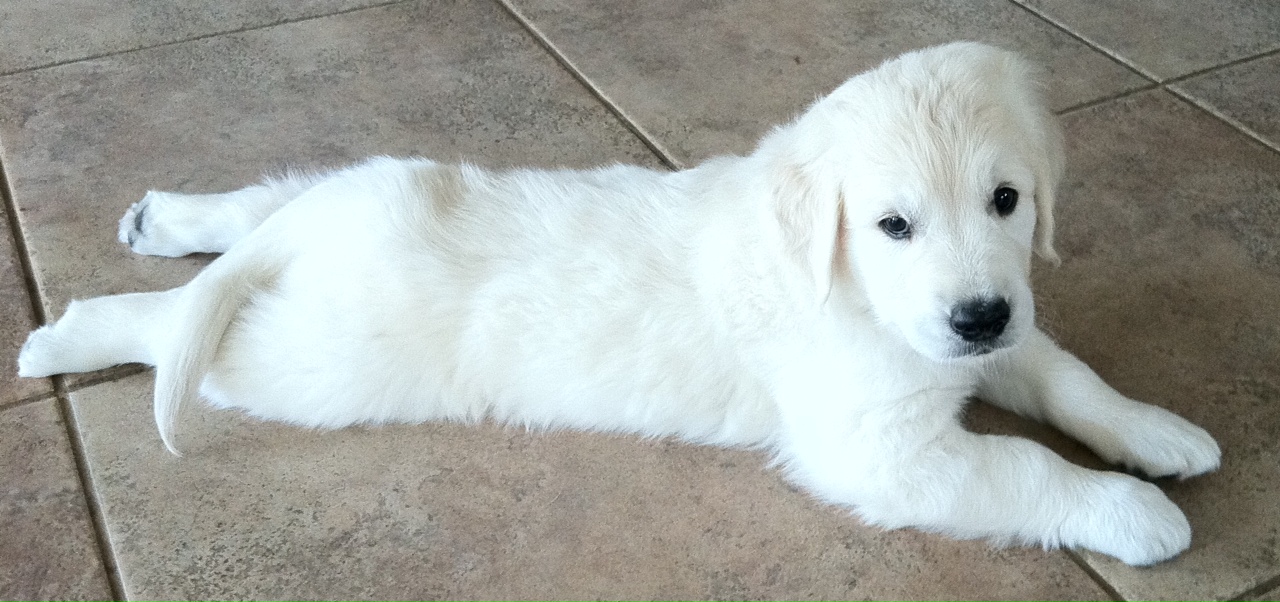
Ain’t he cute? He comes home to M’hijito’s house next weekend.
The only thing necessary for the triumph of evil is for good men to do nothing. ―Edmund Burke

M’hijito sends a photo of his Intended Puppy, below.
Ain’t he cute? He comes home to M’hijito’s house next weekend.

OMG! I think the German shepherd lady just moved out!

Not for certain yet… It was on the late side of mid-afternoon when I drove into the neighborhood and spotted a BIG-a$$ Bekins truck parked out in front of the house where the late, great crime occurred. Whichever way the movers were going, they were about done, and so there was no action. So I couldn’t see whether they were carrying things in or out. But because several brand-new, unused boxes were leaning against the front of the house, my guess is she’s moving out and those were boxes she was returning to Bekins. Or boxes the movers were going to use to pack up her stuff.
A bright red FOR RENT sign was stuck in the front yard. Why would the landlord have a for-rent notice out there if the tenants were moving in?
Cruised by the house a couple of times, as unobtrusively as possible, which wasn’t very. Came home, put the groceries away, let the dog out, changed my clothes, idled a few minutes away. Then I rode my bike down there, through the 109-degree heat, to see if a slower, closer look would resolve the question.
By then, the truck had left. It looked like the house was vacant! Of course, I was afraid to charge right up to the front windows and peer in. But I do think SHE’S GONE!!!!!!!
I’ll drive by there tonight after dark. If there’s no light in there, then maybe I’ll be emboldened to barge up and look in the windows tomorrow.
Wow! How awesome would that be, if she really were gone?
Cassie and I would get our favorite evening walk route back. It’s the best after-dark doggie-walk trail through the neighborhood, because it doesn’t go near the park, which isn’t very safe at night, and because it doesn’t cross the main north-south feeder street, taking us further afield than one would like to be on foot at 10 or 11 p.m. This route passes several really beautiful homes, borders a horse property where the burros come up and kiss Cassie on the nose, and goes through a lush, quiet neighborhood full of mature trees and cool, irrigated lawns. All these things make it the closest desirable place to walk, day or night.
I haven’t taken Cassie back there, of course, and was resolved never to walk anywhere near that house again. That meant we couldn’t go into that part of the neighborhood at all, since we have to pass that house to get into the enclave to the south of it.
LOL! She must have called the landlord, told him there was a crazy woman in the area, and demanded to be let out of the lease. Heeeeeee!
Whatever: good riddance. Now we’re free to walk anywhere in the neighborhood we please.
Update
Bicycling past the house early Sunday morning, I saw a vehicle parked in the driveway. Damn! She must have been moving in, not out. Doesn’t matter, I guess…Cassie now refuses to walk in a southerly direction from our house, anyway.
Images:
German shepherd dog. Ameliorate! at en.wikipedia. Creative CommonsAttribution-Share Alike 3.0 Unported license.
Pembroke Welsh Corgi. Pmuths1956. Creative Commons Attribution-Share Alike 3.0 Unported license.
 Horrible evening and night. Along about 10 pm as we were walking in the neighborhood, some idiot’s out-of-control German shepherd dog charged across our main feeder street and down the side road where we were standing and attacked Cassie.
The shepherd belonged to the guests of some renters in a house on Feeder Street. This bunch were out in front of the house, apparently taking their leave of their hosts as they loaded stuff into the back of a small SUV. As we approached on Side Road, I could see they had a couple of dogs out there, one of them a shepherd, and that the shepherd was squirreling around their truck. I stopped to watch for a moment, but then decided we could get by since we were all the way on the other side of a wide road.
About the time we stepped forward from this pause—well before we reached the corner—this dog spotted us and shot across Feeder Street like a rocket. It grabbed Cassie by the nape of the neck and started shaking her, trying to kill her.
Wouldn’t you know, I’d decided to carry along a glass of tea instead of my coyote shilelagh, and I was wearing sandals, so couldn’t even kick the damn dog in the ribs.
I grabbed the shepherd but couldn’t force it to release her—she was shrieking and the shepherd was shaking her like a rag and I couldn’t stop it. Finally the moron owners came shuffling up, and the two of them were able to disconnect their fucking dog.
Effing morons! They claimed they had the dog on a leash. Yeah…they had a leash on the dog, all right: they just weren’t holding onto it! The animal was frolicking around the vehicle because they’d dropped the leash. I flew into such a high rage I turned the night air Day-Glo blue yelling at them for their stupidity.
Fortunately it was a fairly young dog, inexperienced, and it grabbed her not by the neck but over the shoulders. Her hair is extremely thick in that area and so the bite didn’t break the skin. By the time we got her free, she was ambulatory, and in fact did not want me to carry her far. She seemed to be able to walk OK, once I hauled her away from the scene.
The emergency vets tried to scare me, over the phone, into hurrying in for some expensive x-rays and tests, telling me she might have internal injuries. But I’m $450 in the hole as we scribble, no sign of my Social Security check, probably not going to get one next month, and after two weeks of entertaining freshmen four uninterrupted hours a day, tomorrow’s “lagging” paycheck from PeopleSoft will cover three, count’em (3) days. Since Cassie sleeps on the bed with me, I decided I could keep an eye on her until morning and then, assuming I didn’t have to rush her to the emergency animal clinic during the night, foist her onto La Maya to schlep to the vet while I was in class.
This morning she seemed sore but OK. So La Maya and I decided to opt the relay race to the vet’s, no doubt much to La M’s relief. Not as though she had nothing else to do… 🙄
From the campus, I made an appointment for 2:00 p.m. with the regular vet—fifty bucks just to walk in the door—but after arriving home from class I decided to cancel, because by the time I got home from class she was standing by the door and looking hale and hearty. Now she seems pretty well…bright-eyed and lobbying to chase her ball around. So I think she’s probably OK.
My throat is sore from all the screaming I did last night. Got to sleep around 3; had to get up at 5. I’ve been a zombie all day.
You know, if you own a big powerful dog that could pose a danger to you, to other people, or to other people’s pets, you have only two choices: either you have it so exquisitely, perfectly trained that it WILL stop what it’s doing under all conditions and come when called (few people know how or have the patience to train a dog like that), or you keep it on a lead at all times whenever it’s outside a fenced area.
Stupid, stupid, stupid people.
Cassie the Corgi fell in the drink this afternoon. Squirreling around with the ball, she tumbled right in. And oh! The terror!
This little dog hates water so much that if she sees a sprinkler while we’re walking, she’ll insist on crossing over to the other side of the street. And if you think dogs don’t feel emotions like humans do, you needed to be here to see the look of raw fear in her eyes.
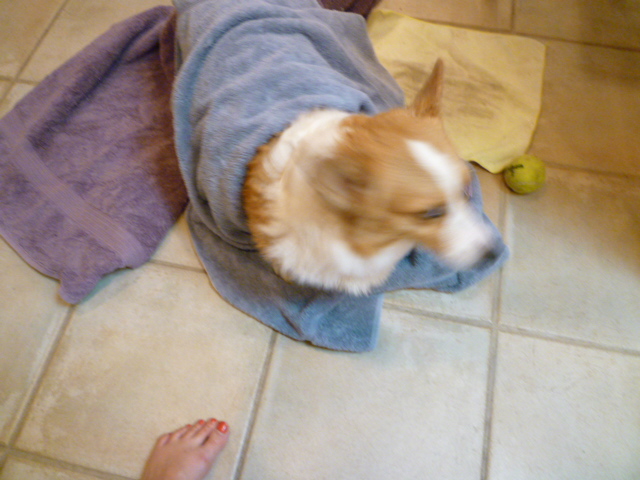
Fortunately, she was so close to the edge that all I had to do was reach over, grab a few hairs on her mane, and guide her over to the steps, where she soon found her footing. And then she was a very, very, very disgusted dog.
Naturally, I’d washed the dog towels, having laundered the dog herself not so long ago. Didn’t notice that after I’d put them on the line, they slipped off and fell on the deck. So when I went to retrieve them, they were lying on the planks in a wet heap, useless. Had to press some human towels into service.
And naturally, it’s 6:00 in the evening, and so she’s still going to be wet by bed-time. This animal’s coat is so thick that when she gets soaked to the skin, it takes her six or eight hours to dry out. So I’ll have to find something for her to lay on that will protect the mattress. {sigh}
Knowing how much she hates water and also knowing that she never lets me out of her sight when we’re in the yard, I’ve been lazy about teaching Cassie to paddle over to the steps, where she can get out of the pool by herself. And indeed, when she fell in, she was right under my feet. In fact, for a while there she was giving me the evil eye…I think she thinks I kicked her in there.
When the puppy gets here, she is going to need to know how to get out of the pool. The first thing that’s gonna happen is that little critter is going to tip her right over into the water. In fact, they’ll probably both fall in. So…I’ve got about six weeks in which to teach this dog to swim. We’ll be starting the first thing in the morning.
Then we’ll have to train the pup to swim out, too.
Hm. This may not be a great idea…
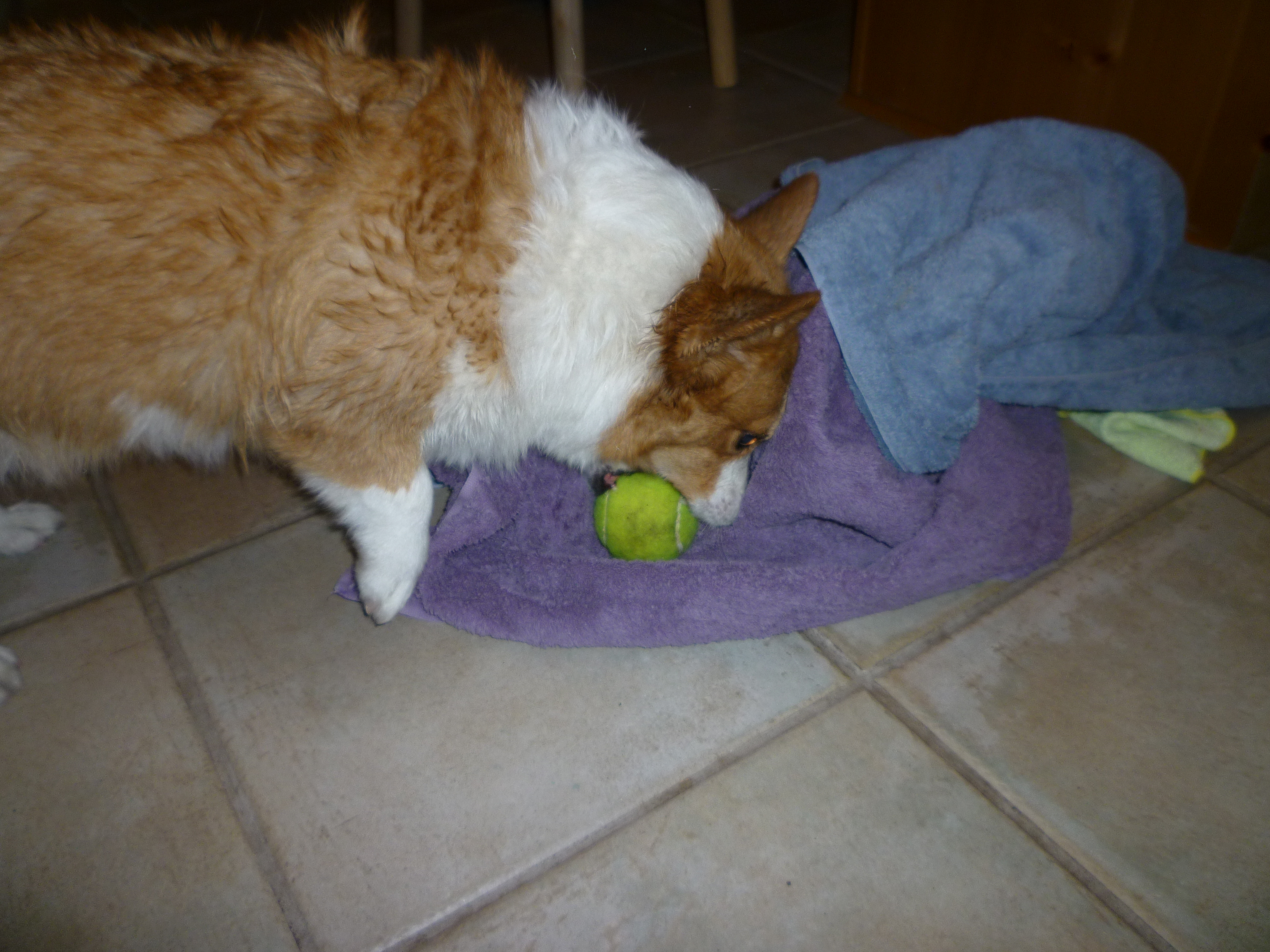
Oh, the dog? Never fear. She’s none the worse for wear.

Before she’d even shaken the last of the water out of her fur and onto the kitchen cabinetry, she was back in business…
You want me:

“Walking vet bill”? Say what? What’s that supposed to mean? Have you taken leave of your senses?

Indeed. You don’t want me. You want two of me!

LOL! Yes, I’m afraid these little furballs are the objects of M’hijito’s affection. Well, not these specific furballs, but their soon-to-be future siblings, expected to appear on the scene in two litters along about mid-June.
For some time, my son has been taken by a variant of the golden retriever known as an “English” golden. Basically, it’s the same breed, only the English type has a preternaturally light coat. They’re white or white with a pale, pale blond top coat. The head, especially on the male, is blockier than the golden we all know and love, and breeders claim (without, it appears, much justification) that the animal is more sound than dogs from the American line. Whatever. You have to admit that it’s a very beautiful dog. Here’s a candid of Dad, a.k.a. Cabot, surveying his domain:

Here’s a more formal portrait of the other future dad (we hope): the breeder recently imported semen from Karvin, a Finnish megachampion. Check out the “don’t you wish you could look like this” pose…

Then we have the “drop dead, you!” pose of one future mom, Tesse:

The other, Daisy, is just as elegant:

The breeder we’ve settled on, Golden Reflection, has two sets of pups due in mid-June, one by Daisy and Cabot and the other by Tesse and Karvin. We’re leaning toward the Daisy-Cabot litter, mostly because the cost will be significantly less (don’t even ask what it costs to import frozen dog sperm from Scandinavia).
Sunday evening we hired a sherpa and trekked to outer Mongoli Mesa, where this outfit resides. We wanted to meet the proprietors, inspect the premises, and see the dogs before deciding on this breeder or another, located on the far side of the Apache Trail. That Cabot character is absolutely spectacular, every bit as gorgeous as he appears in the photo. Their females are very beautiful, too, and all the dogs have calm and friendly temperaments.
But far more important than the handsome dogs is what’s behind the handsome dogs. Big dogs like this certainly can be (and often are) walking vet bills, largely because of the hereditary health issues that come with years of careless breeding: hip dysplasia, elbow dysplasia, eye problems, heart failure—those are just the big ones. Treatment for hip dysplasia, for example, entails lifelong pain medication plus, depending on how inclined you are to impoverish yourself, surgery that can go all the way up to complete hip replacements, to the tune of $2,400 to $4,500 per hip, plus the follow-up evaluations at $200 to $300 a hit. Some breeders will tell you that elbow dysplasia is even more crippling and debilitating than the hip disorder.
So. Before you fall in love with a cute little pup, you’re well advised to look into the background of the sire, the dam, the doggy aunts and uncles and grandparents going back as far as you can find them. Thanks to the Internet, this is no longer an impossible task.
The Orthopedic Foundation of America (OFA), an organization that tracks orthopedic and genetic problems among dogs, maintains databases showing the results for dogs that have been tested for a number of major hereditary ailments. Reputable breeders have their dogs tested, usually more than once, and they should take great care in selecting a sire or dame for their planned litters.
Many breeders, however, are not reputable. Never take a breeder’s word for it that a bitch or dog has no health problems in its background. Look it up for yourself.
Case in point: during our puppy search, we encountered the other breeder I mentioned, whose pups will be ready to go in a few weeks and who is anxious to get us to buy one. Nothing will do but what we must hurry to put down a $500 deposit, “before all the males are gone.” (What will it take to get you to drive this puppy off our lot today?)
Not in any rush to jump off that cliff, I entered the person’s sire and dam into the OFA database search function. And I entered the names of the ten other breeding females this breeder showed on its web page. The simplest way to mine the database is to enter the full name of the dog in a search box. If this doesn’t bring up any data, go to the dog’s pedigree, get the OFA or registration number, and enter that.
First warning bell: many of the dogs’ ancestors had never been tested for hips, elbows, eyes, and heart at all. The most recent testing I saw was dated 2008.
That, in the lifetime of a dog, is a long time ago. Breeding dogs need to be tested more often than that.
Looking further, I noted that one of the dam’s siblings had severe hip dysplasia. Neither of these are good signs.
Enough with that!
Returning to the Golden Reflections site, I copied and pasted Tesse’s long, involved official name into the database and discovered she’d been tested in 2009, 2010, and 2011. Her hips tested good, her cardiac condition was normal, and she passed an eye test. One of her offspring, still owned by Golden Reflections, showed similar test results. Her sire had a minor eye issue that is not thought to be heritable and probably has no effect on the dog’s vision. Cabot has been tested twice in 2009 and twice in 2010. Heart is normal; hips are normal; elbows are normal; eyes show a different condition whose heritability is not known, described as “common in goldens” and “not a concern.” Daisy was tested in 2006, 2007, and 2011: heart normal, hips good, elbows normal, eyes free of problems. Among Daisy’s half-siblings and forebears, I could find only one dog with an abnormal hip test: “preliminary borderline,” which means only that the test results were ambiguous and the dog needs to be tested again later—”most dogs with this grade (over 50%),” say the OFA guidelines, “show no change in hip conformation over time and receive a normal hip rating; usually a fair hip phenotype.” A half-sibling to Daisy’s sire, born in 2000, had degenerative joint disease in one elbow. Otherwise, none of the dogs that show in these records tested positive for the classic hereditary problems.
There’s a big difference between someone who’s breeding dogs that haven’t been tested in four years—or have never been tested at all—and a breeder whose dogs’ health records are complete and recent. And there’s an even bigger difference between one whose vague testing reveals a case of “severe” hip dysplasia (that is very bad) and one whose dogs show almost no ancestral background of hip, elbow, eye, or cardiac disorders.
In the purebred puppy biz, it’s caveat emptor from the git-go. The dog breeding business is infested by clueless amateurs, careless breeders, and downright shady operators. If you want to buy a dog with a fancy pedigree, it’s up to you to educate yourself not only about the breed’s nature and temperament, but also about the individual breeder’s stock.
Here are a few resources that can help:
• Dog Breed Info Center
• Wikipedia: Look up your desired breed
• The ABC’s of Buying a Purebred Puppy
• British Columbia Golden Retriever Club on whether you really want a puppy at all
• American Kennel Club index of breeds
• AKC Breeder Referral
• AKC Breed Rescue Contacts
• Pedigree Database
• The specific pedigree database for your desired breed (Google the breed name + “pedigree database”)
• Local breed clubs (Google them or ask your veterinarian)
• Local breed rescue groups (Google, again)
• Any discussion of a breeder on a breeders’ forum for your desired breed (Google the breeder’s name or the breeder’s name + the desired breed)
A reputable breeder should guarantee the puppy’s health and be willing to take the animal back if its health fails (note that many will say they’ll do this, but few actually will do it). The breeder should show a keen interest in your reasons for wanting the dog, your experience with the type of dog in question, where the dog will live, what you intend to feed it, and even who your veterinarian is. He or she also should ask you to return the dog if you find you can’t care for it.
Be careful out there!
😉
This post was featured in the 33rd Canadian Finance Carnival at Tom Drake’s Canadian Finance Blog and in the 16th Totally Money Carnival at StupidCents.
 Speaking of dogs (as we were indirectly in contemplating the Late Great Dog Food Question), I’ve been reading an entertaining book by psychologist Alexandra Horowitz called Inside of a Dog. In it, she proposes to help us appreciate the canine umwelt—the dog’s unique way of experiencing the world—by understanding what and how a dog sees, smells, hears, senses, and thinks. Based on what we know to date of dog physiology and psychology, she suggests we can figuratively get inside a dog’s mind.
As intellectual exercises go, it’s great fun, and the insights you gain are slightly different from Cesar Milan’s dominance-and-submission theories. She points out that though dogs probably are descended from wolves, after tens of thousands of years spent living with humans, they’re not wolves, and their mentality, intellectual capacity, and social interactions are markedly different from those of wolves. This has some amusing implications.
The book isn’t especially well written and in places it’s poorly edited, especially near the beginning. She doesn’t start to get on a roll until almost half-way through, but once she does hit her stride, her story gets pretty interesting. We’re amazed by how “smart” (human definition) dogs are about some things and how obtuse they appear to be about others…quite reasonably, on reflection, in light of what dogs and humans do to get by in the world.
At one point, Horowitz reflects on the extent to which dogs understand the meaning of human speech, specifically their skill at recognizing individual words. She suggests they respond to the prosody of speech—its patterns and musical “meaning”—but they’re not always good at recognizing individual words. Says she,
Try asking your dog on one morning to go for a walk; on the next, ask if your dog wants to snow forty locks in the same voice. If everything else remains the same, you’ll probably get the same, affirmative reaction. The very first sounds of an utterance seem to be important to dog perception, though, so changing the swallowed consonants for articulated ones and the long vowels for short ones—ma for a polk—might prompt the confusion merited by this gibberish.
Hmmm…. A challenge! To paraphrase a less than perfectly articulate robot, “I love a challenge!”
But first, what the heck is a swallowed consonant? Simon Mumford, an English instructor, tells us a “swallowed consonant” happens when a speaker elides a consonant in such a way that it can barely be heard or can’t be heard, as in “I got a cold” for I’ve got a cold. Doesn’t seem to apply in the substitution of polk for walk, but what the hey. Every writer needs an editor.
So, to try this on Cassie the Corgi:
HUMAN: arising, walking up the hall, and paraphrasing the daily liturgy with accustomed verve: Do you want to go for a smoggy talk?
DOG evinces puzzled expression.
HUMAN evinces continued verve: C’mon! Let’s go for a smoggy talk!
DOG’s expression morphs to utter befuddlement.
HUMAN: Smoggy talk! Smoggy talk! Hurry up! Let’s go for a SMOGGY TALK!
Still appearing mystified, DOG eyes HUMAN with evident curiosity and takes a few tentative steps after it.
HUMAN: Gathers collar, leash, package of dog mound baggies, and hat.
DOG, viewing HUMAN‘s activities: Arf!
DOG dances toward front door.
HUMAN: It’s time for a smoggy talk!
DOG, whirling in circles: Arf arf arf arf ARF!
HUMAN: “Smoggy talk,” eh? {snort!} Here, hold still while I get this collar on you.
DOG and HUMAN exit, stage left.
So, alas, it does not appear that dogs deduce meaning from tone, emphasis, prosody, or brute human verve. It also appears that this particular dog can tell the difference between “doggy walk” and “smoggy talk.”
Arf, she said. Arf.
