Yesterday afternoon while I was driving around I happened to pass by Outrageously Pricey Gourmet Grocery Store and heard the siren song of the bakery department…
Apple pies are calling,
Come to me,
Come to meeeee….
Who could resist?
Well… Truth is, I’m not crazy about sicky-sweet foods, though I do like apple turnovers, especially when they’re made with puff pastry. Once in the store, I’m eyeballing the turnovers and thinking, “That sticky-looking white frosting gunk they’ve drizzled on there looks like it’s mostly sugar. Ick!”
Still wanted a pastry; just not that pastry. As I was about to leave unsatisfied, I recalled that I used to make my own apple turnovers with frozen puff pastry and fresh apples. And they were pretty darned good. So! It was straight to the frozen food department, thence to produce, and then out past the checkstand for only $7. A package of frozen puff pastry shells and a couple of gala apples and I had stuff for not one, not two, not three, but six turnovers, for the price of one and a cup of coffee!
You can use the frozen pastry sheets, too. If you’re only cooking for one or two, though, the inchoate shells are convenient, because they let you defrost only enough for one or two servings. They’re incredibly easy.
You need:
frozen pastry shells or sheets
an apple
a few pecans, walnuts, pistachios, or almonds
sprinkle of nutmet, cinnamon, or both
turbinado sugar
flour
Preheat the oven to about 400 or 425 degrees.
Defrost as much frozen pastry as you need. One pastry shell rolled thin will make one good-sized turnover. Flour a clean cutting board and rub some of flour on a rolling pin.
Set the pastry shell (or small piece of pastry sheet) onto the floured board and roll it flat and thin, rotating the pastry dough a couple of times in the process.
Seed and cut up the apple (peel it if these are for guests). Break or chop the nuts into small pieces. Set some sliced or chopped apple and nuts in the center of the rolled-out piece of pastry. Sprinkle on a little nutmeg or cinnamon—or both, if you like. Fold the pastry over the filling and seal it around the edges by pressing the tines of a fork around the outside edge. Poke a few holes in the top with the fork, and set the turnover on a cookie sheet. Sprinkle the top with some crunch turbinado sugar.
Bake 15 or 20 minutes in a fast oven, until brown and delicious. And voilà! Apple turnovers, better than you can buy at the bakery, and cheaper!
Finally done with all the English 101 stuff, the grades finally entered in the District’s system. Let’s hope nothing there comes back to bite. That’s a forlorn hope, of course: as anyone who teaches anything knows, someone has to make an exception of himself. Every. single. time. So let’s rephrase that: let’s hope that whatever comes back to bite isn’t a pit bull. 😉
We now have three days until class starts again, this time not one but two eight-week gigs: the magazine-writing course and another English 101 crew. People are already turning in stuff for the magazine course, it having gone online a few days early, for their convenience. Oh well.
Having been sick for the past two and a half weeks with some sort of indigestion and heartburn paired with an unending headache, I’ve been madly self-medicating. Started with my usual subtractive medicine: stop ingesting things I love that I know are probably bad for me. Getting rid of the coffee helped some—alas. One of the small things that makes life worth living, or at least tolerable, is starting the day with a delicious cup of top-quality French-press coffee. But it must be admitted that the stuff keeps me awake at night, contributes hugely to the tooth-clenching, and does annoying things to the gut.
Then it was off the sauce—damn it. The other small thing that makes life worth living is celebrating the end of the work day with a beer or a glass of wine. But we suspect that daily tippling is not good for our health, or at least not good for our moral standing. After I snuck back into the grocery store two days ago to purchase a Murphy’s stout to go with dinner, the instantaneous and unmistakable protest from the belly showed, beyond a shadow of a doubt, that there will be no more swizzling for the likes of me!
I’d been using a generic version of Pepcid AC, which was laying around the house because the vet recommended it for the dog, who occasionally would barf in the weeks after I got her. This stuff did so little that it soon became apparent it was doing nothing. So yesterday when I was at the Safeway I picked up a package of omeprazole, the stuff that’s in Prilosec. The pharmacist said it had virtually no side effects.
Right.
These days I don’t take anyone’s word for that, so looked up a non-woo-woo study to check the side effects and their incidence rates.
HOLY God! Headache? Chest pain? Severe diarrhea? Severe stomach pain? Pancreatitis (some fatal)? Esophogeal candidiasis? Liver failure (some fatal)? Liver necrosis (some fatal)? And on and on…
Like I’m not sick enough?
So we’ll be returning that stuff to the store.
Moving on, I turned to the woo-woo pages, where I learned that a tisane of sage leaves and hot water has been used for centuries to treat indigestion and heartburn. Supposedly, too, chewing up and swallowing a half-dozen blanched almonds calms your stomach. We’re also told that raw apple is imagined to be soothing.
Well, what the heck. I happen to have a sage plant growing in the back yard, almonds in the freezer, and a lifetime supply of apples in the fridge. None of these things is known to cause necrosis of the liver.
So I picked some sage leaves, made a tea of them, and then blanched some almonds. Surprisingly, munching the almonds seemed kind of calming. Probably all in my head, though.
The sage tea, however, actually did seem to work to good effect. Can’t say it cured anything, but after drinking it, I did feel quite a bit better.
This morning, having awakened queasy again, munched some more almonds, brewed some more backyard sage tea, and took the dog for a walk. When we returned, I ate some of the rice I’d fixed for the dog’s cuisine, and afterward felt OK.
So, who knows? Maybe the stuff helps. Or maybe the passage of time helps (three weeks seems like a lot of passaging…but when you get old, your body heals very, very slowly). Experience suggests that these little ailments will do one of two things: kill you or go away on their own. Not much exists in between.
Old age. 😀 It’s not for the young or the faint of heart.
Right now a gigantic pot full of chicken carcasses and the bone from a chuck roast (found yesterday for $1.69/pound!! and converted to hamburger) is simmering with onion and herbs to make a glorious stock for future soups, which we hope also will be duly therapeutic. So good…
How to Make Leftovers Stock
You can make this in a slow cooker, but for some reason I think the stuff tastes better when it’s made in a pot on the stove.
Save a bunch of bones from chicken, beef, lamb, and pork—toss them in the freezer till you’re ready to use them.
When ready to spend the better part of a day keeping an eye on a slowly simmering brew, break out a large stock pot. Skim the bottom of the pot with olive oil. You’ll want to start this process in the morning, BTW.
Then coarsely cut up a fresh onion—no need to peel it—and brown it gently in olive oil. Add some cut-up celery and carrot. Toss in a couple of garlic cloves. Add herbs to your taste—I used some dried fines herbes and (what else?) the sage leaves wilted when I made the sage tea. Anything will do nicely.
When the onions have lightly browned or fully caramelized, depending on your mood and how closely you were watching the pan, add your collection of bones. Cover the whole mess with water.
Turn the heat to medium high. This is the only time you’ll need to hang around the kitchen. Keep an eye on the pot, and when it just comes to a boil, turn it down to low. Cover and go away.
Allow the broth to simmer for hours. Many hours.
When you get around to it, much later in the day, turn off the heat and heave the pot over to the drainboard next to the sink. Set a large bowl in the sink and place a strainer over it. Ladle the broth and cooked stuff into the strainer, draining the juices into the bowl. Use the back of the ladle to press as much of the broth out of the bones & veggies as you can. Discard the used-up bones and veggies.
You now have a stock that you can use for any number of delicious things, either to cook with or simply to eat as a light soup. You can add stuff to it to make a sturdier soup—pasta, rice, veggies, barley, whatever. A little white wine or sherry gives it a very nice flavor.
This is not real stock, which has to be clarified and reduced. But it’s sure good enough for government work!
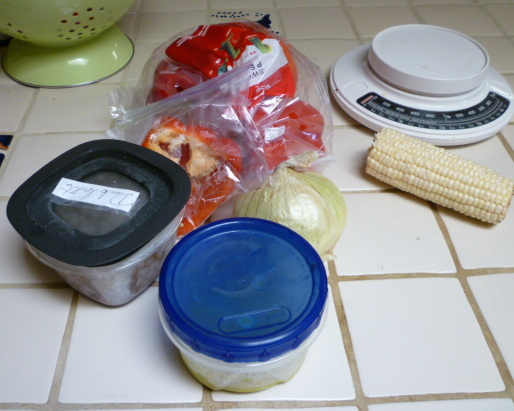
Nothing would do the other day but what I had to shovel out the fridge and use some of the lifetime supplies of Costco produce before it spoiled. Three and a half bright red bell peppers and one cob of fresh sweet corn surfaced among the loot. Out of curiosity, I decided to try making a red bell pepper soup.
It turned out so well that now I’m craving some more, having finished it off at last night’s dinner. Here’s how it came down:
You need:
• an onion • several ripe, red bell peppers • small amount of good vinaigrette dressing (bottled or home-made*) • one or more cobs of corn • one or two cloves of garlic, chopped • broth or water (I had about two cups of duck broth) • small amount of olive oil • salt and pepper to taste • for garnish: yogurt or sour cream; fresh or dried herbs
How to put it together:
Preheat a backyard grill or the broiler in your oven.
Coarsely chop the onion and sauté it gently in the olive oil until it is nicely soft and caramelized. Near the end of this process, add the chopped garlic. Cooking the onions should be a fairly slow process; this releases their sugars and makes them quite delicious.
With a sharp paring knife, slice the corn off the cob. Set aside.
Remove the stem from each pepper by slicing around the stem’s circumference and gently pulling out the stem and seeds. Try not to poke a hole in the sides of the pepper while doing this. Rinse out the seeds and drain the water out of the peppers. Now pour a few drops of vinaigrette into each pepper and gently swish around to coat the inside.
While the onion is cooking, place the bell peppers over a hot grill or run them under the broiler. If you’re using your oven broiler, put the rack down about a third of the way, so the peppers won’t be too close to the heat. You’d like them to cook a little while singeing.
Occasionally stir the onions. Keep an eye on the peppers. When the skin begins to blacken, remove from the heat. While the peppers are hot, peel off the blackened skin. You can facilitate this by putting the peppers inside a paper or plastic bag (personally, I would avoid plastic, but each to his own) and letting them sit for a while. In this instance, I had no problem peeling off most of the skin without that step.
Coarsely cut up the peppers and add them to the browned onions. Add broth or water to cover. I used about two cups; the amount is not set in stone.
I happened to have some duck broth in the freezer, left over from last December’s Christmas feast. Because we smoked the duck, the broth was smokey-flavored. This created an interesting effect. Next time, though, I’d probably use chicken broth or, maybe better, just plain water. The roasted peppers have a distinctive, appealing flavor that should be allowed to shine through. If you wanted some extra flavor in the liquid, you could add a little sherry or white wine to the water.
Allow the peppers, onions, and liquid to simmer together in the pan for a while, until any crispness is cooked out of the peppers. This, too, is a forgiving process. You could let it simmer for a half-hour or so.
Now run the cooked ingredients through a blender. I have an immersion blender, which worked perfectly for the purpose. Purée to make a lovely hot chowder. Season to taste with salt and pepper.
Finally, add the corn to the hot purée. Let this sit for a few moments; the residual heat from the soup will cook the corn a little without overcooking it. If you like your corn really soft, either use canned corn or put the purée back on the heat and simmer the corn in it for a few minutes.
And that’s it. To serve, add a spoonful of yogurt. If desired, sprinkle with fresh or dried herbs, such as chives, tarragon, or herbes de Provence, or fines herbes.
* How to make vinaigrette dressing
The classic “Italian” or vinaigrette dressing consists of one part tart stuff (vinegar, lemon juice, or lime juice) and three parts oil (I prefer olive oil, but any good vegetable oil will work). To suit your taste, add herbs and a minced clove of garlic. Whip or blend. Here, too, I use the immersion blender, obviating the need to chop the garlic finely and creating a rich, creamy dressing. But you can put the ingredients in a jar with a lid and shake them together, or you can just whap them up with a fork or wire whisk.
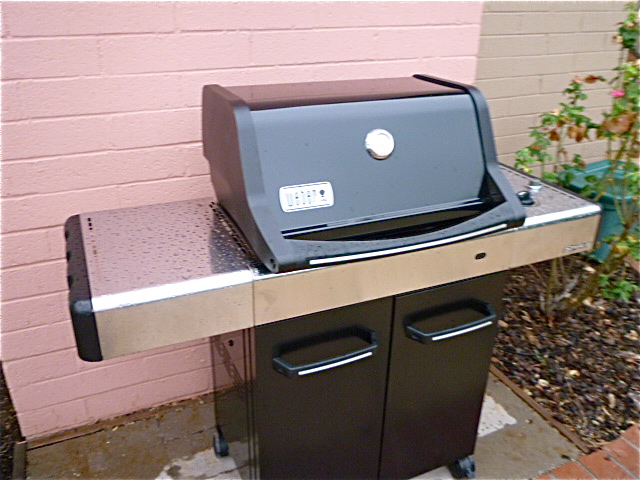
So Thursday M’hijito came over and helped wrestle the latest extravagant purchase out of the car, having agreed to do so in exchange for the opportunity to partake of the first meal cooked on the thing. He hauled the big charcoal grill off the pad I want to use for cooking and over to the ad hoc flagstone patio(?) I built some time back, and then positioned the new gas grill in the desired spot.
Naturally, it was raining. Monsoon season is finally here, driving temperatures into the 80s and 90s for the evenings…and driving a lot of wind, dust, and rain, too.
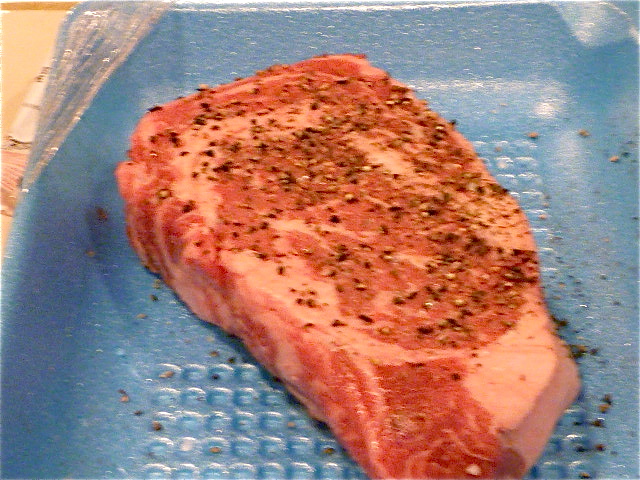
But so happy was I that he was coming over for dinner that I went a little overboard with the meal planning. At the better Costco outlet up on the I-17, I came across this incredible steak:
The cost was not unreasonable—about what I would expect to pay for a thick choice ribeye in the grocery store—and so I didn’t notice that it was prime until M’hijito arrived and pointed that out. Wow!
On the way home through the muggy heat (by midday it’s 105 or so, and still very wet), I stopped by the Safeway to pick up some frozen veggies for future reference, and there picked up some garlic, a yellow onion, and a bunch of little green onions. When I got here, I was so whipped I forgot about the fresh produce in the plastic grocery bag and, anxious to sit down, rest, and cool off, just dropped the whole thing in the freezer.
By the time M’hijito got here, the produce was frozen.
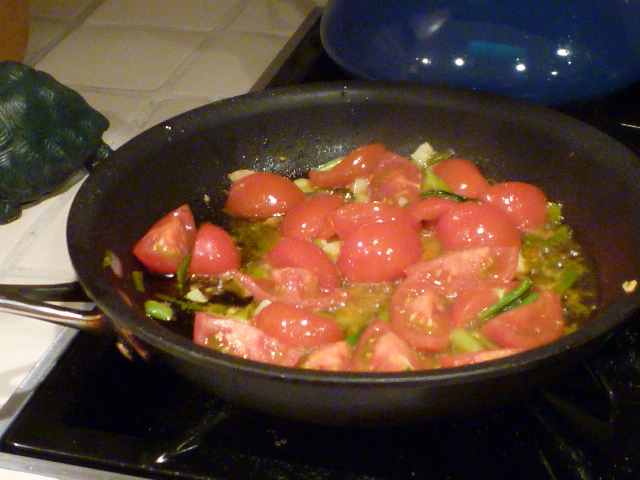
Rather than throw it out, I chopped it up and used it before it could turn to mush (which it was rapidly doing as it defrosted!). The result:
A tomato sauce containing a couple big cloves of garlic and the entire bunch of green onions…
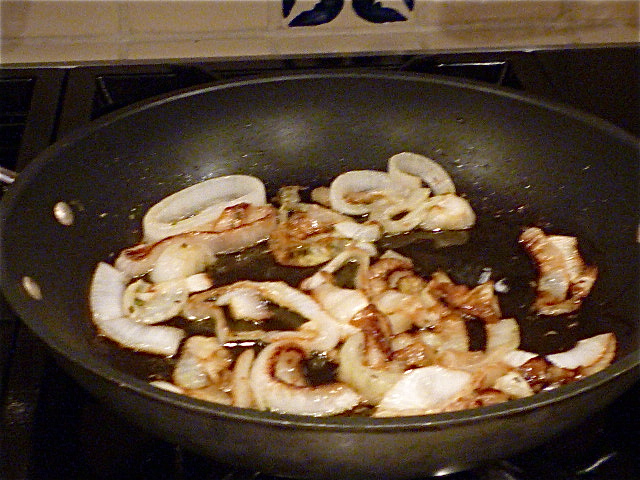
Slowly, sweetly caramelized yellow onion to go over the steak…
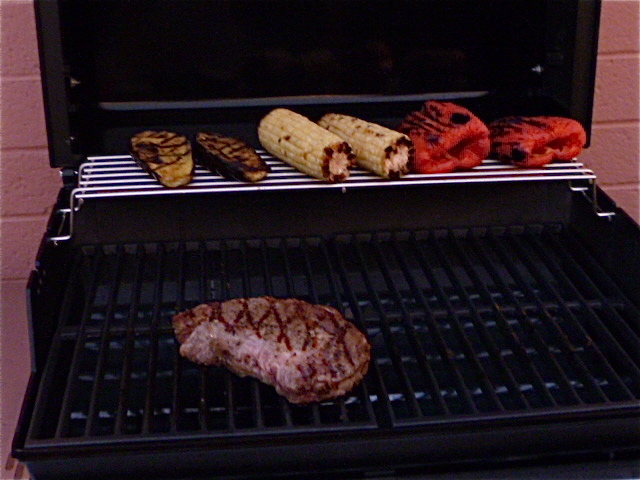
…And an exuberantly garlicky lemon vinaigrette that we used for cooking. M’hijito carved out the stems and seeds of a couple of red peppers and then poured some of the vinaigrette into the interior. These went onto the grill along with a small eggplant (also basted with the garlic vinaigrette) and a couple cobs of corn.
OMG, what an awe-inspiring dinner this made. The frozen garlic and green onions dissolved into the gently simmered tomatoes, which we used to smother the sliced eggplant, and the onion cooked down to make an intense kind of compote for the grilled ribeye. Eat your heart out, Ruth’s Chris Steak House! With the moderately priced Merlot I picked up at Costco and a very nice salad, we couldn’t have had a more wonderful feast in the fanciest eaterie in town.
So this bodes well for the plan to eat better. Yesterday evening, still craving red meat, I defrosted a smaller, lesser piece of beef and grilled that along with some more corn. Some leftover salad filled out the menu. I still have some shellfish that can go on the grill, and there may even be a piece or two of salmon or mahi-mahi in the freezer, along with a lifetime supply of chicken thighs.
Thanks to the rainstorms, we had another amazing sunset. You really can’t get the full effect in this snapshot—the entire western sky was suffused with neon peach light. The lower the sun dropped, the brighter the light grew, until finally at the end the heavens slipped through coral red into darkness.
It was a great way to launch the new ’cue. And so, to get on with life. A happy Sunday to you all.
Sooo…. The instant the sign-up sheet for the end-of-year choir party surfaced, I shot over like a rocket to get my name in first, so as not to be cut off at the pass in my quest to volunteer to bring my favorite amazingly cheap but amazingly delicious dish, potatoes au gratin.
Never sign up for anything when you’re distracted by ambition. My beady little eyes were so blinded by the glory of getting there first that I neglected to consider the venue. This shindig is not taking place at the church, which has a kitchen (two of them, actually) with enough refrigerator space to accommodate the 11th armored division’s mobile mess hall. It’s happening at the choir director’s house.
{sigh}What was I to do with a bubbling, 350-degree panful of potatoes, sauce, and cheese for the two hours in which we are to rehearse and perform before the party starts?
Couldn’t easily take it with me. It would have to be cooked in the church kitchen, which would mean it would be overcooked, since the period between the time we process up the aisle and the time the last note soars out of the organ is over an hour. Also, it would be wildly hot: getting a pan of searing hot potatoes from the stove to my car through a mob of people and from my car to the choir director’s house would be a challenge…to say nothing of figuring out how to keep the pan from melting the synthetic rugs in my car.
Having chewed on this dilemma for a week, I’d about decided to punt with potato salad. Then I flipped open my ancient Beard’s American Cookery, and what should I find but M. Blot’s Recipe for au Gratin Potatoes. This little gem uses precooked potatoes. Not only that, but it turns out to be very easy to prepare—much easier than the traditional lasagna-like layering of potatoes, butter, béchamel sauce, cheese, and crumbs.
And it takes ten minutes flat to warm in a 400-degree oven.
E-mail to the boss: OK to use your oven to heat this thing? Boss to underling: Nooo problem—we have all our ovens at the choir’s disposal.
Though I haven’t tasted this yet, obviously (because the party’s tomorrow), I did prepare it this morning, and it looks delicious. The sauce is splendidly savory.
Here’s my adaptation, enlarged for a crowd:
You need:
6 or 8 boiling potatoes
2 cups milk or 1½ cup milk and ½ cup heavy cream
4 Tbsp butter
4 Tbsp flour
4 egg yolks, beaten
cayenne pepper
salt & pepper to taste
a cup or so of shredded cheddar or Gruyère cheese (I combined Irish cheddar with Jarlsburg)
more butter to oil the pan
buttered breadcrumbs
Wash the potatoes but don’t bother to peel them. Bring a big kettle of water to the boil and place the potatoes in it. Cook over medium-high heat until a knife blade can be inserted easily into one of the larger potatoes.
Meanwhile, grate the cheese and beat the four egg yolks.
When the potatoes are done, drain them in a colander. Allow to cool for a few minutes. At this point, the peels will slip right off—so, when the potatoes are cool enough to touch, remove these with your hands and then slice the potatoes fairly thickly.
Butter an oblong baking dish.
Next, make the béchamel sauce.
How to make the béchamel:
Melt the butter in a saucepan. Add the flour and cook gently, stirring, until the butter foams. Add the milk (or milk + cream) and heat over medium-high heat, stirring frequently and watching, until the sauce thickens. Flavor to taste with cayenne, salt, and pepper. Remove the pan from the heat. With the pan off the heat, stir in the beaten egg yolks.
Now add the grated cheese to the hot sauce and stir well to blend.
All that remains to do is to arrange a layer of about half the sliced, cooked potatoes over the bottom of the baking pan. Spread half of the béchamel-cheese sauce over these, and then layer the rest of the potatoes atop that. Spread the rest of the sauce over the second layer. Finally, top it with buttered bread crumbs.
To cook: heat in a 400-degree oven about ten minutes or until heated through.
Since I expect there’ll be little room in the fridge at 9:00 a.m. and I don’t want anyone stacking stuff on top of the tinfoil-covered pan, I’ll wrap it in a big plastic bag with several of those cold brick-shaped things, frozen solid. That should keep it cool until it goes in the oven at 11:00.
Voilà! A scrumptious dish guaranteed to turn the best of church ladies green with envy, hand-made by you with almost no hassle.
Yeah, I know: “beer substitute” is a kind of oxymoron—brings to mind those watery “lite” brews and the horrid, pointless alcohol-free concoctions. Hear me out, though.
The other afternoon a great craving a cold, refreshing, and not sweet drink came over me. Normally I’d respond to that with a beer laid on ice for twenty or thirty minutes. But no. The new ur-Atkins diet prohibits booze of all kinds.
The fridge, however, happened to be harboring three of those long seedless cucumbers. {click!}Why not make a cucumber fresca?
Hey. Nothing ventured, nothing gained. 😉
So I peeled about half of a cuke, cut it up, tossed it in the blender. Added the juice of half a large Meyer lemon (because that’s what grows in the backyard) and a dash of cold water. Dosed it with a little salt and a generous sprinkle of fresh-ground pepper. Then puréed it into submission!
This created a nice, smooth purée. Poured about a half-glass of this over some ice, filled the glass to the top with more cold water, stirred gently, and garnished with a spring of mint.
AWESOME! This stuff is an admirable substitute for the beloved afternoon beer! But instead of loading in empty carbs and calories, it’s actually good for you. It would stand up to the rigors of a full-out Atkins regimen. It tastes wonderful, doesn’t leave you feeling bloated. Perfect for a hot day!




 , and what should I find but