Coffee heat rising

Culinary Blast from the Past: Hippy-Dippy Rice Pilaf

So I’m thinking about dinner and thinking how I’d like some rice with it and thinking how I sure as hell don’t want to drive to the Safeway to restock the now disappeared jasmine rice…when I recall the storage jar full of brown rice — real brown rice — that’s been sitting in the fridge since before the memory of Human runneth not to the contrary.

Hm. Real brown rice takes 40 minutes or so to cook. But WTF…so much the more time to absorb the contents of the bottle of wine I just bought.

Back in the day, brown rice was THE thing among us back-to-the-earthers. Not that we could raise it in our organic backyard gardens…but as a generation, we were prone to manias. One of our manias was the macrobiotic diet, in which one ate brown rice until one’s health failed. Well, actually, that wasn’t the goal, but it was the de facto outcome, if you could stand eating the stuff that long.

Given the vast popularity of brown rice, everyone and every restaurant had a recipe. I mean, if you ever had anyone over for dinner, you had better know how to cook brown rice.

I took my mother’s recipe for what she called “fried rice” (and my friends all called “pilaf”) and substituted brown rice for the Uncle Ben’s Instant (don’t ask), added nuts (macrobiotic!!!), and flavored it with sherry or white wine if I had any on hand. If guests weren’t vegetarians I’d use beef bouillon, beef stock, or home-made chicken stock for the cooking liquid. The result is extremely tasty.

Here’s how this shakes out:

You can use…

1 cup old-fashioned, non-quick-cooking brown rice
some wild rice, if you have it (maybe 1/8 to 1/4 cup) (hippies love wild rice) (don’t know why, but it’s good)
2 to 2.5 cups cooking liquid, which may be all or any combination of the following:
…..water, beef bouillon, chicken or beef or lamb or veal stock, white wine, sherry
1 or 2 garlic cloves, minced
1/2 to 1 whole onion, chopped pretty finely
herbs of various types, to taste, preferably fresh (from the garden last night, I picked marjoram and rosemary)
other vegetables such as carrots and celery and bell peppers, to taste, as desired or available, chopped
nuts of one sort or another, such as pecans, walnuts, almonds, cashews, hazelnuts, or pine nuts
olive oil
salt & pepper to taste

Skim the bottom of a good frying pan (one with a lid) with good quality olive oil. Preheat briefly over medium to medium-high heat.

Add chopped onion, celery, carrots, and/or mild peppers. Stir until the onion is softened. Add the garlic, nuts, herbs, and rice. Continue to cook until the nuts and rice are toasted, BUT do not let the garlic scorch(!).

Add the cooking liquid. As soon as the liquid comes to a fast simmer (which may be instantaneously if you’ve overheated the pan), turn the heat to medium low. Cover and allow to simmer slowly for about 40 minutes. But come back and check after 20 minutes or so. If the rice has gone dry, add a small amount of water, wine, bouillon or beef stock, or…whatever. Just don’t overdo it.

Continue cooking for a total of around 35 to 40 minutes. The rice(s) should be tender but not soggy, more or less al dente. Wait until the grain(s) are cooked to season with salt and pepper, since the amounts required will depend on what you used as a cooking liquid.

While this stuff is cooking, prepare the rest of the meal. Stir-fry, grilled fish or whatever, baked squash, salads, etcetera.

To serve, garnish with some finely chopped little green onions or, if your guests will put up with it, grated Parmesan or crumbled feta cheese.

It really is  surprisingly delicious. Well worth the time it takes to prepare.

P1020078


Amazing Cashew-Yam Casserole

So last night M’hijito and I went over to his friends’ house, watched the twins play, admired the laid-back dogs, socialized with 87 degrees of friends and relatives, and ate ourselves stupid. Among our contributions to the feast was a cashew-yam casserole resurrected from my hippie-dippie youth.

A vintage recipe, one might say. Served up in a vintage orange enamel pan with an avocado green interior. 😀

It went over well: the young people liked it. Maybe you will, too. Here’s the trick:

Get your hands on…

about 2½ pounds yams or sweet potatoes
1 tsp cinnamon
¼ tsp salt
1 egg
¼ orange juice
¼ dry sherry
3 Tbsp butter, melted
about 1 tablespoon grated orange rind (optional)
½ cup cashews, coarsely chopped
small amount (about 1/6 cup) sugar, to taste (I used demerara sugar; brown sugar’s nice; white sugar will do the job)

Preheat the oven to 350 degrees.

Wash the yams and trim off any scruffy parts. Cut them in half or thirds. Place them on a baking pan (I like to line the pan with a sheet of tinfoil, thereby minimizing clean-up), set them in the oven, and let them roast until they’re tender all the way through — about 45 minutes or an hour.

When the yams are cooked, remove them from the oven and let them cool until you can handle them. Peel off the skins (they should lift off in your fingers) and trim away any caramelized spots and flaws. Smush them with a fork and then measure: you should have about three cups. Transfer the cooked yam into a mixing bowl.

Add cinnamon, salt, egg, juice, sherry, orange rind, and sugar. Using an electric mixer, beat the mixture like crazy until it’s nice and fluffy. If it seems too dry, add a little more juice or sherry. Mix in two tablespoons of the butter.

Spoon the whipped yams into a one-quart casserole or soufflé dish. At this point, you can cover and refrigerate the dish, if you’re making it ahead of time.

Melt the rest of the butter and mix the cashews around in it to butter them well. Sprinkle over the casserole and bake, uncovered, in a 375-degree oven until heated through: about 15 minutes, or about 35 minutes if refrigerated.

You can place this dish in a 325-degree oven with a turkey, baking it a little longer to make up for the lower heat.

Also, you can double it for a large holiday meal; in that case, bake it at 325 degrees for about 1 to 1½ hours.

Postscript: The Best and Highest Use of Meatloaf

Yesterday Funny emitted a recipe for genuine 1950s meatloaf, the elixir of the working class. As I mentioned then, IMHO the best use of meatloaf is to stuff a sandwich. Meatloaf is the same variety of chow as pâté and liverwurst (which my father used to call “the worst of the liver” :-D): low-end food designed to fill hungry bellies and stretch dollars. As such, it makes a truly great lunchbox ingredient.

Personally, I think the best of all possible meatloaf sandwiches is made with home-made white bread; a close runner-up is sourdough bread. Try to avoid whole wheat bread: too healthy. Spoils the whole point of this exercise.

Slap a piece of bread on the counter. Cover it liberally with your favorite mustard. I favor Dijon types, but a good ball-park yellow will do the job handsomely.

Not spicy enough for you? What the heck: add a layer of horseradish. Slap another piece of bread on the counter next to the first one, and slather that one with plenty of ketchup.

Take last night’s leftover meatloaf out of the refrigerator and slice off a chunk. Size depends on how hungry you are now or how hungry you think you will be during your lunch break on the job. Place this on one of the bread slices.

Think you should have a vegetable? Break off a piece of lettuce from the head in the fridge and place that on top of the meatloaf. It’s optional, though, and may be too healthy for good sense. Remember, Ronald Reagan taught us that ketchup is a vegetable. Now take the other slice of bread and place it on top of the mound you’ve created…with the condiment side down, of course. Slice the sandwich in half, if you like.

Serve with a dill pickle spear (another vegetable!) and a mound of potato chips (more vegetables!).

Now you have a nutritious and tasty lunch.

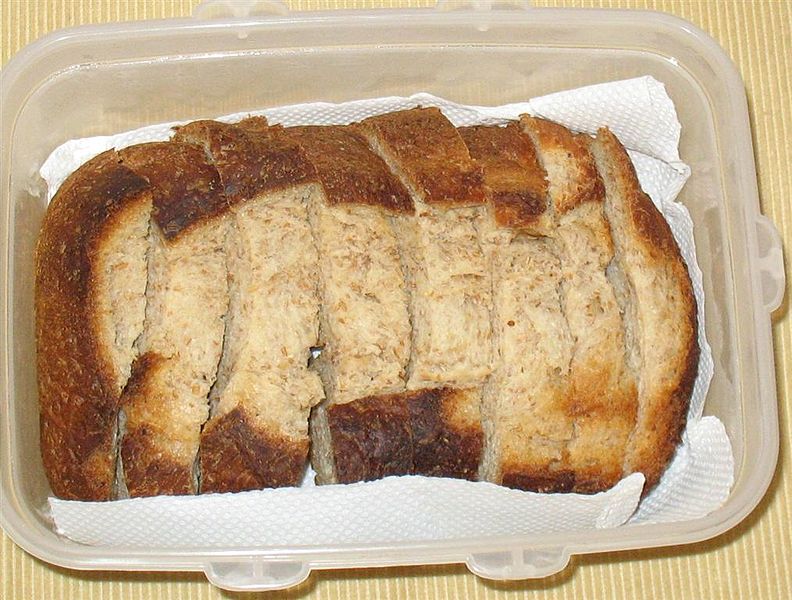
Image: Actual bread. Real home-made bread, that is. Project Manhattan. Creative Commons Attribution-Share Alike 3.0 Unported license.

How to Make Real Meatloaf

The choir had its gala dinner and silent auction last night, the group’s major annual fundraising event. As usual, it was a lot of fun, though turnout seemed less dense than it has been in past years. I purchased a place in a hike up  near Sedona, complete with gourmet lunch and good company. It would cost more in gasoline alone for me to go up there on my own. Sure hope the plantar fascitis and sciatica have cleared up by next April, when this junket takes place.

The party’s theme was 1950s cruising. Accordingly, the caterer came up with an approximation of 1950s cuisine, but featuring a 21st-century twist. They served up meatloaf made with Kobe beef.

😀

LOL! In the 1950s, no one this side of Tokyo had ever heard of Kobe anything. Certainly not in Phoenix, where the term “bread” meant Wonderbread and “cheese” meant Kraft slices. When we moved here in the 1960s, literally you could not buy a decent piece of cheese in a grocery store, and if you wanted a loaf of bread with anything resembling a flavor (other than caraway seeds), you had to go to the kosher bakery.

My mother made a great meatloaf. IMHO, the highest and best use of meatloaf is as a sandwich filling, served cold a day or two after the meatloaf is cooked. But some like it hot.

You need:

about a pound of ground chuck or ground round, decidedly not of the Kobe variety (meatloaf is working man’s food!)
one onion, chopped
one stalk of celery, chopped
one or two pieces of grocery-store white bread
salt and pepper
maybe a little garlic salt or garlic powder
an egg
butter or vegetable oil
one small can of tomato sauce
1/2 small can of tomato paste

Preheat the oven to 350 degrees.

Grease a bread loaf pan liberally with butter or vegetable oil (my mother favored Mazola).

In a bowl or mixing cup, combine the tomato sauce and half a can of tomato paste; with a fork, stir these together well.

Place the meat in a large mixing bowl. Tear one or two pieces of low-rent bread into small pieces and add these to the meat.

Skim the bottom of a frying pan with a little vegetable oil. Add the chopped onion and celery and cook over medium-high heat until the onion is translucent. Then add the vegetables to the meat and bread in the mixing bowl. Add some salt and pepper, as seems appropriate. If you’re using the optional garlic salt, you can add about 1/4 teaspoon of that; if garlic powder, use about 1/8 teaspoon. Add the egg, too — just crack it into the bowl with the other stuff; no need to beat it.

Take a fork and toss the meat, veggies, egg, and bread together until they’re well mixed. But don’t smush them or overdo the stirring. Just gently stir them together so everything is distributed evenly.

Transfer the meat mixture into the baking pan. Pat it down so it fits smoothly and has a nice rounded top. Spread the tomato sauce over the top (the more the better: IMHO, the tomato sauce topping is what makes meatloaf edible…).

Place the meatloaf into the oven and cook about an hour or an hour & 15 minutes. Remove it from the oven and let it stand on the counter to set up while you’re finishing the rest of the dinner. This stuff was typically served with things like green beans, carrots, mashed potatoes, and green salad. Or Jell-O salad. Jell-O salads were big in the good old days. That’s why we apply the word “good” with a degree of irony.

The mixture is pretty forgiving where ingredients are concerned. The whole point of mixing bread with hamburger was to extend the meat, so as to make it feed more people or last longer as leftovers. The egg is there to make the stuff hold together. You can have less meat and more bread. You can use two eggs instead of one.

You can add other stuff, such as ground pork or sausage, ground veal, parsley, real garlic, chopped bell pepper, mushrooms, and the like. You can dollop catsup over the top instead of tomato sauce. You can use all tomato paste or all canned tomato sauce, depending on what you have on hand. You can add pitted olives to the topping, or mix horrible pimiento olives into the meatloaf itself. Some people would add herbs: my mother’s idea of herbs was pretty much limited to dried parsley, thyme, marjoram, rosemary, and oregano, very typical of the average 1950s middle-class cook. None of these add much interest to this particular dish. Summer savory will work pretty well in meatloaf, but in those days we’d never heard of the stuff. I think some women would add a little cream or milk to the meat mixture. Instead of the tomato topping, some people would place a few pieces of raw bacon over the top before sticking the meatloaf into the oven. Whatever rings your chimes, that’s what goes into meatloaf.

Even, I suppose, Kobe beef. 🙂

Image: Meatloaf with sauce. Renee Comet. U.S. Department of Health and Human Services. Public domain.


Yummy Little Fig & Bacon Bites

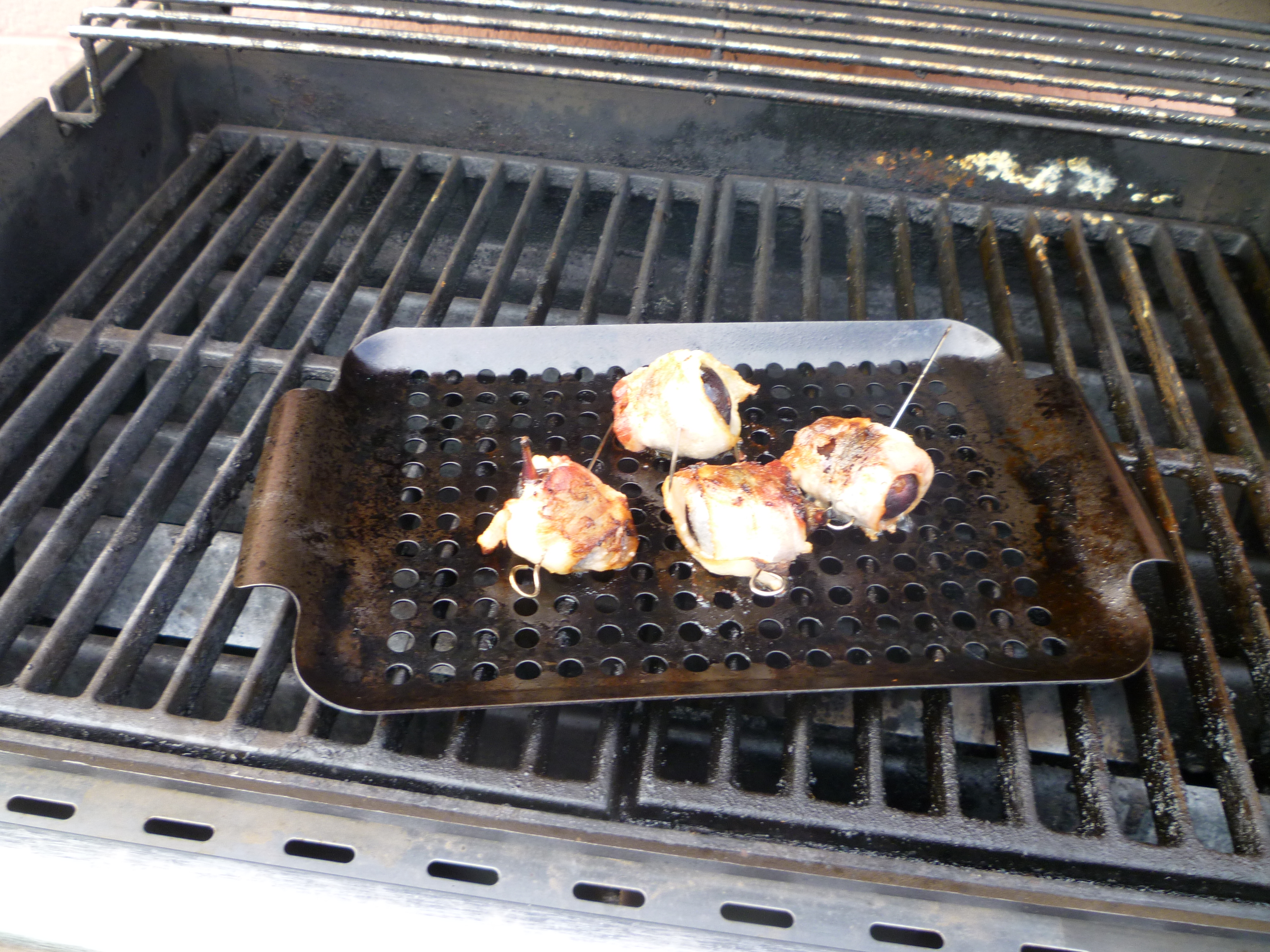
Trader Joe’s has had an abundance of fresh, ripe figs in its produce section. Yum! They are so good. M’hijito taught me to wrap bacon around figs to make a nice li’l snack. I’d been cooking them on the stove, but recently discovered it’s pretty darned easy to cook them on the gas grill. Or charcoal grill, should you care to go to that much trouble.

Just get yourself one of those grill griddles that has holes in it–inexpensive at Lowe’s or HD. They’re designed, I think, to hold fish without letting it flake into the fire. But they work fine for any small food items.

Wrap a piece of bacon around a fig and secure it in place with a skewer or a long toothpick. The thin-sliced variety seems to work better than thick-sliced bacon, simply because it cooks through quicker. But either will do the job. Place the wrapped figs on the grill griddle pan and put them over medium to medium-high heat. Cook, turning a few times, until the bacon is browned to your taste.

Great for breakfast with some cereal or toast. Great as a casual hors d’oeuvre (they could be finger food, but offer plenty of napkins…and remove the toothpicks). Great all the way around.

Real Retro: The frugal virtues of never throwing stuff away (+ how to percolate coffee)

Retro is so in. The other day a Crate & Barrel catalog arrive in the mail. The stuff on the front cover and most of the furniture and tchochkies it advertised looked just like what my friends and I used to covet along about 1972. Couldn’t believe it: avocado green,  Hallowe’en orange, harvest gold, dirt brown and Marimekko are b-a-a-a-c-k! My mother used to say that if you wait long enough, sooner or later your old clothes and stuff you don’t want to throw away will come back into style. Guess she was right: not throwing stuff away turns out to be a frugal virtue.

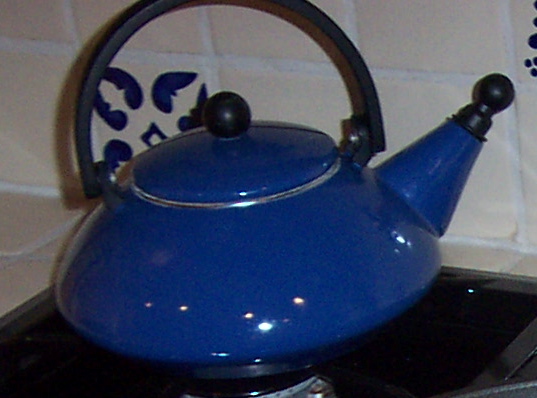
Case in point: my favorite tea kettle gave up the ghost last week. Our fine city water finally ate through its enameled surface and it started barfing flakes of rust into the French press coffeemaker.

I loved that kettle. It was bright blue and pretty and it had a LOUD whistle that would call me back to the kitchen no matter how absorbed I was at the computer or how distracted with some hassle out in the yard. It was perfectly balanced so it was easy to pour even if it was overfilled, and its handle and the strange little whistle stayed cool even if it had been left on the stove a little overlong.

They don’t make them anymore, of course. Manufacturers know when I like things. They have a radar system that picks up my “like it” vibes, and when they find out, they instantly take the item off the market. It’s true. Magic. This one came from (where else?) Crate & Barrel, purchased back in the day when I could afford to shop there. C&B doesn’t carry anything like it today.

Target has a few that are similar, but they’re too small and the colors aren’t as pretty. So I got onto Amazon and searched for tea kettles. Same deal: this thing is no longer being made, it appears.

However, at Amazon I happened to notice that people are buying a type of heat-resistant glass tea “kettle” that works on those accursed glass-top stoves and will also function on a gas stove. Hm. Customers don’t universally hate them, but some complain that they break, because their construction is rather thin. One of them is described, in the sales pitch, as “retro” in style. By that they mean “somewhat clunky.”

“Retro”? Glass? Glass pot?

Hey! I have one of those!

Matter of fact, I have two of them.

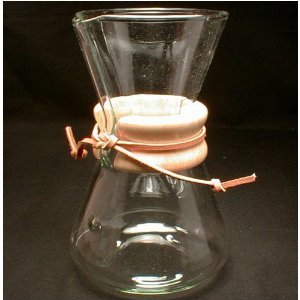
Back in the day—OMG, so far back that dinosaurs roamed the earth—I used to make coffee in a percolator. No one in this country had ever heard of a French press. You had three choices for making decent coffee: a Chemex drip coffeemaker (what a lash-up! literally—you tied a wooden collar around it with a length of rawhide so you could pick it up without burning your hand), a plastic cone that held a drip filter you set on top of a pot, or a stove-top percolator. The ubiquitous electric percolator didn’t make coffee—it made battery acid. And the early electric drip coffeemakers made roadside restaurant “coffee”…ugh!

I would percolate coffee, on the stove. And I was very, very good at it: I could make perc’ed coffee that was every bit as delicious as French press coffee. We’ll see how in a moment. First, though, the point: to do this, I used glass percolators made by Corning. I had two of them, a small one that held about four cups and a large one that would make enough for a dinner party.

At some point along the line, my ex and I started making coffee in a drip machine. They’d improved enough to make OK coffee, and with a kid and two dogs in the house, I didn’t have time to fiddle with elaborate coffee preparations. The glass percolators went into the back of some cabinet. And strangely, when I ran off with the harmonica player I chose to take those things with me.

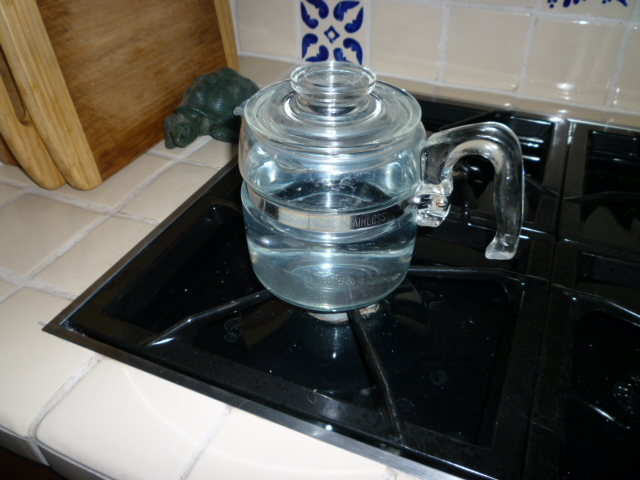
Well. They make fine tea kettles, absent their percolator innards. Those can simply be lifted out and left in the cabinet. Check out the little one:

Retro? That is so retro it’s the real thing. And its sides are thick, solid Corningware glass. The only way you could break it would be to stuff it with ice cubes and then stick it over a burner turned to “blow-torch.” And see that handle that looks like glass? It’s some sort of clear plastic. It stays cool even when the pot’s contents are at a full boil.

Hot dang! I’m back in style again. And it’s not costing me a penny.

😀

Here’s a warning, however: Do not use Corningware and Pyrex cookware that is of recent vintage. To be safe, the product should be at least 30 years old, or sold in Europe. The stuff made in China for the U.S., Australian, and Canadian markets is prone to exploding, because they add soda lime to the glass, which develops tiny cracks when exposed to heat. Smart, huh? If they’re not trying to kill your dog, they’re trying to kill you. 😉

* * *

So…how do you make percolator coffee that doesn’t taste like battery acid? Well, there’s a trick to it. Goes like this:

Never, ever let a stovetop percolator come to a full boil. The water does not have to boil for the percolator to perc. It only needs to come to a rather slow simmer. If you let it boil, you get battery acid. That’s why electric percolators make such horrid coffee. If you keep the heat low, you get incredible coffee.

Fill the pot with enough water to come no higher than just below the percolator basket. It should not touch the percolator basket. You can use less if you’re making less coffee, but don’t overfill.

Put about a tablespoon of ground coffee per serving in the percolator basket. If you grind your own, it shouldn’t be too fine. Note that the percolator basket’s little holes are not all that little; finely ground coffee will fall through those holes.

Place the percolator on the stove over medium to medium-high heat. And now here’s the hard part, for us moderns:

Do not leave the kitchen. This is not something you can do while frenetically multitasking. You can cook the bacon and eggs, but you can’t wander off and get distracted.

Pay attention to what’s happening on the stove. Watch and, if the pot is opaque, listen. The minute the water starts to bubble up into the percolator’s little glass top, turn the heat down. Regulate the heat so that the water continues to perc, but just perc. If it stops percing, turn the heat up a little; if it percs very fast, turn it down. You’ll get the hang of it.

This is much easier on a gas stove. If you have to use an electric stove, you may need two burners, one turned quite low and another set to medium or medium-high to bring the water just to the percing point; move the pot to the low-heat burner the minute it starts to perc.

I don’t recall how long the process took. The number that sticks in my mind is four minutes. But it probably was longer than that…eight, maybe. Test it after four minutes, and if it’s too weak, let it perc another few minutes. I don’t think it takes very long once the water starts to perc. You can tell how strong the coffee is by the color of the brew that’s bubbling into the little glass thing on the top of the percolator’s lid

* * *

LOL! The Corningware glass pot heats very fast. Because it’s glass, it doesn’t impart any metallic flavor to the water for your French press coffee. If you can find one (a couple are available on Amazon right now), this gadget will put you at the height of style (again…). Just be sure they predate 1998.