Coffee heat rising

Makin’ Olives, Greek-Style

The alleged fruitless olive in the front courtyard is not. Fruitless, I mean.

This summer it bore a nice crop of smallish olives, very  much like the olives that appear on the old stock planted years before the state’s ban on olive trees went into effect.

Olive pollen is said to be too cruel to the delicate noses of allergic residents here, and so to protect the hapless, the beautiful and useful olive tree was made illegal. Eventually a nursery entered the breach with the Swan Hill olive, a patented sterile tree.

Supposedly.

The one I planted in the front yard must have been grafted onto fruiting stock, because in recent years about a third of the canopy has taken to bearing olives.

Well. I happen to have a recipe for curing olives without benefit of lye. Many years ago, a friend returned from Greece with instructions for how to cure olives in water. It’s very easy, though it takes a while.

Charley, scarfing olives
A-huntin' the wild olive...

Fresh off the tree, olives are too bitter to eat, because of their high content of phenolic compounds and oleuropein, which makes them pretty unpalatable. Except to dogs, that is… Charley the Golden Retriever, like Anna the Ger-Shep before him and Greta the Ger-Shep before her, loves the things and will scarf them up off the ground with great joy.

Last weekend was truly beautiful, and I was done in with work and an endless, miserable cold. So, watching Charley clean up the fallen olives, I decided to chuck the paper-grading and the writing and the editing and spend some time going back to the earth.

Olives FrontyardThe tree was heavy with olives, at least on the northwest side. The first step in curing olives, of course, is to get the olives. So I dragged the ladder around from the backyard, climbed up, and pulled off enough to fill a couple of quarts.

Charley thought that was just the business, since I probably knocked as many on the ground as I got into my collection basket. Apparently they don’t harm dogs—I’ve never had one of my dogs get sick from eating raw olives, and the pits just pass right through.

The next thing to do, after you put the ladder away, is to prepare the fresh-picked olives for a long soak.

For this process, the olives should be ripe—deep red or dark purple, but not mushy overipe. I’ve learned, too, not to use the ones that have hit the ground. They shouldn’t be bruised or contaminated with dirt. I washed my little harvest well in a sinkful of cold water and dilute dish detergent, then rinsed thoroughly.

Now here’s the pleasant part: this is where you get in touch with your ancestors.

The time-honored way of getting started—and it’s a very ancient way—is to sit outside in the shade of your lush olive tree and prepare your fruit for the next stage. Take a sharp knife and cut a single slash across the blossom end (opposite the stem) of each olive.
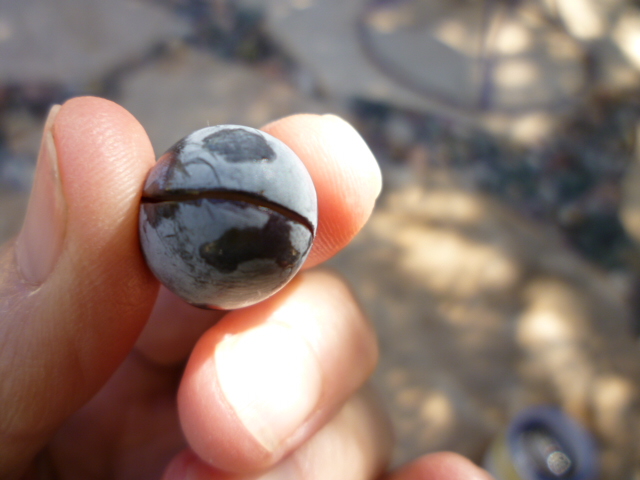
Slash oliveThis takes awhile. But it’s an amazingly soothing and calming process. There’s something zen about working with your hands in the way women before you must have done for thousands of years back into the Mediterranean past.

Every time I do something like this, I think how I wish I could live in Yarnell, making a living with my hands at some quiet, soothing craft. Would you buy my olives? Could I sell you some jewelry? Enough to keep the old miner’s shack warm with propane through the winter? Imagine spending one’s afternoons always in some peaceful, reasonably productive pursuit that does not require you to read student writing that grates your nerves or to dispense D’s and F’s to the authors of said works, that does not require you to meet deadlines, that really doesn’t ask much more of you than patience and a little facility with your hands.

Yes.

Cassie thought this was an altogether appealing idea and found the whole olive-slashing project pretty exciting.

Cassie would love it in Yarnell.

Charley in love?

Charley is easily distracted. He soon moved on from olive-hunting to the Tup-the-Corgi game. The trouble is, he doesn’t seem to quite know which end is…uhm…which. Half the time he tries to hump her head. Apparently he’s too young to understand what this is all about.

Make my day, mutt!

What Cassie understands about Charley’s obsession remains unknown. It is known, however, that she sometimes eggs him on, and it’s pretty obvious that she’s doing it on purpose.

Somehow, this wasn’t what I had in mind when, back in my hippie-dippie days, I used to sing along with with Buffy Sainte-Marie…

Gwine to be a country girl again,
With an ole brown dog an’ a big front porch an’…

Yeah. They still have those in Yarnell. And coyotes and cougars and javelina and skunks and rattlesnakes, all of which regard small brown dogs as fair game and your big front porch as something to sleep under.

Okay. So after you get all your olives slashed, your next challenge is to find a nonreactive container to hold them in. Glass or stoneware is best, though I’m told plastic will do.

Scavenging around the house, I came across the lifetime set of beverage jugs I’d bought at Costco. Glass, large, lidded, and easy to manipulate…perfect!

Instead of packing all of the olives into one of them, I decided to distribute the prepared fruit between two jars. This leaves lots of room for extra water. And since the jars are easy to dump and refill, two are no more trouble than one. In the past I’ve used large stoneware bowls. These work fine, too, but take up more room on the countertop, and to pour off the water you end up dumping everything into a colander in the sink, dirtying up a tool each day.

Bear in mind, this next phase of the project takes five or six weeks. So it’s convenient to use compact containers that are easy to haul around.

Place the olives in the container, whatever it is you decide to use, and cover them with cold tap water. Put some sort of cover over the top of the container, and leave it to sit in a cool place. I imagine you could keep it in the refrigerator, though presumably the ancient Greeks didn’t have refrigerators. Just depends on how authentic you choose to be, I suppose.

Now, each day for the next five or six weeks, pour the water off and refill the container with cold tap water. Do this every day, without fail.

About four or five weeks into the process, you can begin tasting the olives. When they no longer set your teeth on edge but instead have a nice Greek-olive flavor with a tang, it’s time to pack them in brine.

Wash the olives again, in a sink full of clean cool tap water.

Make a pickling solution, as follows:

4 tablespoons salt
2/3 cup vinegar laced (if desired) with lemon or lime juice
bottled water to make one quart

Do not use home-made wine vinegar, because its level of acidity is not reliable.

Gently pack the olives into clean, lidded jars. Add your choice of spices, according to your imagination. Possibilities include any and all combinations of the following:

garlic
celery seed
dried onion
rosemary
oregano
dill

You can, I’m told, substitute the juice from a jar of dill pickles for all or part of the water. However, in my opinion the very best way to flavor up these olives is to add, to your quart of pickling solution, 1 teaspoon of curry powder, 2 teaspoons of minced dried onion, and 1/2 to 1 teaspoon crushed red pepper.

Leave about an inch or so of headroom in each jar after all the olives are covered in pickling solution. Then pour in about 1/2 inch of olive oil. If your jar narrows at the top, olive oil sahould cover the wider part below.

In my younger days, I used to store these at room temperature. Now that I’m older and wiser, I’d keep them in the fridge. It is impossible not to eat them promptly.

While you’re enjoying your first harvest of olives, read this and dream on.

Ancient Roman Wine

The other day while editing a novel set in Britain during the first-century Roman occupation, I had occasion to look up the drinking habits of the ancient Romans. Particularly their wine-drinking habits.

As it develops, Romans of the first century AD drank lots of wine. They thought it was good for one’s health. They even fed it to their slaves, because they figured it would keep them going despite the low-grade nutrition slaves were given.

Interestingly, though, they didn’t drink it straight. They cut it with water: about three parts water to one part wine. Ancient wine was very sweet by comparison with today’s dry preferences—roman vintners would let the grapes sweeten on the vine before harvesting and fermenting—and people flavored the product with some very strange things. The result, I imagine, was something like soda pop without the fizz.

Flash forward to the twentieth century, to a kitchen in Arizona.

After dinner I’d had a second glass of cheap red wine but couldn’t get through it, so had left the glass with about one swiggle sitting on the kitchen counter. Later, I was thirsty and wanted some iced tea. Knowing there wasn’t enough room in the dishwasher for another glass, I was going to toss the wine and pour the tea into that glass. But…throwing out food (or wine) (especially wine!) frosts the tightwad’s cookies. So, casting my mind back over the facts of ancient Roman tippling style, I thought…hmmmmm….

And tossed in some ice and cold tea on top of the wine.

The result was amazingly good!

This sounds bizarre, but iced tea with a few drops of red wine—maybe a tablespoon or two—is really delicious! And very refreshing. It gives the tea a nice little zing, but the combination contains so little wine, it can hardly be called an alcoholic drink.

And so…in vinum veritas! To say nothing of dona nobis pacem.

Image: Red wine in a glass. André Karwath aka Aka. Creative Commons Attribution-ShareAlike 3.0 License.

How to Cook

Fearlessly. Incrementally. Ad lib. That’s how we cook.

My mother used to say “if you can read, you can cook.” Surely that’s true: following a recipe isn’t very hard, and the result is usually better than anything you can buy in a restaurant.

Cooking goes beyond reading, though. Eventually it arrives at creativity: at making it up.

La Maya gave me a couple ears of some corn she bought at a roadside stand whose proprietor said they would be wonderful if you just cooked them long enough. Yesh. This corn is white and hard and, when raw, flavorless: the sort of thing, I’m sure, that led humans to feed corn to their livestock.

Coincidentally, my teeth hurt.  The temporary crown the dentist’s assistant applied to the tooth His Dentisthood ground down to a nubbin hurt, and it was making all the teeth in my upper jaw think they hurt so much I couldn’t chew on a damn thing. Hence: soup.

Soup, soup, wonderful soup!

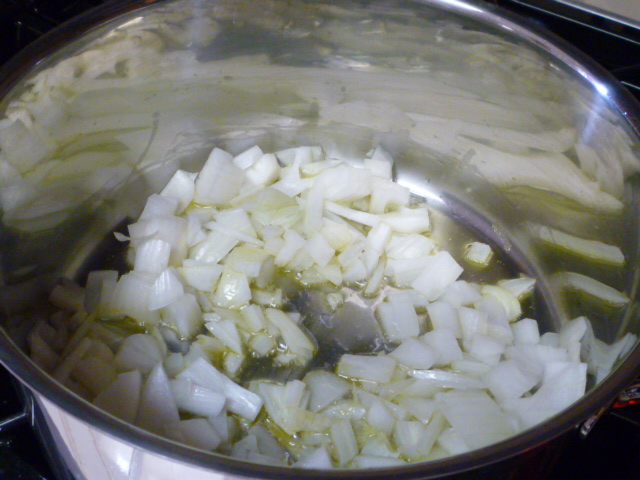
sauteeing onions

Picked up a cebolla cafe at the Mexican market this afternoon—if you speak my language, you would call it a yellow onion. Raided the pantry: a tin of cheap Target canned tomatoes; another of canned beans, a canister of bulk rice. Invaded the refrigerator: remains of a head of red cabbage. Back yard: parsley, marjoram, thyme, sage, carrots growing long in the carroty tooth. Explored the freezer: spinach, peas, the dog’s veggie mix of broccoli, cauliflower, and carrots.

What to do with a cebolla? Dice it and sauté it slowly, over low heat, in olive oil, in the bottom of a stock pot. Add some chopped garlic (ajo); continue to cook slowly.

Cut the tough, strange corn off the cob and throw it in with the cebolla and ajo. Let it keep cooking slowly. Mince the garden herbs and throw them in with the cebolla and ajo and maize. Let it continue to cook slowly. This is where we get the “incremental” part.

After a while, when it looks like the cebolla is soft and golden and maybe even beginning to brown a little over that very slow heat, open the can of tomatoes and dump the contents into the pot. Take a wooden spoon or whatever you have to hand and break open the tomatoes. Stir. Cover and continue to cook slowly.

Now add a fair amount of homemade chicken-beef broth, which you cooked up some time ago. Stir. Add a splash of cheap red wine from the bottle standing on the countertop. Put in a half-cup or more of rice. Stir. Continue to cook slowly, covered.

Slice the cabbage into strips.

Go into the garden and pull up a bunch of carrots. Wash these well; cut them into bite-sized pieces. Place the tops and trimmings into the compost. Let the cut-up carrots sit on the cutting board with the sliced cabbage until the rice appears to be about cooked.

When you think the rice is coming onto cooked, add the cabbage and carrots. Continue to cook slowly, covered.

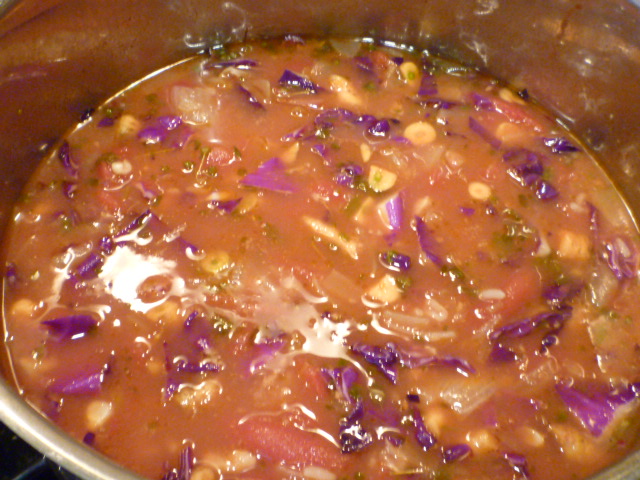
soup w tomato, cabbage, riceAbout the time the rice is looking almost soft enough to eat, add the cabbage and carrots. Let these cook slowly another short while, until the cabbage brightens up in the way that some veggies do when added to hot liquids.

Open the can of beans. Dump them into a strainer or colander and rinse off the liquid from the can. When it appears that the rice and the fresh veggies are just about cooked, add the beans.

While they are heating through, feed the dog.

Then feed yourself with the elixir that is in your stock pot. Add whatever seasonings and condiments please you: yogurt, sour cream, croutons, herbs, wine, whatEVER.

That is how we cook.

😉


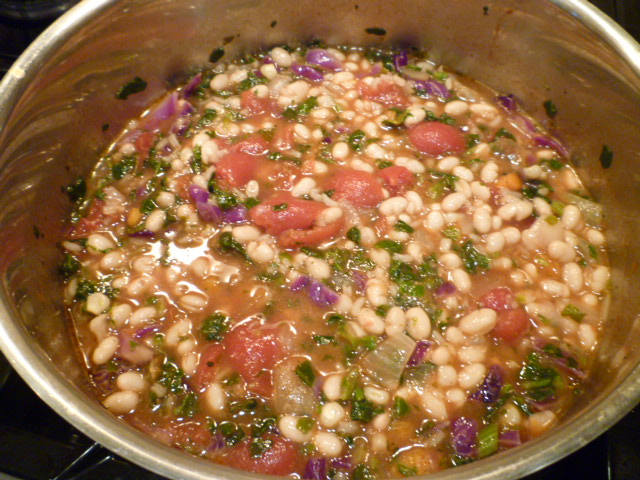
Finished veggie soup

Summer Boozie Pops

Remember the time I accidentally made the boozicle by putting a half-consumed glass of bourbon and water into the freezer and then forgetting about it? Well, wouldn’tcha know it…some people do this kind of thing on purpose. One such person is my former student, Jennifer Wood. With summer y-cumin’ in, Jennifer contributes this great set of recipes for grown-up hot-weather treats.

Artisan Ice Pops: A Cool Twist on Cocktails

Not your mom's popsicles...

Popsicles aren’t just for kids anymore. Adults are getting in on this childhood staple by turning a nostalgic treat into a grown-up concoction. The popsicle has evolved from just the everyday frozen juice pop and has taken on a new life full of fresh flavor and innovative ideas. Inspired by the paleta, a Mexican ice pop usually sold from street carts, artisan ice pops come in all kinds of flavor combinations, from the frozen ginger cherry cosmo to orange blossom delights. With their impressive presentation, artisan ice pops are the hottest cool trend in outdoor entertaining.

Ingredient choices for ice pops are not only endless and easy, they allow you to create an edible work of art in hours. Mint, cilantro, cucumber and figs are just a few of the unique ingredients that make these perfectly proportioned delights an absolute hit.

Harvest the flavorful makings from farmer’s markets, grocery stores and even your own garden. Ice pop molds and sticks can be found online or at a discount retailer, but Dixie cups work just as well and give the pops a fun shape. You can make artisan ice pops a day ahead, leaving plenty of time to enjoy the party; just remember to plan to free up enough freezer space.

Frozen Ginger Cherry Cosmo

Makes 24 two-ounce ice cube-tray pops, six 8-ounce pops, or eight 6-ounce pops

You need:

2 3/4 cups 100 percent cherry juice
1 1/2 ounces SKYY Infusions Ginger Vodka
Juice of 1 small lime
6 pitted fresh cherries

1. Combine cherry juice, vodka and lime juice in a large measuring glass with a pour spout. Place a cherry in each ice pop mold.

2. Pour juice mixture into molds. Place lids on molds or insert wooden ice pop sticks and freeze for 3 hours or until frozen.

Tip: Don’t overdo the liquor or you run the risk of the pop not freezing

Lime Mint Mojitos

Makes 24 two-ounce ice cube-tray pops, six 8-ounce pops, or eight 6-ounce pops

You need:

1 1/2 cups fresh lime juice (Note: I used 8 limes)
2 1/2 cups club soda
1/3 cup fresh mint leaves
1 lemon, peeled and cut into wedges
3 limes, peeled and cut into wedges
1 1/2 cups sugar
4 tablespoons light rum

1. Pour the lime juice, club soda, and 1 cup water into a pitcher and let sit for 5 minutes.

2. Add the mint, lemon and lime wedges, sugar, and rum to the pitcher. Mash all of the ingredients together with a muddler or a wooden spoon.

3. Pour into pop molds, being sure to distribute the fruits and mint evenly among the molds. Insert the sticks. Freeze for at least 12 hours. Remove from the freezer; let stand at room temperature for 5 minutes before removing the pops from the molds.

Tip: Be generous with herbs, spices, and sweeteners, because freezing can dull flavors in the pops.

Watermelon Margarita Pops

Makes 24 two-ounce ice cube-tray pops, six 8-ounce pops, or eight 6-ounce pops

You need:

5 cups chopped seedless watermelon (1 1/4 pounds)
2 tablespoons fresh lime juice
3 tablespoons superfine granulated sugar
1/4 cup water
1/4 cup silver tequila

1. Purée all ingredients in a blender until smooth,

2. Strain through a fine-mesh sieve into a large measuring cup, pressing on and then discarding solids.

3. Skim off any foam, and then pour into molds. Freeze 30 minutes. Insert sticks, and then freeze until firm, about 24 hours.

Tip: During the months when fruits are in season, collect the juices and freeze them for use later

Orange Blossom Delights

Makes 15 to 30 pops depending on size of small cup or ice pop form used

You need:

4 8-oz containers of greek full fat plain yogurt
1 12-oz can frozen orange juice concentrate
1 Tablespoon vanilla extract
4 Tablespoons of Orange Blossom honey
Zest of 1 medium orange

1. Blend all the ingredients together in a pitcher

2. Place mixture into small Dixie cups or small ice pop mold

3. Freeze for 1 hour and insert wooden sticks. Freeze again until solid.

Tip: Freeze a cake pedestal to display your beautiful pops or stick pops in a decorative bucket full of ice

Asparagus cheese torte!

Lenten thanks, Day 17

LOL! Thanks, God, for making us hungry and providing plenty of delicious veggies for us to deal with that. Oh yeah: and for coming up with that fire thing so we can cook the stuff.

Now, I ripped this idea off from a recent issue of Sunset magazine. The original had a different variety of cheese—don’t remember which, but it was something melty like gruyère or Emmenthaler. I happen to have a wheel of brie sized to feed a small army, courtesy of Costco, home of the Lifetime Supply of Just About Anything. From the same bottomless well came a gigantic package of lovely crisp spring asparagus. And deep in the freezer lurked the remains of a package of frozen puff pastry; in the fridge, some leftover caramelized onion.

Here’s how this goes:

You need…

Some sort of delicious, meltable cheese
A fistful of asparagus
A little butter
A little olive oil
Maybe a little nutmeg
Sautéed onions, if you so desire
Frozen puff pastry dough
Flour for rolling out the pastry dough
A small oven-proof vessel sized to fit the amount of ingredients you have.

Preheat the oven to around 375 degrees.

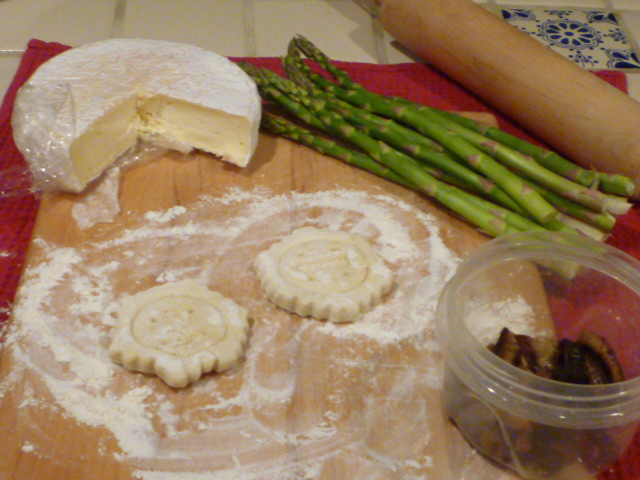
IngredientsAsparagusTorte

Break the asparagi into pieces that will fit into whatever you’re going to cook with; ideally, leave them long, but if push comes to shove, snap them into pieces.

Place the asparagus on a little dish, dribble some olive oil over it, sprinkle on some nutmeg (probably optional; you could use tarragon, or nothing), and roll it all around to coat the veggies.

Defrost the pastry dough (I did this in the microwave: about 20 seconds at medium on one side; 10 seconds on the other). Flour a pastry board and roll out the pastry so you can cover the bottom and (ideally) the sides of your cooking vessel. Line the vessel with this stuff; you may want to butter the pan or pottery first.

Slice the cheese and layer it over the pastry. Next time, I think I’d pre-bake the pastry shell for 8 or 10 minutes to crisp it up, but it probably doesn’t matter much. If you try that and you have enough pastry to make a rim around the dish (I didn’t, here), you may have to cover the rim with a little tinfoil to keep it from over-darkening.

Place the onions, if you so choose, over the cheese.

Finally layer on the nicely oiled asparagi.

Place this lovely little package into the hot oven and let it cook until the cheese is exquisitely melted, about 20 minutes (for brie, anyway).

Serve with some wonderful bread.

AsparagusBrieTorte
Ready to pop in the oven!

Crockpot Chicken Stock, Avgolemono Soup, Braised Sauerkraut

If you have a nice large crockpot, you’ve got a gadget that calls out to make you some wonderful chicken stock, a glorious base for home-made chicken soup and delicious stuff to cook with in general. Making stock in your slow cooker is easy as…well, pie.

You need:

A chicken carcass or collection of bones from baked, roasted, fried, or barbecued chicken; the more the better
An onion
One or more garlic cloves
A stick of celery
A carrot or two
Water
White wine or sherry (optional)
Fresh or dried herbs to taste: thyme, chervil, parsley, fines herbes, tarragon, basil, rosemary…whatever you have in the pantry or in the garden

Trim the root end off the onion and then cut the onion into chunks, skin and all. No need to peel off the papery skin. Coarsely chop the garlic, not bothering to peel the cloves. Wash the carrot—don’t bother to peel that, either—and cut it and the celery into coarse chunks.

Place the chicken bones into the crockpot. If using a carcass, you may want to break it apart into large pieces. Add all the vegetables and herbs. Add enough water to cover everything. If desired, add a generous dollop of white wine or sherry with the water.

Turn the crockpot to low, cover, and go away. Allow the whole mess to simmer all day long, or, if you prefer, all night.

After many hours have passed, turn off and unplug the crockpot. Set it on the counter next to the sink. Place a large bowl in the sink and set a strainer over the top of it. Ladle the liquid and cooked ingredients into the strainer, using the back of the ladle to press the liquid out of the cooked stuff and through the strainer as thoroughly as is practical. Discard the exhausted cooked solids.

Allow the bowl of stock to cool uncovered until it’s reasonable to put the bowl into the refrigerator. Once you can get it into the fridge without disrupting the temperature inside, cover the bowl and allow the stock to chill for six or eight hours or overnight. This will cause the fat, which floats to the surface, to congeal.

When the stock is thoroughly chilled, remove from the fridge and simply peel or ladle the congealed fat off the surface. Discard it.

You now have a bowl of very tasty low-sodium, low-fat chicken stock, which can be used on its own as unadorned chicken soup or used in recipes asking for canned chicken broth.

I happen to be very partial to…

Avgolemono Soup

This easy and tasty dish is Greece’s answer to Jewish penicillin. Into a pan or microwave-safe bowl, ladle as much home-made chicken stock as needed for the desired number of servings. Heat it to serving temperature. Add some cooked rice or pasta, and then squeeze the juice of half a lemon into the broth. Stir and serve hot. Season to taste with salt and pepper. If desired, sprinkle a little chopped parsley and Parmesan into the soup.

And just the other day I had a great deal of success with this:

Braised Sauerkraut

In a strainer, drain and rinse a bottle, can, or bag of sauerkraut. Place this in a pot large enough to hold it with some room to spare.

Cut a seeded apple into bite-sized chunks. Toss these into the sauerkraut. Flavor with about a teaspoon of fennel seeds and a quarter- to half-teaspoon of dried thyme leaves. Add enough chicken broth to just cover the kraut.

Bring the ingredients to a simmer and then hold at the simmer over low heat for forty-five minutes or an hour. The apple should be cooked soft and the kraut should be mellow in flavor.

Serve hot or cold with sausages, pork, chicken, duck, or whatever suits your fancy.

When I’m not planning to use the broth immediately, I like to freeze it in one- or two-cup containers. Keep it handy to use in any recipe that calls for chicken broth. Also, the next time you have another chicken carcass, defrost and add some of the old broth to the liquid for the new crockpot stock, creating an even richer and more delicious product.

Image: Rooster Portrait. Muhammed Mahdi Karim. GNU Free Documentation License