Coffee heat rising

Burnout: When Something’s Gotta Go…

Over at Surviving and Thriving, proprietor Donna Freedman describes the exhaustion she feels after cramming too much work into too many hours for too many years:

But I’ve been on a dead run for years. I started out tired and the more things I take on, the more tired I become. Too often I meet deadlines at the expense of a personal life. Too often, writing is my life.

Don’t know how that woman does it, but somehow she manages to express exactly what’s crossing my mind, and she does it better than I can. Like Donna, I also am spending altogether too much of my life working (generally for very low pay) and altogether too little of it enjoying life. Last week’s mail meltdown, which led to 42  hours in front of the computer punctuated by a three-hour nap in the middle of the night, really was the watershed moment.

This stuff has gotta stop. I can’t keep on doing it. The overwork and the constant fatigue are starting to make me sick.

Yesterday at choir, just as we started to process up the center aisle at the start of the service, I suddenly had another dizzy spell. It was the third one to visit in a week or ten days, and by far the worst. I could barely walk, to say nothing of walking straight. People must have thought I was drunk! For a minute or so, I thought I was going to have to sit down, berobed, in one of the pews. That would have made a nice spectacle.

But no. Managed to stagger down the side aisle and out the side door with the assembled company, and I even managed to climb back up the steep staircase to the choir loft.  Don’t know whether the cause is stress, migraine (a headache usually ensues and lasts all day), an inner-ear problem, MS, impending stroke, or a brain tumor…though I’m inclined to suspect the first.

Ugh. Whatever’s behind that, the fact is that despite many resolves to quit it, I still spend way, way, way too many hours in front of a computer.

A fair quantity of that time is spent reading the seemingly endless supply of news sources. I do need to be up-to-date with current events, not only to write this blog but to perform the teaching and editorial work I do, and so I consider that activity, though unpaid, to be part of my various jobs. And occasionally, when my brain starts to fry, I’ll take a break at my favorite Mah Jongg site or fill in the USA Today crossword. That time, too, is spent staring into a computer screen—which is to say, rest breaks do not take me away from the computer. Consequently, I can easily spend ten or twelve hours without getting up from my desk. Some days (and nights) I spend a lot more hours than that parked in front of Macintosh hardware.

So it occurred to me that if I rationed the number of hours spent online, I’d be forced to focus on work and not sit on my fanny nonstop. And if the computer were actually turned off, I would get up and do something else. Maybe I’d even leave the house and reacquaint myself with the out of doors.

The most likely day for that is Saturday. There really is no reason for me to have to work on the weekends (except that the magazine writing students have papers due on Fridays…next semester, we’ll be changing that). Another possibility is Wednesday afternoon. I have choir on Wednesday evening. Why can’t I take off the entire afternoon, rather than working through the dinner hour and then chasing out the door like a scared rabbit and arriving at rehearsal barely on time or late? Usually I end up fixing dinner after I get home—around 9:30 at night—which means I don’t get to bed before 11. If I sit back down to the computer after dinner, it’ll be after midnight before I crawl into bed.

Work expands to fill the time available.

But it may shrink to fit time available, if the time available is reduced.

This revelation came to me when I decided to take the dog for a walk at 5:00 a.m. (after dawn in these parts) instead of plopping down in front of the computer, as I habitually do. Walking the dog and then taking even more time to make the bed, shower, and brush my teeth did not cause any less work to happen during the day than I would have accomplished had I started stumbled to the computer the minute I rolled out of the sack. I actually got the same amount of work done—maybe even more. And in the meantime, I got a little bit of exercise and started the day refreshed.

Would the workload compress if a day or a day and a half were taken away from time spent at the computer?

Stay tuned—we shall see! Meanwhile, tell me…what do you do to control malignant work overload?

Am I Going Slower? Or Is There Just Too Much to Do?

Now, I know I’m not the first one to think this, because a lot of my friends say the same thing: It seems like the older you get, the harder it is to get to places on time, because it feels like you just can NOT get through all the stuff you have to do to get out the door. Objectively, it can’t be true that there’s just too much to do: after all, we raised kids without feeling that we couldn’t get through all the diddly little tasks on our plates, and nothing will slow you down in your effort to get out the door better than a kid! So, either we’re going slower as we age, or something else is interfering with our progress.

Hint: As I write this, I’m multitasking: trying to fix my breakfast so I can bolt it down before M’hijito gets here with his dog (not gonna make it: it’s already two minutes to eight) while writing a post while being pestered by my own dog while waiting for a video for the magazine-writing class to upload to YouTube.

***

And now that breakfast is done and Charley is here, I’m back in front of the computer where I find that MacMail is AGAIN demanding that I type, retype, and re-retype my password, a cycle that doesn’t stop until you crash out of the mail program. This, it develops, has been a known issue for quite a long time, though I didn’t experience it until upgrading to Lion and moving to the endlessly pointless iCloud. When it starts, thanks to flicking iCloud’s servers, where MacMail now resides, it affects all my computers. And now I can’t get my mail.

So, I’ll have waste some more time wrestling with that while watching the upload to YouTube and then, whenever that video goes online, posting it to the Eng. 235 site.

It’s now 8:27. I’ve been up since 6:00 a.m. and accomplished little more than to bolt down two pieces of toast, two pieces of bacon, and a handful of cut-up oranges. I haven’t been able to read the newspaper. I haven’t put the clean dishes away and loaded the dirty dishes littering the counter into the dishwasher. I haven’t made the bed.

I did at least wash my face and brush my teeth this morning…something I often don’t seem to be able to get at until I actually do have to go out the door.

The ordinary bits and pieces of what once was normal daily life get shunted aside while I try to cope with what looks like work on the computer (but, because it’s paid so little, isn’t real work, IMHO). So…what have I done in the two hours and 31 minutes since I rolled out of the sack?

Checked on upload status of “Interviewing” video
Retrieved  URL, opened video, checked it.
Embedded video in “Lecturoids” section of the website
Also embedded it in a new post, by way of bringing it to stoonts’ attention
Uploaded “Query Letter” video to YouTube
Answered several e-mails
Discussed two projects with business partner, via e-mail
Checked grades for two sections of 102 stoonts; observed great improvement over last fiasco
Mentally blocked out a post for Adjunctorium
Responded (again!!!) to confused Eng 235 stoont
Fed and watered the dog
Got the paper; watered a plant that got missed by the sprinkler system
Fixed coffee; started bacon and toast
Discovered I’d somehow uploaded “Interviewing” as “Query Letter” to YouTube
Got into YouTube account; deleted video
Re-uploaded the “Query Letter” video to YouTube
Read another e-mail; framed answer mentally
Retrieved bacon from microwave; retrieved carbonized toast from toaster
Picked and sliced oranges
Sat down to breakfast
Almost finished when M’hijito showed up with dog; coped with dog bouncing activities
Finished breakfast
Responded to another e-mail from confused stoont
Checked “Query Letter” video on YouTube
Embedded video in Eng 235 post and in “Lecturoids” page; posted both
Came back to this FaM post and continued writing it.

And now I’m about to go zap my cup of stone-cold coffee in the microwave. Gotta respond to that e-mail. Gotta sit down and study for real estate course. Gotta go see what that wacky pup is doing. Gotta check the pool chemicals. Gotta water the new plants. Gotta write a post for Adjunctorium. Gotta work on the client’s project. Gotta update client billing. Gotta work on edits for book-length piece of pseudo-lit-crit. Which reminds me…yes: pseudo can work on its own as an adjective. Did I forget to mark that in the middle of the night? Bet I did. Gotta search back pages of pseudo lit-crit; delete hyphen.

Gaaaaahhhhhhhh!

***

Well. The 50-ton digital elephant in the room is…what?

The computer!

e-mail
blogs
iCloud
YouTube videos
more e-mail
online courses
still more e-mail
{plink!} Facebook notice
more e-mail
Google calendar reminder: teleconference in 20 minutes

About 90% of this stuff wouldn’t have occupied time “back in the day,” because it didn’t exist. As for the constant onslaught of e-mail messages: People felt no great need to be “connected” and so refrained from blitzing everyone with their thought of the moment. More phone calls took place, probably, and those did take time; but nothing like as many phone calls were made as e-mails today. Business memos (up to 100 a day pour in from the community colleges) were distributed in hard copy, and because printing the things cost time and money, a lot fewer messages were emitted.

Look at the vast amount of my time that’s consumed with computer-related tasks. I’m squeezing my life in around them—barely finding time to wash up and get breakfast by the 8:00 a.m. deadline; barely finding time to gather what I need to do before I have to leave the house; dropping the newspaper before I’ve even read a page so as to get back to the chores waiting on the computer… Life has become nonstop gestalt: every single thing you do is interrupted constantly by demands from e-mail, online calendars, and work that didn’t even exist before life became digitized. In the Dark Ages, the work that did exist—say, publicizing your business—happened in discrete chunks. It wasn’t something you had to do unendingly over Facebook, Twitter, and WordPress.

Maybe it’s not old age. Maybe our lives really, objectively are out of control.

Makin’ Olives, Greek-Style

The alleged fruitless olive in the front courtyard is not. Fruitless, I mean.

This summer it bore a nice crop of smallish olives, very  much like the olives that appear on the old stock planted years before the state’s ban on olive trees went into effect.

Olive pollen is said to be too cruel to the delicate noses of allergic residents here, and so to protect the hapless, the beautiful and useful olive tree was made illegal. Eventually a nursery entered the breach with the Swan Hill olive, a patented sterile tree.

Supposedly.

The one I planted in the front yard must have been grafted onto fruiting stock, because in recent years about a third of the canopy has taken to bearing olives.

Well. I happen to have a recipe for curing olives without benefit of lye. Many years ago, a friend returned from Greece with instructions for how to cure olives in water. It’s very easy, though it takes a while.

Charley, scarfing olives
A-huntin' the wild olive...

Fresh off the tree, olives are too bitter to eat, because of their high content of phenolic compounds and oleuropein, which makes them pretty unpalatable. Except to dogs, that is… Charley the Golden Retriever, like Anna the Ger-Shep before him and Greta the Ger-Shep before her, loves the things and will scarf them up off the ground with great joy.

Last weekend was truly beautiful, and I was done in with work and an endless, miserable cold. So, watching Charley clean up the fallen olives, I decided to chuck the paper-grading and the writing and the editing and spend some time going back to the earth.

Olives FrontyardThe tree was heavy with olives, at least on the northwest side. The first step in curing olives, of course, is to get the olives. So I dragged the ladder around from the backyard, climbed up, and pulled off enough to fill a couple of quarts.

Charley thought that was just the business, since I probably knocked as many on the ground as I got into my collection basket. Apparently they don’t harm dogs—I’ve never had one of my dogs get sick from eating raw olives, and the pits just pass right through.

The next thing to do, after you put the ladder away, is to prepare the fresh-picked olives for a long soak.

For this process, the olives should be ripe—deep red or dark purple, but not mushy overipe. I’ve learned, too, not to use the ones that have hit the ground. They shouldn’t be bruised or contaminated with dirt. I washed my little harvest well in a sinkful of cold water and dilute dish detergent, then rinsed thoroughly.

Now here’s the pleasant part: this is where you get in touch with your ancestors.

The time-honored way of getting started—and it’s a very ancient way—is to sit outside in the shade of your lush olive tree and prepare your fruit for the next stage. Take a sharp knife and cut a single slash across the blossom end (opposite the stem) of each olive.

Slash oliveThis takes awhile. But it’s an amazingly soothing and calming process. There’s something zen about working with your hands in the way women before you must have done for thousands of years back into the Mediterranean past.

Every time I do something like this, I think how I wish I could live in Yarnell, making a living with my hands at some quiet, soothing craft. Would you buy my olives? Could I sell you some jewelry? Enough to keep the old miner’s shack warm with propane through the winter? Imagine spending one’s afternoons always in some peaceful, reasonably productive pursuit that does not require you to read student writing that grates your nerves or to dispense D’s and F’s to the authors of said works, that does not require you to meet deadlines, that really doesn’t ask much more of you than patience and a little facility with your hands.

Yes.

Cassie thought this was an altogether appealing idea and found the whole olive-slashing project pretty exciting.

Cassie would love it in Yarnell.

Charley in love?

Charley is easily distracted. He soon moved on from olive-hunting to the Tup-the-Corgi game. The trouble is, he doesn’t seem to quite know which end is…uhm…which. Half the time he tries to hump her head. Apparently he’s too young to understand what this is all about.

Make my day, mutt!

What Cassie understands about Charley’s obsession remains unknown. It is known, however, that she sometimes eggs him on, and it’s pretty obvious that she’s doing it on purpose.

Somehow, this wasn’t what I had in mind when, back in my hippie-dippie days, I used to sing along with with Buffy Sainte-Marie…

Gwine to be a country girl again,
With an ole brown dog an’ a big front porch an’…

Yeah. They still have those in Yarnell. And coyotes and cougars and javelina and skunks and rattlesnakes, all of which regard small brown dogs as fair game and your big front porch as something to sleep under.

Okay. So after you get all your olives slashed, your next challenge is to find a nonreactive container to hold them in. Glass or stoneware is best, though I’m told plastic will do.

Scavenging around the house, I came across the lifetime set of beverage jugs I’d bought at Costco. Glass, large, lidded, and easy to manipulate…perfect!

Instead of packing all of the olives into one of them, I decided to distribute the prepared fruit between two jars. This leaves lots of room for extra water. And since the jars are easy to dump and refill, two are no more trouble than one. In the past I’ve used large stoneware bowls. These work fine, too, but take up more room on the countertop, and to pour off the water you end up dumping everything into a colander in the sink, dirtying up a tool each day.

Bear in mind, this next phase of the project takes five or six weeks. So it’s convenient to use compact containers that are easy to haul around.

Place the olives in the container, whatever it is you decide to use, and cover them with cold tap water. Put some sort of cover over the top of the container, and leave it to sit in a cool place. I imagine you could keep it in the refrigerator, though presumably the ancient Greeks didn’t have refrigerators. Just depends on how authentic you choose to be, I suppose.

Now, each day for the next five or six weeks, pour the water off and refill the container with cold tap water. Do this every day, without fail.

About four or five weeks into the process, you can begin tasting the olives. When they no longer set your teeth on edge but instead have a nice Greek-olive flavor with a tang, it’s time to pack them in brine.

Wash the olives again, in a sink full of clean cool tap water.

Make a pickling solution, as follows:

4 tablespoons salt
2/3 cup vinegar laced (if desired) with lemon or lime juice
bottled water to make one quart

Do not use home-made wine vinegar, because its level of acidity is not reliable.

Gently pack the olives into clean, lidded jars. Add your choice of spices, according to your imagination. Possibilities include any and all combinations of the following:

garlic
celery seed
dried onion
rosemary
oregano
dill

You can, I’m told, substitute the juice from a jar of dill pickles for all or part of the water. However, in my opinion the very best way to flavor up these olives is to add, to your quart of pickling solution, 1 teaspoon of curry powder, 2 teaspoons of minced dried onion, and 1/2 to 1 teaspoon crushed red pepper.

Leave about an inch or so of headroom in each jar after all the olives are covered in pickling solution. Then pour in about 1/2 inch of olive oil. If your jar narrows at the top, olive oil sahould cover the wider part below.

In my younger days, I used to store these at room temperature. Now that I’m older and wiser, I’d keep them in the fridge. It is impossible not to eat them promptly.

While you’re enjoying your first harvest of olives, read this and dream on.

How to Control Financial Stress

Unless we’re born with a ton of money, most of us worry about our finances. Even if you’re not struggling to make ends meet, you may wonder if you’ll ever pay off your student loans, ever get out from under credit-card debt, ever own your house free and clear, ever manage to save enough to see you through retirement. Or maybe you’re sick of working but dare not quit your day job. All of these concerns (and  more!) add up to one big issue: stress.

Funny is going to do a series on controlling financial stress, since personal finance and stress are part of this site’s theme. Over the next few weeks, here are the stress control strategies we’ll cover (not necessarily in this order):

1. Budgeting to cut worries

2. A frugal shopping mantra

3. Living minimalist

4. Paying off revolving debt

5. Living free of revolving debt

6. Focusing on what matters

7. Living beneath your means

8. Strategic stockpiling

9. Building a second income stream

10. Eating well and saving

11. Simplifying your financial life electronically

12. Paying yourself first

13. Planning for the kids’ education

14.  Planning and saving for your own retirement

15.  Paying off the house

So, watch this space! Over the next few weeks, Funny will revert to its orgins as a PF blog, becoming a little more finance-ish and a little less personal.

🙂

The Joy of Listing

Yeah, I know: Evan and my other east-of-center friends will be thinking “Yup, the woman lists to the left!” But that tendency notwithstanding, I’m here to testify to the endless benefits of making lists to organize your time and beat yourself into finishing those tasks you just. don’t. WANT. to. do.

By this morning I’d only just started to climb out of the hole I’d dug for myself by falling behind on a single regular chore: grading student papers. That slippage led to a cascade—an avalanche, we might say—of missed deadlines and stuff that wasn’t getting done. Last night I read copy until 2:00 a.m.; then overslept until 7:00 this morning, meaning I didn’t get breakfast before M’hijito showed up with pesky Charley the Puppy, which meant I didn’t get the pool backwashed or the plants watered or the dishes washed or this post written while there was still time to work in relative peace.

With that little bouncer underfoot, precious little gets done. And by now a vast lot needs to get done.

Well, after tying the end of Charley’s long lead to a doorknob, I figured I’d better get organized or nothing would get done: ever again! Hence, the disorganized organizer’s secret weapon: a list on a yellow pad:

Refill hummingbird feeders
Backwash pool
Test water
Adjust chemicals
Enter debits in personal and corporate books
Read the last straggling student paper
Water plants
Read new client’s chapter;
…. Enter preliminary edits in two pages, timing the effort
…. Write assessment, commentary, and estimate
…. Compose agreement letter
…. Send all of the above to him under cover of an e-mail
Write October ABPA newsletter
Write new CE Desk website copy
Update LinkedIn copy
Find out if there’s a LinkedIn badge that could go on new CE Desk website
Contact former client; ask advice on marketing
RSVP to networking opportunity
Remember to enter dog training appointment in calendar
Dust furniture
Clean floors
Write FaM copy

Well, of course I came nowhere near getting all those things done. In fact, only the items that absolutely positively HAD to get done got done.

For some reason, writing down the things you need to do does something to the brain. It weirdly  motivates you to perform, for reasons I don’t understand. Maybe the satisfaction of checking off yet another obnoxious chore—DONE!—releases just enough happy-chemicals into the brain to keep you going.

I can think of a thousand things I’d rather do than read another student paper. And I especially resent reading late papers, even if the kid has what looks like a legit excuse.

I am sick of watering plants.

I’ve already backwashed the pool twice this week, which is two times too many.

I never want to write the mind-numbing newsletter.

And the prospect of reading client copy (and constructing an agreement letter and writing an assessment that made sense) plus writing the newsletter was enough to send me off on a cruise aboard the Good Ship Google, a fugue that would guarantee the nonaccomplishment of all the above.

Tomorrow I have to teach all day, race home, feed the pup, bolt down dinner, and then shoot out the door to choir practice. So none of the other undone things on today’s list will get done. The gritty floors will continue to stain the bottoms of my feet gray. The books will fall further out of date. More bills will come in today’s and tomorrow’s mail and not be entered in said books. Cassie’s dust allergy will continue to make her eyes run. The Copyeditor’s Desk website will remain out of date. LinkedIn will remain out of date. The recently former client may shuffle off this mortal coil before I get in touch with him.

But at least the worst of today is done.

Mary Kay Ash wrote, in her long-ago autobiography, that listing was THE way she got herself organized and moving forward when she started her business. And, she said, she continued to write and follow lists throughout her formidable career.

She advised her acolytes to write the next day’s to-do list on the bathroom mirror, in lipstick.

Why not? Use the stuff as a marking pen, and you’ll buy all that much more Mary Kay lipstick!

Messy, but you can be sure it worked. It’s hard to ignore a to-do list that’s between you and your morning makeup. You have to see it as you stumble into the bathroom to use the terlet the first thing in the morning. What a reminder.

She also suggested putting the chore you least want to do at the top of the list. For her, it was cold-calling. Her theory was, once you got the don’t-wannas out of the way, the rest of the day would be downhill skiing.

And there certainly is something to that: I find I tend to put off all my chores when there’s some major don’t-wanna lurking. Because I don’t want to do that one thing, I don’t want to get started at all, because sooner or later I’ll have no choice but to face the aversive task. So I don’t do anything at all.

Organizing your tasks seems to organize your time, as if my magic. Automatically, so to speak. And now it’s 8:00 p.m. and I need to schedule this post to go online tomorrow ayem, fix something to eat, feed Cassie, finish reading the current ARC (author’s review copy–a type of page proof), and go to bed.

Tomorrow:

Backwash pool
Test water
Adjust chemicals
Enter debits in personal and corporate books
Write new CE Desk website copy
Update LinkedIn copy
Contact former client; ask advice on marketing
Dust furniture
Clean floors
Meet three classes
Go to choir
Read draft stoont papers before going to bed
Write FaM copy

Yeah. Sure.

🙄

“Now Matters”: Balancing frugality with life

Trying again to get this post online. Looks like the WP glitch is now fixed; it was apparently a bug in Akismet. But now I’m having a heck of a time getting it to post at all. Have a bad feeling this thing has gone out to subscribers two or three times, but when and in what form, I don’t know. My apologies if you’ve received one or more versions of this already! 🙄

Spent the past hour or so stealing a few minutes to cruise my favorite blogs, which I’ve neglected shamelessly over the summer. At A Gai Shan Life, what should I come across but a rumination on the psychology of frugality—of the tendency to hoard, actually—and of Revanche’s fairly recent revelation:

…the idea that Now Matters has sunk in.

Yeah. Revanche attributes this insight to the maturing relationship with PiC, now her fiancé.

I’m slowly beginning to get the picture, too, though it may never come in clearly without some degree of “snow.”

LOL! Revanche describes not Seven Kinds of Ambiguity but Seven Kinds of Hoarding: saving the best food for last, so that you can enjoy the good stuff after you’ve polished off the required vegetables and stuff your mom made that you’d better not complain about. Racing through all your chores so as to collect up plenty of “free” (you thought) time. Stashing the candy, so you’d always have some for later. And of course, squirreling away every g.d. penny toward some uncertain “future.”

To this day, I always carve out the heart out of a piece of watermelon and set it aside, so as to eat the sweetest, most delicious part at my leisure: later. And indeed I do try to get all the sh!twork out of the way so as to have more time later, either to work on more productive things or just to loaf. As for money…well, you know, I am “a little funny about money.” 😉

I believe this tendency is in the genes. It’s hard-wired. I got mine from my father, and my poor son, who is even more miserly than I, inherited a double-whammy from his grand-dad and from me.

But like Revanche, I also am beginning to suspect that we need to invest something in the Here and Now, and we need to do it…well, now, not later.

I spend way, way too much time and energy depriving myself. As Frugal Scholar observes wryly about herself, “I do have a tendency to be a little too hair shirt in the frugality department.” She has decided to make a conscious effort to “loosen up,” as she puts it, by way of observing a few small milestones in life.

The women are right. It’s time to get a life. You can’t keep saving life for a rainy day.

In keeping with this impulse and my existing scheme to simplify my finances, I decided that I needed to find the single simplest way to regard income and outgo and then arrange the money management along those lines.

The biggest and best (I hope) manifestation of said impulse is that I’ve determined to stop worrying about every penny that comes and goes month by month—a stressful exercise, given the irregularity of adjunct income—and instead take a big-picture view of the budget and living expenses. Every winter break and all summer long, I chew my nails and tear my hair because I think “Oh GOD! I don’t have enough to pay the bills.”

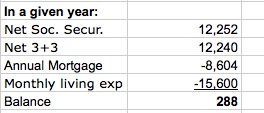
Well, yes I do. Over the course of an entire year, I have more than enough to pay the bills. Between Social Security and the income from teaching three sections a semester, enough comes in to cover regular bills, pay for necessities, and leave a little to spare. You don’t see that when you look at month-to-month income. But if you back up and look at annual income, it comes into focus.

Videlicet: A year’s worth of income and outgo looks like this:

If I budget $1300 a month to supplement Social Security in covering discretionary and nondiscretionary costs, I just about break even, assuming I teach only three-and-three. But in fact, this year I’ve taught not six sections but nine, adding another $5,428 net to the bottom line. Thirteen hundred dollars is $200 a month more than I’ve been budgeting; it represents a more realistic figure in light of recent inflation. The income figures don’t include the $4,400 of RASL still owed to me in 2012, or the $2,000 or $3,000 income tax refund, or the annual American Express kickback, and so giving myself a little raise should be within reason.

Clearly, if I quit hoarding, I could afford to parcel out enough, month by month, to cover the bills. Occasionally there might even be enough to go out to dinner now and again.

One thing that’s made this not so obvious is that, in my terror that there just would not be enough to cover my share of the underwater mortgage on the downtown house, I started shoveling every penny of my salary directly into the joint account my son and I established to pay that mortgage. Over the summer, I had to stop doing that, because I needed the income from my summer classes to pay the exorbitant hot-weather utility bills. By the end of spring semester, however, I’d stashed enough in there to cover not only the three summer months but the entire year’s worth of mortgage payments.

This exercise made it clear that if I stopped doing that and instead transferred only enough to cover my part of the bargain, quite a bit of money would remain in my hands. Enough, indeed, to ensure that as long as I can dodder into a classroom, I’ll never have to draw down from retirement savings to put food on the table and a roof over my head.

Hmh.

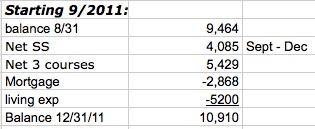
If I were to put all my salary into Survival Savings (a money market account containing the fund of cash I had at the time I was laid off, which I’ve been slowly consuming by way of delaying drawdowns from IRAs and brokerage accounts), I could transfer $717 a month to the joint mortgage-paying account and $1300 to my checking account…and come out smelling like roses! Survival Savings has a balance of $9,464, so if this scheme begins on September 1, the numbers fall out like this:

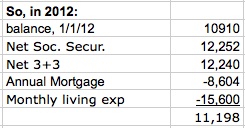
So what happens if I keep doing this in 2012? Again assuming I teach only three sections a semester, with no summer courses and no overload:

Yup, $288 to the good, not counting tax refund, 2012 RASL, the American Express card kickback, and the various other little windfalls that come my way. And that’s without having to teach in the summer! One summer course would cover emergency costs or keep me firmly in the black from now until Doomsday.

This zen-like strategy is made possible by the fact that I’d managed to squirrel away a substantial emergency fund while I was working full-time. After over 18 months, I still haven’t gone through it, despite a number of unpleasant financial surprises, like the $1500 on the teeth and the $800 on the car and the water bill of almost $200 and the power bill pushing $300.

So I can’t say that hoarding is a bad thing. Obviously, having built this stash by making myself think I was barely scraping by on $65,000 a year worked to my benefit.

However: it’s probably time to recognize that “Now Matters.”