
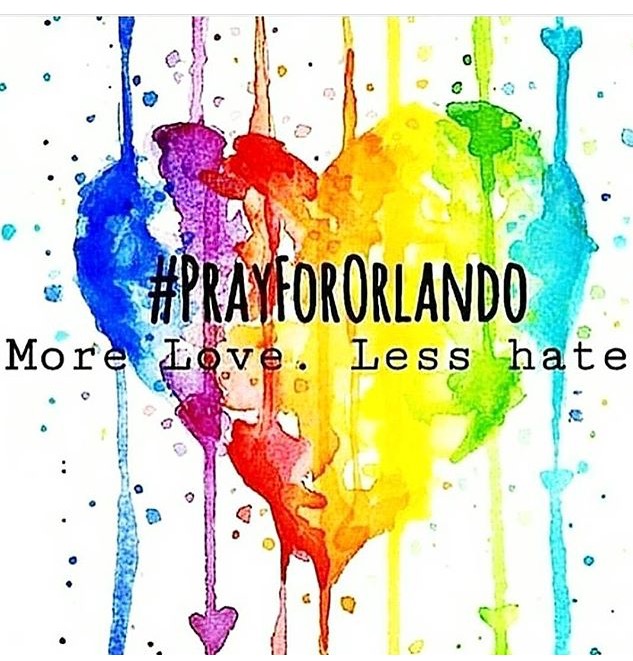
 Another atrocity occurs, and once again we have frenzies of screaming about everything from Islamism to gun laws. That the horrific event was not an act of foreign or even of true domestic terrorism doesn’t change the fact that crazies on the right think we must immediately ban all Muslims from immigrating and crazies on the left think we must immediately confiscate all Americans’ guns. That the perpetrator himself was crazy gets lost in the uproar.
The sanest conversation I’ve heard about the heartbreaking event in Orlando is taking place in a Facebook group called Writers of Nonfiction, where a member asked,
DO WRITERS HAVE A DUTY to give a voice to the feelings of important times? The news out of Orlando yesterday was horrifying in its scope for so many reasons. The internet responded by widely circulating Mr. Rogers’s “look for the helpers” quote. Prominent political figures scrambled to posture, and news outlets stepped over each other to try and scoop each new detail first. As a writer, do you feel you have a higher duty to bring your point of view to the much-needed catharsis of profoundly stirring events? In what ways are you moved — or not — to action or expression?
The responses, which went on throughout the day, were more than you could count: dozens and dozens. They were thoughtful, reasoned, and insightful, and as the hours passed they explored any number of issues related to the phenomenon of high-profile mass shootings.
Since it’s a private group, I hesitate to quote much of what is said there. But I have no fear of repeating what I said myself. 😉
One member remarked, in response to another comment, that he tried to “take the moderate approach, adding a middle ground that dilutes some of that whipping up behavior. As I mentioned, I feel I have an obligation to join the conversation, but I clearly have an equal obligation to do so with respect and consideration, never letting go with the off-the-cuff comments.” I came back with this:
Yes! It’s hard to stay moderate when something like this happens. And “Moderate,” alas, is not my middle name… That’s why, at least for me, it’s probably best to watch and wait before jumping into the fray.
That, to come back and address Barbara’s question, is not to say writers have no obligation to speak out. Those who think faster than I do and who are able to separate reasoning from emotion better than I do absolutely should put fingers to keyboard. Pour moi: I’m chronically mad as a hummingbird and really need to keep a grip on the opinions until the adrenaline passes.
I do not know when I’ve ever been so angry as when I learned the Orlando shooter was able to buy a street-sweeper even though the FBI was aware of his terrorist leanings. It has taken until this morning for me to remember the FBI abuses during the Civil Rights and the Vietnam War periods, and to remind myself that a citizen’s civil rights should not be curtailed because some government agency dislikes what he thinks. In this case, a “guilty until proven innocent” policy would have saved lives. But do we really want such a policy in place, all the time?
These are difficult, terrible issues. It takes time to think them through. I personally am not quick enough on my feet to start writing before some time has passed. But…writing is what we writers do, and what we should do when we have something significant to say on the big issues of life.
What a lot of stupid stuff appears in the media whenever a gut-wrenching event like this happens! Journalists must be trained to ask shallow questions and utter sappy things: that’s the only explanation. And we have the evidence.
I belong to a group whose members volunteer to let students at the Great Desert University’s School of Journalism to interview us, by way of preparing print and broadcast copy. And by golly, before the day is half-done, along comes this little quiz (complete, here, with my responses):
• What most concerns you about the shootings? Are politicians and community leaders addressing those concerns?
The politicization of the event: everyone is jumping right on the bandwagon to push his or her special agenda. Politicians and community leaders by and large ARE the concern.
• Does this shooting change the way you think about your safety? Is there anything that should be done about public safety in Arizona?
Question 1: No.
Question 2: Yes. Improve mental health care and make effective mental health care services available to unstable, mentally sick individuals. All of them. Without cavil, without stigma, and without excessive cost to the person.
• Do you fear terrorism is becoming more prevalent in America?
No. Of course not. Please don’t promulgate such silliness. In the first place, the perpetrator was not a terrorist. In the second place, an efflorescence of madness is not an act of terrorism.
You’re many, many times more likely to be hurt or killed by a lightning strike, a car wreck, or a fall from a ladder than you are to be harmed by a terrorist.
• Do you consider this a hate crime? Why or why not?
To the extent that a mentally ill individual can commit a crime, obviously it’s a “hate” crime. This demented soul was consumed with hatred. Evidently he was not actually associated, in any real way, with any of the terrorist groups who are our self-appointed enemies. Thus his act was not terrorism in the sense of war-like acts motivated by political goals. Clearly his act was motivated by hatred.
• Has the Orlando massacre affected any community you belong to? If so, how?
Of course everyone is disturbed, heartbroken, and angry. Many of my friends are gay, lesbian, or trans, and about 99.8 percent of my friends are Americans. All of them are horrified and grieved.
• How should we talk to children about what happened in Orlando? What do we tell them?
I wouldn’t know. It’s been a long time since I had a child around, and when I did, children didn’t have access to social media and electronic tools that expose them not only to responsible reports but to lurid alternatives. I don’t envy parents today.
I have one more thing to say about that, and then I will sit down and shut up:
All through the day, NPR journalists repeated the phrase “the deadliest mass shooting in U.S. history.” They said that over and over, about every five minutes. The meme was picked up, seemingly on every news outlet in the land.
Folks. Fifty victims “the deadliest mass shooting in U.S. history” do not make.
Leaving aside Wounded Knee, where 150 men, women, and children were massacred by Euro-American soldiers, the ground is littered with corpses, white, black, and Indian.
• In 1877, for example, a band of US soldiers and civilian volunteers attacked a Nez Perce village as the residents slept, slaughtering 89 men, women, and children before the Indians fought them off.
• In 1872 — right down the road from where I write today, my friends — US troops and Indian scouts killed 76 Yavapai Indians who had taken refuge in a remote cavern in the Salt River Canyon, today known (aptly) as Skeleton Cave.
• A year before that, the ex-mayor of Tucson and a group of Mexican and Yankee followers with about 100 allied Pima Indians attacked a band of Pinal and Aravaipa Apache men, women, and children who had surrendered to the US Army and taken refuge next to Camp Grant. More than 100 were killed; a sole adult survivor and a number of children were sold into slavery.
• On the ranch I used to own with several business partners, up out of Yarnell on the road from Kirkland Junction to Crown King, you could see the adobe footings of an old Indian village, up atop a low knoll that overlooked the area above the Hassayampa River. One time I asked our foreman, a grizzled old-timer who had known the Hole-in-the-Wall gang as a young fellow, what he knew about that. He said the villagers had been exterminated by the locals. And, he remarked, “it was a good thing.”
• Native Americans have not been the sole targets of our historic atrocities. In 1857, a band of Mormons attacked a wagon train passing through southwestern Utah. They killed 120 men, women, and children.
• Not quite in the same category, but close, were the race riots that took place in Tulsa, Oklahoma in 1921, during which some 300 people died.
The episodes barely scratch the surface.
Please. Let us contain our hysteria. The explosions of madness we see today among our neglected mentally ill and our hate-infected enemies are truly hideous. But in the interest of our own sanity, we need to cling to the truth and to keep the facts in perspective.
I wish I could say that the attack surprised me, but it was only a matter of time. We can all clasp our hands and talk about how horrible it is, but only those who deny the reality of the country we live in can truly be surprised by this attack. Hatred toward the LGBT+ community is widespread and is tacitly/overtly condoned in our education system, in our political system, and in our religious institutions. In the US we often hear of how barbaric non-Christian religions are when some extremist religious leaders/followers cheer these types of events, but blindly ignore while some Christian leaders/followers do the same within this country. Our politicians are busy crafting religious freedom (only if you mean Christian) bills and bathroom legislation. Combine widespread support for the hatred of a minority group with a lack of mental health care and easy access to weaponry in this country and no one should ever be surprised when one of these attacks occur.
As a gay man in my 30s, I have heard my entire life the vitriol spewed from religious “leaders”, politicians, through the education system. I spend my entire life with one eye assessing is my life in immediate danger simply for being gay, doing the calculated risk assessment before holding my partner’s hand in public or giving him a quick peck. My partner and I want children, but it terrifies us that someone may harm our children simply because their parents are gay.
It’s impossible to deny that there’s a lot to what you say. Did you see the reports about THIS idiot? https://www.washingtonpost.com/news/acts-of-faith/wp/2016/06/14/pastor-refuses-to-mourn-orlando-victims-the-tragedy-is-that-more-of-them-didnt-die/
The Devil can quote scripture, hm?
The politicians busy crafting religious freedom (for themselves and their adherents) are not necessarily “our” politicians. Some of us are still capable of recognizing evil when we see it.
The church where I sing is open to gay couples — it has yet to be struck by lightning. And I know there are other organizations whose members open their hearts to gay and lesbian couples, because I know lesbian women who are associated with them. About the best you can do, I guess, is seek out groups of people who are given to common decency.
In the circumstances, it must be difficult to feel there are very many such groups. And it makes perfect sense, given the madness that surrounds us, to feel that one must be wary at all times.
Meanwhile, what can people of good will do?
Fight to unelect doctrinaire haters: get the fake “Christians” and the bigots out of Congress and out of state legislatures.
Demand truth. Do not let the chronic lies take over the national conversation.
Open your churches, your clubs, and your social circles to new friends of all racial, ethnic, cultural, and sexual persuasions; show them they are not alone and not hated.
Demand decent mental health care in this country!
Demand that military-style repeating automatic weapons be taken out of the civilian market. No one needs one of these things to bring down a deer — or even a burglar, for whom an ordinary shotgun will suffice.
Nothing right will happen here until Americans of good will rise up and throw off the tyranny of the crazies and their Big-Money handlers.
I work at a high school, and as I struggled to find a way to respond to the massacre, I leaned towards love rather than fear and anger – though I experienced a mix of rage and distress. I prepared a card for the LGBT community at our school on which I wrote a message of support and friendship on behalf of all staff and students. There are now hundreds of signatures on that card. Ours is a very multi-cultural school, and staff and students from a wide variety of religious, ethnic, and linguistic backgrounds put their names to that declaration of alliance. I hope that everyone in LGBT communities finds that people from outside those communities are standing by them – even people whose support they don’t expect to find.