Yesterday as I was chatting with the tile guy at the former home of Dave’s Used Car Lot, Marina, and Weed Arboretum (recently foreclosed upon, bought out of auction for $162,500, and resold to a flipper for $192,500), up comes a perky blonde Realtor. She was meeting a buyer there to eyeball the place.
Asked what they hope to get for the place, she showed me a listing sheet: $269,900.
Well. That’s not a disaster, all things considered: if they get $260,000 for it, the value of my house (relatively) at least will not drop below what I paid for it four years ago. My place certainly won’t sell for anything near $300,000 anytime soon (it was valued as high as a giddy $375,000 during the bubble), but at least I’m not going to go broke. Yet.
Really, as long as the new resident is not another biker, another furniture-flinging berserker, or another slob, the trade-off will be worth it. Cleaning up that pigpen across the street transforms this part of the neighborhood. If the place stays halfway decent, I can get rid of some more of the shrubbery designed to screen my front windows from the view of Dave’s hovel, which will improve the looks of my place considerably. And over time, without the drag of that run-down property, values should improve. If nothing else, at least the street is now a more pleasant place to live!
If you’ve been awake in the PF blogosphere lately, you’ve probably heard of Tip’d, a new personal finance social networking site that’s been a-building for awhile. Well, it’s out of beta format and has “gone public.” Check it out!
For some reason, it seems easier to use (to my mind, anyway) than other social networking sites I’ve looked at. The layout is really attractive—soothing to the eye and handsomely designed—but more to the point, it’s extremely simple to navigate. The right-hand sidebar gives you many clues to what’s current, with a “what’s hot” list, latest comments, and the “20 top tags” cloud. Though the footer is a long way down the homepage, it’s worth scrolling to for its links to handy tools and the community blog.
One narrative subplot in the ever-escalating media buzz over the economy is that the new fad for frugality, for paying off debts, and for living within one’s means is bad for America and bad for the global economy. When people stop buying, the story goes, retailers stop selling, lenders stop lending, importers stop importing, and manufacturers stop manufacturing. All the worthies in these sectors then close stores, go belly-up, and lay off employees, who are forced to behave frugally, pay off their debts, and live within their means, causing more retailers to stop retailing, more lenders to stop lending, more importers…and so on to infinity.
So it is that seedy characters like you and me, eccentrics who subscribe to the wacky theory that we should spend no more than we earn, refrain from buying every piece of junk set under our noses, and maybe even put some of what we earn into savings, are responsible for bringing this country to the brink of depression.
Yes. That’s you and me, fellow PF blogger: our little terrorist coterie has darn near brought about THE FALL OF THE AMERICAN EMPIRE! Worse! THE COLLAPSE OF THE ENTIRE PLANET’S ECONOMY!
Think of that.
Well, I am thinking of that. And I think not.
The way I see this, we’ve arrived in our present predicament not because consumers stopped spending but because they spent so much, so profligately, and so stupidly. Consider: If over the past two decades 80 percent (say) of Americans had been living within their means—if they had been educated adequately on personal finance matters and understood the basics of lending, saving, budgeting, and investing—we would not be in the mess we’re in.
Most Americans, having navigated clear of the shoals of unmanageable debt, would have plenty of money to spend on the things they need and—yes!—want.
Few people would have been naïve enough to get themselves into booby-trapped mortgages for absurd amounts of money that King Croesus himself couldn’t afford.
Most people would have had a fair idea of what a house is really worth. Because the public in general would have resisted buying at absurdly inflated prices, real estate prices would never have blown out of control, and so no housing crisis would have occurred.
Retailers would still be selling products at a steady pace.
Manufacturers would still be making products at a steady pace.
Layoffs would not be occurring.
The President of the United States would never have thought of responding to the horror of 9-11 by telling Americans to go out and spend themselves silly. (Who knows? Maybe his speechwriters would have been forced to come up with something more worthy of a world leader, like “We have nothing to fear but fear itself.”)
Nope. We ants are not responsible for the collapse of the economy, nor are we the ones who are digging its grave. The grasshoppers did it. The grasshoppers and all the greedy little critters who got rich off them.
The newfound penchant for frugality that the newspapers and broadcasters tell us is now the hot fashion will no doubt pass. But if it doesn’t, that won’t be a bad thing. We will have hard times—we’re going to have hard times whether we all go out and load up our credit cards or not. But if members of the American public learn to get a grip on their spending and figure out how to manage their money so they can have what they want without getting themselves over their heads in debt (or if, more amazing still, they figure out what’s really important in life), in the long run the economy will be healthier and stronger. And the world will be a better place.
At what I hope is the right site this time, Make It from Scratch has posted this week’s Make It from Scratch Carnival, where Funny’s discovery about olive oil as the skin care product from heaven gets a mention. In the “Wish I’d Though of That” department, FWP came up with an awesome idea for clothesline rope, described at Financial Wellness Project. If you’re into amazingly wonderful food, you’d better check out Mary’s recipe for wild mushroom strudel at Simply Forties. If that’s not enough to impress your Thanksgiving guests, follow it up with Mama Bear’s thick & chewy chocolate chip cookies at I’ve Got a Little Space to Fill…good grief! And if you enjoy photos of extremely cute kids and tales of what moms will do for them, check out ChristineMM’s great story at The Thinking Mother.
Financial Wellness Project hosts the 152nd Festival of Frugality, where the recession has come home to roost. Funny’s plans for living in poverty over the next 2½ years appear there. Credit Withdrawal reports that frugality has become fashionable, highly entertaining. John is Fit reveals four ways to get PR people to send you free stuff (fifth way is to get on the staff of a popular magazine!). The Shark Investor comments, as I did Monday 11/18, on the new trend to blame the deprecession on frugality. This festival has about a jillion really interesting posts—if I highlighted all the ones I’ve enjoyed I’d probably have to paste the whole post in here. Be sure to make a visit!
BTW, FWP announces a new blog carnival, the DIY Jubilee. This sounds like fun—check it out, and send in a submission; next deadline is Nov. 23.
Spent all of yesterday afternoon at a little party helping a friend go through her deceased mom’s clothing. Some of it. The challenge: decide which pieces, in about ten huge bagsful, should go to the consignment store and which should be yard-saled or sent to Goodwill. Press, fold, and box the consignment-worthy stuff; bag the yard-sale stuff.My friend has already earned enough to take a nice vacation by consigning earlier rafts of the mom’s clothes, and she still has many bags and boxes of stuff left to go. So far, she’s made $1,500 selling clothing through consignment. I’ll bet she’ll tote another $800 worth to the store today.
Mom was a lively gal, very funny and charming. She LOVED clothes, and shopping for clothes was her main source of entertainment. Mother and daughter often shopped together. Most of the stuff they bought wasn’t very expensive—Mom worked at WalMart. But she had a real flair, and quite a lot of it is very cute. She was a sucker for sales, and so much of it was bought at deep discount.
The result was that her apartment was chuckablock full of stuff, stuff, and MORE stuff. The clothing alone, as you can imagine from the prices it’s fetching, was enough to stock a boutique. Then there were the mountains of perfumed bathing supplies, makeup, and various bric-a-brac.
Well, she always looked nice.
As a confirmed cheapskate, this habit amazes me. She was far from wealthy. The only reason she finally got out of a cheap rental in a less-than-ideal part of town and into a little condo was that near the end of her life she inherited a small sum of money. I find myself wondering how much better she could have lived—or even IF she could have lived better—had she bought about a sixth of that amount of clothing over the years and done something else with the money.
I don’t know whether she paid for the stuff in cash or ran a tab on a credit card. Either way: she ended up with money out of pocket and a vast clothing collection in house. Many pockets, we might say, with little or nothing to put in them.
What would have happened if she had put, say, $200 a month in savings instead of into pants, tops, skirts, loungewear, and dresses?
Would it have mattered? She suffered diabetes and failing kidneys. Saving $2,400 a year wouldn’t have extended her life, and it’s hard to imagine that the occasional plump bank statement would have done much to make her life better. If buying clothes made her happy, why not? She supported herself adequately and didn’t depend on anyone else financially.
The only downside, of course, is that the clothing collection poses a huge burden for her two daughters, each of whom has spent uncountable hours trying to deal with a Himalayan range of outfits. Yesterday three women spent five hours sorting through bag after bag after bag of stuff. Even after we kiped the things we wanted, we still filled four big baskets to overflowing for consignment and repacked a half-dozen big black yard bags with yard-sale stuff. And that was only a tiny part of the job my friend faces. On the other hand, going through all the stuff reminded us of her mom, a great old gal who should never be forgotten.
Okay, so the bee dude showed up yesterday noon. He looked at the composter and said the bees had taken up residence in there, and that normally in an object shaped like that, they’ll attach their hive to the top (as in the top of a cave). This meant, in his humble opinion, the bees had built a colony on the backside of the compost lid.
He felt the only thing to do was to exterminate them.
Shit.
One of my quirks is that I hate, loathe, and despise insect sprays. Exterminators are not allowed near my house. Though I’ll use some boric acid and, in extreme cases, traps on ants or roaches, I don’t allow spraying. Instead, I keep attractions away from the living quarters and encourage insectivorous birds to visit frequently. And, except for the mosquitoes from the swamp behind Dave’s Used Car Lot, Marina, and Weed Arboretum, I never have any insect issues.
It took a while to reach that harmony. When I moved in to The House from Hell, Satan and Proserpine’s* pet ants had built an ant metropolis that I’m sure extended all the way down to Satan’s favorite throne in Hades. The place had roaches, too, although not in the gay profusion characteristic of other dwellings I’ve enjoyed. Oddly, there wasn’t a single black widow or scorpion to be found.
The place was barren: no trees except for two young willow acacias, a ridiculous sort of tree whose branches aren’t really strong enough to support the weight of a roosting bird or a bird nest. The one in back was planted directly upwind of the pool, so that summer monsoon gales blow bushels and bushels of Devil Pods (I call the thing the Devil Pod Tree, in honor of the previous homeowner) and stringy, pool-cleaner-clogging leaves directly into the water.
As soon as I got moved in, I planted four new trees in the backyard, buying the largest specimen trees my budget would tolerate. I also cultivated a number of bird-attractive shrubs. Although most birds will eat ants, what I really needed were thrashers, towhees, and woodpeckers, plus a nice tribe of geckos. A mockingbird or two would help, too. I put up two big bird feeders, knowing that insectivorous birds will usually come along for the ride if they see a lot of seed-eaters around. ThenI planted some roses and mulched them with a thick layer of bark chips, a substance much favored by small bug-eating lizards.Before long a pair of towhees took up residence. A woodpecker showed up and made short work ofthe cockroaches residing in the detestable palm trees. It took a year or two, but in time the birds and the geckos brought the ant situation under control—you hardly ever see an ant nest in the yard anymore,and when you do, it’s a normal, healthy ant colony, not a berserk ant empire.
Applying insect spray in the backyard will disrupt that equilibrium, and before you know it, all sorts of problems will arise. No bees, no pollinated flowers. No pollinated flowers, no seeds. No seeds, no birds. No birds: ants, crickets, grasshoppers, and roaches coming out the wazoo!
It’s interesting that even a guy who cultivates bee colonies in his backyard assumes it’s normal for people to be afraid of insects. He very clearly thought I was and should be frightened of the bees foraging for pollen in the acacia tree.
What is it with that? What about something that’s an inch long should scare you? For crying out loud. Yeah, it’s true that some insects will bite you—most annoyingly, fleas and mosquitoes—and that some carry disease. But there are relatively easy ways to deal with that, not the least of which is getting rid of swamplike puddles on the bottom of drained swimming poools.
And yes, bees do sting if you piss them off. Duh! The trick is don’t piss them off!
The term “killer bees” is an obscenity coined by the infotainment media, who sell papers on the “if it bleeds it leads” theory. Long before Africanized bees came along, plain old boring European-style honeybees were known to swarm humans, dogs, and horses, and working together they also can deliver fatal doses of venom. The difference is that the African strain of honeybee is a little crankier than the variety that evolved when the ice ages chilled Europe, cooling the temper of the bee along with the climate. Also, European bees are less likely than African bees to build their nests near the ground, where humans and pets can mess with them.
The bee dude seemed set on eliminating the bees not only from the composter beneath the willow acacia but also from the acacia itself. No amount of explaining that I like bees humming around the puffball blossoms festooning the willow acacia in back seemed to make him understand that I didn’t see a problem with the bees in the acacia, especially since he stated the foragers were not the builders of the hive.
If the new residents had settled into some out-of-the-way spot, I probably would have sent our boy on his way. But the fact is, they had occupied a device I use several times a week, located in a place where the dog and I both move around all the time. Being that they were no doubt Africanized, sooner or later we were going to piss them off.
Well, he said he’d apply a powdered pyrethrin to the composter and this would do in the hive. It also would do in a year’s worth of organic compost. Then he goes on about how the surviving bees will still be clustering around the hive area for three days to a week and I should be careful to keep the dog away from there and stay away from it myself, and so forth.
Unhappily, I agreed to this, since I figured a colony of potentially touchy bees near the ground in an area where the dog and I are likely to disturb them did pose a hazard.
So he went off to do his thing.
Pretty quick he shows up and informs me that he’s finished, and I’ll be pleased to know there was no hive inside the composter.
Huh?
No. They were foraging for something in the composter.
That’s when I remembered I’d dropped some old toast that had a bit of honey in there. Sumbitch. Well, say I, then you didn’t have to kill them?
Oh, no, he said proudly, he had dumped pyrethin powder all over everything and all over the inside of the composter. They’re all dead.
Uhm…so my compost is ruined?
Oh yes. In a few days you’ll want to put on some gloves, get rid of the compost, and scour the composter inside and out first with detergent and then with bleach.
Well…uhm…if there was no hive inside there, why did you dump insecticide all over it?
Because, said he, he didn’t realize they hadn’t built a hive until after he’d already applied the stuff.
Ducky.
Well, this morning there’s not one bee anywhere near the acacia. You’ve heard of Silent Spring? In Arizona, fall is spring. What we have in my backyard is Silent Autumn. It’s dead quiet out there. And I use the word advisedly.
Sometime this weekend I will have to roll the compost barrel out to the alley. Being an old bat, I don’t have the physical strength to scour a thing like that inside and out, first with detergent and then with bleach. So I guess it’s done for, along with 40 pounds of beautifully ripened compost that I was about to use to build a new vegetable garden. I’ll just have to roll it into the alley and leave the whole arrangement for the trash pickup.
Lhudly sing goddam!
*Satan and Proserpine: the previous owners
Gecko: ZooFari
Towhee: Alan D. Wilson
Thrasher: Charles & Clint
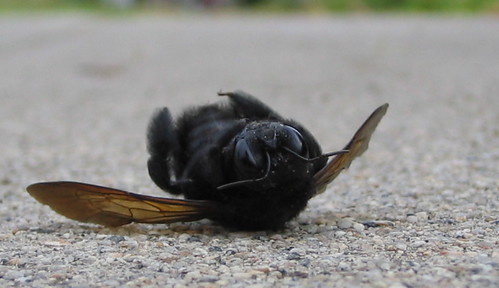
Dead bee: jilldoughtie