
What’s your preference? A real tree or a fake one to stick in your living room and adorn with Christmas lights and gewgaws? Over at Bargain Babe, the conversation is under way: she lists the pro’s and cons of each (fake ones are cheaper over the long run but shed pollutants—maybe even lead—and are expensive upfront; real ones are cheap as a one-time cost but cost more over time, and besides, they suck up fuel), and then leaves it to readers to consider.
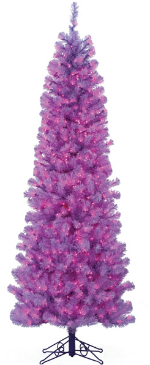
Reminds me of my misbegotten childhood. Growing up in Saudi Arabia, of course, we had no access to any kind of tree, unless you count the occasional date palm as a “tree.” Everyone had fake trees, purchased at the commissary.
When I was small, my mother had a weird white thing made of…what? some sort of early plastic? Nylon? I believe it came with its own built-in colored Christmas lights. It was about two feet high. She would put it on a table, drape the table and base of the…uhm, “tree” with white flocking to suggest “snow,” and that was that. Far more interesting to a little kid was the tableau she built by arranging some of the flocking around a small metal mirror set on a table and then placing a couple of plastic reindeer atop the mirror. This was meant to evoke wild game standing on a frozen pond.
All very fascinating to a child who never saw snow until she was almost 18 years old.
Not too long after my first exposure to snow, I got my first exposure to marriage. My husband insisted on bringing a real pine tree into the house and setting it up in the front window.
This custom has always mystified me. What is it about killing a living thing and then watching it wither for two weeks that appeals?
Oh well.

For some years, we had these trees. The house we’d moved into had thick, luxuriant shag carpeting. Know what dead pine trees do? They drop their needles. The needles—scores of them!—would work their way into the warp and woof of that fancy shag carpet.
As it develops, there’s a reason pine needles are called needles. I would walk around my house barefoot. For months after Christmas, whenever I’d walk into the living room, I’d get a jab on the bottom of the foot! No amount of vacuuming could get all those damn needles out of the carpeting.
Mercifully, the price of Christmas trees outpaced the double-digit inflation of the 1970s. One year my husband allowed as how the tree business was getting a bit out of hand.
That was when we got the Christmas jade plant.
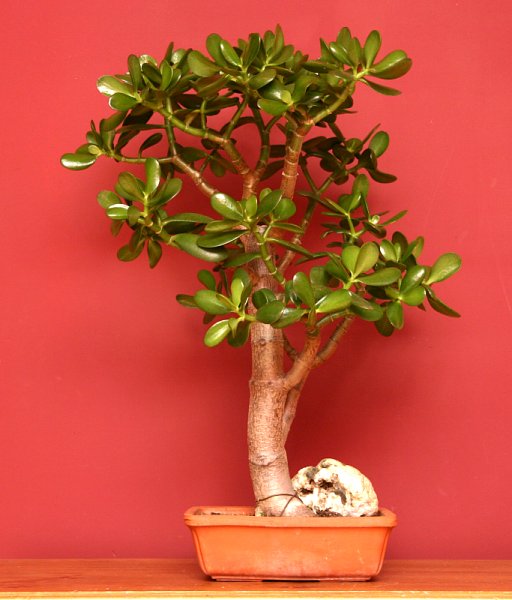
As was the fashion in that decade, I had put a jade plant on a stand in front of the south-facing two-story-high window that graced our living room. The jade plant shivered with joy and soon grew to be something of a jade sequoia: large and green and muscular.
Come Christmastime, I started decorating the thing with ornaments and aluminum icicles.
It worked. For several years we were free of Christmas trees, thanks to the Christmas jade plant.
Eventually, though, the jade plant got a fungus and croaked. By then my husband was making an income that was large and green and muscular. The Christmas tree discussion returned.
Don’t remember how, but I managed to convince him that we preferred a living tree. I must have threatened to sue his a$$ if I ever got another pine needle in my foot. At any rate, however it came about, after the demise of the jade plant we took to buying small potted pine trees at Home Depot. These would survive for two or three years in a good-sized pot. Once Christmas was over, we’d tote the living Christmas tree outdoors, water it well, and there it would reside for a year. The following winter it would be hauled back inside, tormented for two or three weeks, and then dragged back outdoors.
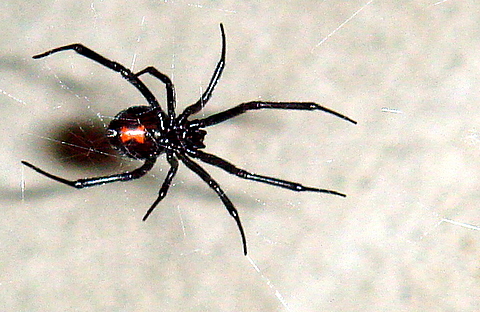
Well. You know, a tree is its own little habitat. Certain creatures like to live in trees. Some of these creatures like to lay their eggs in trees. One such creature is the black widow, Arizona’s finest earwig-, mosquito-, and cockroach-eating machine. This worthy arachnid is nice to have around the house. The outside of the house. It’s not something you want indoors, because it can deliver quite the nasty bite.
One year while the living Christmas tree was enjoying the out of doors, one of the ladies deposited a clutch of eggs in its boughs. When we brought it inside, the warmth of the heating system caused the babes to hatch.
Do you know what happens when a clutch of infant black widows gets into the air-conditioning ducts of a 3,300-square-foot house? No? That’s good. It’s best not to know.

The following Christmas we acquired a very convincing green phony Christmas tree. A fakenbaum, as it were. It was so believable that the only way you could be sure it wasn’t real was by the absence of pine pitch aroma. That, and by walking across the carpet barefooted.
The fakenbaum lasted for many years. I rather liked it. It didn’t hurt my feet. Setting it up inside the house didn’t entail killing anything. And the only thing that wanted to live in it was a vintage plastic troll.

Images:
Alarming purple fake Christmas tree: Santa’sOwn.com, Creative Commons Attribution-Share Alike 3.0 Unported license.
American Christmas Tree. Iknowthegoods at en.wikipedia. GNU Free Documentation License.
Jade plant: Crassula ovata presented as an indoor bonsai, Emmanuelm (talk), Creative Commons Attribution 3.0 License.
Credible fake Christmas tree, Mfisherkirshner, Creative Commons Attribution 2.5 Generic license.