

Lately I’ve been considering where I’m going to live during the next and presumably last stage of my life.
It’s a question that was brought into sharper focus when I fell and hurt myself badly enough that I couldn’t easily take care of my home or myself. The shoulder still isn’t healed—but even though it hurts quite a lot, on and off, all the physical work around this house still has to be done. Caring for the pool (a daily project), dealing with the quarter-acre yard, cleaning and maintaining a four-bedroom house…they all represent physical labor. And there’s no one here to help. Just now I ache all over my body, as though the shoulder pain spread to every other joint all the way down to the toes. But none of the work can be put off just because my back hurts.
Clearly, I’m not going to be able to care for this house for many more years.

Then there’s the issue of the costs. Property taxes can go nowhere but up, and at $2,000 a year they’re already at the border of what I can afford. Because I have retirement savings, I don’t qualify for the cap on taxes for the elderly. Though the new AC repairman clearly was trying to scam me, the truth is that sooner or later the HVAC unit will have to be replaced, to the tune of around $6,000. The interior needs a paint touch-up, and the exterior will have to be repainted sometime in the next five years. There’s a crack in the living-room tiles, an ominous development. In another five years, too, the pool will need to be replastered, a $7,000 job. Power and water bills keep going up and up. With no credible source of steady income, where on earth is the money going to come from to cover those expenses?
And who is going to take care of me when I can no longer care for myself?

This train of thought brings me to consider the best thing my father ever did for me: he moved himself into a life-care community. After my mother died, he sold his house in Sun City, divested himself of his possessions, and used the money to buy into a Baptist-run independent living community. This gave him (and later, his new bride) a garden apartment, access to hobby and meeting rooms, two meals a day in a central dining hall, and guaranteed access to nursing care.
For me as his daughter, it meant I didn’t have to take care of him as he grew older and more infirm. When he had a heart attack and triple-bypass surgery, the institution moved him temporarily to a studio apartment next to the nursing home, where an RN checked on him several times a day to be sure he was taking his meds and to coax him to eat. And after he had a stroke, the only medical practitioners who would care for him and respect the wishes he had expressed in his living will were the staff of nursing home at the life-care community.
It wasn’t ideal. The food was awful. The doctor on the staff was ripping off Medicare right and left. The institutional setting was depressing—at least, I found it so. But it probably was better than the situation he would have faced had he tried to stay in the Sun City house for the rest of his life.
After he died, I discovered the staff had provided him with a lot more care than he had contracted to receive. A woman in the central office spent a fair amount of her time running interference with the various bureaucracies the elderly have to negotiate. As he grew more confused in age, he would occasionally mess up his checkbook; someone at the office went through and corrected his figures, balancing and reconciling them against the bank’s statements. So. He got his money’s worth, and then some.
I wouldn’t care to live where he was. They’ve torn down the garden apartments and replaced them with massive people warrens. I’m not a rabbit or a caged chicken, and I don’t want to live like one. However. There are alternatives.

My great-aunt was the one who turned my father on to life-care communities. She came to Arizona one year to visit several such outfits, which at the time were a new development. She sold her house in Sausalito and ended up in a place in Oakland—I believe it probably was this one. From what I understand, it was very pleasant. One could find worse places than the Bay Area to live out one’s last years.
Interestingly, it’s run by my correligionists, the Episcopals. Not that it matters. The Baptists were no less craven than any for-profit outfit about extracting funds from the inmates where my father lived, and I can’t imagine that would differ according to the proprietors.
The Episcopals run a number of life-care communities in northern California. There’s this rather amazing place in San Francisco, for example. I’m sure I can’t afford to live in the City, of course…hell, I can barely afford to live in Phoenix! Here’s a place in the Santa Cruz area that might be less extravagant than living in the heart of San Francisco. One in Pacific Grove, which is near Monterey, probably costs no less than the place in the City. More promising, possibly, is this one near Santa Rosa.
My aunt had enough money to be comfortably set. She and my uncle married in middle age, neither of them with children. They both worked for the California Academy of Sciences their entire adult lives, and my uncle invented the precursor to the Kodak Carousel slide projector. As you can imagine, even a small royalty would have allowed them to buy the architect-designed house in the Sausalito hills where they lived all the time I knew them.
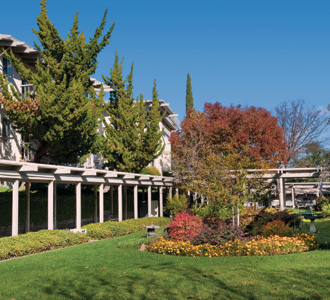
Chances are I can’t afford any of these places. My father and his wife were paying, for a three-room apartment and two meals a day, more than my ex- and I paid for a 3,000-square-foot ranch house with a pool on a third of an acre of prime North Central real estate. On the other hand, most of their food, their utilities, transportation (to a degree), property taxes, insurance, semiweekly housecleaning, landscape care, and nursing home insurance were included in the cost.
I already have nursing home insurance, though I suppose I could stop paying on that. But even with the long-term care insurance, my total monthly bills come to less than my father paid for his dim little apartment. And that was for a not-very-appealing place in Phoenix, Arizona. The cost of living in northern California is so much higher that you likely have to be a dot-com millionaire to live in one of those places.
Nothing ventured, nothing gained, though: I’m sending away for their propaganda packages.
These are very expensive, but I remember reading that prices have gone down a lot recently–with the housing bubble burst.
If you choose the one in Santa Rosa, I can come visit. I have relatives nearby.
You should check the Terraces. Close to your neighborhood. My dad lived there. Expensive to get into- probably the cost of your home- but located nicely by the mountain….and the Mexican food across the street- YUM!
I worked at the other place. Sometimes it was dingy- but the staff was wonderful. Human connection is what it is about at the older end of the spectrum.
@ FrugalScholar: That would be fun! We could run amok in that part of the country…lots of great food and great shopping.
@ Jan: That’s the place my father lived: Orangewood redux. Yes, the staff was absolutely excellent, except for the doctor who gave my stepmother an endless series of psychoactive medications, two of them addictive, and never kept any record of what he’d prescribed. She ended up in the nursing home after the side effects made her appear to have slipped into senile dementia; only after her daughter discovered what she’d been swallowing, looked up all the meds and their effects, and demanded that they take her off all the junk cold turkey did she recover her wits. My stepsister was a superior court judge and no one (but NO ONE) dared to buck her; otherwise I’m sure she wouldn’t have had much luck getting them to do as she asked.
Nor, I might add, was I pleased myself, when I discovered that the same doctor was billing Medicare for office visits and exams after my father had explicitly fired him, in writing, told the guy to stay away from him, and had not seen him in months. When I told my father that we needed to report the deception to Medicare, he forbade me to do so, because he was afraid that making a stir would get him in trouble with the administration.
The other issue I had with Orangewood was the recurring plagues of “stomach flu.” About every six months, everyone in the place would come down with violent diarrhea, all about on the same day. When everyone got sick in synch, it was hard to avoid the suspicion that this was food poisoning, possibly the result of something going on in the chow line that wasn’t up to par.
There are plenty of people who choose to age in place rather than submit to institutional living. You can always pay someone to mow the lawn while you recuperate. That’s what I did for the 3 months of recovery I needed after surgery.
Yes, house repairs are expensive, especially on an older house. Once you get into your 70s, there’s always a reverse mortgage you can turn to if you run short of cash.
I’m 50, live in a circa 1930 house and still mow my acre and a half. My taxes are $6,500. It’s not cheap, but i would buy a condo before I ever considered an adult care facility.
@ fern: Yes, I’ve thought the same: that for about the same cost my father might have managed to get the same services by hiring people. On the other hand…it’s not so easy to find reliable, honest help. As you get older, you become more vulnerable, and so there’s an element of risk involved in hiring strangers to come into your home — often you simply lose the discretion and strength to figure out who should be there and who should not.
In the months between my mother’s death and the time he moved into the life-care community, my father actually took in some guy as a roommate temporarily. That was creepy. I don’t even know where he found this man; he apparently was a homeless man my father had somehow stumbled onto. I saw that happen to a dear friend, too: in her 80s as she was struggling with colon cancer, she rented her garage to someone who was supposed to help out around the house. All that person did was take advantage of her.
I’m pretty vigorous for a woman my age. However, I couldn’t and wouldn’t mow grass (if the house had it) in 115-degree heat — it’s utterly beyond my physical capacity. You’ll be surprised at how much strength and ambition you lose in 15 years. At a point, you not only don’t feel like throwing yourself around that way, you simply see no point in it. This is especially true if you get hurt or sick.
Good god! Sixty-five hundred in taxes? Where do you live? One thing is certain: if I had to pay $6,500 in property taxes, staying in my home would be out of the question. Annually, insurance on my house and car come to $1,900, which has to be self-escrowed along with the $2,000 for the taxes; that comes to a $325 monthly setaside. I strain every gut to come up with that much. If I had to disgorge $6,500 to keep the government from confiscating my home, somehow I’d have to come up with $700 a month!
That would be beyond my means. I absolutely do not have enough income to pay that, period. How do people in your part of the country stay in their homes after they retire? You’d have to be pretty wealthy to be able to scrape that much together on top of the $200/month for Medicare…before you even begin to cover little details like food, water, and power.
LOL! I guess that explains how all those Midwesterners and Californians got to Sun City! 😉
A condo seems a good interim solution. Less maintenance, more time to play!
Or perhaps a “Boston spinsters” arrangement? Find someone ethical who is willing to go halves with you on home ownership & upkeep – even if it means you selling your home and buying half of theirs. Between the two of you, you could more readily manage maintenance and upkeep, whether paying for it or doing it.
Or might there be someone from your church who can be relied upon to enter into a room-for-labor arrangement with integrity? Put the arrangement in writing, and keep good records as it is lived out.
There are plenty of horror stories, true, but also lots of possibilities for someone who is willing to think creatively.
Say, whatever happened to the possibility of living in the investment house you co-own w/your son? Less labor & money expensive to maintain, yes?
We downsized from a single family home to a condo just because it’s easier to keep up. The HOA takes care of gardening and maintenance of the outside of the building (and pool). That frees us up to only maintain the interior).
Without exposure to adult living facilities I can’t add to the converstion but can’t wait to learn about it as you check out the “propaganda”.
@ Bucksome: You won’t believe! Just waiting for a few more packages to come in before writing some more about this.
I’m wondering what a typical HOA fee for a condo is. Anyone have a clue?
@ Vickey: I’m pretty sure that’s what my neighhbors behind me were doing, until one of them passed. The upshot of it was that Sally ended up doing most of the work around that place, and having to do all the nursing care for Catherine after C. had a stroke. It took C. 10 years to die, a long time for Sally to bear a very heavy burden.
The idea of seeing if women at the church would volunteer to drive an old lady to grocery stores is a good one. There probably would be someone or several someones. From what I can see, one of the biggest and most expensive condundrums in trying to stay independent after you reach the point where you can’t drive would be transportation. Without a car in a city with no viable public transportation, you really are in a pickle.