
Well, this gets more and more interesting.
The outfit to whom I sent the sliding door measurements returned a bid yesterday. And they revealed something that none of the other contractors, Home Depot included, bothered to mention:
Starting in 2008, the government began requiring window installers to test any house built before 1978 for lead. My house, of course, was built in ’71. If they find lead paint, they have to jump through an elaborate set of hoops to “contain” lead dust during their installation, which can involve draping all the shrubs and trees with plastic (you realize how tall a mature tree gets???), setting out orange cones and taping off your home (wait’ll the neighbors see that), keeping the homeowners out of the dwelling until the work is done and cleaned up, and on and on. Penalty for evading this hassle is $32,400 per violation, with potential jail time.
All these shenanigans add to the cost of an already expensive procedure. Changing out a window is not cheap to begin with, and the contractor in question adds $150 to the cost of the job if your house tests positive.
Not one of the three other people I’ve spoken with even mentioned this in passing.
And of course, if your house tests positive for lead—which mine certainly could, this being the Wild West where people don’t give a damn about safe anything, especially if warnings come from the hated government—then you’re required to disclose that when you go to sell. If you have to tell a buyer that your house has a coat of lead paint under all those pretty latex colors, then you’re going to be SOL when it comes to unloading the place.
A house built in 1971 has a 24 percent chance of testing positive.
So. It may be better to leave bad enough alone. Obviously, you don’t have to disclose what you don’t know.
Another option would be to tell them to go ahead and do the lead containment procedure without testing. In that event, you still don’t know one way or another…but it costs you an additional $50 per window. Or more.
About the cost of the proposed new sliding doors, yesterday’s conversation added more to that complicated discovery process:
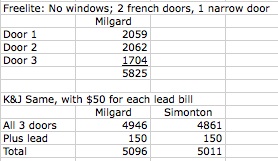
If the house does not test positive, and if by way of cutting corners I opt the windows and get the attractive wide rails on only two of the three needed sliding doors, then comparing apples to apples, Freelite comes in $800 higher than this new outfit, K&J, for Milgard windows.
Home Depot and Home Depot Direct did not give me estimates for the wide-rail style, despite my having told them specifically that’s what I wanted. K&J’s estimate for two wide-rail and one narrow-rail Milgard is about $600 higher than Home Depot’s bid for three narrow-rail Milgards.
K&J also can install Simonton doors and windows, which apparently are better regarded by builders than other brands in this price range. Here, the only other direct comparison is with HD Direct, which bid only for narrow-rail Simontons. With two wide-rail doors and one narrow-rail, K&J comes in only $256 more than HD Direct.
If the house tests positive for lead, you can add $150 to K&J’s bid. But even then, K&J comes in significantly below Freelite’s bid for Milgard, a more expensive door with a lesser warranty than Simonton.
It’s entirely possible that HD, HD Direct, and Freelite simply include the cost of testing and lead abatement in their figures. But it seems kind of odd that none of them mentioned it. On the one hand, if you don’t know the results, it means you don’t have to say anything to potential home buyers. But on the other…one wonders if the federal law doesn’t require disclosure to the homeowner.
LOL! Speaking of dissembling, the contractor for Costco got back on the phone yesterday and asked if he could come over, eyeball the windows, and give me a bid. I agreed to let him do that…and then remarked that HD wanted to sell me Simonton for the windows and Milgard for the doors.
He now says—get this!—that Home Depot owns Simonton. This is why, he says, they have a vested interest in getting you to buy Simonton windows.
That, as it develops, is not true. Simonton is owned by Simonton. The particular line HD Direct sells, called VantagePointe, is manufactured exclusively for Home Depot, but that does not mean Home Depot owns the entire company.
So I canceled that guy. Let’s hope he doesn’t show up anyway.
Well, we’re now at the start of a three-day weekend, so presumably I won’t hear anything from any of these bozos before Tuesday. Entertaining, isn’t it? Gets better and better.
ERGH! We had lead paint, so poor Mr FS–our housepainter–had to wear a gas mask while scraping and painting the house.
Hmmm, the breather mask s a sensible precaution, the plastic draped over the shrubs and trees sounds like — dare I say it — typical government overshoot.
@ 101Centavos: Apparently they don’t want lead getting on and into the soil and plants…especially if they’re plants people and creatures eat.
It’s a day late and a dollar short. If you live very near a road — any road, but especially in a city — that was used before the lead was taken out of gasoline (1975), the soil in your yard is full of lead. And it’s silly, because lead does not accumulate appreciably in plants, especially not in the fruiting parts humans usually eat (http://www.extension.umn.edu/distribution/horticulture/DG2543.html). If the concern is to protect insects that eat leaves, the solution is simply to wash the lead dust off the plants.
This sounds very complicated and the penalties and even the requirements themselves sound absolutely absurd. I can only wish that someone with common sense would examine those laws and strike them down.
High costs are bad enough but when you have to worry about legal things, it can be even worse. The laws have become far to complicated in many instances and we really need to simplify all of it.
Of course the more laws, penalties and problems, the more court cases there are and the more opportunites for a licensed attorney to make more cash.
maybe I should have been a lawyer!