
Finally sent the Eng. 102 and Eng. 235 syllabi off to the chair and his redoubtable admin, along about 12:30 a.m. That would be, yes, this morning.
Though I’m pleased with what I came up with, my God it was a lot of work! It took the better part of a week of the usual 12-hour days to rewrite the 102 course. And the desktop, because it’s so antiquated, runs with the speed of a stumbling snail. So last night it took a full half-hour to e-mail the 235 syllabus and calendar (which, thanks to the MacBook, I wrote while sitting on the sofa) over to the desktop, watch it grind away and grind away trying to open MacMail, watch it grind some more trying to open the files in Word, watch it grind more and more trying to open Acrobat Professional, watch it gasp and wheeze and grind some more at saving the files from Word to PDF, watch it grind and grind and grind merging the PDFs into a single document, watch it slooooooowwwwwwllllllllllyyyyyyyyyy upload the 102 and then the 235 syllabus-calendar lash-ups, and finally, and at half-past twelve, manage to send the damn things into the ether.
Still have to save the stuff down to the backup drive, but since the files now reside safely in MacMail’s “sent” folder, I gave up and went to bed.
The chair has decided he wants to see detailed week-by-week calendars with learning goals and activities for each section. This stuff would normally be on my websites—posts outlining learning goals and assignments go up automatically on Saturday mornings. To convert from WordPress posts to something that can fit in a table set up as a calendar takes freaking HOURS, even though I don’t have to write all new stuff.
Except…I did write all new stuff for the 102s.
{cackle!}
This is so cruel! I just love it. Half the students will flee to other sections when they see what the course will entail this spring. Then I’ll only have about 20 papers to grade.
The idea is to give them specific subject matter to write about. Last semester I did this by coming up with three general topics (the Great Depression in Arizona; communities [ethnic and otherwise] in Arizona; and urbanization and the environment, pertaining to Arizona).
They hated this, because it precludes recycling the puerile ramblings they’ve already written for other courses. And while the approach worked in the short summer term, which attracts brighter students, the fall bunch struggled (three of them confessed to not knowing what the word “urbanization” means, and one of them never did figure it out). The library’s resources are rather limited when it comes to local issues (electronic databases focus on national and international scholarship). And because most American students know so little about their country’s history and don’t want to know (some people are utterly lacking in intellectual curiosity), many failed to come up with workable paper topics. This, despite days of in-class brainstorming and coaching.
So, this semester they will have one large topic—Prohibition and the Great Depression—and instead of having to craft their own topics, they will choose topics of my devising.
What took so long to rebuild the 102 course, then, was coming up with 90 workable paper topics about U.S. and international history of that period. Make that 90 linked paper topics, so that each student can write three papers on roughly the same subject, the issue being that unless they’ve done some of their research for the 2,500-word position paper early in the semester, they don’t have a chance of coping with a ten-page end-of-term paper. Videlicet:
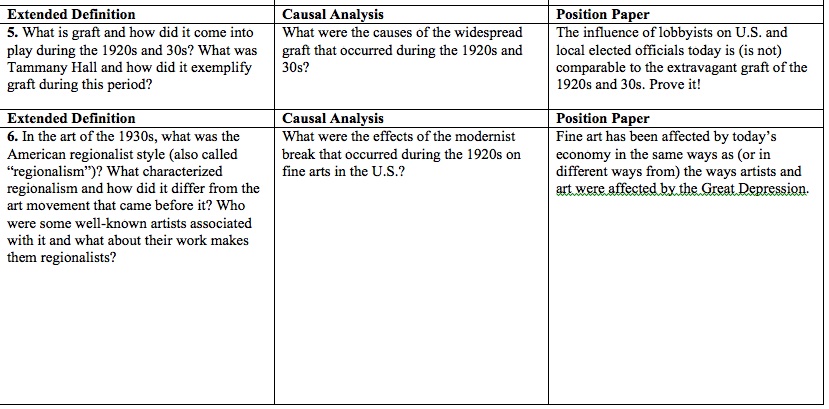
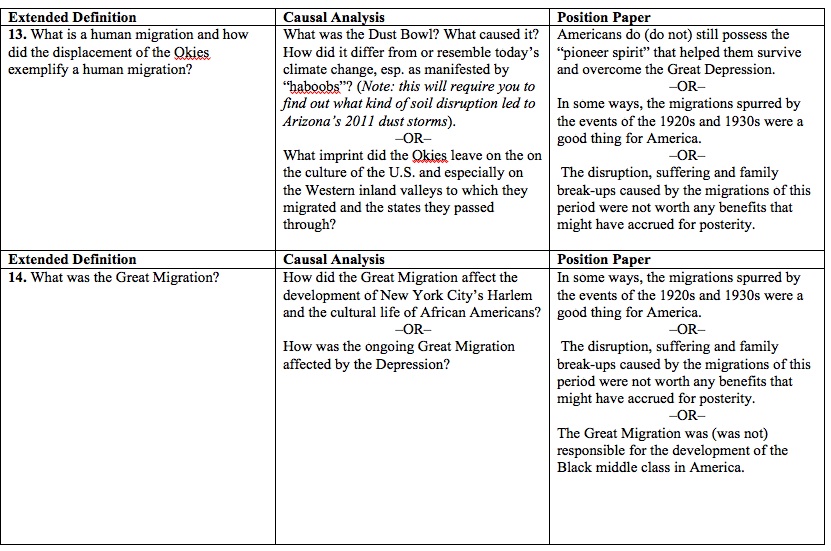 Mwa ha hah!!!! I ended up with four pages of this stuff, which I printed out and scissored apart, horizontally across the landscape page. Come the first week of class, I’m going to hand out the sliced-apart topics and each student will get to pick one. With that in hand, she’ll have topics for all three papers assigned before the end of Week 1. They’ll have a sign-up sheet on which to record which set of topics they reeled in, so I also will know what they will be writing about all semester long.
Will they hate this? Ohhh, you have no idea how much they will hate it.
Will it mean I don’t have to read any post-adolescent ramblings about how the drinking age should be lowered to 18, how beauty is an internal thing, how medical marijuana should be made legal with no questions asked, how we should build an electrified fence along the entire US-Mexico border? Oh, yes.
Will they do a half-baked job on these papers? Of course. They’re just kids. But at least they’ll try. Some of them may actually learn something.
Better they should do a half-baked job on a paper that requires them to do some research, learn something about the world, and actually think about it than that they should barf out still more uninformed teenage drivel based on breathtaking ignorance and eye-glazing clichés. Or turn in their senior social studies paper for credit, for the eleventh time.
The drafts, comments upon which they ignore, are going away. They will have just one draft, for the first paper. Since even fewer of them have ever written an extended definition than have ever written a sourced paper (no joke!), the first paper of the semester is actually the most difficult for them, even though it’s only 750 words.
So we’ll do a draft on the first paper—no peer review, a pointless waste of time. This draft will be graded according to the same rubrics that will be applied to the final version, but since it will be worth only 50 points, a failing grade will have less effect on their final semester score than a flunking grade on a regular paper. I will then tell them that they now see what the standards are and how the papers will be assessed, and so henceforth it will be their responsibility, not mine, to put together a decent paper.
And that will bring a stop to the frustration of spending hours trying to help them succeed, only to have them paste the original clumsy draft into a Word file and turn it in unedited. It also will cut the grading workload in half.
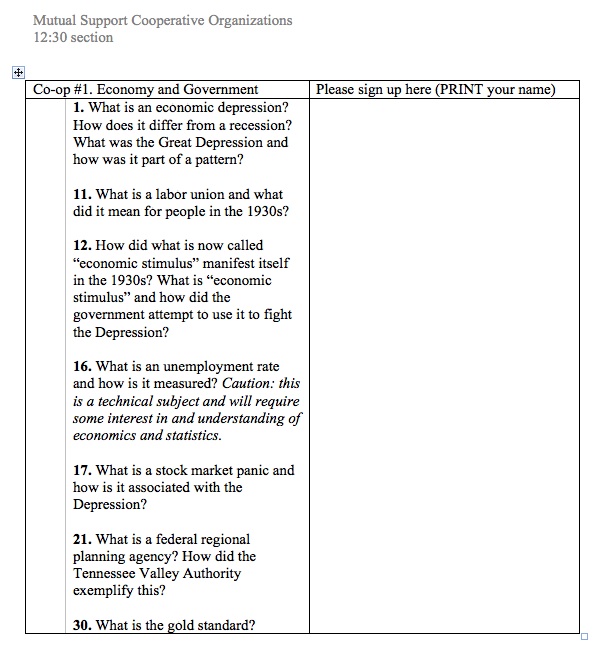
Collaborative groups will go away (another waste of time!), except insofar as we’ll set up informal groups of people with roughly similar topics to function as mutual support groups. In keeping with the Depression-era theme, I’m calling them “co-ops.” They can commiserate with each other, help each other with research (to the extent that they figure out how to do research), and ask each other out on dates.
 So. That was a bitch to design and write.
Naturally, I created some extra work for myself in the Eng. 235 department, too. Ruminating over the course schedule, I realized the order of the assignments was kind of self-defeating. It should go from the easiest-to-write type of magazine feature to the toughest, ending with something short that I can handle while coping with fifty 2,500-word research papers from the 102s. In fact it went from middling easy to difficult to simple to middling easy to the shortie. Reorganizing the order in which those papers occur entails rewriting the entire course. That didn’t take anywhere near as many hours, but it still ate up an entire day.
And now I still have to redo both courses’ websites. That probably will consume another three days. You understand, all of this work is done off the clock. The semester is over, and whatever I do for the college when class is not actually in session amounts to free labor.
Before I get to that, though, I’ve got to shovel the mountain of incoming paperwork off my desk and catch up with the bookkeeping I’ve neglected for the past month.
Is there a question as to why I never get around to writing the e-books I’d like to spin off this site?
Careful…we get in trouble if we have too many drops.
@ frugalscholar: Though the community colleges do actively work for retainment, no one seems to be surprised when large numbers drop courses. The noncompletion rate in the community colleges is phenomenal.
Part of the reason, I think, is that so many cc students are trying to go to school while holding down jobs and raising kids, which is just damn near impossible. Another reason is that some are fairly weak academically or have one minor learning disability or another; add that to the struggle of trying to work while taking college-level classes, and something’s gotta go. Usually it’s the classes.
In any given semester, a third to half of my students will drop by mid-term. Several more will stop showing up between mid-term and finals week. This doesn’t seem to be related to how challenging the course is; you can make the course as mickeymouse or as difficult as you like, and you’ll have the same drop rate. It is related, apparently, to the instructor’s personality and degree of empathy with the student. If you act like you care whether they live or die, they’ll hang in with you for quite a long time. If they think you’re unkind or unfair, they’ll jump ship in droves.
One of my students told me he was one of TWO who made it all the way through to the end of an English 101 section. Apparently the instructor was meaner than pussley and roundly hated. Interestingly, few students complained about the woman; they’re afraid to rock the boat or they don’t know how to complain.
In water-cooler chats with other faculty this semester, I was amazed to learn how many people do not do drafts. The district’s guidelines specify that we’re supposed to be teaching writing as a recursive process, which to my mind means you teach make them write drafts, rewrite, edit, and proofread.
One person said he has them write outlines (IMHO about as useless an exercise as one can invent — when I was an undergrad, my response to that kind of assignment was to write the essay, outline it, turn in the outline, and then a couple weeks later turn in the unchanged essay). He indicated he spends as much or more time gnashing his teeth over the outlines as I do over the drafts, so clearly that does not solve the problem of time and effort wasted on a service students ignore.
Two others said they do one draft and only one draft, then let the students figure out how to do it on the rest of the papers. The theory here is that these ARE college classes, after all, and at the college level students need to take responsibility for their own learning. Both of these instructors are full-time faculty, and so I figure I’m hearing the department’s prevailing wisdom from them.
This seems to me to circumvent the District requirement to teach them writing as recursive process. However, it must be admitted that for 98% of the students, making them write a draft is a waste of the instructor’s time. Reading their drafts to indicate areas for revision is an even worse waste of time.
My plan is to substitute one-on-one conferences for drafts of the 2,500-word paper. So they’ll have a draft and written feedback on the first 750-word paper; they’re on their own for the second 750-word paper; and they’ll get individual coaching on the endless position paper.
My prof for one of the core classes I took last term (grad school; state university) assigned a PowerPoint presentation (live narration or pre-recorded, at the student’s option; I frankly didn’t have mine done in time to learn the recording software, so I did it live) of our term paper topic about two weeks before the paper was due. That forced me to produce — and revise! — a good outline and really helped me develop a position on the issue rather than just regurgitate facts.
I’d also like to say that if I had been handed a list of possible paper topics in high school or undergrad, I would have been THRILLED. (I cringe now at some of the stuff I wrote in my freshman English/critical thinking class.) Perhaps one reason students turn in puerile meanderings is not only because that’s easier than researching, but that they can’t think of an appropriate, interesting topic!
@MLISunderstanding: Great exercise on your professor’s part. And good for you for doing an actual presentation rather than relying on PowerPoint, which can be a bit of an eye-glazer.
Hmmm…. If you had every kid do a 15-minute power-point on his or her topic, you could kill days and days of class in which you wouldn’t have to lecture. Twenty-five students speaking 15 minutes each would occupy SIX AND A QUARTER HOURS. That’s two weeks of class time! Hot dang…genius!
Well, we’ll soon know how the new classmates respond to this scheme. Last semester when they were told they had to come up with topics on broader assigned subjects (e.g, something like “write a cause and effect paper on a topic having to do with urbanization and the environment in Arizona”), they just hated it. They want to recycle old papers, and in fact during a class discussion it became apparent that they feel entitled to do so. Their papers, they argued, belong to them, and they should therefore be allowed to re-use them as many times as possible.
I think also that assignments people make actually encourage puerile maunderings. Ever looked closely at a freshman comp textbook? Many of the readings, selected because the authors imagine the subjects will interest young people (patronizingly, IMHO), are on subjects like lowering the drinking age and legalizing marijuana use. Suggested topics can be very sappy — prompts for the extended definition, for example, include such chestnuts as “what is love?” and “what is beauty?” So it’s not at all surprising that when they seek topics on their own, they find cliches.
When I was in freshman comp back in the dark ages, we wrote about literature. We had two texts, not one: a style manual and an anthology of short stories. We were required to write essays that addressed the works in the anthology. It limited our opportunities to imprecate against the dangers of drunk driving or to argue that 18-year-olds should be allowed to drink legally.