Coffee heat rising

Real Estate: Is everyone down the Rabbit Hole?

Who pays people to write headlines like this?

Home Prices in U.S. Showed Signs of Stabilizing in June

Filled with optimism, we dive into the copy:

The S&P/Case-Shiller index of property values in 20 cities fell 4.5 percent from June 2010, after a 4.6 percent drop in the 12 months ended May that was the biggest since 2009, the group said today in New York. The median forecast of 31 economists surveyed by Bloomberg News projected a 4.6 percent decline.

Well, that’s cheering. So…where does the bright, sunny headline come from? Anywhere in this story???

Values fell by 0.1 percent in June from the prior month after adjusted for seasonal changes, matching the decrease in May, indicating the deterioration is slowing.

That values continue to drop does not, to my mind, represent “stabilization.” In the next breath, Bloomburg’s reporter adds,

Nonetheless, any recovery in home values is probably years away as foreclosures dump more properties onto the market, while a jobless rate hovering around 9 percent and strict lending rules hurt sales.

Property values have dropped so sharply here that the county is predicting most of us will see a drop in taxes, even though the community college district, which has something like absolute taxing authority, is jacking up the tax rate.

In spite of property tax rates that rank Arizona among the lowest 11 states in that department (and give us a school system to match: yesterday one of my students came up to  me, pointed to a word in the syllabus that she couldn’t pronounce, said she’d looked it up in several sources and tried to figure it out, and added that she still could not understand its meaning. The word was urbanization), our doughty citizens continue to call for a Proposition 13, which goes on the ballot here next year.

LOL! The politics here get stupider and stupider. We can say good-bye to our libraries, as well the health and public safety infrastructure. Roads have already gone to Hell, as the city has stopped filling potholes and repairing heat and rain damage. One silver lining: our schools couldn’t get much worse, so I guess we won’t have to bemoan the loss of that service.

Meanwhile, homeownership is going away in this part of the country. My Realtor friends say they’re doing a land-office business. One woman is working 14-hour days, seven days a week. She says she’s selling almost exclusively foreclosures and short sales. One day she closed on seven sales. In one day! Another friend has reinvented himself. He no longer calls himself a real estate salesman. He’s now a “property investment consultant.”

Both say most of their buyers are Canadians, with a few well-heeled American fix-and-flippers. Most of them are buying homes with the specific intention of turning them into rentals.

The rental market here, for obvious reasons, is very hot. We’re told now that even if you’re stuck with an underwater mortgage, you can often rent a house for as much as the mortgage payments. The locals are no longer buying, whether because underemployment will not support a house purchase, because they can’t qualify for a loan no matter how good their credit is, or because they’ve lost their homes and won’t be able to borrow to buy a house anytime in the foreseeable future.

So, large numbers of houses in formerly quiet residential neighborhoods are being turned into commercial properties owned by foreign investors.

Experience suggests that this is not a good thing. The last time hordes of Canadians bought Arizona real estate—in the wake of the savings and loan fiasco—the result was a contagion of blight. When you live in some other country or state, you do not care about the condition of your “investment property.” It does not matter to you whether the lawn is mowed (or even watered), whether the paint is peeling, whether the shingles are curling, whether a public nuisance occupies the place.

This was so when the clown in upstate New York bought the house across the street, where the obnoxious Biker Boob and Bobby McGee resided for a couple of years. Before those two, we had the passel of male roommates, one of whom led a police chase through the neighborhood and had to be subdued in the front yard by the occupants of five cop cruisers plus two motorcycle cops. He finally unloaded the house. Whoever bought it did some fixup on the inside but nothing to the exterior. Unclear whether the owners live there or whether it’s a rental. Various signs suggest the latter, though. People who rent a house do nothing to care for it, and if the landlord doesn’t maintain the place, it quietly (well, sometimes not so quietly) sits there and deteriorates.

A steadily declining rate in property values “stabilization” does not make, any more than an excess of renters “stabilizes” a neighborhood of single-family homes.

End-Times Bargains! (End of season, that is)

So this weekend I decided to act on my new vow to loosen up on the frugality and get a life. Or at least get a few things to make it look like I have a life.

The set, about $540 at Amazon

For quite some time I’ve been craving some of that fake-wicker outdoor furniture—you know, the stuff that looks like wicker but really is some sort of extruded plastic woven on steel frames. These combine the design look I favor (OK, I know: it’s not a “look,” it’s just bourgeois) with some resistance to Arizona’s ferocious elements.

Right now I have two beloved white real wicker rocking chairs on the westside deck. These things came with me from the old house, where they resided for some years after I bought them at Cost Plus (World Market). Once every few seasons (used to be every season, but I got lazy), I drag them out and apply a new coat of spray-on white enamel paint.

Despite the paint, though, rainwater is singularly bad for them. Plus the wind really howls through the side yard during a good storm. The damn things kite and sail off the deck. So far they’ve landed in the yard rather than crashing through the Arcadia door, but in either event, it’s a mess. So I’ve taken to hauling them inside the house every time the sky so much as hints at rain.

Then there are the four wooden chairs I bought at Cost Plus a couple of years ago, to arrange around the back patio table. Not a terrible choice, but an inconvenient one. The chairs are attractive enough and they’re very comfortable (given a cushion). But they are unfinished wood. I’ve never gotten around to sealing them, and…well, when a hard rain falls the back patio can flood right up to the back door, two or three inches deep. Not relishing the thought of having those things soaking their legs in three inches of muddy water, I invariably haul them inside the house every time it rains, too.

This has become a real nuisance.

I wouldn’t mind cluttering the dining room with a couple of sailable rockers during monsoon season. But filling up the dining room, family room, and living room with six scruffy outdoor chairs every time a fluffy little cloud appears in the sky? Enough, already!

Then we have four clunky old metal and aluminum-strap outdoor chairs given to me by a friend as she was moving out of her perfectly affordable home into a bottomless pool of debt. They were, when new, very expensive. When she let go of them, they weren’t new; and price or no, the things were never to my taste. Particularly noxious is the circular tube base on which each chair assembly rests. This object collects trash. Lots and lots of trash. Every time a light wind blows, leaves, pollen, and twigs dune up inside the circles that are the chairs’ bases; don’t ask what happens when a stiff breeze comes up. The duning phenomenon means that every time I or Gerardo tries to blower off, sweep off, or wash down the deck, all four chairs have to be dragged around the KoolDeck. Drag them back, drag them forth, drag them around some more because every time you run a blower or squirt the hose anywhere near the things, more debris catches in those damn metal circles. Beyond enough!

So on Saturday it was off to Pier 1. No longer do I shop at Cost Plus/World Market: they’ve started demanding that you give them give them private information so you can get a “shopper’s card,” without which you pay a premium price. With the exception of Safeway, whose employees think I’m my dog and that my phone rings at Safeway’s local business offices, I do not shop at businesses where they pull that stunt on customers.

For all of these gigantic chain stores, the end of August signals the end of the outdoor season. Never mind that it’ll be another month before Arizonans can venture into the backyard; never mind that when we do, we’ll be out there for nine or ten months straight, every day. Despite the fact that people here are hotly in the market for outdoor goods, Pier 1 and its ilk have got everything that smacks of backyard living hugely on sale!

mwa ha hah!

And did they have fake wicker furniture on sale? Holy mackerel, did they ever have fake wicker, and was it ever on sale! Everything was marked down significantly from its original price, and then marked another 20% off the mark-down.

I found this nice fake wicker rocking chair in white, practically identical with the beloved real wicker rockers. Just as pretty as the numbers available through Amazon, pictured near the top of this post. Couldn’t believe how close this comes to the chairs I use almost every day when the weather’s good, out in the Leafy Bower. And the darn thing is just as comfortable.

Ordered up two of those.

And they had a rather attractive and amazingly comfortable stackable chair, perfect for sitting around the big glass-top table in back. I loved them: the’re ideal. Could not be better for the purpose! Fortunately the fake wicker weave also came in a kind of tan straw shade, much more convincing than the sort of brindle effect pictured here. So that’s what I ordered.

The cushions I got two years ago are still perfectly serviceable. They’ll probably last another year or two. So: all told the tab for SIX FAKE WICKER CHAIRS came to $500.

When you consider that Amazon’s $500+ tab for just two chairs and a tacky-looking table is relatively cheap for this stuff, five C-notes doesn’t seem so bad at-tall. Amazingly some places sell pieces like these for upwards of $200 apiece.

They’ll be in late next week. Yay!

So:

The hideous plastic-strap chairs will go on the curb, there to warm the cockles of some metal scavenger’s heart.

Two of the Cost Plus wooden chairs will go outside the bedroom door, taking the place of a pair of hideous plastic-strap numbers. They’ll get rained on and will weather to the classic silver outdoor wooden chair look, but since water doesn’t pool up there, they’ll never actually be standing in a puddle.

The other two will be offered to M’hijito, who could in theory use them on his front porch. Or stash them in back to accommodate friends during his many parties. The little twins will soon be big enough to sit in chairs, and so these could come in handy. If he doesn’t want them, I’ll either fob them off on some other friend or put them in my own front patio. Or someplace.

Ditto the white real wicker chairs. They could in theory, be repainted and parked inside M’hijito’s house, giving him a couple more chairs in front of his giant computo-television monitor. Or they could go to the Salvation Army, I suppose. Hate to give them up. But…they need to go now.

Now it will be much, much easier to clean up outside. The chairs themselves can be washed down with a hose. A blower or broom will scoot the plant debris and dust out from under the old wooden chairs, which have no weird circular footprint to collect trash. And though I may need to bring the rockers in when the wind comes up, those nesting chairs can stay on the back porch through all but a high gale.

Five hundred bucks is a chunk I don’t like to part with. But I’ve got the money, thanks to teaching two sections in the summer, and thanks to my fourth course making this fall. It it’s not like the purchase was a whim: this is something I’ve been thinking about for over a year. I’ve wanted to upgrade to fake wicker out there, and I’ve also known I couldn’t afford to do it at regular retail prices.

The end of a season is the best time to look for sales like this. Especially when someone else’s end of season is your beginning of season.

🙂


“Now Matters”: Balancing frugality with life

Trying again to get this post online. Looks like the WP glitch is now fixed; it was apparently a bug in Akismet. But now I’m having a heck of a time getting it to post at all. Have a bad feeling this thing has gone out to subscribers two or three times, but when and in what form, I don’t know. My apologies if you’ve received one or more versions of this already! 🙄

Spent the past hour or so stealing a few minutes to cruise my favorite blogs, which I’ve neglected shamelessly over the summer. At A Gai Shan Life, what should I come across but a rumination on the psychology of frugality—of the tendency to hoard, actually—and of Revanche’s fairly recent revelation:

…the idea that Now Matters has sunk in.

Yeah. Revanche attributes this insight to the maturing relationship with PiC, now her fiancé.

I’m slowly beginning to get the picture, too, though it may never come in clearly without some degree of “snow.”

LOL! Revanche describes not Seven Kinds of Ambiguity but Seven Kinds of Hoarding: saving the best food for last, so that you can enjoy the good stuff after you’ve polished off the required vegetables and stuff your mom made that you’d better not complain about. Racing through all your chores so as to collect up plenty of “free” (you thought) time. Stashing the candy, so you’d always have some for later. And of course, squirreling away every g.d. penny toward some uncertain “future.”

To this day, I always carve out the heart out of a piece of watermelon and set it aside, so as to eat the sweetest, most delicious part at my leisure: later. And indeed I do try to get all the sh!twork out of the way so as to have more time later, either to work on more productive things or just to loaf. As for money…well, you know, I am “a little funny about money.” 😉

I believe this tendency is in the genes. It’s hard-wired. I got mine from my father, and my poor son, who is even more miserly than I, inherited a double-whammy from his grand-dad and from me.

But like Revanche, I also am beginning to suspect that we need to invest something in the Here and Now, and we need to do it…well, now, not later.

I spend way, way too much time and energy depriving myself. As Frugal Scholar observes wryly about herself, “I do have a tendency to be a little too hair shirt in the frugality department.” She has decided to make a conscious effort to “loosen up,” as she puts it, by way of observing a few small milestones in life.

The women are right. It’s time to get a life. You can’t keep saving life for a rainy day.

In keeping with this impulse and my existing scheme to simplify my finances, I decided that I needed to find the single simplest way to regard income and outgo and then arrange the money management along those lines.

The biggest and best (I hope) manifestation of said impulse is that I’ve determined to stop worrying about every penny that comes and goes month by month—a stressful exercise, given the irregularity of adjunct income—and instead take a big-picture view of the budget and living expenses. Every winter break and all summer long, I chew my nails and tear my hair because I think “Oh GOD! I don’t have enough to pay the bills.”

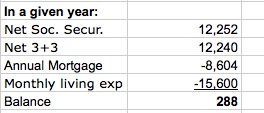
Well, yes I do. Over the course of an entire year, I have more than enough to pay the bills. Between Social Security and the income from teaching three sections a semester, enough comes in to cover regular bills, pay for necessities, and leave a little to spare. You don’t see that when you look at month-to-month income. But if you back up and look at annual income, it comes into focus.

Videlicet: A year’s worth of income and outgo looks like this:

If I budget $1300 a month to supplement Social Security in covering discretionary and nondiscretionary costs, I just about break even, assuming I teach only three-and-three. But in fact, this year I’ve taught not six sections but nine, adding another $5,428 net to the bottom line. Thirteen hundred dollars is $200 a month more than I’ve been budgeting; it represents a more realistic figure in light of recent inflation. The income figures don’t include the $4,400 of RASL still owed to me in 2012, or the $2,000 or $3,000 income tax refund, or the annual American Express kickback, and so giving myself a little raise should be within reason.

Clearly, if I quit hoarding, I could afford to parcel out enough, month by month, to cover the bills. Occasionally there might even be enough to go out to dinner now and again.

One thing that’s made this not so obvious is that, in my terror that there just would not be enough to cover my share of the underwater mortgage on the downtown house, I started shoveling every penny of my salary directly into the joint account my son and I established to pay that mortgage. Over the summer, I had to stop doing that, because I needed the income from my summer classes to pay the exorbitant hot-weather utility bills. By the end of spring semester, however, I’d stashed enough in there to cover not only the three summer months but the entire year’s worth of mortgage payments.

This exercise made it clear that if I stopped doing that and instead transferred only enough to cover my part of the bargain, quite a bit of money would remain in my hands. Enough, indeed, to ensure that as long as I can dodder into a classroom, I’ll never have to draw down from retirement savings to put food on the table and a roof over my head.

Hmh.

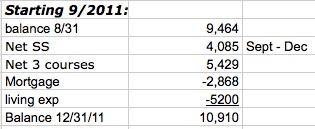
If I were to put all my salary into Survival Savings (a money market account containing the fund of cash I had at the time I was laid off, which I’ve been slowly consuming by way of delaying drawdowns from IRAs and brokerage accounts), I could transfer $717 a month to the joint mortgage-paying account and $1300 to my checking account…and come out smelling like roses! Survival Savings has a balance of $9,464, so if this scheme begins on September 1, the numbers fall out like this:

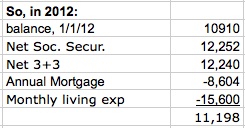
So what happens if I keep doing this in 2012? Again assuming I teach only three sections a semester, with no summer courses and no overload:

Yup, $288 to the good, not counting tax refund, 2012 RASL, the American Express card kickback, and the various other little windfalls that come my way. And that’s without having to teach in the summer! One summer course would cover emergency costs or keep me firmly in the black from now until Doomsday.

This zen-like strategy is made possible by the fact that I’d managed to squirrel away a substantial emergency fund while I was working full-time. After over 18 months, I still haven’t gone through it, despite a number of unpleasant financial surprises, like the $1500 on the teeth and the $800 on the car and the water bill of almost $200 and the power bill pushing $300.

So I can’t say that hoarding is a bad thing. Obviously, having built this stash by making myself think I was barely scraping by on $65,000 a year worked to my benefit.

However: it’s probably time to recognize that “Now Matters.”

Aborted Day…and night

Well, I see WordPress published that malformed post yesterday, despite my having taken it offline twice. Yuch. What an afternoon!

Hotter than the hubs of Hades here! Yesterday it was 110 and overcast.

I dread seeing another astronomical power bill next month. The AC has been pounding away day after day after day. Over July and August we’ve had two mornings, count’em, (2), when it was cool enough to shut the system off for a couple of hours. Otherwise, the system has ground along 24/7. And a couple of days I forgot to turn the thermostat back up to 80 in the morning—I no longer can tolerate having it much warmer than about 76 at night. At this age, when I can’t sleep at night I get sick. But after the last programmable thermostat produced not lower but higher bills, I had the AC guys put in a regular thermostat when they installed the new unit. This requires one to remember to turn it back up in the morning, another of those things you don’t do so well as age advances.

Pup was fairly good yesterday—at least I didn’t have to clean up any puddles. But during the hottest part of the day, when he and Cassie are crapped out on the floor like a couple of doggy corpses, I was working myself into a sweat struggling with the damn computer.

Ever since I upgraded to Worpress 3.2.1, the program has decided that it will engross the copy that follows an image into the caption. NOTHING seems to make it stop. It’s OK until I hit “preview” or “publish,” but that action seems to override the HTML clearly visible before then and move the content into the cutline. Sometimes entering a non-breaking line space after the code for the image & caption will work in a crude way, but it doesn’t work consistently. Tried to fix it in two browsers on two computers…finally had to give up. I guess the program is corrupted.

Fixing it is way, way beyond my abilities. Now I’ll have to hire someone to fix that.

Anybody got any nominations? With Mrs. Micah retired from that business, I haven’t a clue to who has that kind of skill.

So, until such time as I can hire someone to figure out how to deal with that, I guess no more images will be going up here.

M’hijito, continuing his after-hours project to escape to better employment, had a chemistry lab last night that went until 10:00 p.m. By evening, of course, Charley the Infant Golden Retriever was going strong. But since I’d wasted the entire flicking afternoon wrestling with WordPress, I had to grade 75 quizzes over my syllabi.

This, it develops, is the only way to get students to read your syllabus: give them an exam on it. And make them sign a form that swears they read and understood the syllabus, which you have to keep all semester because if you don’t they’ll try to claim they didn’t understand your due dates, the nature of your assignments, your “no late papers” policy, and the consequences of blatant plagiarism. As strategies go, it’s only mildly effective at making the students grasp what you’re saying, but it’s extremely effective at adding extra work to your day.

So while Charley was bouncing, I was trying to plod through scoring papers. That led to a fair amount of bouncing on top of Cassie, who was getting tired; running in and out to pee every 20 minutes or so; grabbing of verboten objects; and general frolicking. A couple of times I had to put him in his crate so I could focus on what I was doing, which didn’t help because he barks every minute he’s in there.

With M’hijito gone into the middle of the night, Charley’s visit here extended into Cassie’s dinner hour. Since Charley is a living vacuum cleaner that sucks up everything even vaguely resembling food (including pieces of paper, dead plant leaves, small insects, seeds, bark chips, sticks, and anything else residing on the ground, in the dishwasher, or inside a refrigerator), this posed a problem. Cassie gets real food: meat, veggies, and a starch. Charley finds this cuisine even more exciting than the exuberantly overpriced kibble he’s fed. And he’s already a third again as big as Cassie.

Okay, so I decide to snap a kiddie gate across the hallway with Cassie on the far side of it and then slip her food to her while he’s preoccupied with inhaling his kibble.

Not one of the brightest ideas ever to light up a marquee… Fazing one past Charley is not easy.

The instant he finished polishing his own dish to a high shine, he raced over to the gate to see what she was doing. There he became so exercised by the fact that she had FOOD that he jumped on the gate and knocked it over right on top of Cassie!

He dropped the gate on Cassie’s head, flipped the food dish completely upside down, and then landed on Cassie with so much force she couldn’t even bring herself to snap at him.

Oh god!

After that, he kept jumping on me while I tried to see if she was hurt—she kept licking her lips and I was afraid she’d broken a tooth. Finally I had to put her on the bed, which is so overly high that even I can barely climb into it. That kept him off her for a minute and her out of harm’s way until I could lock him in his crate, clean up the mess in the hall, and get back to inspect her more closely. She was OK, but she did seem a bit shaken up.

Charley continued active right up until the time M’hijito came over to pick him up, sometime after 10:00 p.m.

This made for a long day, since I’d had to be in Scottsdale for a business meeting at 7:00 in the morning.

That notwithstanding, I could NOT get to sleep! At 1:00 a.m. I sent an e-mail to La Maya to tell her I really didn’t want to leave the house at 6:00 a.m. to make the estate sale we were planning to visit—way to hell and gone back out in Scottsdale!

So of course she called me as dawned cracked.

Now I’ve gotta get up, feed Cassie before Charley shows up again, wash the sleep out of my eyes, and get ready to go teach another couple of classes. Thank god it’s Friday!!!

Urk!

Sorry, folks. Something must have corrupted when I upgraded (belatedly) WordPress. Just spent three hours trying to get a post online, and I can’t do it.

Soon as I can find someone techie enough to help figure out the problem, Funny will be back. Meanwhile, I’ve gotta get back to work!

Debt Consolidation: Proceed with Caution

Every time I get an offer from some feckless freelance writer trying to “give” me a “free” article plugging her customer, yet another debt consolidation service, I’m quietly amused. Well…no. I’m amazed: obviously some PF bloggers are publishing articles on debt consolidation that don’t give the whole story.

Debt consolidators negotiate with your creditors so that you make a single monthly payment to the consolidator, which then disburses small amounts and skims off a nice finance charge for itself. This may be useful for those who truly do not have the self-discipline to pay their bills and to snowflake them down with every small windfall that comes along. But for most people, it’s an expensive way to go. The FDIC notes that even though a consolidator may lower your monthly payments, the resulting plan will take longer to pay off your debts, and that the use of debt counseling is likely to show up on your credit report.

Some of these outfits are very smarmy. The Consumerist reports, for example, on the case of a “debt relief law firm” that collected $450 a month from a mark’s checking account, supposedly to pay down $23,000 worth of credit card debt. Not until the victim applied to rent an apartment did he discover the “debt relief” was actually theft, and that nary a dime had been paid toward his cards.

Some debt consolidators or alleged law firms charge excessive fees, often collected up front. These lead consumers even deeper into debt, failing to relieve their problems and even landing them in bankruptcy court. Although most debt consolidation companies claim to be nonprofits, they make a great deal of money at customers’ expense.

A number of years ago, while I was teaching at the Great Desert University’s westside campus and wishing I could earn more for less work, I applied for a job at a so-called nonprofit debt advising company. Starting pay for a job that required me to write lessons and conduct training in budgeting and personal finance was about $90,000—a phenomenal amount in a right-to-work state like Arizona. Various bonuses and perks were also promised. Companies don’t pay low-level executives that kind of money unless they’re making plenty of it.

Debt consolidation companies profit from their customers’ woes in a number of ways. One is simply to deduct a percentage of the payments passed along to creditors. Another is to engross one or two entire payments for “administrative costs,” dealing a blow to the borrower’s credit report when no  part of the payment ever reaches the creditors.

You don’t need a third party to settle your bills. Whatever these outfits do, you can do for yourself, and then some—at no extra cost.

First, call your creditors and try to negotiate a better interest rate or payment plan. They don’t want you to default, because that costs them money. Many will work with you to pay down your debt.

If you’re behind on your payments because of a documented personal disaster, such as a health crisis or loss of a job, lenders will sometimes negotiate a reduced balance. This is far preferable for them than having you declare bankruptcy and pay them nothing.

Next, always pay more than the minimum due. A minimum payment applies only about one or two percent toward the balance; your goal is to pay down the principal.

Most car loans and mortgages allow you to pay extra specifically toward principal. You may have to go in to the bank in person to accomplish this, but it’s worth the trip. The more of your money that goes toward the principal, the faster you pay down the debt.

Establish a budget and stick to it. This budget should be designed to keep you from running up more debt. Stop charging stuff. Easier said than done, but that’s why you make a plan and stay with it.

Create a sidestream income and pay all of the net proceeds toward the debt. If this means delivering pizzas after work in the evenings and on weekends, so be it. A side job is one of the most effective tools for paying down debt and building savings.

Pay every extra penny that comes your way toward the debt. Got a rebate? Tax refund? A few bucks from a yard sale? Pay it straight into the debt, no matter how tiny it is. Every little bit helps. It’s surprising how quickly you can whittle down debt this way.

Decide which works best for you psychologically: to attack the largest debt first or to go after the one with the largest interest rate. From a practical point of view, it’s usually best to get rid of high-interest debt first, since that costs you the most money over the long term. Some people, however, feel most oppressed by larger debts, even if the interest is low relative to a smaller debt.

By “larger,” I don’t mean your mortgage. This should be the last debt you decide to pay off. Get rid of revolving debt first. The small tax advantage given to mortgage holders defrays the actual cost of interest on these loans, and so the most urgent debt is represented by credit card and automobile loans.

Pay off debts in an organized, systematic way. Establish a monthly amount you can disburse toward existing debts. Devote the largest part of it toward the account you decide to liquidate first, while paying something more than the minimum toward other debts. When that account is paid off, move your largest payment to the next account, and so on until, one after another, all the debts are settled.

None of it is rocket science. You don’t have to fork over any of your money to someone else to do these things. You can do them for yourself—for free!

If you still feel the need to talk with someone about your debt problems, the National Foundation for Credit Counseling can refer you to free or low-cost counseling and offers a number of consumer tools on its website.