
…or is it “all that glisters is not gold?” Not sure, but lately we’ve seen some hopeful signs that The Copyeditor’s Desk, the little editorial business my associate editor and I started together when we were canned from the Great Desert University, just might manage to make enough to support one or (preferably) both of us. Whence this shining image? And is it a mirage?
 Well, first off, we decided that we needed to seek a different kind of clientele. We’d been networking with local publishers and authors. Nothing wrong with that, except that Arizona, renowned as a cultural backwater, is about as far from a hub of the publishing industry as you can get, this side of the Sahara desert. With a few notable exceptions (such as Pearson, Poisoned Pen Press, and the University of Arizona Press), publishing companies here tend to be DIY operations staffed by a Would-Be Author with a desktop computer, whose raison d’être is to print and, with any luck, sell a few copies of the W.B.A.’s magnum opus. To the extent that these entrepreneurs recognize their need for an editor, they’re willing to pay just a shade more than minimum wage. They’re running on a shoestring themselves, and they expect to get shoestring contractors. A number of vanity presses serve those who aren’t quite techie enough or just don’t want to invest the time to create camera-ready or Kindle-ready copy; these outfits, too, expect the hired help to earn less than a good cleaning lady commands.
Much of the material we saw from this set would be unpublishable in the mainstream market because it tends to the woo-woo: full of theories about space aliens, strange diets, and life on the other side of the veil. A great deal of it is painful to read.
Late last year we realized that other kinds of businesses—the client in hand was a plumbing and HVAC company—would actually pay a living wage. In fact, they expect to pay a living wage. And by that, they mean about six times what we’ve been charging.
If you offer to contract to these folks for the wages we’ve been asking, they think you’re an amateur. However, if you ask for $60 an hour—a number that looks stratospheric in our limited view—they don’t even blink.
As a matter of fact, if you take time to do some fairly extensive research on what people like us earn, you discover that sixty bucks an hour is on the low side. That is to say…what we think is an extravagant figure is actually competitive.
So, lately we’ve been seeking business clients, and we’ve been practicing the art of uttering “sixty dollars an hour” with a straight face.
And y’know what? It’s working!
In the past two months, we’ve landed four clients who hardly even gagged when we said the magic words. For one academic, we agreed to drop the fee to $45, knowing what it means to be a tenure-seeking academic. For the others, we’ve acted like we believed what we were saying. In two months, we will gross more than half what we normally make in an entire year. And the content of what we’re reading is great: working documents for two excellent nonprofits, a new book for a handsomely published up-and-coming author, and an interesting academic study that’s already been accepted for publication.
Not a word of woo-woo among these folks.
Next, we’re taking some steps to encourage a steady flow of this kind of work. We hope. We’ve applied for a two-year business development program called AAAME, backed by the Small Business Association and Arizona Public Service, a large regional utility. You get mentoring, workshops, and project-based training with an emphasis on marketing (exactly what we need the most!), with regular meetings and opportunities to meet hordes of business owners and community leaders who could use our services. And amazingly, it’s free.
No guarantee that we’ll get accepted, of course—only about a dozen small businesses make the cut every couple of years. However, just writing a new, more formal business plan has already generated a few insights. We’ve begun to build a database of contacts and created a newsletter, the first issue of which we distributed to 57 past clients and current friends. I have a vague idea about how to market…what’s needed is some understanding of how to apply it to finding our client base and selling our service to it.
At any rate, just in the past month and a half, The Copyeditor’s Desk has found enough paying work to free me from teaching not one but two classes.
I came up with a spreadsheet to express our revenue goals for the next two years. If I earned $15,000, it would replace my teaching income with something to spare. Twenty grand would not only spring me free of the classroom but pay all the bills, and a similar drawdown would free Tina from waiting tables, allowing us both to earn our living at what we do best. Twice that much, and we’d both be living like queens. Why? Because I have about $12,000 worth of Social Security coming in, and Tina earns significantly more than that as managing editor of a large scholarly journal.
Interestingly, even two salaries of $40,000 plus enough to cover overhead would not require us to generate an unreasonable number of billable hours. At least, I think not: truth to tell, I don’t yet know what to expect as “reasonable.”
For each set of projected goals over the next two years, I calculated a bare minimum we would need to earn, what I think is probably within reason, and a figure that would make us do a wild dance of joy. Check out the Year 2 figures:
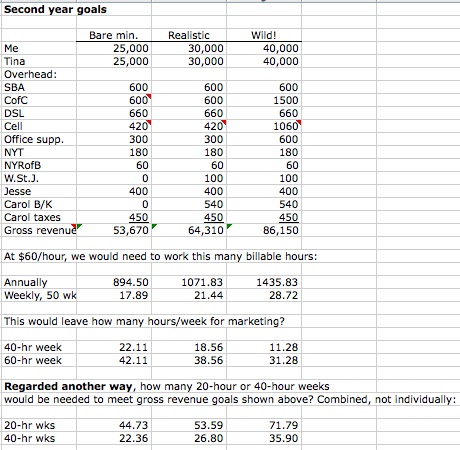
The amazing thing about this is the number of hours we would (or rather, wouldn’t) have to work to meet the goals. To earn enough to pay ourselves $40,000, between us we would only have to bill about 29 hours a week. You see…that’s 15 hours of work apiece. Assuming, of course, that we can get our $60/hour rate—which apparently we can.
Presumably work will not come in steadily. Right now it never rains but it pours, and we have no reason to think that will change. So I asked how many weeks we would have to work in year 2 to meet our revenue goals.
Welp, even if we’re still dorking around in classrooms and restaurants, we could make our goal by working half-time, because that 71.79 hours represents our combined workload. With two of us sharing the work equally, we’d each work about 36 weeks to earn enough for the corporation to cover its overhead and to pay us each 40 grand. If we bestirred ourselves to work at it 40 hours a week, it would take 35.9 full-time work weeks—18 work-weeks apiece—to make our goal.
LOL! Well, of course, we know all this glamorous work isn’t going to find its way in the door by itself. So I calculated the number of hours that would be left after finishing the paid work to spend on marketing. If I did all the work (which I won’t, because Tina will be handling some of it), I’d still have 11+ hours left in a 40-hour week or, in my more usual 60-hour week, 31 hours to devote to marketing activities.
This could work.
As long as we’re baking pie in the sky, I say to Tina, “how much would you like to earn from the editorial business?” Says she, “Well, my real goal is to someday earn $100,000.”
Holy moley. This could require us to quit carrying plates of chicken mole out to restaurant patrons. But…what would that actually look like? Could it be done?
In this scenario, I figure I don’t need any more than 40 grand, so there’s no point in my drawing any more than that out of the business:
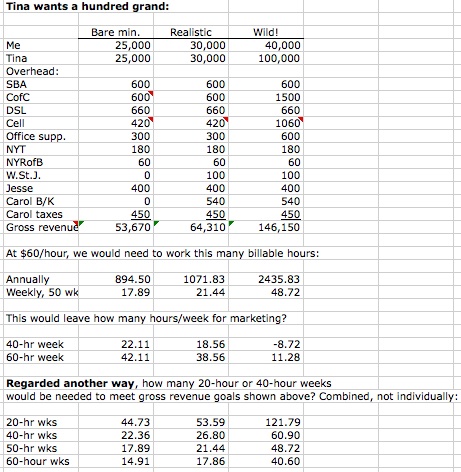
Hmmm… We’d both be reduced to working at least 40 hours a week. However, remember that we’re sharing those hours, so instead of 60.9 forty-hour weeks, the actually load of billable hours would be more like 30.45 full-time weeks. And we also would be farming work out to print and Web designers, proofreaders, and the like, from whom we would engross a 25% cut. Still…the negative balance in the hours available for marketing doesn’t look good…possibly what would need to be farmed out is the marketing work!
Well, we’re not going to earn any of that unless I get back to reading some copy. And so…to work!
Image: Stars in the Sky (LH 95 star-forming region of the Large Magellanic Cloud). European Space Agency. Creative Commons Attribution-Share Alike 3.0 Unported license.
Pie in the sky is so much better when you run the numbers and they actually support the big ideas. How exciting!
Good luck! Don’t think your service is worth any less because it sounds perfectly viable at $60 an hour. It’s fascinating to watch this.