Coffee heat rising

Would I Have Done This? Would You?

Y’know, sometimes I look at what my students do, often out of simple self-defense in a world fraught with absurd bureaucratic demands, and wonder if I would have done the same thing as a freshman.

Would I refuse to buy the textbook for a college course I was paying to take? If I did buy it, would I refuse to read it? Would I turn in a paper that was copied whole cloth from the Internet (or, in my day, from a magazine or book)? Would I beg for an exception from the no-late-papers rule because I had a full-time job and was taking 18 credits? Would I need to be taught how to acknowledge a source in-text?

Well, off-hand the answers would be No, Probably not, No, Not a chance, and No.

BUT…on reflection…

The truth is, there’s really no comparison between today’s student’s experience and my college experience a half-century ago.

In the first place, I did not take English 101 and 102, the two-semester iteration of the high-school English that apparently does not “take” for most Arizona kids. I didn’t go to school in Arizona, thank all the Gods and Goddesses that be: California schools, even the lesser schools of southern California where my parents moved after three years in San Francisco, went so far as to teach basic literacy and basic expository writing. My SAT scores got me into a one-semester substitute for the advanced dumbbell English most students had to take, and that was a course in modern literature — it wasn’t a composition course at all. So it should be noted that there really was no comparison. With that in mind, let us consider:

Would I refuse to buy the textbook for a college course I was paying to take?

No, certainly not. In the first place textbook publishers did not gouge students upwards of $80 for what really are nothing more than $20 trade paperbacks. So buying a semester’s textbooks did not mean I’d have to skip paying the rent that month.

And in the second place, it never even occurred to me not to buy a required textbook — or even one of the optional texts. Of course you bought the text. What would be the point of taking the course at all if you didn’t buy the books?

I remember being absolutely shocked when a third-year student bragged, in the moments before a particularly boring history class convened, that he  hadn’t bought the course textbook and that in fact he had never purchased a textbook for any class in his major, and he had a B+/A– average.

Tellingly, he was an education major.

Speaking of that history course…

Would I refuse to read a textbook that I’d bought?

That history course was taught by a dry, monotone professor who required a heavy, thick, equally dry and monotone textbook. It’s hard to make history boring, but this guy did it. That book was the most tedious piece of published anything I’ve ever read this side of a journal article in higher mathematics.  It was almost unreadable.

I didn’t refuse to read it — I tried to read it. But if he’d sat me down and asked me what I’d read, he’d probably have concluded the answer was “nothing.”

These comp textbooks are similarly boring and tendentious. They’re excruciating to read, and I know the subject matter. No. I live the subject matter. And I find them perfectly awful.

I would not have read it because, at the age of 17, when I entered college, I knew all this stuff. I had been writing sourced (i.e., cited and documented) expository papers since the seventh grade. By the time I left high school, a textbook like the ones we require for today’s freshman comp courses would have nothing to offer me. I certainly could have passed a 2015 freshman comp course without ever looking at the text.

Being the little doobie that I was, I probably would have looked at assigned readings. But I wouldn’t have studied them carefully, because I would have considered it a waste of time.

However…it must be remembered that for today’s students, the material is not a waste of time. Many, many high-school graduates entering your comp courses will tell you that they have never written any researched paper in all the 13 years they spent in Arizona’s K-12 schools! Some will tell you they’ve never written a piece of exposition at all. Any piece of exposition, like “what I did on my summer vacation.” They do not know how to find research sources. They do not know how to distinguish, in terms of credibility, between something they read on Faux News and something on the same subject that emanated from the New England Journal of Medicine. They cannot recognize when they’re indulging in a fallacy. Some of them don’t know what the word “fallacy” means. As many as a quarter of them do not write in coherent paragraphs — they can’t organize their thinking in rational blocks of copy.  About a third to a half habitually write in fragments and fused sentences.

Although the average American high-school kid did not score in the 99th percentile on the SAT’s verbal section, nevertheless a good 80 percent of them were capable of writing a coherent paper without a lot of basic grammar and logical thinking errors.

So: not a fair comparison. Quite.

Would I turn in a paper that was copied whole cloth from the Internet (or, in my day, from a magazine or book)?

No. I was too scared to pull a stunt like that. Nor did I need to: I knew how to find information and how to synthesize it from several sources into a single coherent argument. I left high school knowing how to do that — it was as natural as breathing.

Over the decades, a sea change in attitudes toward honesty has taken place. People in general — including young people — have discovered that it’s very easy to get away with things. Keep a straight face and no one is likely to question you, first because most people are too busy to be bothered and second because few instructors want to go through the hassle of flunking you out of their course for plagiarizing.

That’s a function, I think, of the number of bureaucratic rules that now afflict us all. We have restraints and demands coming at us from all directions. And one of the things people have figured out is that nothing much happens if you quietly neglect to obey. Or that the chances that you’ll be caught out and hassled are relatively low.

I knew a young woman who indulged in a fair amount of insurance fraud. She’d become expert in navigating insurance claims and would even offer to help her friends maximize collections. A couple of times, her scams were pretty damned transparent. But you know what happened? Nothing. She collected. She got not one but two houses completely rebuilt (questionable whether the fire that burned down the second house was actually a fraud or a genuine attempt on the part of her psychotic husband to murder her — probably the latter, IMHO, but that was never proven). Neither of these people — the crooked wife or the equally unethical demented husband — have ever had to account for their scams in any meaningful way.

Young people aren’t fools. Students can see this stuff going on. And when they attempt their own small frauds, they learn the same thing: getting caught is a very, very long shot.

If I’d been functioning in this environment, who knows what I would have done? It’s a different social ethic altogether.

Would I beg for an exception from the no-late-papers rule because I had a full-time job and was taking 18 credits?

Never would’ve entered my mind. You did not challenge your teachers. Or your parents. Or a cop. Or a principal. Or the IRS dude. Or anyone else.

The kid who asked to turn in a major paper three days late did so not once but twice — she actually came back after I said “no” and tried to change my mind.

But once again one has to ask: is there really a comparison here?

Except for reading texts to a blind student once or twice a week, I didn’t hold a job during the entire four years of my undergraduate training. People didn’t. No one expected kids to go to school full-time and also go to work. For a student, your job was to study. That’s what you did. You didn’t go out and sell furniture or wait tables. The very idea would have been frowned upon.

And sign up for 18 credits? Are you kidding? Sixteen units was considered a heavy load. I doubt if the university would have allowed me to take 18 credit hours in a single semester. I would have had to get some kind of special permission to pull it off, and you can bet that if an adviser had a clue that I was working on the side, no such permission would have been forthcoming.

Tuition at public universities was almost free. Families did not have to damn near bankrupt themselves to send a kid to college, and students were not saddled with a lifetime of debt to get a degree that is now considered indispensable for white-collar employment.

Blue-collar jobs that would support a family existed in those days, so a college degree wasn’t regarded as non-negotiable for entrée to the middle class. For that matter, the middle class still existed, too…

So again, there’s really no comparison. College kids were not subjected to unreasonable demands or exploited mercilessly. They didn’t have to work as wage slaves while they were trying to take classes, and so they didn’t have to beg dispensation to turn in assignments late. And instructors were full-time faculty on the tenure track, not wretched part-timers juggling two, three, or four mini-gigs to put food on the table. So they could afford to fit an occasional late paper into their workload.

Would I need to be taught how to acknowledge a source in-text?

Sure. We used footnotes back in the Dark Ages.

But the principle driving the practice was the same. And I’d been using footnotes since the seventh grade. No one needed to take my little hand and sit me down and explain to me what sources to cite, when, where, or why. Today’s  poor little things haven’t a clue.

How’z about you? Would you refuse to buy the textbook for a college course you were paying to take? If you did buy it, would you refuse to read it? Would you turn in a paper that was copied whole cloth from the Internet (or from a magazine or book)? Would you beg for an exception from the no-late-papers rule because you had a full-time job and were taking 18 credits? Would you need to be taught how to acknowledge a source in-text?

Spock, Say It Ain’t. . .Logical!

This does not compute. How could Spock die at 83, a mere thirteen years older than me, when I’m only 25?

We must be in some kind of time warp. It’s the only logical explanation.

{sob!} Spent yesterday evening watching old Star Trek episodes and movies on Netflix. And I must say…I wonder what I found so alluring in that stuff? Really, they were pretty clunky stuff. The ones with Jean-Luc Picard were more nuanced, a little better in the fiction department. Oh well. He was loved while he was with us.

While watching reruns, I learned to knit from some YouTube videos. Well…not the whole shebang, but only what’s needed to make knitted “buttons”: casting on and casting off.

Casting on means to build the original number of stitches on a knitting needle. It’s extremely easy — essentially, you use the needles to tie loose knots on one of the  needles.

Casting off means to get the finished product off the needles by sort of tying off the stitches, one at a time, so they form a neat ravel-proof edge. That chore is more difficult because it’s fussy and it’s easy to drop a stitch.

For my purposes, a dropped stitch was not the end of the world, but it sure would be frustrating if you spent hours and hours and hours making a sweater or some such.

Anyway, I got one of the button thingies made, and hallelujah! It looks like it’s going to work to make the Raggedy-Ann Cushions workable!

The R-AC’s, those of you who have been watching  may recall, were sent by Knitted Knockers to be used as fabric prosthetics — foobs, as we call them. They work pretty well, except that the person who made them pulled the yarn that was supposed to flatten the backside so tight that the things look like fat little cushions for dolls! 🙂

Being the offspring of an avid knitter, I realized that if you could make a pair of knitted buttons — which are nothing but a narrow strip of knitted yarn rolled into a circular shape and stitched tight — you could attach them over the indentations, and inside a bra the effect would then look like actual boobs, not like you had inverted nipples.

The effect is surprisingly good.

Here we have the hilarious before…

P1030335And here we have the more credible after…

P1030411

I think that’s going to do the job. If the new pair Knitted Knockers said they’d send is any good, then I’ll have two pairs. I’m also going to learn how to knit these things, so I can give them to my friends and also possibly use them myself.

But interestingly, I’m finding I rather like being as flat as I was at the age of 10. It’s amazingly liberating! No hassles, no uncomfortable underclothing, no sags, no sticky sweatiness…. Jeez. Why didn’t I do this years ago?

So it remains to be seen whether I’ll use things and how much. Most of my clothes look just fine without blobs of flesh protruding from the chest. I’m not, after all, going to have to trudge out and buy a whole new boobless-friendly wardrobe — what’s in the closet will suffice for the nonce. Maybe a couple of things will look better with these foobs, but they’re not things I wear all the time. Still, it’ll be handy to have them.

And if learn to make them, it’s something to do in front of Netflix when I’m not grading papers, and they can be donated to women who feel that can’t be seen in public looking boyish.

😀

NMP: Not My Problem!

WonderAccountant has a term for the High Drama friends and family like to inflict on us (and everyone around us): NMP! That’s short for Not My Problem! You know whereof I speak, I’m sure: we all have a variety of Drama Kings and Queens in our lives. “NMP” is a  handy device for disconnecting from that noise.

Well, I’ve been in high NMP mode all day, trying to throw off the traces of not one but two Other People’s Problems.

First off, the college (or maybe the district) has an annual thrash-around in which they try to do “Assessment”: a perennially fruitless effort to quantify (digitally!) all the ephemeral qualities of teaching and learning that really can’t be quantified, so they can report this to the community college board and anyone else who decides to make it their business. A couple years ago, they devised a vast (I do not overstate here) online assessment survey and asked everyone to fill it in.

It’s a gigantic pain in the ass, and we are not paid to do it. What we have to do is navigate through several layers of websites, signing in with username and passwords here, there, and everywhere, and then pull up rosters of our classes and go through EVERY STUDENT’S PERFORMANCE filling in numerals representing how they’re performing on 87 gerjillion rubrics.

This is very time-consuming. Free, unpaid overtime-consuming.

And of course it means nothing, because to do it right, you would have to pull up all the papers the students have written and examine each one to figure out how it aligns with the rubrics. I have been specifically told not to grade student papers by the district’s rubrics because they are, in a word, inadequate. So that means the rubrics are only incidentally relevant to your own evaluation of your students’ work. So…you end up looking at their current grades and then just guessing at how they’re doing vis-à-vis the district rubrics. And that of course converts the whole exercise into a gigantic waste of time.

If it weren’t already that at the outset.

Well, a day or so ago the chair sends out his call to us to please get to this, attaching two .doc files full of instructions. I groaned when I saw that hit the in-box. It’s not like I have nothing to do here… And if the true assessments I promulgate — the students’ grades — mean nothing, why the hell are you asking me to read and grade their papers and assign them semester grades at all???

Having put it off as long as I could, this morning I re-opened his email and got into the two files. I’m sitting there studying them and I think…hm. Y’know, there’s nothing in any of the stuff that says we have to spend a couple of unpaid hours on this sh!t. There’s a lot of “thank you for participating,” but no “do-it-or-you-die” messages.

On reflection, I conclude that the whole clown’s dance is probably optional. And that makes it NMP.

Not.

My.

Problem.

Other People’s Problem #1: out the door.

So now I figured I would move on to my truly huge Other People’s Problems Evasion Project. To wit:

All of my comp courses are now online. This effectively turns our college courses into latter-day correspondence courses. And among the several large headaches associated therewith is the fact that most students don’t have the self-discipline to do the work on time, and about two-thirds of community college students are unable to read and comprehend well enough to understand more than about 10 percent of what a college course demands.

In the face-to-face classroom, you assign readings in the textbook or elsewhere, with the understanding that very few of them will read a word of it. You then remedy that by regurgitating the high points of the assigned readings as so-called “lectures.” Or you give them in-class exercises that force them to  pull the textbook out of their backpacks and at least rest their eyeballs on its pages. You can’t do that in the online environment unless you want to spend untold hours recording YouTube videos of yourself rehashing the readings, which I and most of my honored colleagues are not gonna do.

You can’t read? You won’t read? That’s NMP.

They need to read about a dozen of the book’s chapters to learn how to do a research-based position paper (many of them have never written a piece of exposition, to say nothing of a researched expository essay…and “position paper”? What’s that????).

So, to try to get them to learn something , I’ve been assigning “Reading Reviews,” which ask them a) to synopsize a chapter (try to explain what that word means to people who don’t know how to summarize to start with…) and then b) to apply its principles to one of the essays the textbook compiler attaches to the end of each chapter.

In some cases this works. In others…heh! One guy looks at each chapter title, guesses what’s in the content, and writes a “summary” of what he imagines the chapter is about. Others may venture a little further into the text, but not much.

To get them through this material in time to apply it to the District’s three required writing assignments (one of which is 2,500 words long…), I have to front-load the course with it. That means that in the first month or two, a great flurry of the time-wasting Reading Reviews come in. One week three of them hit the server by midnight Friday.

Well. We have two sections to deal with here, each of which hosts 22 students.

22 x 3 papers x 2 sections = 132 effing  papers!!!!!

Meanwhile, strangely enough, some of us have other things to do. Paying things to do. A hundred and thirty-two busywork papers was way, way too much low-paid labor to take on, especially with clients lined up at the door mewling for help.

Because these Reading Reviews exist to address the students’ Problem — they can’t read because they don’t read and they don’t read because they can’t read — what the RRs do is turn the Students’ Problem into My Problem.

And the fact that they can’t read? NMP!

So. I decided we should replace the Reading Reviews with machine-graded true/false-multiple-guess quizzes whose purpose is to highlight the important parts of the chapters. Although they’ll be scored the same number of points as the Reading Reviews, their real function is not to assess but to direct classmates’ attention to the details they should know about and think about. In the past, I’ve found this to be a surprisingly effective strategy. And we will never have to plod through another pile of bullshit again.

The problem is, though, that writing a dozen TF/M-G quizzes and converting them into digital format for a CMS is a BIG job. Coming up with questions that will work takes a good two hours. And then…o god. I actually timed the last upload: with me working as fast as I could (which is now very fast — practice makes perfect…), it took almost 45 minutes to get the crap online.

You can’t just click a button and upload. Nooooo…. You have to copy each and every line, one by one, out of Wyrd into Canvas. Then click to file the entire instrument  to disk. Then proofread it.

Can you not just write it in Canvas? Yeah, you can do that: at your peril. I’d rather spend the extra time to write it in Word and then paste it into Canvas’s “quiz” function than take a chance on losing data in some new digital fu!k-up. It’s only an extra 40 minutes, which is a lot less than it would cost you if you had to rewrite the entire damn thing from scratch.

So anyway, that’s what I’ve been doing this week: approximately three hours per quiz, eleven quizzes. That’s 33 hours required to turn the student’s problem into NMP.

Cost(co)-Cutting as a Budgetary Strategy

Old_Mother_Hubbard_and_Her_Dog_1889So yesterday being Tuesday of the first week into the new budget cycle, I made a gigantic Costco run. As part of the new budget strategy, I’m determined to limit the visits to Costco to one (count it, 1) visit a month. After that, I figure if I run out of something, I either do without it or get it at a grocery store.

But…the dogs and I were out of almost everything. The larder was as bare as Old Mother Hubbard’s cupboard.

We actually had run out of dog food. Fortunately I’d picked up a roll of the overpriced dog food I learned about during the late, great infirmity. But even the largest packages don’t last long. To allow enough meat to feed both dogs for a full month requires at least four gigantic  packages of Costco’s pork “country ribs” and chicken thighs.

Meanwhile I was out of everything for myself, too: oatmeal and butter and yogurt and fruit and tomatoes and maple syrup and nuts of all varieties and eggs and Parmesan cheese and snacking cheese and salt and olives and on and on and even propane. Had to haul an empty jug of that up there to be refilled. The impulse buy of the day, now that I can stand to have a shirt hanging off my torso, was a package of cheap lace-topped camis (probably not the best idea: they hurt).

By the time I staggered out of the place, I’d spent over $350.

That’s probably not as bad as it sounds. Over the course of a normal month, when I can be expected to make two or three trips up there, I’ll probably spend that much anyway.   But if I determinedly decline to go back again this month, you can be sure there’ll be no more impulse buys. And when I have to replace something — the Cetaphil, for example — buying one unit of it when needed will cost less in the moment than a lifetime supply, even if the per-unit cost is higher than Costco’s.

We certainly will see. I was much heartened by two months in a row under budget. Wasn’t thrilled about being confined to the house over that period. But what the heck.

Schlepped a little over three grand up to the credit union, long as I was on that side of town.  A thousand was from an investment that pays off once a year. Put that money in the emergency fund. And another two thou’ covered several months’ worth of work for a client, and so belonged to the S-corp. All that notwithstanding, I was feeling moderately if unrealistically flush, so didn’t feel too bad about the gigantic hit to AMEX.

Tuesday did indeed turn out to be a good day to visit Costco, as predicted by various onlookers. It was much less crowded than usual. Employees were less harried, even friendly, and once I even found a guy to ask a question of, right there in an aisle without having to track someone down. So the message is definitely avoid the weekends (we knew that), avoid Mondays (they’re low on stock then), and avoid any day before a long weekend or a Big Game.

My plan now is to make one huge Costco run on the first Tuesday of the monthly budget cycle, and then to pick up random groceries at the stores I pass on the way home from my Thursday morning meeting. So that should limit grocery shopping to a max of four days a week and Costco runs to once a month.

Hope it works.

Back on Budget at Last! But…at what cost?

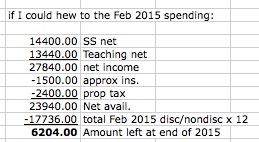
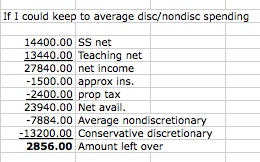
A miracle has  happened: January and February expenditures came in well under budget. On average, I figure to spend $657 a month for nondiscretionary bills (factoring in the high summer utility bills with correspondingly tiny winter ones) and about $1200 for things I have some control over. Total budgeted for day-to-day expenses: $1857/month.

In January, I managed to come in at $1,665, and in February, at an amazing $1,447: TOTAL. Hot damn!

February’s discretionary spending was kept to an almost incomprehensibly low $862, in spite of the $240 brake job! Nondiscretionary expenses, which now include a couple of maintenance expenses I used to regard as discretionary but have moved into the inescapable category, amounted to $615.

Not bad.

In February 2014, the Year from Hell, I spent $2,188. Every month during the YfH brought another unplanned expense, some of them large. Overall in 2014, I spent $2,727 on the dog,  $2,233 on little surprises like pool repair and maintenance, plumbing ripoffs, the air-conditioning ripoff, replaced a pair of  very expensive glasses I lost, and on and on and on. Clearly the $765 I donated to charity was about $765 more than I could afford. These costs, of course, did not account for the couple thousand for Medigap, the amount for Medicare Part D, the property tax, the homeowner’s insurance, or the auto insurance. By the end of the year, I just barely broke even — only because I’d taken $11,000 out of savings to live on, an amount that far exceeded projected needs.

The  YfH consumed all of that 11 grand, plus the money I earned teaching seven sections, plus all of my Social Security.

How amazing would it be if I could keep costs down to the February 2015 level? Well, here’s how amazing:

1 2015 based on Feb

Yes. If I lived in Never-Never-Land, where every month is February and the temperatures never rise above 80 degrees or drop below 60, I could in theory end the year $6200 in the black, without drawing down a dime from savings!

We know, however, that we live not in Never-Never-Land but on the Other Side of the Looking Glass, home to the Cheshire Cat and the Queen of Hearts. In that ever-so-much-more realistic world, I’ll be lucky to stay on a budget based on average 2014 non-discretionary, non-emergncy costs:

2 2015 based in average In this scenario, I’d have about $2,860 of budgetary play, enough to cover a few unplanned emergency expenses if none of them is very large. Even that is not bad, because — amazingly — it still suggests that if I can keep a death-grip on expenses, I might not have to draw much down out of retirement savings to survive the year 2015.

That, as we know, is not going to happen: we still have no idea how much I’m going to end up owing the Mayo, after all is said and done by Medicare and Medigap. I’m sure it’ll be at least $2,000 and wouldn’t be surprised to see the total come in at around $5,000. I’ll be unhappy but not very surprised to get hit with a $10,000 bill.

So, it will behoove me to continue to keep an iron grip on costs.

What does that actually mean?

Keeping to the February budget (assuming that were not made impossible by the summer power and water bills) will mean essentially living under house arrest.

In January, I hardly went out of the house at all. For good reason: convalescing from the January 6 surgery consumed most of the month.

In February, I didn’t feel much like running around town, but I also suffered a spate of Bag Lady Syndrome. I determined to get a grip on the spending. And that meant not going out of the house at all unless absolutely forced to. I’ve barely left the house except to walk around the neighborhood, run down to the church, and go to a doctor’s appointment. As the budget cycle ends, I’m out of groceries, out of dog food, out of gas, and out of just about anything else you can name.

To stay on this tack, maintaining expenses at the lowest possible figure for any given month in any given season, I’ll have to pull off the following tricks:

• Never go to any event of any kind that costs money
• Never eat in a restaurant
• Restrict Costco trips to one a month
• Restrict grocery trips to one a week
• Purchase no new clothing, not even anything to accommodate the new Boobless Wonder look
• Purchase no new shoes
• Travel exactly nowhere
• Avoid driving the car as much as possible
• Do not donate one red dime, no matter how worthy the cause
• Do not repair or replace things if they can be left to limp along or done without
• Do not get my hair done
• Stay away from veterinarians
• Stay away from doctors
• Stay away from dentists

After just two months of house arrest, I can assure you that I’m already going stir-crazy. Getting used to living like this is going to be a challenge, although I will say I did it after I was laid off the job. But I am not pleased at the prospect of making it a permanent Thing!

SDXB, who lived like this out of choice so he could quit his job in his late 40s, used to have a long list of Free Things to Do. It’s surprising how many there are, from hiking in the local mountain parks to Bum’s Night at the city museum (yeah: the local museum lets people in for free on Wednesday evenings). There’s a free lunch-time music event in Scottsdale, and low-cost or free lunch-hour plays downtown (or there used to be — those may no longer be operative). Biltmore Fashion Square, an upscale shopping mall, is dog-friendly — you can take your dog over there and loaf around their central greens, and even take the pooch into most stores that don’t serve food. One could take up art again and go paint or draw en plein air.

Art supplies, though, cost money.

Or, of course, one could go grade student papers…

Tang Me! Tang Me! Yuh oughta take a rope an’…

…hang the dishwasher? 🙂 Remember the rage, a few years back, for cleaning out the dishwasher with Tang, the fake-food sugared orange drink mix? Ever wondered how that worked?

Welp, after much scrubbing and cleaning and vinegaring of the stinky freakingbrandnewDishwasher, I got the weird smell out. For awhile. But within a week or so, it was back.

The machine doesn’t seem to be dirty. In fact, I began to wonder if it was the water — the city adds some very strange chemicals to the water as the weather starts to warm. This is a new odor, but every now and again we do get a new odor. Sometimes even the dogs won’t drink the water. Then I have to fill their dish with filtered water for days on end. But after much sniffing around, I decided that probably wasn’t the issue.

In a moment of desperation, I decided to try this folk remedy. Looked it up on the Web; found a few handymen holding forth on YouTube, explaining how much to dump in. Took a drive to the Safeway, which carried the stuff, oddly enough, down at the end of the aisle full of fake drinks.

A small plastic bottle of ominous-looking orange powder costs about three bucks.

You empty the dishwasher, and then you sprinkle about a cup of the stuff — about half the small Tang container — around the floor of the washer. Turn the kitchen faucet to hot and run it till the water coming out is is hot as it’s going to get. Set the dishwasher on the sani-cycle. Then turn it on and let ’er rip!

After a couple of hours of this, the Bosch came to the end of its cycle and sat there in dignfied silence.

Opened the door, stuck my head in, and took a whiff.

It smelled very much like…well, orange Kool-Aid.

Better than how it smelled before, anyway.

After the first washing of dirty dishes, the machine still smelled a little of artificial orange flavoring. (Do astronauts really drink this stuff? REALLY???? And it takes a research grant to figure out why they’re ailing when they come out of orbit?) But that scent dissipated within a day, and we went along for several days absent the weird odor.

By  now — about three weeks later — the odor seems to be coming back slightly, but not bad.

You’d expect to clean out the filter thingie in the bottom of the washer about once a month, if not more often. It does collect a little grease, which may be the source of the smell, although…I’ve never had any other washer create a smell from its filter, and I’ve had a few dishwashers in my life, including an earlier model of the Bosch. Nothing like a little upgrade to make your life more pleasant, eh?

So if you dumped in a cup of Tang each time you washed the filter (I soak mine in hot detergent water laced with about 1/3 cup baking soda), you’d use one package of the stuff a month, adding an extra $3.00 to your monthly housekeeping bill.

No doubt you can get the stuff cheaper if you shop in venues other than Safeway. Plus it’s the sort of stuff that coupons are made for — I’ll bet you can get the small size for two bucks, if you look around.