Coffee heat rising

When Someone You Know Is a Crook

Money Beagle has a great post on how one goes about making bail, a reflection occasioned by the discovery that a former friend was accused of embezzling $400,000. It’s really a shocker when someone you thought you knew well turns out to be crooked as the proverbial hound’s hind leg.

First time it happened to me was when an ex-flame of mine was arrested somewhere east of Yuma, ferrying the largest haul of cocaine that had ever been nabbed in Arizona.

Heh. He always aimed high. This was the guy who soured me on Republican party politics. If you think “dirty tricks” were dreamed up by Richard Nixon’s boys, think again. 😉

Never occurred to me, though, that his career ambitions extended beyond sabotaging the presidential campaigns and hustling call girls for visiting big-wigs.

Krantcents, commenting on Beagle’s post, reflects on his experience teaching at the Leavenworth army prison and remarks, “The main difference between a criminal and me is I realize I would be caught the very first time where they think they will never be caught….”

Maybe that’s the fundamental difference between the law-abiding type and the crook. I was always too scared of getting caught to cheat, lie, and steal.

So namby-pamby was I, it wasn’t until I hit middle age that I noticed how much stuff some people get away with. The reason some people think they’ll never get caught is that it’s objectively true that they very well won’t ever get caught. The first time I realized a married couple of my acquaintance was committing what appeared to be insurance fraud — again and again! — I was flabbergasted. The worst that happened (other than the disintegration of their life, more a function of their personalities than their larceny) was that their insurer eventually refused to cover their home or car.

After that I began to notice what people around me were pulling off: outrageous mortgages that of course they couldn’t pay; selling bloated mortgages to people who obviously couldn’t afford them; “buying” a dressy outfit, wearing it to a party, and then returning it with a claim that it didn’t fit right; drinking and driving; buying and selling weed and ’shrooms; shoplifting from clothing and grocery stores with impunity; gaming the FMLA law; collecting from insurance companies for nonexistent neck injuries after minor fender-benders; declaring bankruptcy and then heading off to California for an upscale vacation; embezzling from a law firm and leaving the partners holding the bag; and on and on and on.

It’s no wonder college-age students think they can lie and cheat their way to honors-level grades, given the role models they see. They seem to expect to get away with it.

And probably, most of the time, they do.

Would you like a set of Noritake? Or a place setting of Lenox? At a discount!

By way of clearing out some space here at the Funny Farm, I’ve decided to sell some fine China that my then-young self and my then-young husband purchased in late ’60s or early ’70s.

The most interesting of the two items on offer is an 8-place-setting set of Noritake in the “Trudy” pattern. Apparently Trudy is no longer made, so you have to go to places like Replacements, Ltd. to get it — or find it serendipitously in an estate sale. Here’s what it looks like:

noritake_Trudy

That’s the cup and saucer, and below is the plate:

noritake_trudy_dinner_plate

This is stamped on the back of each  piece:

P1020052

Proof positive:

Noritake — yes
Trudy — yes

They’re quietly elegant China. Tiring of the heavy, casual-looking stoneware that was the rage when I was married, I bought this set because I wanted something a little more formal for entertaining, part of the job description for a corporate wife. I found them at Goldwater’s, probably in the early or mid-1970s. Was very proud of them until it dawned on me that hand-washing dishes for eight people was not my cup of tea. It’s been lightly used, and as far as I know (I haven’t unpacked the entire box yet), it has no chips or dings. I think some of the plates may have a little wear of the platinum ring around the outside.

Then we have one place setting of this:

lenox_china_solitaire

I have one, count it (1),  full place setting of Lenox in the Solitaire pattern: plate, salad dish, bread & butter dish, cup, saucer. It’s in perfect condition, having never been used.

When I was a young bride about to marry a corporate lawyer on his way to partner at one of the most prestigious law firms in the Southwest, I did what all the other young brides did and signed up for the registry at every department store in town. For our China, we chose this Lenox Solitaire, which to this day I think is just gorgeous.

Lenox still makes this pattern. Today it’s selling for much less, relative to what Americans earn, than it did back in 1967, when I entered the blessed state of matrimony. The firm bought us a full set of the silverware we craved. But only one person gave us a place setting of this stuff. There was no way my husband and I could afford to buy any more of it — and he made very good money. The company was acquired in 1983; I have no idea whether they made changes in their production or quality control, but one reviewer at Amazon observes that pieces she purchased within the past couple of years don’t compare with Lenox from the 1960s.

Apparently not all the newer products carry the Lenox stamp on the back, which you can see on mine:

P1020056

I’m going to sell both sets — the eight place settings of Noritake and the single five-piece place setting of Lenox, either through a consignment shop here in Phoenix or through e-Bay. However, first I’d like to ask Funny about Money’s readers if anyone would like to purchase one or both directly from me.

The Noritake has been offered at Replacements, Ltd. for $630 for 45 pieces (eight place settings, of course, will give you 40 pieces); Classic Replacements has had it for $60 for five pieces but evidently has no Noritake in stock; and on e-Bay it has been sold for $55 a place setting (that would come to $440 for the complete set). I’d be willing to sell the Noritake set to a reader for $400, plus shipping.

The Lenox is $90 per place setting at Bed Bath & Beyond, and I spotted it at Amazon for the same price. Replacements, Ltd., is selling it for $70 a place setting. I think $65 plus shipping would be a fair price.

If you would like to purchase one or both of these, please let me know. You can reach me at funnyaboutmoney {at} gmail {dot} com.

Less I$ More

Not in the good frugal minimalist way. At Cox, it develops, “less is more” means “less for more.”

After endless calls from “Rachel of Card Services” (who actually is a recorded message used by several offshore phone solicitation scammers) and more recently from creeps who know my age and try to scare me into buying various redundant and useless “security” services and devices, I decided to quit resisting and shell out an extra $10 a month for Caller ID.

So this seems to be working. It’s kinda cool. The phones flash up the caller’s phone number, and for unknown reasons one of the extensions tries to enunciate, in Electronic English, the caller’s name, usually coming up with something  unintelligible. Entertaining. And on the first couple of days it derailed several incoming scams. Nice!

Then a couple of people said they’d tried to call but the voicemail wasn’t picking up.

I figured they probably dialed the wrong number.

Yesterday I’m on the phone with a client. She’s calling from a cell phone with kind of a weak connection, so I figure the periodic BLEEEET in my ear is from some sort of interference.

Conversation ends. Check the e-mail. Message the first:

“I tried to call but your voicemail isn’t answering…”

Check machinery. Yes, it is answering.

Hmmmm….. BLEEEET…no busy signal…no voicemail…uhmmm… Duh!

So I kill another 10 minutes or so trying to get through to a live person at Cox. I figure the guy I talked to a few days ago added Call Waiting in addition to the Caller ID…must’ve figured he could do me out of another few bucks by tacking on an extra “convenience.”

Dunno about you, but I really dislike Call Waiting.

It’s rude.

• In the first place, I don’t want to be badgered by someone trying, unknowingly, to butt in to a conversation I’m having.

• In the second place, it’s incredibly offensive when someone says “Oh, there’s another call! I’m putting you on hold so I can answer that.” Implication: you aren’t important enough for me to give you my full attention. Or, other possible implication: I think I, wonderful little me, I am sooo important I must be at the beck and call of all my operatives, underlings, and superiors. Either one: offensive.

• And in the third place, it’s just plain bad manners to push the person you’re conversing with out of the way so you can let someone else horn in. If, after all, the late-comer’s call is important, she or he will call back.

Rude. Rude, rude, rude.

Finally a human picks up the line. She confirms that yes, the guy I spoke with did give me a package bundling Caller ID and Call Waiting together.

I say I don’t want Call Waiting.

She says she can arrange that, but it’ll cost more.

“What?”

“To get Call Waiting alone will cost $1.20 extra. Plus tax.”

For godsake.

Well, I figure it’s worth $1.20 — $14.40 a year (plus tax!) — to eliminate yet another of the myriad nuisances of life in the 21st century.

But boy, does it piss me off. Why should consumers have to pay more to NOT get something they don’t want?

Then she remarks that the total bill for the Internet and the land line will come to just under $100 a month.

Really? Seriously? A hundred bucks a month for about $30 worth of flicking services????

Started to look around for other high-speed providers. Looks like there are quite a few, and some, including Verizon (roundly hated, I know…but are any telecommunications providers not reviled?), offer the same things I’m getting for less.

So I guess tomorrow when I feel more like hassling with these people, I’ll start calling around to see if I can get a better deal.

Like I have nothing else to do with my time. 🙄

Survivors and Succumbers

P1020031LOL! Is there such a word as “succumber”? I couldn’t think of a noun antonym to “survivor” that ended in -er or -or, so made that one up. Possibly, though, it’s more closely related to “cucumber”?

Spent most of the day yesterday thrashing around the yard. The late frost was one of the strangest climatic episodes I’ve seen here in the low desert. Plants I expected would die made it through just fine, and plants I thought were pretty cold-hardy croaked right over.

The orange and lemon trees suffered more damage than they did in the harder frost we had several years ago, when they were less mature. About half the harvest of candy-sweet oranges is ruined — some pieces are still juicy and good; others are dried out. The Meyer lemon is dropping all its big, ripe fruit into the mud. I’ve tried to give them away to friends but don’t know whether anything remaining can be salvaged. If the hardier oranges are parched, the inside of those lemons must be sawdust.

The lime tree may be lost. Though I hung a couple of shop lights on its limbs, there was nothing I could do to cover it — the tree had grown taller than the roof. At least half of it froze back; it remains to be seen how much more will die.

P1020024

Click on the images for higher resolution.

I picked the wrong time to have the trees pruned! The parts of the lime that survived were the areas sheltered by the adjacent devil-pod tree. Just a few days before the freeze, the arborist removed a large limb that hovered menacingly over the house — and that also overhung the lime tree. Probably less of the lime would have been blighted had that big limb still been in place.

It will have to stay untrimmed until well after the heat comes up. It will be weeks, maybe months, before we know how much it it will come back.

The yellow oleander also looks like a goner:

P1020038

Weirdly, this tree did much better in the last frost, which was colder and lasted longer. This year we only had a couple of nights in the low thirties and high twenties. The last frost seemed to go on and on, and as I recall it came and went through several episodes.

On the other hand, that last big frost came with rain. This year has been droughtier than droughty — not a drop of rain in sight. So the plants probably were stressed to begin with, since I cut back the irrigation (which isn’t very effective to begin with) in the winter.

I hope the yellow oleander doesn’t die. It’s a pretty little tree that’s covered with bright yellow blossoms all spring and summer. Most of its limbs are still springy, giving some hope that the leaves may come back. However, with no viable leaves at all, right now it can’t photosynthesize, so my sense is that what we have here is very slim hope, indeed.

Even highly xeric plants, including these agaves and cacti, died back:

P1020039

Ouch! We’ll be paying Gerardo a nice bonus for shoveling out that mess.

The bougainvillea back there only looks dead. Bougs hate frost and instantly convert themselves to dried arrangements at the first sign of cold. But they’ll come back. The trick is to leave them looking like that, without pruning off the dead stuff, until the weather is good and hot. Along about May, we’ll be able to see which limbs are really dead and which are just hibernating.

Some plants that I covered also died back. Everyplace the sheets and towels touched the potted ficus tree’s leaves, it fried:

P1020007

Ficus are notoriously touchy about environmental changes, though. Some of these limbs may regrow their leaves, so here, too, I’ll have to wait until the weather has been warm for awhile to see how much needs to be cut back.

I knew the red salvia would freeze, despite being covered. What I didn’t expect, though, is that most of the eight plants that went in last summer would survive! When I went to pull them out yesterday, what should I discover but new growth at the base of the dead sticks:

P1020008

This was quite a surprise — I’ve rarely seen salvia live through a frost.

I was certain the new gardens I’ve planted over the past few weeks would be flattened, and that all the new bulbs would be frozen underground. But no! In front, the only loss was a lovely little lavender plant. Everything else, even the mint, made it.

P1020029

Some of the bulbs I planted out there have even started to grow!

P1020033

I think these are lilies of the valley. But am not sure. Whatever…they look promising. And their appearance bodes well for the survival of the other bulbs lurking in that bed.

Turns out to have been a good thing I pulled the four unwaterable roses out of the front flowerbed and the two in the light-starved westside bed. I’m getting too old to cope with 89 gerjillion rose bushes. Yesterday I pruned the three in back and was just done in by the job. The back, legs, and foot hurt something awful after what seemed like not much exertion.

Though it must be allowed that “not much exertion” did entail hoeing and shoveling 50 or 100 pounds of damp gravel back from one rose to build an enlarged watering pan, hauling rocks over to line it, emptying the new stuff out of the compost bin and digging the fully composted material from the bottom of the bin, shoveling it into the wheelbarrow, and depositing it around two of the roses, and then refilling the compost bin with the uncomposted stuff. That was a bit of a job, I suppose.

P1020020

This very pretty rose has been struggling with only one piddly little dripper and with the crushed granite top dressing right up against its trunk. It makes a beautiful orange and red flower, but they never last long because the plant is perennially heat- and drought-stressed.

turtle figurine🙂 Found that piece of flagstone buried under the crushed granite. Next time I’m at Baker’s or Summerwinds, I’ll look for a kitsch frog or some such to set on there. Though I have a Talavera frog pot with a cactus in it, Gerardo’s underlings invariably break anything made of pottery that’s left in their way. Baker’s sells molded resin turtles that are amazingly lifelike, and of course cast frogs are a dime a dozen.

At any rate, this pushes the broiling hot granite back from the rose, and it also gives the rose some new and very rich compost.

Also dug in some systemic fertilizer/disease control, since all three plants are showing signs of blackspot and something that’s turning leaves yellow and stunting them.

Closer to the house, a vigorous, large perfumed delight rose struggles through the hot summer.

P1020021

The trees don’t block enough of the fierce afternoon sun to save it from fricasseeing, and the stupid drippers, even with the largest gallons-per-minute gadget available, don’t give it enough water. It’s a bit out of the way, too, and so I often forget to drag the hose to it when I’m adding extra water to the other plants. That notwithstanding, over a summer it’ll grow as tall as me.

I didn’t prune either of these back as far as I probably should have, because they’re so stressed it’s hard to tell which canes are likely to live and which not. So I removed the diseased and damaged foliage and the canes that obviously were already dead, but tried to leave enough healthy-looking stuff for the plants to keep puttering along as it gets warmer — which is happening very rapidly.

The unruly, ferally beautiful blue plumbago morphed into a gawdawful haystack.

P1020028

I was about to cut it back to the ground, but thought better of it after having googled care of frost-bitten blue plumbago. While the site linked above says plumbago responds well to pruning, another site says it’s best to wait and see what parts of the plant come back after a frost before pruning.

After the last frost, it died all the way back, and I thought it was gone. As in gone gone. And in fact, the plant that had been put in the flowerbed was gone. This thing sprouted from roots that had extended outside the bed — it actually is growing (or was growing…) just on the other side of the decrepit railroad tie some long-previous owner used to build that bed.

{sigh} There’s going to be a lot of dead foliage sitting around the yard this spring, then. Not only the walloped plumbago but five hammered bougainvilleas, the decimated lime tree, the slammed yellow oleander….lovely.

Oh well. At least some survived. And of course the deciduous vitex and desert willow soon will be back in their full glory.

 desertwillowflower_2

 Desert willow image: Stan Shebs. Creative Commons Attribution-Share Alike 3.0 Unported license.

Adventures in Furniture Repair

The furniture in my house has a checkered past. Some pieces bear the deformities of their misadventures.

P1010996The central attraction is a set of solid birch, blonde 1950s Conant-Ball casework. It must have been pretty expensive, back in the day. At least, I think it was.

After 10 long years in Saudi Arabia, living with metal Company-issue furniture (yes: metal bedsteads, metal bureau drawers,  metal nightstands, metal everything. Anything that wasn’t metal was something they’d scrounged second- or third-hand from other Americans in camp), my parents decided that my father would quit and we would come back to the States.

How my mother pulled this off, I do not to this day know. Left to his own devices, my father wouldn’t have quit at that time. He was earning a lot of money as a harbor pilot in Ras Tanura, where petroleum products were loaded from the refinery onto American and European tankers, earning far more than he could have made Stateside. He salted every penny of it into investments (mostly ill-advised, but there’s another story), because his life’s goal was to retire at the earliest possible moment. To that end, the couple lived, shall we say, ascetically.

She must have told him she was going to leave him if he didn’t quit. If she did, it was pretty daring, because he was fully capable of saying “fine!” At any rate, she persuaded him to quit prematurely; after 10 years, he still didn’t qualify for a pension from Aramco. I expect for that he probably would have had to stay on for 15 or 20 years.

She and I came back to the States several months before he did — again, the “why” of this was never explained to me. But I can imagine.

We took a train across the country and arrived in San Francisco, where she set up housekeeping in a very pleasant apartment on the sixth floor of a very pleasant high-rise in a very pleasant lily-white middle-class apartment development. The first thing she did was to take herself to Sloan’s, a very nice (all very nice) downtown furniture store, where she engaged a designer to furnish the entire rather large dwelling.

P1010998The effect was amazing, unlike (I’m sure) anything my mother had ever had. All the sofas and chairs were stylishly color-coordinated, and all the wooden casework in every room but mine (she put dark maple pieces in there, for unknown reasons) was this mid-century Danish modern stuff, heavily influenced by the Shaker style.

What makes me think it was pretty good stuff is that it’s lasted 60 years despite a fair amount of abuse. And the abuse is what makes me suspect my father could have had no idea on God’s green EARTH how much she must have paid for it.

This was a guy who thought Levitz was upscale and a bit rich for our blood.

When he finally did accumulate the hundred grand he thought he needed for retirement, he moved her and himself to Sun City, then a development out in the cotton fields west of  Phoenix, Arizona. The little house they moved into didn’t have enough room to hold both a dining room set and a television, as well as the living room furniture. Given a choice between furniture and the TV, my father’s choice would always be the TV. Hands down.

They had a screened-in back porch, and my father decided that he was going to convert this gorgeous set of furniture — a solid birch table, four spindle-backed side chairs and two captain’s chairs — into outdoor furniture.

My mother must have been devastated! But even then, she must have been afraid to tell him what she’d paid for it. He couldn’t possibly have had a clue.

He coated all seven pieces with layer after layer after layer of shiny polyurethane. By the time he finished, the stuff looked like yellow plastic.

He did a good job of slathering varnish (he loved polyurethane!): it was impervious to water and heat. His idea of cleaning the porch was to haul the backyard hose in and squirt everything down. And in a good monsoon, rainwater would blow through the screen and douse the set. By the time I inherited it, fourteen years later, it still had no water damage.

It was pretty horrible-looking, though, with all that polyurethane shit on it.

My then-husband and I had a friend who was seized by a passing desire to become a furniture-maker. He proposed to strip and sand off the varnish, and then I would refinish the table and chairs with Danish oil.

This came to pass, more or less. And the result actually was not bad — certainly not compared with the high-gloss polyurethane. He stripped the table and the four side chairs, but drew the line at the captain’s chairs, the project having proved to be more difficult than he expected.

The sets of cabinetry and chairs replaced the old bargain pieces and the bricks and boards with which my husband and I still furnished our home after fourteen years of wedded bliss. I took them with me when I fled.

P1010985My son now has the dining table, but I’ve kept the side chairs and the captain’s chairs, as well as the occasional tables, the bureau drawers, the dressing table, the desk, and the nightstands.

The other day, one of the captain’s chairs finally broke. Its underpinning split, causing one of the legs to come loose.

Well. I’ve always wanted to have those chairs stripped and refinished. This was my chance. A couple of guys came highly recommended on Angie’s list, so I asked them to drop by look at it. Ninety bucks, and they were willing to hand-strip (no dipping!) and sand the crud off the chairs, and to apply a new hand-rubbed oil finish.

Good.

But there was more.

Some years ago, back when I had a job and an income, I coveted a Thomas Moser coffee table. Indeed, so much did I covet the thing that I actually ordered one up!
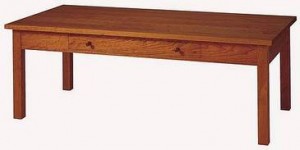
thosmosercoffeetable.php

Lovely, eh? Cherry. Hand-rubbed. Nice.

Well before the six weeks required to make this bauble had elapsed, I discovered that Ethan Allen made a coffee table whose design was very similar, and whose price was a fraction of a hand-made Thomas Moser chef d’oeuvre. They were phasing out the model, and if I would come down to their shipping facility I could have it at cut- cut-rate — a tiny fraction of the Moser piece’s cost.

This appealing mightily to my cheapskate impulses, I promptly canceled the order from Thos. Moser and bought the Ethan Allen thing.

When they delivered it, I regretted having done that. It had a shiny finish, and shiny furniture really is not to my taste. It didn’t go with the Stickley side table I’d acquired at a vast discount, nor of course did it go with anything else in the house. Except maybe the polyurethaned chairs.

But…there it was. I thought it could sit there for a few days until I decided whether I could live with it.

DCP_1364That decision, however, was forthwith made for me. The thing hadn’t been lurking in the living room more than 45 minutes before Walt the Greyhound, in an uncharacteristic flash of exuberance, reared up on his hind feet and dropped one massively clawed paw on the brand-new shiny tabletop. Dug a big scratch into it!

Shit.

At the time, I was too dumb to know that my credit card likely insured it. Matter of fact, I probably was too dumb to have put it on the card. Chances are I paid cash.

Whatever. I figured I couldn’t send it back with a scratch my dog had put into it less than an hour after Ethan Allen’s delivery guys had carried it into the house. So I’ve lived with it for lo, these several years.

And I still covet the Thos. Moser coffee table.

Turns out the Ethan Allen finish was so fragile the mere force of your eyeballs staring at it could inflict a scratch. Over time it picked up many more dings, some from unfathomable sources.

Lately I’ve been thinking, what the hell; life is short, a train of thought tending toward a possible purchase. A Thos. Moser purchase. But I’d look at the table and think its wood didn’t look all that bad, and under the layers of dark stain and shiny varnish its construction looked much like the Stickley’s. And it occurred to me to wonder if I could strip and refinish it myself.  But…I’m past my handyperson days.

So when Gustavo and Manny were here I asked if they thought they could refinish it.

Gustavo speaks mostly Spanish and has the look of an old-country craftsman about him. He may just be a campesino, but he puts on a convincing show of knowing what he’s doing.

He said he thought the table was made of maple, and he pointed out that the top was not veneered — he showed me how to tell. He proposed to refinish it to match the Stickley piece rather than to apply a hand-rubbed oil finish. However, he will make several test pieces for me to approve.

He was taken by the Thos. Moser continuous-arm chair and the Thos. Moser New Gloucester rocker, particularly by their amazing joinery. And he also noticed the table that I’d paid $300 for at the model-home furniture clearance store.

I allowed as to how I thought it was junk — particle-board with a veneer — but it looked pretty good. He said it wasn’t fine furniture, but it wasn’t actually junk, either: he pointed out that the veneer is unusually thick, thick enough to withstand one sanding and refinishing. Not bad, he thought, as veneer goes.

P1020002

Well, what it all boiled down to is that Gustavo will repair the broken captain’s chair, hand-strip both chairs and the coffee table, and refinish all three pieces for less than half the cost of a new Thos. Moser coffee table & shipping. They also propose to level the annoying eight-foot bookcase in the living room.

It’ll pare down the diddle-it-away fund, but I do believe I can afford it.

🙂


Old Lady Skypes iPad, Dumps T-Mobile

😀

It worked!

This morning I downloaded the Skype app onto my handy little iPad, which mostly has functioned as a Kindle reader and game center. Set up an account, fed my friends’ phone numbers into it, and (most important!) entered numbers for the roadside service and for Chuck’s Auto Service.

Tested: ta da!!! Works likes a remarkably high-quality squawk box. No earbuds required. No need to hold a gadget up to your head. Kewl.

Canceled the endlessly frustrating T-Mobile service. The phone, disconnected from its carrier, will do just fine to dial up 9-1-1, should the need ever arise while I’m on the road.

I’m quite tickled. In fact, I’m feeling a lot happier about this than I did when I bought the T-Mobile phone and signed up for the allegedly low-cost month-to-month service.

AT&T costs $15 a month. Skype costs 2.3 cents a minute; that would be $2.30 for 100 minutes, probably more time than I’ve spent yakking on phones over the past year. The optional Skype phone number is $60 a year or $5 a month, bringing the cost to about $20, maybe $22 a month. You can use it for texting, too.

T-Mobile’s no-contract service is $33 a month (plus tax, which brings it to $35) for a few minutes of conversation and unlimited texting and Internet.

The iPad is intuitive and easy to use. Links to contacts’ phone numbers are large, obvious, and easy to click. Skype also provides a dialpad that fits your fingers. You get as much low-cost talk and text as you choose to pay for; unlimited Internet; access to iCloud, your MacMail, and all your contacts; apps coming out the wazoo; Kindle and iTunes books; a browser you’re familiar with; and virtually no learning curve. The Nokia provided by T-Mobile is endlessly puzzling, anything but intuitive, microscopic, and has a keypad designed for the delicate appendages of a mosquito.

Pretty neat improvement, IMHO.

Today’s Grand Switch had an immediate cause, beyond the general user-unfriendliness of the Nokia. Month or two ago I set up T-Mobile to charge the monthly $33 to my AMEX card. This worked at first. Then along about the 10th of this month, in comes an email saying they’ve received the most recent payment and now I have to go to the T-Mobile site, sign into my account, and “purchase a pass.”

So I attempt to jump through this hoop. Go to the linked page and find…no choice to “purchase a pass.” You can “fill,” but in my experience this is a command to bill you for another $33. Not inclined to experiment with that, I drop by the T-Mobile store around the corner.

There I ask what is meant by “purchase a pass.” The employees have no clue. They’ve never heard of “purchasing a pass.” They say it means I haven’t paid this month.

Back at the Funny Farm, I call American Express and discover that T-Mobile charged and received their $33 on January 4. A few days later, while I’m driving around, I drop by another T-Mobile store. It’s about 10:30 a.m. Their signage says they open at 10. But the doors are locked and no one’s in the store.

Enough, already, with paying $33 a month for air, a gadget that makes my head ache when I try to use it, and endless hassle.

If this works out, I may buy an iPad mini and put Skype on that — sometime after Apple emanates new versions, pushing down prices for the iPad that will be made “obsolete.” The mini model would easily fit in a zippered pocket in a purse. Until then, I’ll have to hide the iPad in the car when the weather’s cool and tote it around during the summer.

But at least I’ll be toting around something I can use.