Coffee heat rising

Busy days upcoming

Have to spend half the afternoon in unpaid labor at the campus. To be allowed to continue teaching online courses, we’re required to attend a three-hour workshop in Canvas, the new course management software with which the college is replacing hated Blackboard. The thing is, Canvas has online tutorials, and so it’s unclear exactly why we need to sit through three hours of unpaid training.

It’s particularly annoying because I have no intention of changing my present strategy, which is to post an announcement on the CMS’s homepage directing students to the website I constructed after I ran out of patience with Blackboard.

If they order me to stop doing that, then I will quit teaching the magazine writing course, because I am not going to rebuild that whole complicated course AGAIN, for free. At $2,400 a semester, it’s just not worth my time. The truth is, if I feel I just must teach one or two courses a semester, I can go over to the Great Desert University and pick up  a course for $3,000, a far cry from what the junior colleges are paying.

Anyway. Before that I have to go down to the church and help set up for tomorrow evening’s silent auction. Won’t be able to spend as much time as I’d like doing that, because I’ll have to leave here at quarter after noon to get to the campus and find the building and room, and will have to bolt down some lunch before leaving for that. So my coreligionists no doubt will once again regard me as a hopeless slacker and tightwad. Oh well.

Tomorrow my friend KJG and I are spending the day at a big artwalk event. That should be fun. Probably we’ll have to break off early, though, to give me time to get to the evening shindig on time. So…it looks like all day today and tomorrow will be occupied.

vite, vite…

Planting Our Pennies has posted a new balance sheet, very  positive. I like the bar graph strategy they use.

Speaking of planting, 101 Centavos has a gardening report  with some information I didn’t know.

Money Beagle posts part 3 of The Worst Job Ever.

Revanche reflects on strength of character.

Donna Freedman generates an incredible number of comments in her report on the pissing match between her daughter Abby and Financial Samurai.

TB sees the light at Blue Collar Workman.

Evan posts an update on his net worth: modest growth in October, pretty darned good for 2012, awesome over the long haul.

And my grutch about yesterday’s classroom pains in the tuchus, complete with salutary illustrations, went live yesterday.

Drat! Must fly! Later…

Opt Out of Forced Arbitration!

A number of companies have, over the years, forced consumers to agree to arbitration of disputes—it’s that, or don’t do business with them, in some cases not a very practical option.

Agreeing to arbitration puts you, the consumer, at a huge disadvantage. In the first place, when you accept this arrangement, you lose your right to file a suit before a judge and jury, and you also lose your right to be part of any class action suits against the other party, whether or not you have been damaged by that party. And in the second place, the arbitrator is chosen by the parties in the dispute, which generally means that the huge corporation with the bottomless pockets gets to choose an arbitrator whom their lawyers knows will most likely rule in their favor. For you, the consumer, it’s a recipe for loss.

American Express is stuffing its billing envelopes with a mass of fine print that offers customers an opportunity to opt out. The deadline is February 15, 2013. The way you do it is to download and fill out this PDF. Send it by snail-mail to the address printed on the PDF.

Do it now. This is important. It may not put you in the driver’s seat, but at least it will put you back within arm’s reach of the steering wheel.

Several other companies are giving (or have been made to give…) consumers opportunities to opt out of enforced arbitration. Check out these sites:

Paypal escape
Comcast form
eBay opt-out form letter from Public Citizen ***DEADLINE: NOVEMBER 9

If you do business with any of these outfits, you should move quickly to opt of their despotic arbitration clause. Don’t delay.

Moment of Fame Leads to Education Moment

So yesterday morning I went down to the studios of KFNX-Radio to record a 12-minute blurb about The Copyeditor’s Desk, a freebie perq for members of the North Scottsdale Chamber of Commerce. It was kinda fun…and interesting. The host of this program is none other than the Chamber’s executive director, Joe Galli, who, it develops, is a veteran broadcaster.

Don’t know if it’ll bring us more work—Joe seemed to think it will, but then, that’s his business and it pays to be optimistic about one’s business. If you’re interested, it airs at 11:00 a.m. Mountain Standard Time (which is the same as 11:00 Pacific Daylight Time) on Saturday, November 10. It looks like you can pick up a live stream on the “Daily Lineup” page. The logic of KFNX’s web site is a little hard to follow, but from what I can tell, it looks like the Chamber Business Hour is accessible online only as a live stream, not as asynchronous downloads.

Anyway, after our conversation was recorded, Joe pulled off his earphones and said, “You know, this touches on a big concern in my business. Every time I hire new employees, they can’t write! Their grammar, their spelling…they can’t even put together a whole sentence that makes sense. I need people to help me, but what I’m finding is I can’t trust anybody to do the job and do it right. I end up having to go back and rewrite everything they do—and if I had time for that, I’d do the job myself in the first place.”

Unfortunately, there wasn’t time to discuss this much before he had to record the next session; about all I could say was “I can’t teach in 16 weeks what people haven’t learned in 13 years of K-12 education.”

The problem is, in the absence of any formal training in grammar and style during the lower grades and with virtually no consistent, across-the-disciplines practice at writing, they come into my classes ignorant as posts and they go out almost as ignorant. When you have nothing to build on, you can’t add much to the edifice.

Instead of learning their subject matter and spending class time teaching their subjects, educators get swept up in amazingly stupid stuff, faddish psycho-social theories that distract from teaching content in favor of the teacher-as-social-worker model. In America, we’ve subscribed to theory after theory after theory, and the result is that kids arrive in college thinking that Wisconsin is a Rocky Mountain state, World War I happened in the 19th century and was the only event of note during that century, and that all essays must contain either three paragraphs or five paragraphs. Many of my students cannot work with fractions. When asked how to figure out how much a tax of 9.13% would cost them if they bought $12 worth of laundry detergent, they have no clue. Social work may keep students in the lower grades from tearing each other apart, but it sure isn’t helping them to learn anything even remotely academic.

While this may look like an educator’s problem, Joe’s anguish over the state of his employees demonstrates the real issue:

The state of K-12 and higher education in this country is a problem for business and it’s a problem for our national security. Businesses cannot function when their white-collar workers arrive on the job unprepared to do white-collar work. The nation cannot function if its businesses cannot function. It’s as simple as that.

If the U.S. is falling behind as the hegemonic leader of the world—and that hegemony, IMHO, is not uniformly a bad thing—it is because over the past two generations our educational system has been sinking into the slough of despond. We try to educate everyone so they’ll fit into the same round holes, but not every child is suited to absorb that education, and not every child’s time should be spent in that effort. We need to provide reliable employment for kids who are better fitted for jobs that require skill at working with one’s hands and one’s common sense—here, in America, not in Indonesia or India!—and honor those jobs, both with respect and with decent pay. At the same time we need to make space and provide high-quality content for the kids whose cast of mind suits them for sitting in front of a computer screen all day. Then we need to get rid of all the psycho-socio-babble theories and teach the real stuff.

Elitist? Sure…unless we bring back manual jobs and bring back good pay for those jobs. It may cost business more to pay American workers a living wage. But the cost of offshoring the work that two-thirds of our population is best suited to do is far higher: one day the cost is likely to be the loss of America as a First-World economy.

Image: 1942 photograph of carpenter at work on Douglas Dam, Tennessee (TVA). Alfred T. Palmer. This image is available from the United States Library of Congress‘s Prints and Photographs division under the digital ID fsac.1a35241.  Public domain.

Starbucks ≠ Neighborhood Coffee Shop

Over at Blue Collar Workman, TB rounded up another blue-collar dude as a guest contributor, who tells a funny story. Along the way he describes searching for a coffee shop and ending up having to settle for a Starbucks, a place where both the coffee and the clientele were jarringly overpriced. Ron’s mention of this episode came literally just a few hours after some friends of mine, true old-Phoenix folks, invited me to breakfast at a favorite hangout of theirs, a real honest-to-God neighborhood coffee shop.

When they asked me to meet them in darkest Sunnyslope, one of those lock-your-car-doors parts of town, I was given pause. However, we’d have a man along (albeit an 80-something man…wonder if he packs heat?). So, bright and early it was off to breakfast at the Eye Opener Café.

Talk about your blast from the past! It’s a real, genuine roadside coffeeshop, the sort of place every small town and wide spot in the road used to have, and that, in bigger cities, used to grace every neighborhood. The wall-sized (incredibly high-E) windows gazing out onto the passing traffic, the Naughyde-upholstered booths with the Formica tabletops, the 1970s green Formica cabinet in behind the cash register, the amiably blowzy blue-jean-clad waitress, and best of all, the locals!

It used to be you’d go to one of these places around breakfast-time and find it full of guys in khakis or jeans and workshirts, all of them chewing more metaphorical fat than bacon: solving the problems of the world (and along the way sharing a fair amount of town gossip) before heading out to the jobsite. The Eye Opener had a bunch, most of them gray of hair and beard.

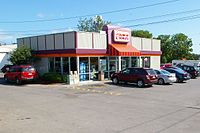
Reminded me of a place I used to visit, oh…40, 45 years ago, also in Sunnyslope. It was an old Dunkin Donuts.

We owned a ranch outside of Yarnell, up above the Rim. Two or three times a week, I’d drive up there, usually to meet a friend there, grab a horse and just be gone all day long. It was only about a 90-minute trip, once you got beyond the Phoenix traffic. In those days—and still, I’m told—Dunkin’ had the best coffee of any fast-food joint. So as I headed out, I’d stop at the Dunkin’ in Sunnyslope to grab a cup of coffee and a doughnut to sustain life during the drive.

The place was always full of old-timers and working men, and every time you’d go in there, you’d overhear some entertaining snippet of local news. It was great.

Probably they were there because by that time Sunnyslope was getting a shade blighted and any coffee shops that might have existed there were long gone. So they were forced to have recourse to a chain.

In due time, the Dunkin’ closed, too, presumably done in by Cinnabons and those icky Krispy Kreme things. Bad taste drives out good, so they say. 😉 It was replaced by a shop from some other chain, whose owners did not understand the concept of “coffee.”

My mother and I used to frequent a coffee shop in San Francisco, not far from my junior high school. San Francisco being what it is, the food was pretty good: a hamburger had real meat in it: ground round in hand-formed patties, and you could get it cooked to order. “Rare” meant deep pink, verging on red. Order “very rare” and you were apt to get something like beef tartare. The bread was thick slices of real sourdough, toasted to perfection on a greasy grill, and the French fries were actual potatoes cut up in the restaurant and cooked to order. Delicious!

But that was the exception. We dined our way from coffee shop to coffee shop across the country on the several times we traversed America, from New York to Dallas to San Francisco and back. Typically the food was much like what you’d find in a Denny’s today: ranging from pretty bad to just OK. Your best bet was to buy things that were hard to ruin: ham and scrambled eggs for breakfast, a grilled cheese sandwich for lunch, meat loaf for dinner.

That was about the story for our Sunnyslope discovery. It’s hard to ruin a pancake made from a packaged mix, for example (it can be done, but the short-order cook has to work at it), so that’s what I asked for. The blueberry pancake that came out was a little soggy, probably because the berries hadn’t been mixed into the batter but tossed on the grill and then the stock pancake batter poured over them. The bacon was very good: crisp but not burnt. The coffee was passable, a cut above Circle K’s.

Maybe the quality of the food explains the swift extinction of the ubiquitous greasy spoon when the horrid McDonald’s and its ilk came on the scene. If you’re going to eat mediocre food, why wait for it when you can drive past a window and pick it up without ever getting out of your car?

Too bad. We lost a crucial piece of Americana when we abandoned the local coffee shop. As Ron, the guest author at Blue Collar Workman, points out, a Starbucks ain’t no coffee shop. The atmosphere is unwelcoming—in fact, all that echoing hard-edged plastic decor was specifically designed to discourage people from sitting around and talking at length—the food is ridiculous, and the coffee that underlies the sticky confections they sell as drinks is akin to battery acid. Why anyone would want to go there beats me.

When Edward Hopper painted Nighthawks, he spoke to an American vernacular experience that anyone who grew up in this country during the mid-twentieth century would instantly know. The sights, sounds, smells, and flavors of such a place were part of our culture. Probably the greatest value of such places was that they gave us a place to hang out, shoot the breeze, and get to know each other.

Where do you hang out today? Can you hear each other talk there?

Images:

Nighthawks. Edward Hopper. Link to Wikipedia file.
Dunkin’ Donuts shop in Geneva, New York.
N-Lange.de. GNU Free Documentation License.

Why?

Now is the winter of our discontent
Made glorious summer. . .

William Shakespeare
Richard III, Act I, Scene 1.

Alone this afternoon I stood in the empty classroom amid the thoughtfully designed seating, sunshine flowing through the ceiling-high windows, and I wondered: Why do I hate teaching? Am I making a neurosis of this? Or is there some reason I should hate what I’m doing so passionately? And if so, do I exaggerate that reason?

It wasn’t always thus.

Although I will say I’ve disliked teaching freshman comp since the first day I set foot in a roomful of sullen nineteen-year-olds as unhappy then as their children are now at being forced to take a hoop-jump course, nevertheless after I went to work at the Great Desert University’s west campus, I enjoyed teaching.

But then, our typical student was quite a different creature. When I started at West, it was an upper-division and graduate-level campus. The average student was a 32-year-old woman.

Teaching was great for six or eight years. You could even go so far as to say I loved my  job. Working with adult students was a joy, and I never taught composition. I taught upper-division courses in workplace, technical, and scholarly writing and advanced courses in editing. Pay was comparable to that of tenure-track people with the same number of years on the job, but because the full-time job was nontenurable, I didn’t have to worry about publishing (not that it mattered: my book was already published; had they seen fit to  hire me on the tenure track, I would have achieved tenure quickly) and when it came to academic politics, I could keep my head below the line of fire. This was good. Very, very good.

But then morale on the campus began to sag. Tenured and tenure-track people felt the effect of President Michael Crow‘s hostility to the Westside campus, which he regarded as a red-headed stepchild. Things became so bad that our department fractured in two. During one memorable faculty meeting, our chair and the instigator of the palace revolt almost came to blows; the only thing that kept them from physically engaging was two rows of tables that had been pushed together to form a barricade between them.

As things political went from bad to worse, the Crow administration decided to convert West into a four-year campus, despite the fact that we didn’t have enough faculty to handle an influx of lower-division students and that the several two-year community colleges that fed our campus opposed it.

Suddenly, everyone had to teach freshmen, trained in rhet-comp or no.

Certainly the faculty who had no rhet-comp training were abhorred by the idea. And those of us who were trained in rhetoric and composition were equally disgusted: if we’d wanted to teach composition, we would have sought jobs in the junior colleges or gone after teaching certificates and taken (better paying!) jobs as high-school teachers. If most lower-division students intuit that freshman composition is a fraudulent waste of time, Research One faculty know it is.

At about this time, I started looking for another job. I applied for three openings with the community colleges, figuring if I had to teach composition, I might as well be paid decently for it (starting pay for me would have been about 15 or 20 grand more than I earned at GDU West). One job was made for me, and I had contacts there who were pushing for me; however, an internal political conflict over whether the candidate had to be a person of color led to the position being taken off the market. Another job was promising but they called and asked me to create an elaborate PowerPoint dog and pony show just as final grades for four sections were coming due; overwhelmed with work, I simply couldn’t get it done. I applied in the business world, coming close to landing a corporate training job for an outfit that later proved to be even more fraudulent than the freshman comp scheme.

As the psychological and political clouds filled the sky over the West campus, I came to dislike my job more and more. Like everyone else in the department, I went to campus to meet my classes and, if forced to it, for the occasional departmental meeting; otherwise office hours were “TBA” and I stayed away as much as possible.

Despair was setting in when an opportunity arose to build and direct an editorial office at the main campus. Here, too, I had spies, and this time they served me well.

This was one of the best jobs I’ve ever had. It was great.

Or…it was until, university-wide, steadily collapsing morale took its toll on the main campus, too. My main supporter retired early and fled the state. Her mentor and my office’s most powerful supporter fell ill with cancer and died. The administration’s ham-handed leadership and obsession with corporatizing the university devastated the faculty, shot tuition rates through the stratosphere, and set the stage for disaster.

Meanwhile, the economy was flying high. As I became increasingly dissatisfied with GDU as a place of employment, I conceived the idea that it wasn’t teaching I disliked: it was working. Period. With a phantasmagoric net worth of over a million dollars, I  considered simply quitting. When word got out that I was serious about walking, some issues that had to do with administration of my office were magically resolved from on high.

So I stayed, none too happily but nevertheless wisely, until the collapse of the Bush economy and a rabidly right-wing legislature openly hostile to education devastated the university. Funding dissolved and the administration was forced to can many hundreds of employees, among them me and all five of my staff.

As legislative madness targeted education and funding evaporated, the administration fired thousands, including me and all my staff. On the one hand, I really couldn’t afford to “retire” eight years ahead of schedule. But on the other, my joy at leaving was an ill-concealed secret. In a matter of months, I went from being financially comfortable to wondering whether I could afford to stay in my paid-off home, with no hope of ever seeing fiscal “comfort” again, as long as I live.

Do I really hate teaching? I wondered as I stared at the ten-feet-high and fifteen-feet-wide map of the world glued to the wall of the empty classroom. Maybe what I hate is working. Or, I thought, maybe I exaggerate this stuff with all the negative self-talk, which naturally is exacerbated by writing it into blog posts.

Maybe.

But maybe not. We have, for example, today, a bitch of a day crowning a string of days that made up a bitch. of. a. week.

No. I don’t think I’m aggravating myself into an irrational neurosis. It may very well be true that I hate working. But of all the kinds of work I’ve done in my life, academic and otherwise, I hate teaching freshman comp more than any of them. I hate putting up with this kind of garbage. And even though the chair was highly supportive when I described today’s Eng. 101 antic and said I figured the girl was laying groundwork to come back and beg me to let her turn in a paper two and a half weeks late; even though he urged me to refuse any such request, I hate dorking around with anything that is so stupid, so time-wasting, and so pointless.

I truly do hate teaching freshman composition on an adjunct basis, as I think anyone with a shred of self-respect and a particle of sanity would hate it.

And I’m so glad I’m not going to have to put up with it after December 13. Assuming I live that long.

Ever so much better to take up residence under the Seventh Avenue overpass.

Image: Portrait of Richard III of England, painted c. 1520, after a lost original, for the Paston family, now owned by the Society of Antiquaries, London. Public domain.

New Little Garden!

So Gerardo, at my behest, pulled out the two struggling roses that have just barely stayed alive in the hot, deep shade that is the north side of the wall between the front and back yards on the westside of the house. For lo! these eight or ten years I’ve poured water and fertilizer on the things, to no avail. It’s just too broiling hot and too dark up against that wall for roses to thrive. In fact, it’s amazing they’ve even managed to hang on as the half-naked sticks that they were.

I conceived the idea of putting a little rock garden in there, mostly cobbled together with cuttings from plants around the yard or from $1.99 succulents from Home Depot.

From a large and fierce agave that graces the south side of said wall, I pulled off a pup and stuck it in a big pot:

(Click on the images for larger, higher-resolution versions.)

This flowerbed, such as it is, houses the valves for the watering system. Sooner or later, these will need maintenance and repair, and so, in a rare moment of clarity, it occurred to me that planting a large, sculptural agave with barbed, sword-sharp leaves next to the valve boxes might not be the brightest move in the history of gardening. In a pot, it’ll be (relatively) easy to move when the time comes to work on the irrigation system.

On the way home from the college, I stopped by a down-at-the-heels Mexican import shop, not visited since the time its erstwhile owner put up signs saying it was going out of business. Either someone bought it or the guy changed his mind, because it’s still there. And it still sells these pretty wall pots:

Those sprigs are cuttings of elephant’s-food plant, which grows in abundance around here. Eventually I hope it will look like this plant, growing in a pot nabbed from the same seedy store some years ago:

It’s growing on the east face of the west wall, mostly in the shade. I think the red pot’s cuttings will grow up to be rangier and leggier, because that corner by the front wall is really very dim.

The day’s extravagance was this sweet little Talavera-style sun face, spotted at an upscale local nursery where everything costs about three times what it’s worth:

Overpriced, without a doubt. But who could resist her?

The cactus in the Talavera frog was dragged around from the back yard, as was the stuff in the blue pot, which had become submerged in a sea of overgrown spider plants:

The blue pot has been colonized by a society garlic and a volunteer spider plant, which I may (or may not) pull out. The flat pots holding the hens-&-chicks and the baby cacti were laying around the potting shelves. The little cactus buds are from magenta and pink Easter lily cacti in the yard. Doubt if they’ll grow, because it may be too wet there, but nothing ventured… Can you believe coleus (those red things) will actually grow in Arizona? I doubt if they’ll last long, especially if we get a freeze this winter. But they’re kind of pretty for the nonce.

Here’s another old pot, this one stuffed with spider plant cuttings.

Three is probably overkill. But I’ve found that only about one in three baby spiders takes root and grows, so this is an attempt to get at least one of them to take ahold.

I stacked that pot into an old plant stand that’s been sitting empty in that corner for years—mysteriously not rusting. The plan is that once the spider plant(s) get growing, they’ll cascade down over the sides to add a dramatic touch to the garden. So, here we are in our nascent splendor:

The grassy-looking thing is an African iris or fortnight lily, which makes a pretty little flower now and again. It’s a bulb-like plant. Next to it is a real bulb, an amaryllis that I couldn’t resist grabbing out of a Home Depot bin. I kind of doubt that the African iris is gonna like it there—probably too shady. But one never knows. If it seems to hate it too much, I’ll try to transplant it.

Those metal spikes are there to support a length of nylon mesh cloth, thrown over the plants to protect the infant succulents from The Yanker, who loves to pull up the things. The plants are usually OK after they’ve established themselves, but until they get well set in the ground, The Yanker will yank them out.

The Yanker is a curved-bill thrasher. If you’re an insect, this orange-eyed little winged dinosaur is meaner than a junkyard dog. It’s a fine, insectivorous critter, about the size of a mockingbird and, I think, a distant relative.

Yankers are good to have around the yard, because they eat ants in vast quantities. Very good for holding the Armies of the Ant Queen at bay. I expect they pull up little succulents in search of bugs. Or…who knows? Maybe they just like to chew on juicy green leaves.

So, we shall see. It’s probably not the best time of year to plant a rock garden. But it may be no worse than any other season.

Image: Curve-billed thrasher. Peter Wallack. Creative Commons Attribution-Share Alike 3.0 Unported license.