Coffee heat rising

Higher Education in America: A Modest Proposal

Over at Thousandaire, proprietor Kevin McKee argues that college students need to develop salable skills rather than focusing on grades. He suggests young people avoid  majoring in subjects that won’t result in high-paying jobs (such as general business) and instead focus on majors such as those among CBS Money Watch’s 20 Best-Paying College Degrees.

One of the problems with this point of view is that it conflates education with vocational training. Both are important, but they’re not the same thing.

Personally, I’d like to see my college students have some skills: I’d like them to be able to write an idiomatic sentence and cobble together several comprehensible sentences into a coherent paragraph and then build an adequately researched, well organized document from a bunch of such paragraphs. About 60 percent of them cannot.

I wish they could all read at an eleventh-grade level, the level for which the Wall Street Journal writes. At least 40 percent of them cannot.

And it would be wonderful if they could think logically and clearly, without falling into error, fallacy and confusion. A good 70 to 80 percent cannot.

It would be astonishing if they understood something about the history, sociology, and literature of their native culture. The ignorance displayed by the typical lower-division student takes your breath away. Among other things, students ranging from freshmen to seniors have told me that nothing of importance happened during the 19th century except the Industrial Revolution, that Wisconsin is a Rocky Mountain State, that the word “urbanization” is incomprehensible, that Arizona is a Great Plans (sic!) state, that all African-American children are ipso facto children at risk, and that the Dust Bowl occurred in the Southwest. One graduating senior majoring in English (not the university’s dumbed-down English Ed program) raised his hand in a second-semester advanced editing course to ask what a noun is.

Interestingly, a large proportion of CEOs and successful business owners have undergraduate degrees not in business or accountancy but in the liberal arts. This is because liberal-arts training teaches critical thinking skills and communication skills, as well as furnishing the mind with a broad understanding of history, culture, science, language, and math.

Kevin is right in saying that GPA doesn’t matter once you get past that initial job. But stump-dumb ignorance sure does.

On the other hand, for all but the best and the brightest, our business culture devalues true education and instead seeks worker bees. As it stands, the average college student’s stump-dumb ignorance doesn’t matter much, and so he or she might as well be using the four-year college education period for vocational training. This state of affairs, unfortunately, does little to make our children’s lives better and over the long run performs a disservice to America’s businesses and industry.

So, here’s the modest proposal…

With a small change to our educational system, we could do something to fix that predicament. We could make college-level education a great deal more efficient and provide our young people with a future that is far more secure than what they now can look forward to. It goes like this:

Instead of going straight into a four-year bachelor’s program, American college students should be required to start with a two-year vocational program.

Pick a job. Any job. In the first two years of school, you will take courses and apprenticeship training (i.e., internships, preferably paid) related to that job. For example, you’re interested in medicine (say you want to be a nurse, a P.A., or a doctor), that first two years will be spent learning an entry-level occupation in that field, such as EMT, respiratory therapist, or medical office skills. If you want to be a business executive, you would first learn bookkeeping, office skills, marketing, and human resources. During this period, you would also take lower-division core courses around the voc-ed training. Some jobs require rudimentary math, science, and communication skills, for example, and so you could take your lower-division math, science, and composition courses during the voc-ed phase. Time might remain for you to complete a few other lower-division core courses that fulfill B.A. requirements, too.

At the end of this first two years, you will be qualified for a job. If you chose wisely, you might even be qualified for a job that pays a living wage.

Now you can complete the bachelor’s degree or take college classes online in any subject you please.

If you took enough core courses during the voc-ed segment of your higher education, you could finish the bachelor’s in two or three years, allowing you to proceed to the master’s rather quickly. Bright students could accelerate their graduate-level training in the same way they could accelerate their undergraduate degrees, by taking certain key courses (such as research methods) before they officially move up to the next level. So, it might be possible to complete an 18-month graduate program (an MBA or an MMS, for example) in a year.

Students would spend five or six years completing the B.A. (many already do that, as they struggle to hold minimum-wage jobs while triaging their college courses), but by the time they finish, they absolutely will be qualified for a job that will put food on the table. And because that first two years will guarantee a living wage, a student who suffers from intellectual curiosity actually could major in the liberal arts, anthropology, or whatever other course of study appeals to her or his bliss. A bachelor’s degree in general business on top of a voc-ed certificate plus some summer work would indeed qualify a graduate for something other than stocking the bookshelves at Barnes & Noble.

Meanwhile, since American k-12 schools do little or nothing to qualify students for real college-level work, those who can’t or don’t want to jump through the hoops to get a bachelor’s degree could stop at the end of two years and go to work at a job that will let them move out of Mom and Dad’s house.

Proportionately fewer students would go into bachelor’s programs, but universities would lose little in tuition, because they’d be clipping it from 18- and 19-year-olds in the first two years of voc-ed. Actually, this scheme could increase university enrollment: young people who would ordinarily go to community colleges might be drawn to four-year campuses, when offered a vocational degree or certificate with a university’s name attached to it. And with momentum and two years of maturity under their belts, many students who would have stopped at a junior-college A.A. might move into the B.A. path.

Colleges and universities already offer the coursework that would make up these two-year programs, and so rather little adjustment would have to be made. For not much expense and rejiggering, universities could educate and train…and a bachelor’s degree would get a young person a decent job.

Moment of Fame

Speaking of the vagaries of American higher education, Funny’s post on building an academic career off the tenure track was included in this week’s Carnival of Personal Finance, hosted by Money Cactus.

Beautiful on a Budget—Naturally

Here’s a guest post from one of this spring’s magazine writing students, Audrey Gallinger. Audrey says she has a blog of her own, but it’s not ready yet for the whole world to see. Here’s hoping for a bright new blog in the New Year! 🙂

Staying beautiful on a budget can be difficult. Luckily with just a few pantry staples (and no excess packaging or chemical additives) you can create these four all-natural beauty treatments at home.

For an exfoliating mask mix 2 tablespoons of honey with a teaspoon each of ground nutmeg and cinnamon, microwave for 5 seconds to soften the honey and apply all over your face and neck. Leave on for 30 minutes and gently scrub away with a warm damp cloth using a circular motion. Immediately follow with your favorite moisturizer for silky soft skin.

Love Bioré pore strips but not the sticker price? Mix 1 tablespoon unflavored Knox gelatin with 2 tablespoons of milk, microwave 10-15 seconds, stir and quickly apply across the bridge of your nose. Let harden 15 minutes then gently peel away the mixture to reveal clean, dirt free pores.

To restore shine to dull, damaged hair combine 3 teaspoons of olive oil with 1 teaspoon of honey in a small saucepan, heat until mixture begins to boil. Remove from heat and allow hot oil treatment to cool. Apply mixture at the roots, comb through hair and wrap in a towel or cover hair in a shower cap. Leave treatment on for 30 minutes then shampoo as normal.

For incredibly smooth skin create a brown sugar body scrub by combining ½ cup of coarse brown sugar with a tablespoon each of honey and olive oil and ¼ tablespoon of fresh lemon juice, apply all over your body using a gentle scrubbing motion and rinse.

These simple, inexpensive beauty solutions are as good for your wallet as they are for your body. Now you can create a DIY spa right in your own home, so raid your pantry and pamper yourself with these all-natural beauty treatments tonight.


Strange Little Money Habits

Yesterday at the weekly networking meeting, I sat next to one of the younger members. Every week we have a drawing: we all put in a dollar and take a ticket. If your number is picked, you get the pot.

All I had was four quarters (one of them turned out to be a 100 yen piece…), which I tossed into the basket. The young man next to me abstained, saying he had no cash. I remarked that I never carry cash, and he said he didn’t, either.

If I don’t win the pot (which I didn’t) I will have no cash for the next week, unless I go out to lunch with a friend, put both meals on my credit card, and get the friend to reimburse me in dollars. He said that was true for him, too.

LOL! I was surprised to run into a young person who doesn’t haunt ATMs. I refuse to use the things, largely because I don’t care to pay for the privilege of taking my money out of the bank.

But the real reason for this odd habit is that cash sifts through my fingers like sand. Back when I did use ATMs, I’d take $50 out in the morning and by evening it would be gone! And I would have no idea where it had gone. It would just disappear.

Having to go to the trouble of taking out a credit card (breaking a fingernail in the process), swiping, and signing is just aversive enough to make me think twice about purchases. Buying in cash is just too, too easy, I guess.

So, for me, not carrying cash is a frugal habit.

Well…there’s also a bit of self-defense there. The ATM I used to habituate was located behind a sky-scraping bank building, facing an open multi-story parking structure. Often I would go there after hours and on the weekends, when there was no one around. It wasn’t all that long after ATMs were introduced, and people were only just beginning to realize that when you went up to an ATM and took out money, you made yourself an obvious mark for muggers. It occurred to me that anyone could stand inside that parking garage, watch for people to drive up, and then approach you from behind as you focused on trying to make the machine work.

So I quit doing that.

My friends and son think I’m nuts for not having cash on me at all times. What seems to me to be a “frugal habit” strikes them as a “strange habit.”

What strange little money habits do you indulge?

Where Have All the Shopppers Gone…?

…long time passin’?

Looks like some of the young girls (young men, soldiers, whatever) have learned something. ’Cause wherever the shoppers are, they’re not in down-scale and middle-class stores today, four days before Christmas.

Had to wait until this morning to restock the much depleted larder, having run out of money on last month’s budget cycle. That budget cycle ended yesterday, and so today was the day to fly out the door and grab the stuff I’ve run out of.

Boy, did I dread it! Shopping right before Christmas: Vast mobs of people, beleaguered parents dragging their sick kids out there to cough in your face and scream in your ears, Mom and Dad as cranky as their sick little kids and taking it out on their fellow drivers, lines all the way back to the butcher counter…UGH!

I needed stuff that I couldn’t get anywhere else than Costco, a real zoo during the run-up to Christmas, and after that I had to make a Walgreen’s run, a Target run, and a Safeway run. Walgreen’s: maybe OK. Target: oh god. Safeway: bring a tent for camping in the butcher’s department.

But nay.

I’d planned to hit Costco the minute it opened at 10:00 a.m., but as usual ran so late I didn’t get there till after 11.

Dear readers: at 11:10 in the morning, NO ONE WAS THERE!

Well. Practically no one.

Gas was selling at a price unheard-of in years, $2.99 a gallon, but there was no line at the gas pumps! In the parking lot, I got a space within easy walking distance of the door, without even hogging one of the usually jammed crip spaces. Inside the store…whaaa? No mobs?

This time last year, the place was just packed—work day or no work day. In the ghetto, work days and nonworkdays are the same, since many of the residents live on one form or another of welfare or disability, while others struggle with “self-employment” or sporadic contract work. Even when jobs are to be had, unemployment rates are astronomical. So normally, neither day of week nor time of day has has any effect on the number of people inside the stores I was visiting.

But unlike last year, it was into that raggedy Costco and out without hassle.

Target: parked right next to the door. Found a bored checkout lady who had no one in front of me.

Across the metaphorical tracks and several miles to the north and east, the same story held true at the Safeway and the Walgreen’s. The Walgreen’s seemed to have more employees than customers.

Both stores were practically giving stuff away. At Walgreen’s I got an object (which shall remain nameless) for my son at about half the putative retail price. Safeway was almost throwing foodstuffs at the few customers wandering through the aisles. There I found one of my favorite wines for less than $8! It normally sells for around $14, plus tax plus tax plus tax. Scored three bottles to take to friends’ houses over the holidays.

So…uhm…where is everybody?

The other day I was over at Scottsdale Fashion Square, home of the rich and the feckless. You couldn’t find a place to park unless you had a crip-space sticker, and even then, your chances were slim. The place was jammed.

Can we hope that Americans all have jobs and so are preparing for the holidays at the most upscale joints in town?

Well. I suppose.

Kinda doubt it, though. The sort of people who shop at my Target and my Costco are not the sort who would shop at Scottsdale Fashion Square under the best of circumstances. My guess is, the (formerly working) poor and the (formerly) middle class simply can’t afford to buy anything just now, anywhere, even at Target or Costco. Meanwhile, them’s who’s got are gettin’.

Are you shopping for Christmas? Did you order it all online? Or  maybe you’re done and don’t even need to buy groceries?

Where have all the shoppers gone?

 Shoppers in Toronto. Originally posted to Flickr as Alone / Together. This file is licensed under the Creative Commons Attribution-Share Alike 2.0 Generic license.

How Do You Spell “Puppy”? c-h-a-o-s

Make that c-h-a-o-s-! The exclamation point is part of the spelling, when the term applies to puppies.

Holy mackerel! What a morning. And it’s just starting. While I wait the 20 to 40 minutes it will take to make the decrepit iMac (the only computer in the house that will speak to the printer) scan and store two clients’ checks and then upload them to the credit union, let us entertain ourselves with Charley’s antics of the day. So far.

So I get a little bit of a late start, in spite of awaking at 4:30 a.m. I’ve dawdled over the online news and my favorite time-killing games until ten after seven. Not only does Cassie need to be fed, but I like to have had my own breakfast before the young dynamo shows up around ten to eight. If Cassie and I don’t get going by seven, breakfast is going to be hurried.

She’s bolted her Queen of Sheba breakfast and I’m about to sit down to my three slabs of bacon and dry toast when I hear the blower running outdoors.

Gerardo! Have to unlock the side gate so he can get into the backyard, and also confer with him.

He wants to know when M’hijito wants him to show up at the downtown house (an assignation my son has  put off, put off, and put off some more, mostly because the yard needs little maintenance that he can’t do, plus with a six-month-old pup excavating, there’s not much point in paying a yard dude. Now, having accrued a fine mess, he wants it cleaned up before his New Year’s party). I say Pup has destroyed a bunch of planting there that needs to be removed but I don’t know what to tell him exactly, it not quite being my house, and but M’hijito will show up in half an hour and they can speak directly.

Now, as a matter of fact I know M’jihito will be flying through like a rocket, because he’s chronically late to work, and I know he’s not going to want to talk to Gerardo. But when he shows up, I make him go out and confer.

This means I have to stand in the kitchen with what remains of my miserable little breakfast congealing atop the table, coffee turning cold, and HOLD the writhing, frantic Charley, because the old bathmat I put in front of the door to the garage (through which my princely son has exited) is all wadded up so I can’t close the door, and I can’t bend down to move it or shove it with my foot without losing my grip on Charley, who is already powerful enough to draw Santa’s sled. And of course M’hijito has left the door from the garage to the backyard open, and Gerardo has left the side gate open, so under no circumstances can I let go of Charley because he will head for Yuma on a dead run.

Conference over, my son pushes the rug back into place, shuts the kitchen door, and races out the front door, even later for work than usual.

I sit down to finish my congealed bacon and now cold, limp toast.

A slurpy little noise drifts out of the kitchen. What? Charley walks out, smacking his lips. I figure the noise was him lapping something off the extremely dirty floor, which as usual I haven’t had a minute to clean in weeks.

I finish eating, look up, and notice Cassie has shat (again!) under the desk in the family room (thank God for tile floors!). So I get up to retrieve some paper towels to pick up that mess. Rummage in the under-sink cabinet; can’t find the spray bottle of Simple Green; start to cuss when I realize I am standing almost up to my ankles in a YELLOW PUDDLE!

Ah yes. That was what the trickling noise was…

Charlie has pee’d a sea of pee all over the kitchen floor. The soles of my shoes are covered with it; he has tracked it all over the kitchen, and now I’m tracking more of it all over the kitchen. And I’m out of paper towels.

Out to the garage, tracking pee behind me. Open a new package. Swab up the piss, after a fashion—it’s raining here and the air is wet (not to say damned stinky) and the stuff isn’t drying and so I have to swab and swab and swab and swab to get enough of it up to matter.

Pour a pail of hot water liberally laced with Simple Green concentrate (never did find the spray bottle, but this job is beyond spray bottle help).

Start mopping the kitchen floor.

Gerardo whacks on the Arcadia door. He’s done and wants to be paid.

Wrestle Charley into his nest. Lock him in. Cassie is hiding in the bathroom, having been terrorized by heights to which the decibel level of the cussing has risen.

Confer with Gerardo. Refrain from telling him that Mike will remove the Devil Pod Tree early next month, knowing that Gerardo will want to do it, that Gerardo will underbid Mike, and that I absolutely positively do not want Gerardo and the Slapstick Sunnyslope Seven taking down a 60-foot tree that abuts my house. He will be offended, but let’s at least wait until after Christmas to offend.

Hand Gerardo a check for twice what he charges: Christmas bonus.

Finish mopping the kitchen and family room floors.

Coffee has gone stone cold.

Free Charley. Watch little dance to spring.

Let Charley into the back yard.

It’s like letting a colt into a pasture! He takes off at a gallop, thudding across the freshly raked, very wet crushed granite, digging it up with every stride. Dump the pissy mop water, wash the mop out, hang it outside.

Pick up the four-inch-deep pile of paperwork that’s accrued on the dining-room table; carry it back to my office to add it to the six-inch-deep pile that’s been building over the past month.

Smell a smell.

One helluva smell.

Go in search of the source. Charley has deposited a gigantic bratwurst right in the middle of the throw rug by the bed.

Why do dogs and cats ALWAYS search out a soft spot to pee, shit, and barf? Have you ever noticed that? If there’s one throw rug in a houseful of hard floors, that is where the animal will go to make a gigantic, stinking mess!!!

What a stench. What a mess.

Takes two plastic grocery-store bags to clean that up. I can’t wash the rug because it’s raining and my dryer doesn’t work. Throw it on the floor in the garage.

Fortunately I can’t afford to run the heater, and so it doesn’t matter that I now have to throw open the Arcadia door in the bedroom and the front door and turn on the overhead fans in my office and the bedroom to move the gagging stink out.

Hate the scanner function on this flicking HP printer. Hate the way the ancient iMac barely works. It’s scanned one side of one check as I’ve written this. Can you imagine how long it’s taken to write this? I could’ve driven to the damn credit union by now. And I can tell you for certain that after all this, the CU’s e-deposit software is going to announce that the back side is a different size from the front side and refuse to accept the check, so I’m going to have to drive up there anyway.

Charley is in the garage going berserk. He’s barking frantically and fiercely. WTF?

Hit “scan” again. And again. Spinning mandala comes on. Traipse out to the garage. Cassie takes up the cry. Both dogs are now berserk. Open the garage security door. Charley tears out like an enraged Rottweiler. He’s looking up into the air and barking.

Two guys are on Terri’s roof. They’re trying to figure out where it’s leaking.

Lure maddened dogs back into the house. Come back to the scanner, hit “accept.” Hit “save as…”

Charley will not be dissuaded from telling the workmen what for. Ah, God, they’re barking in parts: Charley tenor, Cassie soprano. Fortissimo!

My son forgot to bring dog food today, and I’m out. So to avoid having to buy a $30 bag of dog food, which I can NOT afford (damn it, I can’t even afford to buy food for myself!), I’ll have to drive all the way down to his house and then all the way back up north and over to the west side to get to the flicking credit union. This will consume about 90 minutes of my time, maybe more depending on the traffic.

But that of course is not puppy chaos. It’s just ordinary daily chaos.


When DO i get my life back?

Finally sent the Eng. 102 and Eng. 235 syllabi off to the chair and his redoubtable admin, along about 12:30 a.m. That would be, yes, this morning.

Though I’m pleased with what I came up with, my God it was a lot of work! It took the better part of a week of the usual 12-hour days to rewrite the 102 course. And the desktop, because it’s so antiquated, runs with the speed of a stumbling snail. So last night it took a full half-hour to e-mail the 235 syllabus and calendar (which, thanks to the MacBook, I wrote while sitting on the sofa) over to the desktop, watch it grind away and grind away trying to open MacMail, watch it grind some more trying to open the files in Word, watch it grind more and more trying to open Acrobat Professional, watch it gasp and wheeze and grind some more at saving the files from Word to PDF, watch it grind and grind and grind merging the PDFs into a single document, watch it slooooooowwwwwwllllllllllyyyyyyyyyy upload the 102 and then the 235 syllabus-calendar lash-ups, and finally, and at half-past twelve, manage to send the damn things into the ether.

Still have to save the stuff down to the backup drive, but since the files now reside safely in MacMail’s “sent” folder, I gave up and went to bed.

The chair has decided he wants to see detailed week-by-week calendars with learning goals and activities for each section. This stuff would normally be on my websites—posts outlining learning goals and assignments go up automatically on Saturday mornings. To convert from WordPress posts to something that can fit in a table set up as a calendar takes freaking HOURS, even though I don’t have to write all new stuff.

Except…I did write all new stuff for the 102s.

{cackle!}

This is so cruel! I just love it. Half the students will flee to other sections when they see what the course will entail this spring. Then I’ll only have about 20 papers to grade.

The idea is to give them specific subject  matter to write about. Last semester I did this by coming up with three general topics (the Great Depression in Arizona; communities [ethnic and otherwise] in Arizona; and urbanization and the environment, pertaining to Arizona).

They hated this, because it precludes recycling the puerile ramblings they’ve already written for other courses. And while the approach worked in the short summer term, which attracts brighter students, the fall bunch struggled (three of them confessed to not knowing what the word “urbanization” means, and one of them never did figure it out). The library’s resources are rather limited when it comes to local issues (electronic databases focus on national and international scholarship). And because most American students know so little about their country’s history and don’t want to know (some people are utterly lacking in intellectual curiosity), many failed to come up with workable paper topics. This, despite days of in-class brainstorming and coaching.

So, this semester they will have one large topic—Prohibition and the Great Depression—and instead of having to craft their own topics, they will choose topics of my devising.

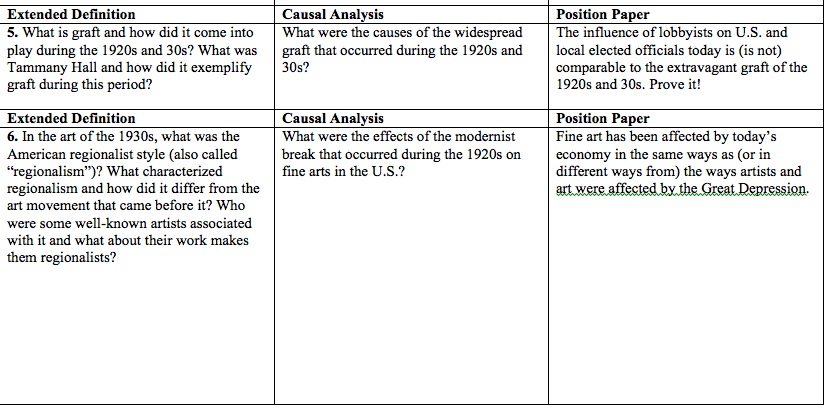
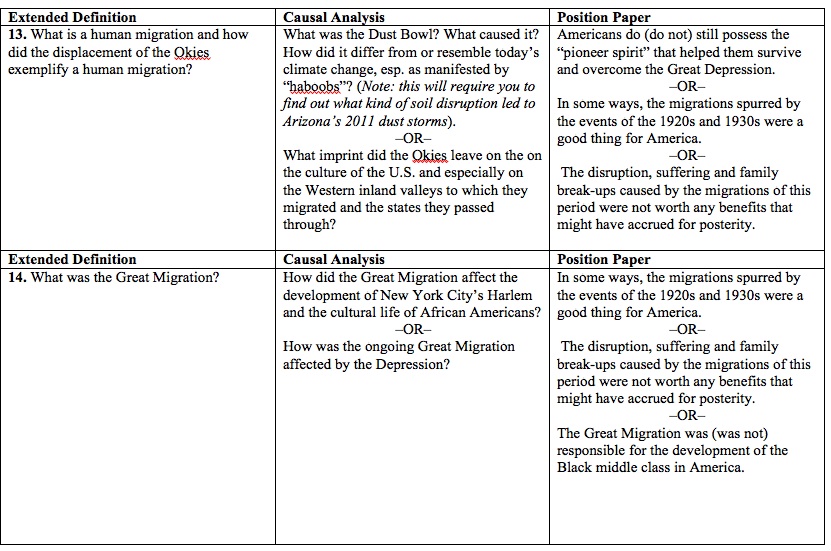
What took so long to rebuild the 102 course, then, was coming up with 90 workable paper topics about U.S. and international history of that period. Make that 90 linked paper topics, so that each student can write three papers on roughly the same subject, the issue being that unless they’ve done some of their research for the 2,500-word position paper early in the semester, they don’t have a chance of coping with a ten-page end-of-term paper. Videlicet:

Click on the image to get a readable view.

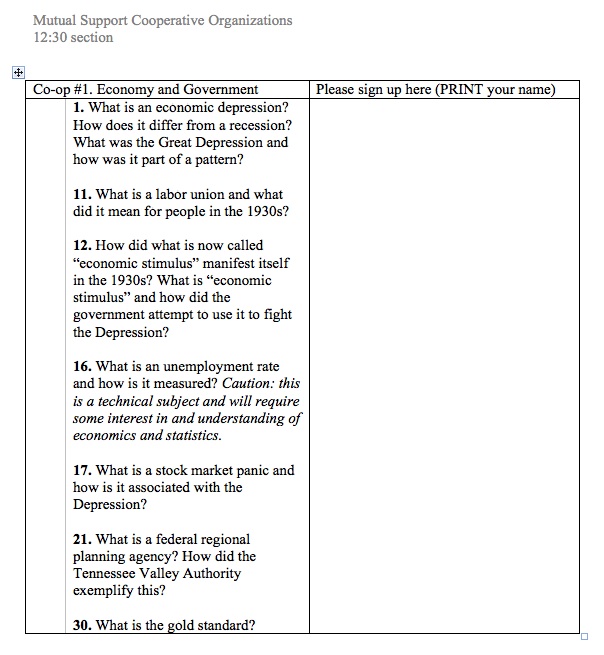
Mwa ha hah!!!!  I ended up with four pages of this stuff, which I printed out and scissored apart, horizontally across the landscape page. Come the first week of class, I’m going to hand out the sliced-apart topics and each student will get to pick one. With that in hand, she’ll have topics for all three papers assigned before the end of Week 1. They’ll have a sign-up sheet on which to record which set of topics they reeled in, so I also will know what they will be writing about all semester long.

Will they hate this? Ohhh, you have no idea how much they will hate it.

Will it mean I don’t have to read any post-adolescent ramblings about how the drinking age should be lowered to 18, how beauty is an internal thing, how medical marijuana should be made legal with no questions asked, how we should build an electrified fence along the entire US-Mexico border? Oh, yes.

Will they do a half-baked job on these papers? Of course. They’re just kids. But at least they’ll try. Some of them may actually learn something.

Better they should do a half-baked job on a paper that requires them to do some research, learn something about the world, and actually think about it than that they should barf out still more uninformed teenage drivel based on breathtaking ignorance and eye-glazing clichés. Or turn in their senior social studies paper for credit, for the eleventh time.

The drafts, comments upon which they ignore, are going away. They will have just one draft, for the first paper. Since even fewer of them have ever written an extended definition than have ever written a sourced paper (no joke!), the first paper of the semester is actually the most difficult for them, even though it’s only 750 words.

So we’ll do a draft on the first paper—no peer review, a pointless waste of time. This draft will be graded according to the same rubrics that will be applied to the final version, but since it will be worth only 50 points, a failing grade will have less effect on their final semester score than a flunking grade on a regular paper. I will then tell them that they now see what the standards are and how the papers will be assessed, and so henceforth it will be their responsibility, not mine, to put together a decent paper.

And that will bring a stop to the frustration of spending hours trying to help them succeed, only to have them paste the original clumsy draft into a Word file and turn it in unedited. It also will cut the grading workload in half.

Collaborative groups will go away (another waste of time!), except insofar as we’ll set up informal groups of people with roughly similar topics to function as mutual support groups. In keeping with the Depression-era theme, I’m calling them “co-ops.” They can commiserate with each other, help each other with research (to the extent that they figure out how to do research), and ask each other out on dates.

So. That was a bitch to design and write.

Naturally, I created some extra work for myself in the Eng. 235 department, too. Ruminating over the course schedule, I realized the order of the assignments was kind of self-defeating. It should go from the easiest-to-write type of magazine feature to the toughest, ending with something short that I can handle while coping with fifty 2,500-word research papers from the 102s. In fact it went from middling easy to difficult to simple to middling easy to the shortie. Reorganizing the order in which those papers occur entails rewriting the entire course. That didn’t take anywhere near as many hours, but it still ate up an entire day.

And now I still have to redo both courses’ websites. That probably will consume another three days. You understand, all of this work is done off the clock. The semester is over, and whatever I do for the college when class is not actually in session amounts to free labor.

Before I get to that, though, I’ve got to shovel the mountain of incoming paperwork off my desk and catch up with the bookkeeping I’ve neglected for the past month.

Is there a question as to why I never get around to writing the e-books I’d like to spin off this site?