Coffee heat rising

Grab It and Run!

While driving around this morning, I happened to hear an NPR report on The Burning House, a site whose proprietor poses the seemingly simple question, “If the house were burning down and you had to get out right now, what would you take with you?” Good question: if you have to grab and run, what do you grab?

Turns out that’s not such a simple question, as Here and Now’s Robin Young learned when she interviewed proprietor Foster Huntington. The answer to “what would you take” is surprisingly personal, and it reflects a lot about an individual’s character, priorities, and social circumstances.

Various PF bloggers have held forth on the idea that you should have a box of key documents and cards ready to grab in an emergency—sorry, friends, but I can only recall having read those posts and don’t remember where they surfaced. I imagine some of my faves have written about these issues: J.D. Roth and the Ineffable Evan, both men of an eminently practical turn of  mind, and possibly Frugal Scholar, who has lived through a major natural catastrophe and whose daughter was in Tuscaloosa during the recent terrifying storm.

What jumped to my mind the instant Robin Young asked “what would you take with you” was the dog. That’s all: the dog. The prospect of rummaging in the office closet for the box of treasures as the draperies are catching flame…not good. Snabbing the laptop or disconnecting the desktop and hauling one or both out the window (along with me and the dog): amazingly bad idea. Grab the dog and run!

Here’s what I think about this business of rescuing crucial documents: Carbonite. Carbonite and a scanner.

Get yourself a subscription to Carbonite’s lowest-end data backup software (amazingly cheap) and a decent scanner, which you probably already have on your printer. Tattoo the Carbonite password on the bottom on the bottom of your foot, so as never to lose or forget it.

Scan every important document to disk: family members’ birth certificates, parents’ death certificates, Social Security card, current credit cards (front and back), receipts for the wife’s diamond engagement ring, whatever. Scan every other important receipt, tax return, and crucial financial document. While you’re at it, scan your wedding pictures and all those historic family photos. Photograph every room in the house, so as to record the superb furniture with which you have decorated, and while you’re at it, photograph all your  jewelry and artwork, too. Now, store every JPEG and PDF to disk. Carbonite will automatically back them up.

Henceforth, it will also automatically back up every damnfool thing you write to disk. This is good, because it means you don’t have to rescue your computer from fire, wind, rain, or flood.

There really aren’t many documents whose originals you need to keep: probably your birth certificate (which you can replace) and the old family Bible are about it. Get a bank safe deposit box for those items, or else buy a truly fireproof safe to stash them and bolt it to the floor.

It probably would be good to keep a few gallons of water in the car, along with a hidden chunk of change or some cigarettes that can be used for barter, if you’re of the survivalist turn of mind.

There you go. Now every material thing you need is retrievable. The furniture and the tchotchkes are irrelevant. All you have to do is gather the living beings and get the hell out.

What would you grab on the way out of a burning building?

Image: dvs’s photostream on Flickr. Creative Commons

The Value of a Dollar

On Thursday Frugal Scholar expressed awe at the extent to which consumer prices have soared over a typical Boomer’s lifetime. And how! I can remember when you could buy a week’s worth of groceries for ten dollars.

She reproduces part of a Faux News squib showing how prices have (apparently) risen over the past thirty years.

Well…hmmm….  Basically all this says is that the relative value of currency changes over time.

My father once said that when he was a young man—that would have been in the mid-1930s—he earned $30 a month and lived well on it. The $1.41 FS cites would have been worth 9 cents in 1935. Depending on how you look at it, 1935’s $1.41 would be worth anything from $22.40 (consumer price index) to $282 (relative share of GDP) today.

Our problem today is that while prices are rising, income remains stagnant or even continues to fall through furloughing, pay cuts, and unemployment. Rising prices are not the issue. Employment is the issue.

Check out the site that produced these figures: it has some fun tools.

Hold the Phone, Here…

Waaaaitaminit! A few belated second thoughts about the pending dental adventure are occurring.

I’m driving down the road headed back from campus to the Funny Farm and thinking, “Good grief! Three thousand dollars is more than a fourth of the savings I’ve earmarked to supplement Social Security for the next year.  That ‘supplement’ represents half my month-to-month living allowance. So we’re talking about disappearing three months’ worth of money for living expenses.”

Furthermore, think I, the prospect of sitting in a dentist’s chair while the guy bangs away at my mouth for two hours sounds…well, counterproductive. As in a very, very bad idea.

Then it occurs to me to wonder whether two crowns are really necessary. Dr. Davis, he of the pricey parking lot, once opined that though the chipped crown on the bottom molar is unaesthetic, a) no one can see it unless I open my mouth in public and yawn like a hippopotamus, and b) it’s perfectly functional. As for the broken tooth on top, the new dentist polished the surface smooth, so that it doesn’t irritate my tongue (in fact, it irritates a lot less than it did after he filled the first break in it). It also seems to be perfectly functional. It doesn’t hurt, and since my teeth are already so dull I can’t chew up a normal bite-sized piece of meat, there’s no change in my ability to chew or eat. hmmm….

The light dawns...

INSIGHT!

If you can get a second opinion for a doctor’s diagnosis and you can get a second opinion for a veterinarian’s diagnosis, why the heck can’t you get a second opinion for a dentist’s recommendation?

If this tooth were so badly damaged it needed to be crowned, wouldn’t it hurt? Not very much of it broke off…certainly not a big chunk, as this guy described it. I would have noticed if a fourth of a large molar had fallen into the mouthful of rice and canned beans I was eating at the time. It says here that the stuff underneath the white enamel of your teeth is called dentin, that it’s yellow, and that if it’s exposed, what you get is sensitivity. I’ve been guzzling iced tea, bourbon on the rocks, and hot coffee for the past two days, with nary a twinge.

Bounce out of the car and into the house, grab the phone, and call Old Doc Davis’s office. Ask if he’ll see me. The receptionist whose head I nearly bit off the last time I was there is polite, if you can imagine. She arranges an appointment on Monday.

Grab a mirror and a flashlight. Take a real close look at that busted tooth. It’s white all over, just the way it looked in the digital image New Doc made of it. That is to say, it’s the same color and consistency of all the other teeth in my head. Pretty clearly, this guy doesn’t think there’s any urgency to crown it; otherwise, he wouldn’t have let his office assistant make an appointment at the end of May.

Maybe, just maybe, it doesn’t need to be crowned at all. Or, if it does, maybe there’s no reason to remove the old crown on the bottom tooth and change that out. And even if that is necessary, maybe it doesn’t have to be done in one long torture session.

And if I really do need two crowns, maybe Davis will do them cheaper.

We shall see.

Image: Chicago Skyline at Dawn. Joe M500Creative Commons Attribution 2.0 Generic license.

Found Treasure: Fancy frying pans and how to care for them

Lenten Day thanks, Day 27

Thanks to God for the lovely gentle rain She blessed us with last night. The air is cool and clean, and this morning all the flowers are shivering with plant joy.

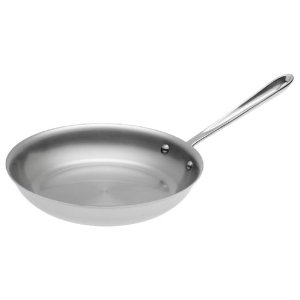
So I was mulling over the All-Clad Frying pan issue, Frugal Scholar having triggered a certain amount of coveting with her discussion of the treasured gourmet cookware and its worthy alternatives. Way in the back of the vast cabinet under the stovetop, I had stashed a pan I’d picked up at an estate sale. A ten-inch stainless pan, just the size of the nonstick Cuisinart that’s about seen its duty and done it.

After I’d bought this thing, I’d thought how can I put my old friend down? Sentimental about a frying pan…think of that! And then instead of putting the new-to-me stainless pan to immediate use, I stashed it and kept on using the tired Cuisinart.

Well, yesterday I pulled that stainless pan out of the back of the cupboard, and what should I discover? Lo! It is an All-Clad!

It looks practically brand-new, but apparently its former owner was one of the ninnies who posts rants at Amazon to the effect that food sticks on the stainless because they don’t know how to cook in a real pan. It has some scratches on the inside as though somebody had scoured it with steel wool, and the bottom looks bunged-up a bit, as though it had been scraped back and forth on a metal burner. But it’s not badly damaged…I think it’s more than serviceable.

We’ll find out soon, ’cause I’m going to try it at the next opportunity. Not just this minute though: I’m still too sick to eat much more than a piece of toast and a cup of tea for breakfast.

Amazon’s price on the 10-inch All-Clad is significantly less than Williams-Sonoma’s, where you’ll pay 110 bucks for the thing. Given the quality of All-Clad and that it has a reputation for standing by its products—even one of Amazon’s complainers noted that he got a brand-new pan, free of charge—a mere $75 for a brand-new one might actually be a good buy.
What do you suppose would possess a person to take steel wool to a hundred-dollar frying pan?

It’s pretty easy to clean a high-quality stainless pan. You need one or all of these:

Barkeeper’s Friend (find it with the scouring powders in the household cleaner aisle)
Ordinary dishwashing liquid
Powdered or gel dishwasher detergent
Baking soda and water
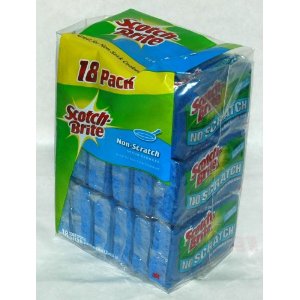
Blue (not green) sponge with nonscratch scouring surface

So. First, if the pan is just ordinarily dirty with a little stuck-on stuff, pour water and a few drops of liquid dish detergent in it and let it soak while you’re eating your meal. Then wash it in hot water with more dishwashing liquid; often after a soak it will wash right up with no scouring. Alternatively, simply run it through the dishwasher.

If this doesn’t work, scour it with Barkeeper’s Friend. Apply BKF to the interior surface; add enough water to form a thick paste. With the soft side of your sponge, rub firmly in circles, moving from the inside to the outside. This will usually clean most dirt and stains off a good pan.

If this doesn’t work but you haven’t seared grease on in enamel-like black spots, rinse the pan well and sprinkle in about a tablespoon of dishwasher detergent. Add enough hot water to cover the soiled areas, stir to dissolve, and leave the pan to soak at least overnight. Use the hottest tap water you can get, because dishwasher detergent is activated by hot water. Next day, discard the soaking solution (do not put your hands in it!), rinse the pan well, and scrub it with Barkeeper’s Friend.

If this still doesn’t work or if you have enameled grease onto it, place a handful of baking soda into the pan and fill with water. Put the pan on the stove and heat the liquid to a boil. Turn it down to a simmer and let it cook in there for about 20 minutes. Keep an eye on it—you don’t want the liquid to boil dry! It will ruin your pan if it does. Also, this stuff sometimes wants to boil over, so you’ll need to be close at hand to regulate the heat. After about 20 minutes of simmering, turn off the heat and let the pan sit until the baking soda solution cools down completely. Then, at your convenience, scrub well with Barkeeper’s Friend.

You can use the type of sponge that has a nonscratch scrubbing pad. These are made by Scotch Brite and are commonly available. Just be sure the packaging actually says it’s a no-scratch scrubber. These are usually colored blue. The green heavy-duty scrubbers will scratch the toughest stainless steel, so do not use these on your cookware. Never use steel wool on a good stainless pan.

It’s pretty easy. Soaking is always better than scouring. Gentle abrasives are always better than fierce ones (try substituting baking soda for the Bartender’s Friend, BTW—it doesn’t work quite as well but sometimes it does the job).

When you’re using a really high-quality pan, you don’t have to and you should not turn your burner to its blow-torch setting. To fry or sauté in a stainless pan, place a small amount of oil or butter in the pan and put the pan over medium heat. When the butter is melted or the oil is hot, add your food. Let meat sear fully before trying to turn it over—if you try to flip it too soon, it will stick. To cook bacon in such a pan, always cook it over low heat. Although this takes longer, you’re less likely to burn the bacon, and when cooked over a low flame bacon does not splatter all over the kitchen.

I do not sear beef on salt over blast-oven heat when using a stainless pan, the way  you can do with a cast-iron surface. I suppose you could, but it seems old-fashioned, and besides, it’s a pretty brutal way to cook a steak. If I’m not grilling it over propane or charcoal or broiling it in the oven, I’ll fry it over medium-high heat in butter.

Have a little respect for a good pan, and it’ll treat you well. 😉

Japan: How to Help

Lenten Thanks, Day 6

Thank you, God, for my safe, pretty little house and for all my quiet, courteous, and civil neighbors.

.

Now we can see what happens to our safe little homes when the gods shrug. Viewing the stills and videos from Japan leaves one stunned at the enormity of the disaster befalling these extraordinary people.

What can we as individuals do to help, if anything? Twitter is awash in appeals to send money hither and yon. Be careful of these: some are scams.

If you want to make a donation, stick to recognized charities, such as the Red Cross. But bear in mind that at this point it’s unclear to what extent donations to entities outside Japan are reaching the country; you can donate directly (in yen only) to the Japanese Red Cross through Google Crisis Response. Before hurrying to send money, go to Charity Navigator for guidelines on wise giving and for ratings of charities engaged in the Japan relief effort.

Among the many creditable organizations that are acting to help, you might consider the ones listed below. However, call and confirm that donations are really being directed to crisis relief in-country.

Médecins sans Frontières (Doctors without Borders)
The Adventist Development and Relief Agency
Catholic Relief Services
American Jewish Joint Distribution Committee
Convoy of Hope
International Medical Corps
Oxfam USA
Real Medicine Foundation
Save the Children
Shelterbox
World Vision

Thinking about Sustainability

On the way home from yesterday’s interminable visit to the Mayo, I dropped by a friend’s shop in mid-town Phoenix, a serendipitous little brainchild that morphed from a nonprofit thrift store to a wonderful design, clothing, art, and gift store featuring nothing but sustainable crafts and products. More about my friend Loral later: I’d like to feature her in Funny’s “Entrepreneurs” series.

Meanwhile, check out what she sold me!

This gorgeous purse is made of a 1970s leather skirt. Remember how we used to make purses out of jeans and denim skirts? Well, the crafter who designed this, Shannon Wallace, came across a buttery-soft purple (love!) leather skirt and used it to build this wonderful, incredibly lightweight bag. It has a silken lining, and the skirt’s pockets morph into handy exterior pouches for the bag. It’s actually reversible—you can turn it inside out and have the wild fabric lining on the outside. But being a sucker for purple, I’ll probably keep it this way. The gaudy flower is detachable; I’m thinking I may move it to one of the handles.

KJG and I came across it while we were doing the Willo Neighborhood Tour–my friend’s shop is in darkest Willo, and so of course she had a booth for the tour. I was going to pick it up when we finished the tour, but we both pooped out a distance from the booths. Hence, the visit to retrieve the purse, not quite on the way home from the Mayo, which from downtown Phoenix is halfway to Payson.

So while I was exploring Loral’s shop, she showed me this amazing patch of wood cellulose and cotton, called a Skoy cloth.

It is said to substitute for not one, not two, but 15 rolls of paper towels! You get it wet and use it as a kitchen rag/sponge, and supposedly you’ll never have to use another paper towel as long as you live. Loral said she tried one and was convinced. Well…nothing would do, of course, but what I had to have one of those.

Amazingly, the thing actually works as advertised! Maybe better than advertised. I just tried it on the kitchen counter, which once again had acquired a fine haze of olive oil and dirt, and by golly, the tiles are shining. It also cleaned the brightwork around the sink better than I’ve managed in many a moon—with no special products.

Visiting Loral’s shop and imbibing her enthusiasm for sustainability left me thinking about ways that I might waste less paper, use less gasoline, spread fewer chemicals around, live a little lighter on the asphalt-covered land.

Pretty soon the City is going to stop picking up the garbage in the alleys, instead inflicting yet another barrel on residents to roll out to the front curb and requiring everyone to dump their bulk trash in their front yards. My plan is to get rid of the blue recycling barrel at that time, since I don’t have room to store two big barrels in the garage and there’s noplace in the yard I wish to grace with an extra garbage bin.

To accomplish that, I hope to start producing a lot less recyclable trash than I’ve been doing. So…have begun thinking about how to live a less trash-intensive lifestyle. The trick would be to avoid bringing stuff into the house that has to be thrown out or recycled. Among the strategies that come to mind:

Use cloth bags or reuse plastic bags for grocery shopping and small sundries from hardware stores, drugstores, and the like.

Buy products in bulk. Even if something comes in plastic and cardboard, obviously if you can buy a larger store of the product, one package is better than a half-dozen.

Get off mailing lists.

Buy food at farmer’s markets and other local merchants who use minimal packaging.

Cancel newspapers; read news online instead.

Read books on a Kindle or similar hardware.

Substitute ordinary household products such as vinegar and baking soda, often available in bulk, for commercial chemicals. Package them in your own reusable squirt bottles.

Use steam, not a mop and harsh chemicals, to clean.

That’s just a few ideas. Many folks have made an art of low-impact living and can offer more and better strategies. But it’s a start.

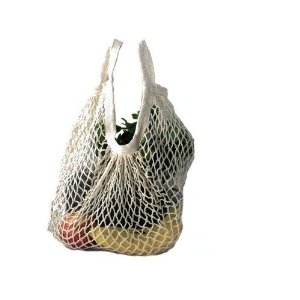
With Trader Joe’s and now even Safeway peddling “green” reusable shopping bags, it’s surprising that Americans haven’t discovered the wonderful string bags we used to see in England. I had a couple of them, which would roll up and hide in a tiny corner of a bag, briefcase, or pocket. None of the shopkeepers up and down the streets, to whom one repaired every day or two because one’s flat didn’t have a refrigerator large enough to hold a week’s worth of groceries (nor did one have a car to carry that much stuff in, anyway), ever imagined handing out paper or plastic bags to customers. That you would bring your own bags was a given.

The beauty of the string bag is that it expands almost indefinitely. I could easily fit two or three days’ worth of goods in just one of them. Two would hold a lot of food.

Amazon offers a couple that resemble the version the English carried around: This one from EuroSac

And one from Simple Ecology that comes in colors and costs two and a half bucks less.

And there’s a variant designed with a shoulder sling, also from Eurosac…

Any of these will hold a lot of stuff and take up hardly any space in your purse, briefcase, or car trunk.

Costco, my primary source of groceries, household products, and casual clothing, already eschews bags. But they pack your stuff in cardboard boxes, which take up a lot of space in the trash bin and are a nuisance. They’re too heavy to lift out of the cart, so I have to unpack each one, repack it into the plastic bins in the back of the van, and then once home unpack and carry the stuff indoors one, two, or three pieces at a time. My plan, then, is to get a bunch of string or fabric shopping bags, ask the Costco staff to pack the junk in those, and let Costco keep the cardboard. Maybe if enough of us do that, Costco will ask their suppliers to ship in less wasteful containers.

Maybe we can all use less wasteful containers!