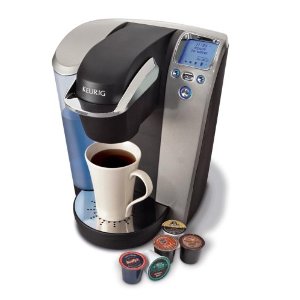
Hang onto your hat, Frugal Scholar! 😀 Yesterday evening while perusing the Times, I was reminded of Frugal’s recent post on small recurring costs, in which she remarks with amazement on the recent coffee pod phenomenon. This increasingly popular method for preparing a cup of coffee—just one!—entails making room for a coffeemaker the size of an infant stegosaurus and feeding it expensively prepared, vacuum-sealed single-serving “K-cups” of coffee grounds. “Do these have any redeeming features?” wonders she.
What's not to love?
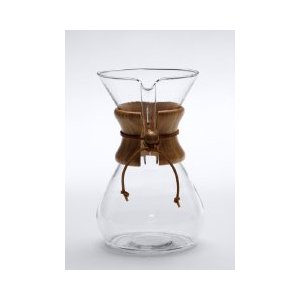
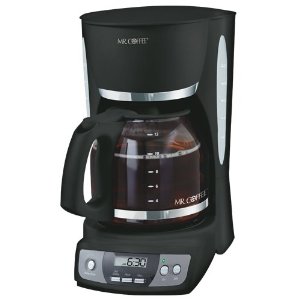
Hilariously, there are caffeine delivery systems that make the coffee pod look like the soul of common sense. Almost. NYT writer Frank Bruni’s column on the subject is one of the funniest damn things I’ve ever read. Shamed by foodie friends over his reliance on his trusty Mr. Coffee (to which he had recourse after a Chemex spat in his eye), Bruni goes in search of a tonier, less bourgeois method of brewing an acceptable cup of java. Working against him: a burning desire not to have to work very hard over his morning eye-opener.
Maybe better not to know...
Along the way, he discovers things that look like something from a chemistry lab (well—the Chemex looks a bit that way, but these contraptions are straight from Isaac Newton’s alchemy lab). He learns that hot water may not be dumped unceremoniously over one’s freshly ground, shade-grown, fair-traded coffee beans, but must be drizzled lovingly through the grounds, only after one has released their “bloom” with a delicate pre-pouring through a carefully rinsed and placed filter.
Poetry in glass, plastic, and stainless
He also learns that the French press, my preferred way to generate a decent cup, is teetering on the edge of obsolescence! Heaven help us.
All I want for Christmas is a lifetime supply of French press carafes. They can reside in the closet with my stashes of incandescent lightbulbs and dishwasher tabs that still wash dishes. A French press produces something akin to cowboy coffee: strong, thick, bracing, and richly flavored. It does not turn the brew to battery acid by holding the coffee over a hot plate for hours. Nor does it have to: believe me, coffee made this way will not sit around long enough to get cold.
After what must have been days of journalistic research, Bruni arrives at a conclusion that surely will warm the cockles of Frugal’s heart: “For me personally, was the pleasure of a higher grade of coffee worth the price? In this instance, couldn’t I depart from the orthodoxy (nay, tyranny) of the artisanal? . . . The current generation of automatic drip machines preserves the [Mr. Coffee] tradition while improving, I’m told, on the product. Gastronomic guilt be damned, I just may put one on my Christmas list.”
Am I the only unemployed person on the planet who’s working like an animal so as to get a break from working like an animal?
Under normal circumstances, I’ve been working 14 to 17 hours a day on my various underpaid enterprises. Since Fall semester began, I’ve had to let FaM slide, simply because there aren’t enough hours in the day to do all the work I was doing on the blog and keep up with three classes and edit arcane copy from the academic set. It’s all I can do to crank one idle essay, not very personal-financeish, each day; I’ve minimized the Alexis toolbar; and I never did figure out how on earth to get into the Yakezi site, so I’ve presumably fallen off that outfit’s rolls. People keep tweeting me that they’re following me on Twitter, and if they’re clearly PF bloggers, I’ll return the favor…but who has time to post on Twitter and Facebook???
{whine!}
So, by way of resolving this whine, I’m determined to give myself a vacation during the winter break, instead of spending the entire month between mid-December and mid-January working nonstop to prepare courses. It takes days to get one of these things lined up, each day planned for, a 15-page syllabus written, a three-page calendar constructed, and everything set up in the endlessly difficult Blackboard.
I’m almost done with the spring English 102 sections, both of which are in-class face-to-face sections. I’ve come up with a number of strategies:
1. Make almost all the learning exercises and quizzes zero-credit affairs. Tell students it’s their responsibility to learn the material, that they’re expected to demonstrate mastery of the skills and knowledge imparted, and that if they expect to get decent grades on the papers they’ll be well-advised to do these things.
This will relieve me of a vast amount of ditzy grading and score-keeping. It cuts the number of grade-book columns from twenty to nine.
2. Convert the exercises and quizzes from open-book homework to in-class activities. Have students spend half the endless class period working them and then use the rest of the time to discuss them.
This turns every no-credit exercise into about 75 teaching moments. It relieves me from having to figure out how to keep them entertained to fill 40 hours with lecture.
3. See to it that the only graded assignments are those that are required by the district: the drafts, the peer reviews, and the final papers, representing the so-called “recursive process” applied to three required papers.
Why give myself extra work if it’s not required? Especially since I’m not paid to do extra work!
4. Load the final paper, which is 2,500 words long, with three times the credit of the two shorter papers, each of which is 750 words. Their final paper will carry 300 points and the two lesser papers 100 points.
Believe me when I say this will get their attention.
5. Require that drafts for the two shorter papers be at least 300 words long, and the draft for the final paper be at least 500 words.
This will eliminate the conundrum of what to do with students who slop together half a paragraph or a crude outline and expect me to waste my time assessing it.
6. Up the score value of the peer review exercise to 50 points, the same as the drafts themselves. Require students to follow a page-long set peer review guidelines to get full credit.
This will make it clear that I don’t have to assess the classic one-line “peer review” that says, succinctly, “This is very good. I saw a few grammer [sic] mistakes.”
7. Create a simplified grading rubric for drafts and peer reviews:
50 points: author does an honest job of filling the assignment; peer reviewer follows the entire set of guidelines.
40 points: author comes somewhere close to 300 words and at least looks like she or he is trying to get a decent start on the assignment; peer reviewer follows most of the guidelines.
35 points: half-baked job.
30 points: inadequate, but at least the person turned in a few words.
0 points: couldn’t be bothered to turn in anything.
8. Lose the computers delivered to the classroom. Limit in-class computer activities to drafting and peer reviewing, cutting the number of computer days from thirty-two to nine.
Having laptops delivered to the classroom turned out to be quite a hassle. And if the class consists entirely of 18- and 19-year-olds and does not have the counterbalance of older students, laptops in the classroom represent an invitation to party.
9. Remove all due dates from listings and descriptions of assignments online.
Contrary to what we’re taught by our course designers and urged to do by the administration, posting elaborate “modules” does little for the students, who don’t read them, and creates vast amounts of extra work for instructors. To recycle a Blackboard course, you have to spend untold numbers of hours combing through each section, subsection, and sub-subsection finding and changing the dates you stupidly inserted.
After this, there’ll be only two places where dates will be visible: the syllabus, and a week-by-week calendar. I have to rewrite those each semester anyway. This will make it simple to recycle courses; effectively all I’ll have to do is copy content from one BB shell to the next and then add the current syllabus and calendar.
10. Lose the endlessly annoying G.D. Blackboard quizzes! Convert them to ungraded in-class exercises.
These hateful things, while they conveniently provide machine-generated grades, are difficult or impossible to copy over and take hour after hour after interminable mind-numbing hour to reproduce each semester. Turning them into hand-outs to be used as the basis of in-class discussion will bring a stop, also, to the quibbling over scores on the things.
11. Combine the entire semester’s worth of hand-outs, quizzes, exercises, syllabus, and calendar into one gigantic PDF package, and send it to the copy center before the start of the semester.
This will eliminate countless fillings-out of copy center forms and countless trudges up and down the stairs to the copy center.
I can’t even count the number of hours I’ve spent trying to accomplish these steps—hours crammed in around the other hours devoted to keeping up with the courses, editing, and blogging. But I think it’ll be worth it: massive simplification should cut the amount of time I have to spend on teaching next semester, with little or no effect on the students’ learning. If anything, it may actually improve learning, since the students will have to focus on learning exercises in-class, rather than flaking off with them whenever they feel like it. Over time, too, it will cut the amount of work needed for course prep, since it effectively puts the courses in tin cans—all I’ll need to do in the future is write a calendar and change the due dates in the syllabus.
Hope it works.
Meanwhile…time to grade papers!
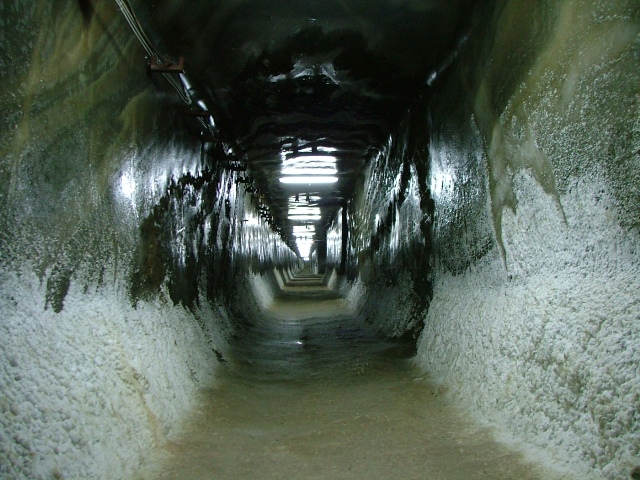
Image: Turda Salt Mine, Turda, Poland. Roamata. Public Domain.
A few weeks ago, I called to make an appointment with the wonderful hair stylist I’d stumbled upon, only to find that she had left the salon! Of course, they wouldn’t tell me where she’d gone.
So I had to sign up with yet another new stylist. Feeling broke, I elected to go down a tier in price. Judee was in their top echelon—sixty bucks, plus tip, for a cut and style. That’s still lower than my original great stylist, whose pre-tip price had gone up to $70, but after the Summer of Desperate Penury, I hoped to find a younger (read “lower-paid”) stylist with talent.
Fail!
I like to get my hair cut really short so a styling will last a couple of months. Most short women’s hairstyles have to be redone every four to six weeks; my hope is always to squeeze eight weeks out of a styling. This presents a challenge to the stylist.
Judee manufactured a cut that stayed good for more than eight weeks, which is some sort of miracle. But I’m happy if I can just skip a month between expensive stylings, bringing the annual cost down by half.
Well, the new kid produced a style that was just barely OK. and I mean just barely.
I hate bangs. They look shaggy and stupid on me, and I truly dislike hair flopping in my face. Hate it hate it hate it.
And that’s what I told the new stylist. Not once. Not twice. But three times!
What did I come away with? You got it: bangs.
Within two weeks the style started to look shapeless. By three weeks it looked shaggy. By the day before yesterday I looked like the wrath of God.
Tried to get in with my last stylist in Tempe, much as I don’t ever want to watch the campus of the Great Desert University and its grungy surroundings heave into view ever again. But no: Thanksgiving coming up, she wasn’t available. So I called the nearby fancy salon and asked for a better-quality stylist. Got one! Seventy bucks, when the tip was included. But it was worth it.
This time I dragged in a few photos of short-haired celebrities nabbed off the Internet:
Not bad, eh? Notice that none of these women are sporting damnable bangs! We decided the redhead’s hair was a lot straighter than mine; not doable. I happen to love Dame Judi Dench‘s look, she being only a bit older than I (by about a decade). And that’s just what the new stylist produced.
So. I had to pay through the schnozzola to get it, but now the hair is really short, it looks sharp as can be, and I shouldn’t have to go back for a month and a half or (with any luck) two. Penny-wise and pound foolish: if I imagined I wanted to look good, I should’ve paid the fare.
Take-away lesson: You get what you pay for. You have to decide what you want to cut corners on. What depends on your personality, your taste, and your circumstances…but some things are just not negotiable.
Over at Surviving and Thriving, Donna Freedman brings up an interesting topic: the old tradition that you don’t talk about money. Spinning off an article that appeared on CBS MoneyWatch.com in which an informant told a reporter that “talking about money is really crass,” especially during a recession, Donna suggests that there’s a limit—a fairly tight one—on how much you should say about what. In particular, she objects to sharing details about one’s salary and one’s net worth. The Surviving & Thriving piece generated a lot of lively discussion, including a comment from a behavioral scientist at an outfit that coaches people on requesting a raise.
Like Donna, I grew up in a time when you did not talk about money matters. It just wasn’t done, as my mother would say. Personally, I find the whole subject of money fascinating, and so I talk about it freely. If that’s crass, it explains why people don’t like me. What’s iconoclastic when you’re young and pretty is something else when you’re old and fat. 😉
The first time I really shocked someone by frankly revealing what I earned came when I was working at Arizona Highways, at the time the largest regional magazine in the country. I was earning about $24,000, the highest salary I’d ever made. Because Highways was a state publication—we were part of the Department of Transportation—my salary was a matter of public record. Anyone could (and to this day can) look it up.
One of my job responsibilities was to trot around town giving little dog-and-pony shows to plug the magazine. I was asked to go to a low-income middle school for “Career Day,” a much-ballyhooed event in the public school district.
Grinding poverty is a real phenomenon here in Arizona. Because it’s a right-to-work-(for-nothing) state, salaries in general are surprisingly low, and when you’re poor, you’re very poor indeed. Low-income districts include the children of migrant workers, who earn minimum wage or less and who often are stiffed for their pay in one way or another. In a state whose schools overall rank near the bottom nationwide, education in ghetto schools is a heart-rending joke. A friend who worked in a low-income high school for several years told me his kids did not know where the Pacific Ocean was or even what an ocean was, that they could barely read, could not do basic math, could not make change, did not know enough to make their way through the modern world.
When I walked across the campus, I noticed only one white face among the teeming students, and that (I was later told) belonged to the son of a teacher. Most of the teachers looked as worn-out as the school buildings, which were old and shabby. As I spoke to the class, the teacher, an older, tired-looking man, translated my words into Spanish.
During the Q&A period, one girl asked me how much I earned. Without a pause, I told her.
After the class ended, the teacher took me aside. He actually was angry.
“You shouldn’t have told her how much you earn,” he said.
“Why not?” said I. “It’s public record. And it doesn’t do me any harm to let her know what a magazine editor earns.”
“She has no way of understanding what that $24,000 means.”
Well, thought I without saying it, You’re her teacher. Maybe you should teach her how many pairs of Adidas $24,000 will buy.
In retrospect, I think he was more offended by the question and the frank answer than by the darkness in which his students lived.
Over at WalletPop, SmartMoney.com reporter Kelli Grant lists five money faux pas, some of which are bound to ring everyone’s bell. Right at the top is asking people what they earn.
Now I will allow that it’s rude to bluntly ask someone about their income. On the other hand, I feel no great compunction about voluntarily sharing such information. There are some situations in which it’s useful to know what coworkers earn or what people in your part of the country earn for the job you do. Certainly, family members, including older children, should know and understand what you earn, so they can make reasonable decisions of their own.
My former husband never told me how much he earned. I knew in round figures, and of course I could have figured it out from our income tax statements if I could have grasped the complexities of a corporate lawyer’s income tax statement. But that was beyond my ken. He just handed me a credit card and a checkbook and that was that. I spent freely, because I had no idea how much we had but assumed a corporate lawyer must be earning plenty. We were in debt up to our teeth, partly because I charged anything I pleased whenever I pleased.
It doesn’t do to be overly private with your spouse about money matters. A marriage is supposed to be a partnership, and in practical terms that means a financial partnership.
Nor, I think, does it serve our interests to be overly private with our coworkers. The only way we can know what we should be earning is to know what people in our company and in our trade or profession are earning. One of the reasons this state does have such grinding poverty is that people don’t fully recognize how poorly they’re paid relative to their peers in other states, and even relative to their peers in other companies. If no one will discuss what they earn, it’s impossible to know how well your own salary stacks up against a fair rate of pay.
To my mind, what’s rude is conspicuous consumption. Living in a McMansion is rude. Bragging about your vast wealth is rude. Carrying a purse emblazoned all over with some expensive designer’s logo is rude. Looking down your nose at people whose clothing cost less than the Armani you’re wearing is rude.
This is more a matter of behavior than of talk. The classiest millionaires are the ones who look, talk, and behave like you and me.
If time is money, it explains why I don’t have enough of it. Money, that is: I never seem to have enough time!
Friday (was that only yesterday?) I was reduced to spending the entire day cleaning house, having let the pigpen slide way, way too long. Dedicating a six or eight hours to dusting, vacuuming, scrubbing, and scouring gives you some time to think, and what I thought is that too much of my time has been wasted on the playground that is the Web and too little of it is used in any actively constructive way.
Not that I don’t spend plenty of time working…commenters will occasionally remark that I seem to work like an animal, and indeed, 14+ hours a day spent in front of a computer, haranguing students, driving from pillar to post, and thrashing around the Funny Farm does make for a tiring schedule. But, as I’ve observed before, I don’t think I’m working very smart. My work pattern is gestalt. Instead of focusing on specific, financially productive activities for specific periods, I’m all over the place: cruising the Web and writing and grading papers or doing course prep and editing copy and checking facts, all the while jumping in and out of the e-mail. Every day about 100 messages a day pour into just one of the four mailboxes that serve me, Funny about Money, and The Copyeditor’s Desk; I don’t have time to check all of them, but I do get pinged by my Mac.com mailbox frequently, all day and into the night. E-mail is one of the biggest time-killers known to Personkind, second only the the Internet playground itself!
One strategy I’ve used to organize time has been listing. This works pretty well: having a to-do list does seem to prod you to get those things done, if only because you get a tiny jolt of satisfaction each time you check one off. Lately, though, the lists seem to get longer and longer. They begin to look like this one from a day last week:
¨1. Move rose, plant bulbs ¨2. Write & print donor forms ¨3. Send ads to Nanette ¨4. Remind Marshall, Jim about SBA ad ¨5. Pick up house ¨6. Build a Mac.com “mailbox” for messages to deal with ASAP ¨7. Clean floors, counters, stove ¨8. Get in touch with Evan, others ¨9. Update student grades 10. Do laundry 11. Check CE Desk mail; cope 12. Order new business cards 13. Compose Time & Charges for PPP 14. Iron clothes 15. Figure out how to copy current 101 course to new BB site 16. Copy current 101 course to new BB site 17. Change at least half of 101 exercises & quizzes to noncredit assignments; figure out adjustment in grading scheme 18. Figure out new due dates for 2nd session 101 course; mesh with 235 assignment due dates 19. Rewrite syllabus accordingly 20. Post new syllabus, due dates, and learning modules 21. Finish editing current PPP novel; compose & print statement and report 22. Water plants 23. Finish planting garden 24. Buy food 25. Fix and eat food 26. Feed dog 27. Walk dog 28. Check rat traps 29. Fertilize citrus & palm 30. Clean, shock-treat pool
Crushing! The effect of a gawdawful list like this is to shut you down. It’s so huge and so discouraging, you don’t even want to start. You just want to avert your eyes and your mind from it.
Still…none of this stuff is disposable. It all has to be done. Maybe not today. But soon. What to do?
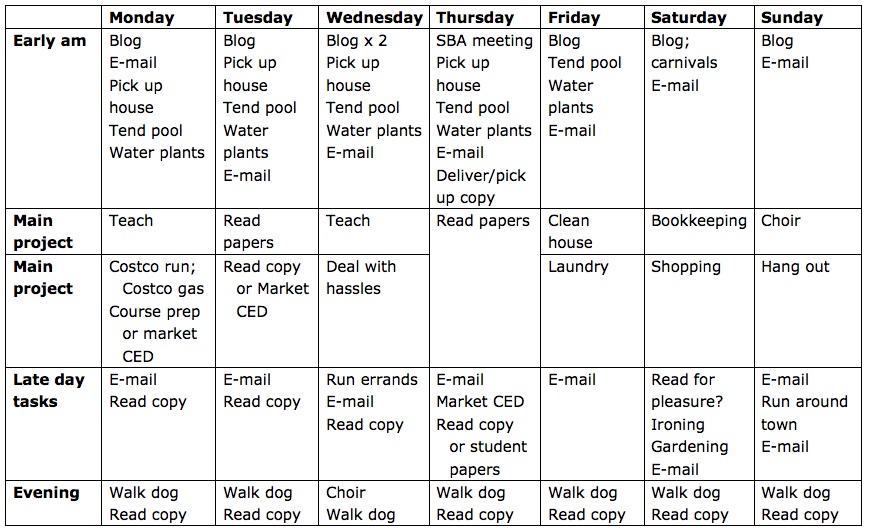
Another strategy is to build a daily schedule that will accommodate chores in focused periods. Rather than trying to accomplish a long and scattered list of tasks, such a scheme would bunch activities under various rubrics, scheduling similar chores during specific blocks of time. Here’s what I came up with:
The plan here is to build two new habits:
1. Limit e-mail to first thing in the morning and last thing in the afternoon, leaving the program turned off the rest of the day; and
2. Pick up the litter around the house every day, instead of putting it off until whenever I think I have time and feel like it.
😀 Of course, developing new good habits isn’t so easy as developing new bad habits (is the sun over the yardarm somewhere in the world, yet?).
The beauty of this schedule, if it can be made to work, is that it specifies blocks of time to market The Copyeditor’s Desk. Right now, the bulk of my income comes from teaching and Social Security: two tiny pittances combine to make one larger pittance. It’s enough to get by on—just—but not enough to live on comfortably. I’d like to build the business into a revenue generator, and the only way that’s going to happen is for me to get off my duff and network among business owners and executives who have budgets to pay for communication services and products.
The ugly of this schedule, however, is that it still prescribes 14 to 16 hours of work: we’re looking at something that starts around 4:00 or 5:00 a.m. and ends between 9:00 and 10:00 p.m. However, that’s ameliorated a bit by the loafing time shown on the weekends. Not much, but better than nothing.
{sigh} If I’m going to work this hard, I’ve gotta have more to show for it than a $29,000 gross income!
Speaking of the which, it’s almost noon and I haven’t even started to read the papers that I was supposed to have done on Thursday. ’Bye!
It’s not really the money. It’s the principle of the thing.
Yesterday I drove down to the dentist’s office to get a cleaning and also to discuss building a new night guard, mine having been rendered questionably useful by a couple of recent crowns. Dr. D’s practice is housed on the sixth floor of a midtown high-rise. His office is nice, but what’s really nice is Dr. D, whose taste in procedures is minimalist and who is personally a very charming man.
Driving down there is a bit of a pain, because you have to cross over the train tracks, which involves an endless wait at the left-turn light to get onto the side street where the parking garage is located. The lightrail pretty much destroyed Central Avenue as a viable road, something one finds peculiarly annoying when one contemplates the millions and millions of taxpayer dollars’ worth of beautiful, exquisitely tended landscaping and public art torn up and replaced with ugly railroad tracks and overhead electric lines.
To get to Dr. D’s office, you have three choices: drive down Seventh Avenue to Indian School, then over to Central and down to Catalina—a process that entails not one but two tedious left turns across the train tracks, where the light stays red for half your lifetime; drive down Central Avenue to Catalina, which puts you into a lot of slow traffic but requires only one time-consuming left turn; or drive across one of the main drags north of the train tracks on Camelback all the way to Seventh Street, then across Indian School or McDowell to Third Street, then over Third to Catalina, then across Catalina to the parking garage on Central, a round-about route that takes you more than two miles out of your way and adds four extra miles to your round trip. Not one of these strategies is ideal, but except for the latter, it takes about 15 minutes to get there.
Okay, so I get parked, ride the elevator up to Dr. D’s office, and bound into the reception area brandishing my parking ticket to be validated…and what do I see but a sign on the receptionist’s desk:
Due to a change in the building management’s policy, we can no longer validate parking. Parking fees are $1.00 per half hour.
Well, hell and damn. I don’t carry money with me! So, I didn’t have a dollar to get my car out of the parking garage! Or more like two or three bucks, because a cleaning takes about an hour by the time you sit around waiting to be seen. Maybe three or four bucks if he decided to fit me for a new bite guard, because that process takes for-freaking-ever!
I said, “It would have helped if you’d told me about this.”
She said, “I’m on the phone!”
I said, “I know,” and turned around and walked out.
When I got downstairs to the garage, the attendant would not let me out, even though my car hadn’t been in the garage longer than about eight minutes.. He proposed to write me a bill, for which their collection agency would come after me. I had to scrounge up a dollar out of quarters, dimes, and pennies, some of which fell on the ground as I was handing them to the clown (honest—I didn’t do that on purpose. But on reflection now wish I’d dumped the whole mess of them on the ground and driven off, since he certainly could have let me out of the garage under the circumstances).
I refuse to pay for parking in Phoenix. Here’s why: There’s no viable public transport. Much-vaunted lightrail notwithstanding, there really is no practical way to get around this city other than by car. My feeling is, if you want to do business with me, you provide a place to park. If your place of business makes me pay to park, I don’t patronize your place of business.
Consider: To get to Dr. D’s office on the public transit, I would have to walk from my house to an intersection with a signal where I could cross 19th Avenue, a dangerous main drag and a conduit of blight. Then I would have to stand outside a run-down tenement, famed for its incidence of crime. Within a day of the last time I picked up the 19th Avenue bus, a young woman was abducted from that bus stop and raped.
Okay, so realistically no one is going to abduct and rape an ugly old bat. What they’ll do with me is mug me. Robberies are not uncommon—thugs will stop their cars at intersections, get out, grab someone standing on the sidewalk, belt him one, and steal his wallet. No joke: this happened outside the Albertson’s just down the street.
The temperature outdoors was 105 degrees yesterday. Nineteenth is under construction, so to get across the road you have to navigate holes in the road and heavy equipment, all the while enjoying the serenade of jackhammers and diesel engines. A typical wait at a bus stop here is around 20 minutes; however, the city in its penury has cut back bus service, so chances are the wait is even longer.
Once on the bus, I would have to ride down to Spectral Mall, stopping at every corner allll the wayyyy down to 19th and Montebello. Once there, I get off the bus on the wrong side of the street and again have to cross a six-lane road through murderous traffic. The ambiance there is even more grungy than it is in my neighborhood, which at least has the vestiges of a middle-class neighborhood on one side of the road (even though the city is busy tearing out our homes.
Now I buy another ticket and wait for the train. This will entail another 15-minute stand in 105-degree heat, likely fending off the odd panhandler. The train will drop me off within several blocks of Dr. D’s office building, after another unbelievably time-consuming milk-run, first backtracking up 19th Avenue to Camelback, then across Camelback to Central, then allllll the wayyyy down to Catalina. The round trip will cost me $3.50…about what it costs to pay to park long enough for a dental appointment.
And—here’s the corker—the trip will take about an hour, one way! Yes: for $3.50, you, too, can kill a full hour making a trip that should take you 15 minutes.
So I spend two hours in 105-degree heat, round trip, standing around on the street in sketchy areas and riding elbow-to-elbow with strangers (some of whom are strange!) and pay as much as it would have cost to make a 15-minute drive and pay to park. Nothing about this system—either the vaunted and costly lightrail or the obnoxious parking fee, which the city parents think will encourage people to ride—makes me anxious to use the public transport. It’s expensive and it’s excruciatingly time-consuming. It is, in short, totally impractical, another of America’s steps along the way of its progress into Third-World living conditions.
If I lived in a city that had real public transit, the way San Francisco did when I lived there many years ago, then I would use it, or I would pay to park without hesitation. We used the buses and trolleys all the time; on the rare occasions that my mother and I drove to shopping, we expected to pay to park, and we paid to put up her car in the apartment community’s parking garage. That was part of the natural order of things.
But here we don’t have such a city. Here we have a city that, like Los Angeles, was quite deliberately designed for the automobile and that, with its city parents in the pockets of developers who have a vested interest in sprawl, continues to be designed that way. For this reason, demanding that people pay to park is unreasonable.
So, I’m in the market for a new dentist. Alas. I like Dr. D and I hate changing dentists. It’s hard to find a good dentist who won’t rip you off by trying to scare you into unnecessary procedures. It’s hard to find a skilled dental technician who doesn’t hurt you when she cleans your teeth. And getting a new dentist is going to be a pricey proposition, now that I’m no longer on Delta Dental. I could barely afford Dr. D, who proposed to give me a 10 percent discount. How I’m going to pay for some new doc, I have no idea. Probably I’m not.
But there is no way I’m going to pay to park as I go about my normal, unavoidable day-to-day errands.