Coffee heat rising

Typhoon! Are you insured?

Head for the bunkers! Batten down the hatches!!

The local Play-Nooz is having a field day with today’s rainstorm. Now we’re being told there’s a tornado watch in effect until 10:00 p.m. HO-lee mackerel!

Well, when you go to the National Oceanic and Atmospheric Association’s weather watch pages, you indeed find notice of a hazard…in the low to moderate range. Probability of a serious tornado: oh, maybe 5 percent.

LOL! Brings to mind the time the local TV stations told us a typhoon was bearing down on us. Right out of a sapphire-blue sky…

We do occasionally get some pretty spectacular cyclonic winds. If you’ve been reading this blog for a while, you may recall the grand storms of the summer before last, which hit the central historic district hard and flattened a beautiful old downtown home.

Because houses here by and large are cheaply built, it doesn’t take a tornado to wreak serious havoc. A few years ago one of my students was put out of her home with her family—husband, two small children, mother-in-law—when a fairly ordinary thunderstorm took ahold of the  central air-conditioning unit and ripped it right out of the roof. Subsequent rainshowers poured  in through the hole, destroying most of the house’s furnishings and interior.

But genuine, certifiable twisters are rare as hen’s teeth. About 25 or 30 years ago, one did touch down in central Phoenix—right on top of a friend’s veterinary practice. It effectively leveled the building. The insurance company tried to deny that the destruction was caused by a true tornado. When that detail came out in a newspaper report (in those days, we had reporters who worked for a newspaper that reported news, quaintly enough), someone who lived in the area came forward with a photo of the thing. It was undeniably a tornado, headed straight for the Alta Vista Veterinary Hospital.

So, it’s a good idea to be insured for any eventuality, even if the risk seems remote.

And in getting coverage, it’s important to understand what specific events your policy covers. Some homeowner’s insurance, for example, requires extra coverage for events like hurricanes, floods, or earthquakes, either as a rider or in a separate policy. And you should be sure that you understand whether your policy covers replacement costs (the cost of buying new stuff to replace things that have been ruined) or actual cash value (the amount you could have gotten on Craig’s list for your moth-eaten sofa and your ten-year-old TV).

As I was writing this, La Maya called to say her sister was on the phone from Yarnell: the arroyo behind the house is running, big-time, and the water is halfway up the slope to the back door. They’re packing now, in case they have to evacuate. La Maya, who owns the house and rents it to her sister and BIL, said she felt very glad that she had  just sent in the $800 premium for the extra flood insurance.

Pay the insurance bill and pass the ammunition!

Classic Arizona Road in Rain

Yes, Virginia, it does snow in Arizona.

Images: Tornado in Central Oklahoma, May 3, 1999. NOAA. Public Domain.
Arizona road and snow at Mormon Lake: Not so much…
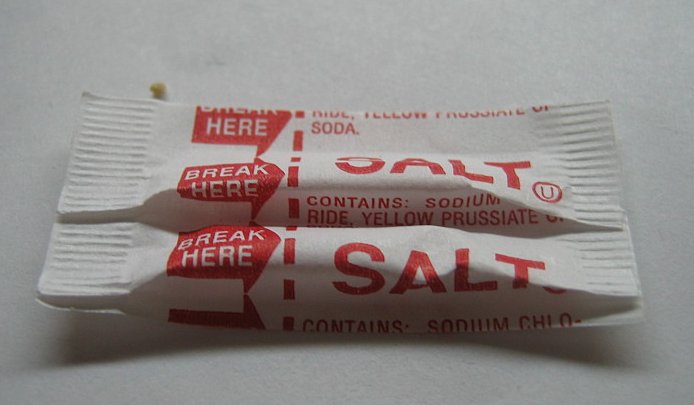

Please, Big Brother: Protect me from myself!

Eeeek!

Did you read where the City of New York has decided to save its citizens from the horrors of table salt?

Well, all I can say is thank God someone has realized us saltheads need supervision at the dinner table!

Disclaimer: I don’t cook with salt (well…except for bread, which is pretty bland without it). When I feel something needs a little seasoning, I’ll salt it at the table.

The result is that most processed foods taste horribly oversalted to me. Even Swanson’s and Campbell’s canned chicken and beef broth: mouth-puckering! That’s one of the reasons I cook mostly from scratch, I rarely eat in restaurants, and I never eat fast food: it’s just too salty. Food should taste like food, not like salt.

However… I don’t make a religion out of that. It’s not a freaking moral precept!

And even if it were, IMHO governments have no more business regulating what seasoning will go into food than they do telling individuals what gender persuasion will qualify them as a marital partner or telling women what they can do with their own bodies.

Anyone who’s awake knows that processed foods are not very good for you, and that most of what restaurants serve is processed food. Anyone who’s even faintly conscious knows that fast food is, by definition, a blob of sodium wrapped in artificial flavors.

If you choose to eat in restaurants, if you choose to consume pretend-food from fast-food chains, then you presumably choose to take your chances. Besides, maybe some addicts like salt in their food.

Take French fries, for example. French fries, like pretzels, exist to carry salt to the tongue. Without this key ingredient, there’s exactly zero point to French fries. Or to pretzels. Or to popcorn, for that matter. It’s stuff that you eat because it’s bad for you. You know it’s bad for you, already. You choose to eat it because it’s bad for you.

We’re being protected from our own stupidity and our own fears quite enough, thank you, with adult-proof caps or (god  help us!) individual bubble-wrap on every nostrum we swallow, with adult-proof caps on every bottle of household cleanser, with mandated prison bars around every swimming pool, with beepers nagging us every time we open the car door without taking the key out of the ignition, with idiot lights that come on to tell us to wrap the seatbelt around the bag of groceries we set on our car’s  passenger seat, with X-rays of our genitalia every time we get on a commuter plane, with spy cameras on every corner, with G-mail filters that make you pass a math quiz to prove you’re rational before you send a message, with flicking password-protected PDF’s, two of which I received today.

You think I’m kidding about the G-mail thing don’t you? Go ahead. Click on that link. It’s real, I tell you, real!!!!

Feed me, Seymour! Feed me some French fries!

Image: Wikipedia Commons

Ads: Credit report monitoring scam

A reader e-mailed to say he had come across an ad on Funny for one of those outfits that proposes to provide free credit reports from all three reporting agencies, but which hooks you in to a subscription whereby you end up paying a monthly fee for “credit rating monitoring.” Please be careful. Do not order “free” credit reports from any such lash-up: it’s a scam. While you do get the free credit reports—which you can get for yourself online very easily—paying someone to monitor your credit reports is unnecessary.

Here’s why: By law, each of the three credit reporting agencies, Experian, Equifax and Transunion, is required to give you a free credit report once a year. Because there are three agencies, you can monitor your own status, for free, simply by asking for a report from one of them every four months. If you then  review your bills and checking account statements each month, you will protect yourself just fine against identity theft. For free.

To get free credit reports without anyone trying to lure you into an expensive scam, go to AnnualCreditReport.com. This site was commissioned by the three credit reporting companies to provide the three annual credit reports mandated by law. You can request your report online, by phone, or by snail-mail.

You don’t have to ask for all three at once. So, if you order one in January, one in April, and one in August, you can cause the system to monitor your credit rating, allowing you to check for anything strange on a regular basis. It’s easy to put reminders in Outlook, iCal, or even Quicken to tell yourself when to call up a new report and which agency to ask.

Apparently different ads come up on different computers. I haven’t seen any such advertisement on my Mac; otherwise I’d get AdSense to block it.

Get OFF the flickin’ PHONE!

This morning as I was strolling home from the daily walk with La Maya, a woman passed me in her car on a neighborhood road.

She caught my  attention because she was driving too fast for a residential street. She had both hands off the wheel and her eyes off the road while she pawed frantically through her purse, which she had balanced on her lap. Presumably she was searching for a ringing cell phone. She didn’t see me. She didn’t see my dog. All she could have seen was her purse and the junk inside it.

I wish I had a loud blatting air horn to blast at chuckleheads who drive while yakking on the phone. Folks. If you’re driving, get off the phone!

In a study recently reported in the New York Times‘s science section, researchers sent a gaudily got-up clown on a unicycle pedaling around a town square. Afterwards, they collared pedestrians and asked them if they’d seen anything unusual.

A third of walkers who were listening to music or (weird!) walking alone in silence said they’d noticed a clown on a unicycle. Even more—almost 60 percent—of those who were walking with a friend remarked on the clown. But only 8 percent of pedestrians yakking on cellphones said they’d seen the clown.

Think of that. Two in 25 cellphone yakkers were alert enough to their surroundings to notice a guy with a red nose perched on a wheel and wearing a purple and yellow outfit with polka-dotted sleeves.

What it means is that when you’re driving down the road or walking on a sidewalk next to a road, only two in every 25 drivers on cellphones see you! Maybe fewer, unless you’re wearing a red nose and a garish costume.

Damn it. Get off the phone! No one needs to be “connected” (grr!) to the entire world every living, breathing minute! It can’t be healthy for you never to have a moment of privacy, not even when you’re alone inside your car where you should be paying attention to your driving.

Very, very few items of personal or corporate business can’t wait until you get home or to the office, where you can sit down and focus solely on the person on the other end of the line. And fewer still can’t wait until you can at least find a place to pull off the road.

Even if you don’t care about the rest of us who are on the road with you, for your own personal sanity and health turn the phone off while you’re in the car. Don’t allow the cutesy ring tones or annoying jangles to intrude on your privacy, especially when you’re behind a steering wheel.

I never replaced my cell after canceling it during the Qwest Wars. Though I occasionally think it would be good to have something in the car to call for help in an emergency, I’ve never missed the thing. I have, however, watched my friends be interrupted in mid-word by jangling phones, which they feel compelled to answer while they’re crusing down the freeway or in the middle of a conversation. Some act apologetic but pick up the call anyway; others seem oblivious to the basic rudeness of leaving a face-to-face friend hanging while they turn on a phone to respond to something that, about 99 percent of the time, is trivial and could wait until after the conversation ends.

It’s just plain bad manners to drop a real-life conversation to yap on a telephone. Unless some real emergency comes up, there’s no excuse for it. You understand, the message to Friend Interrupted is “what you have to say is even more trivial than the trivial message that’s coming in on this phone. You are less important than anything else in my life, no matter how petty and transient it may be.”

And when it comes to yakking on the phone behind the steering wheel, it’s not bad manners: it’s homicidal.

What does this have to do with money?

Your insurance premiums…
My insurance premiums…
Our insurance premiums…

Your car wreck…
My car wreck…
Our car wreck…

Your medical bills…
My medical bills…
Our medical bills…

Please. Get off the phone!

Hamburger: 12 ways to keep your family safe

Because chuck and rump roasts often go on sale for 10 to 50 cents a pound less than the grocery store’s hamburger, I look for bargain roasts and ask the butcher to grind it for me. Not only is the resulting hamburger cheaper, I find it invariably tastes much better than preground burger. Well… did you see the Sunday Times‘s exposé about the gross ways hamburger is prepared in slaughterhouses and the unholy results on public health? Add another good reason for asking the butcher to grind a single roast: ground beef from a source you can see is safer and you know what’s in it!

I’m not going to dwell on the horrific facts reporter Michael Moss uncovered, except to point out that the single burger that poisoned a 22-year-old woman and left her in a wheelchair for life likely consisted of “products” from four different meat packers, some of which define meat in ways you and I would define “garbage.” One of them contributed “lean finely textured beef,” which consists of “trimmings” put through a centrifuge and then treated with ammonia to kill microbes. Yummie!

This explains why the custom-ground hamburger from a butcher’s counter tastes better than even the best of preground burger. It may explain, too, why neither the dog nor I have croaked over from food poisoning. Yet.

Other than abstaining from hamburger, what can you do to keep your family safe? Nothing is 100 percent, but a few habitual strategies will help:

• Buy preground meat at Costco, one of the few retailers that tests meats for bacterial contamination before marketing them.

• Buy beef roasts at a butcher shop or at a grocery store with a staffed butcher counter. Select lean cuts and ask the butcher to grind them for you.

• Never buy preshaped, prepared hamburger patties. Ever.

• Before preparing burger for cooking, place a bottle of dish detergent next to the sink, so it will be handy.

• Use a plate or a synthetic, dishwasher-proof cutting board as a surface for shaping hamburger patties. Use a dishwasher-proof bowl for mixing meat loaf or meatball ingredients. Never use the counter as a surface on which to prepare raw hamburger.

• Never, EVER leave frozen hamburger out on the counter to defrost!!!!! At normal kitchen temperatures, it takes just 45 minutes for E. coli bacteria to double in number. And since just a few cells can make a diner very sick, indeed, the longer meat is out of the freezer or fridge, the greater the likelihood of food-borne illness.

• Each time you handle raw hamburger, go to the sink and use the dish detergent to wash your hands thoroughly before touching any other surface in the kitchen. This is extremely important!

Do not touch the kitchen cabinets, dishes, glassware, silverware, doorknobs, or anything else without washing your hands first.

• After the burger is in a pan or on a grill, place the plate, bowl, or cutting board on which you prepared the meat directly into the dishwasher. If you don’t have a functioning dishwasher, fill the kitchen sink with hot water, strong dish detergent, and about a quarter cup of Clorox. Immerse all tools used in hamburger preparation in this solution and allow them to soak for 10 or 15 minutes before scrubbing, rinsing, and draining.

• Cook hamburger well done. If, like me, you can’t stomach well-done barbecued hamburger, find something better to eat.

• Never reuse the same plate that carried the meat out to the barbecue grill to bring cooked meat back inside! Put that plate directly into the washer, or scrub it well with strong detergent and hot water before reusing.

• Use detergent to thoroughly clean the countertop on which you did the meat prep. Then scrub down the faucet and sink, and also wash doorknobs and cabinet knobs that might have been touched with contaminated fingers. Don’t forget to wash the outside of the dish detergent container.

• Clorox is an effective disinfectant. If your counter will tolerate Clorox, use it. If not, use a strong solution of concentrated Windex, or make your own by mixing rubbing alcohol and water in equal proportions with an added dose of ammonia. Wipe down all countertops, sinks, faucets, doorknobs, and cabinet knobs with this product.

It’s a shame that regulation of the meat industry has grown so lax that we have to take extreme measures to protect ourselves. But of course, when you kill the beast, you take the chance that you’ll kill the consumers the beast was created to protect. That seems to be the case today. If we American carnivores want to live and we want to see our children spend their lives mobile and in good health, we need to take steps to keep our kitchens safe. Let’s bear in mind: we don’t live in Europe!

Image: American Beef Cuts. Public Domain. Wikipedia Commons.