Coffee heat rising

Grocery-store Gasoline Discounts: Deal or No Deal?

At  Planting Our Pennies, Mrs. PoP reflects on grocery-store offers of gasoline discounts that grocery stores sometimes offer regular customers. Ultimately she concludes that these programs are hardly worth the effort.

Here in lovely uptown Phoenix, Safeway stores offer a gasoline discount after you’ve racked up some crazy number of dollars on purchased registered with the annoying red card. So every once in a while, they’ll offer my deceased dog (in whose name the card is made out) cents off on gas.

Problem: the nearest Safeway with gas pumps is way to hell and gone up on the north side! Safeway has reserved its shiniest new stores, the ones that sport gas stations, for the White Flight set. So Safeway gas stations exist only in areas close to the upper-middle-class tracts where the white folks have moved. And those areas are way, way off my beaten track. By the time I got all the way up there and back, I would have spent more on wasted gasoline than I would have saved on the gas buy.

And besides…better strategies exist.  IMHO the Costco AMEX card is about the best of those.  You get 3% back on gasoline (which is usually pretty cheap at Costco to begin with), 2% back at U.S. restaurants, 2% back on travel purchases, and 1% back on everything else. Once a year you get a lump-sum  cash back “reward” — a kickback on purchases made during the year.

There’s a Costco on every corner in this city, so it seems. Costco underprices stations in the immediate vicinity of its stores. Gasoline prices vary wildly by the part of town you’re in: in upscale Scottsdale you can pay ten to thirty cents a gallon more than other parts of town. In the westside slums, you’ll pay ten cents a gallon less than you’ll pay in the more or less middle-class tracts in the central areas or the far west.

One Costco, which is on my way to many destinations, straddles an aging middle-class district and a downscale high-density area that feathers into the gang-infested tracts bordering the I-17. That thing ALWAYS has the lowest prices around. I try to time gas purchases to days when I know I have to drive down in that direction. The gas is cheaper in the first place, and then I get a 3% kickback on it.

So ultimately, by purchasing gas at Costco regularly — even if I happen to be at one of the higher-priced outlets — I end up saving a lot more than I would if I traipsed up to North Phoenix for the privilege of collecting “bargain” gas from Safeway.

In the gasoline department, BTW: man, quitting the hateful teaching gig sure is saving on the gas! In the last month I taught, the four-day-a-week commute racked up an astonishing $230 in gasoline bills. In the first full month of freedom: just $80.

Just think of all the things I can diddle away that $150 savings on! 😀

Enough with the Pieces of Paper, Already!

Over the weekend I was once again reduced to having to enter the month’s myriad charges into Quickbooks. Wonder-Accountant has suggested that instead of wadding receipts into a file folder and forgetting them, I should organize them and staple them to the relevant month’s statement, a strategy conducive to her reconciling the books.

For a person with English-major math skills, doing the bookkeeping is a monthly exercise in self-torment. I just hate fiddling with dozens and dozens of nuisancey little pieces of paper, no two of which have the date in the same place. The accursed Safeway receipts show you how much you supposedly “saved” by presenting your fraudulent red card, thereby getting them to refrain from charging more than the actual retail price for groceries and household goods. So you have to sit there and study the things to figure out which figure represents the amount that actually was charged to your card. The pieces of paper get lost, and so every month SOMETHING doesn’t show up in Quicken, so then you have to kill more time trying to figure out what the charge on the statement means.

This weekend I finally lost patience with that routine.

I’ve decided to go back to the antediluvian process of paying routine bills with checks. It costs more—you have to buy the damn checks. But it creates a paper trail (which cash does not), and you don’t have to fiddle with a thousand little pieces of paper to pay a monthly bill. The bill is paid when you make the buy.

My plan now is to use the charge card only for tax-related purchases that require me to have a receipt and for big-ticket items like appliances and major repair bills. All the rest of the little pieces of paper will go straight into the trash. The small, routine stuff will be strictly pay as you go. Since I’m pretty well behaved about entering my checks in the register, to put those expenses into Quickbooks all I’ll have to do is copy them out of the list in the register. The credit union has upgraded its online banking software so I can view my checks without having to switch from Firefox to Safari, and I can download them to disk with a simple right-click. When the statements come in, I’ll just copy every check to disk. Time Machine will back them up to a hard drive, and voila! A virtual paper trail.

And if that turns out to be too much of a nuisance? Then once or twice a month I’ll go to the credit union and withdraw $500 or $1,000 in cash to use for discretionary spending. Rather not: cash does flow through my fingers like water. But  I have had it with the little pieces of paper.

Regressive? Probably. We’ll see if it makes life better.

Is there any modern convenience in your life that you’ve decided to abandon in favor of regressing to an older way of doing things? Why?

Moment of Fame

The Festival of Frugality appears at This That and the MBA, where the overpackaging rant was included.

Credit Cards: Will a Use Surcharge Change Your Habits?

Last week’s zillion-dollar settlement with Visa and Mastercard, in which merchants at last will be allowed to charge cash customers less than those who pay with credit cards (a transaction that can cost the merchant upwards of 2 percent on every sale), may mean some serious changes for consumers. In their contracts, credit-card issuers impose restrictions on merchants prohibiting the practice of charging more to people who run up the cost of business by charging purchases. As a result, we all pay more, because the only way a retailer or service provider can recover that expense is to increase prices for everyone.

Wouldn’t it be nice if those of us who prefer the convenience of credit and debit cards paid for the privilege, and the rest of us paid the actual price of goods and services?

That may come to pass.

Already, according to a report in today’s Times, ScanMyPhotos.com has lowered prices by 2 percent, and Kroger supermarkets may institute a two-tiered pricing scheme: less if you pay with cash, more if you pay with a card.

If you’re a regular reader here, you know I pay for everything with credit cards, preferably with American Express, and then settle the bill in full at the end of each month. Two reasons for this:

a guaranteed paper trail, and
generous cash kickbacks from AMEX and MasterCard.

Three reasons, actually: cash flows through my fingers like water. I can spend two hundred dollars in a day and have no idea where it went. The extra trouble entailed in signing for a credit transaction—plus knowing that in a few weeks I’ll have to come up with a big chunk of cash to pay the month’s accrued bills—makes me think twice about buying something I don’t really need.

I used to pay for everything with checks. There, too, the hassle factor entailed in dragging out a checkbook, annoying other customers who had to stand around while I wrote a check, and a complicated bank statement to reconcile tended to work against impulse buying and casual overspending.

If merchants start charging less to cash customers, will you abandon your credit cards? Or is the card’s convenience something you’re willing to pay for?

Pour moi, I certainly will start paying by check again. In my case, though, I don’t travel much. If you’re on the road a lot, you’ll still need a card to make airline and hotel reservations. But there’s nothing to stop a person from keeping just one card and using it only for travel costs. I love my credit cards, but I’ll be darned if I’m going to pay 2 percent more for groceries and gasoline.

Et vous?

Back in Hock Again

Added up the bills yesterday. That’s always a thrill a minute! The cost of pulling out the hated devil-pod tree, replacing it with four new plants, blocking off the dug-up muddy area with wire fencing so Charley can’t excavate everything, repairing the damage done to Harvey the Hayward Pool Cleaner by the tree’s last blast of gunky pollen, and while we were at it having Gerardo pull out a couple of ugglified superannuated plants in front and replacing those ran me over $600 into the hole.

🙁

Luckily, there’s some $1700 in the short-term emergency fund, so I’ll still have a thousand bucks to keep the car running or fix the plumbing or deal with whatever damnfool thing happens next.

Ran all these bills up on the AMEX credit card, which gives me a kickback once a year. A single big-ticket item can make that little bonus add up to $400 or $600, which is nice. Usually, though, I just think of it as ultimately cutting the cost of gasoline by a few percentage points. Doesn’t help at the gas pump, but when the money comes in, it goes right straight back into the survival fund, extending the time I can live on post-tax savings as long as possible.

Of course, the kickback come-on would avail you naught if you didn’t pay off your credit card every month. Obviously, having some lender give you two cents back for every five bucks you have to cough up in interest is, shall we say, not in your interest. However, if you’re in the habit of paying your bills every month, it’s an easy way to pick up some free money.

Other kinds of cards might work to your advantage if you always run a tab or are trying to pay down existing debt so you can get in the habit of paying in full—a zero percent card, for example, would be useful in either of those instances. Depending on your needs, it’s crucial to shop around for the best credit card deals. The last time I got peeved at Chase, I checked into a number of options for the S-corporation’s card before finally deciding that Costco’s AMEX card was the best choice for the business as well as for the personal card—interestingly, they’ll issue a corporate card in addition to a personal card, even if your personal card is associated with the so-called “business” membership.

At any rate, the yard should start to look pretty good once it warms up. Amazingly, the big cocoa-red rose that guards my office window survived last summer’s unholy heat (only two others in front made it through). I decided not to prune it back this winter because it suffered so violently–give it a chance to rest. But some fertilizer and water produced this:

To help drive myself into bankruptcy, I hired Gerardo and his sidekick to hack out two overgrown and shabby-looking plants on the front patio, pull up a root from the deceased tree that once again was heaving the brick pavement in back, help me wrestle with pool equipment, and generally clean up the Funny Farm. They came trotting right over at my electronic beck, and the job was godawful, so as usual when he does a lot of extra work for me, I paid him a chunk of extra money. He replaced one of the uglies with a Texas yellowbell, which is already in bloom:

Charley decided an overgrown, invasive wad of bunch grass growing in the front courtyard made a nice mattress. He probably did find the highest and best use of that plant…but if it was tired-looking before, it was fully uglified by the time he rolled in it a few times. Running low on money, I asked Gerardo to try planting a yellow bird of paradise that had volunteered in a pot, where it’s never done well:

It looks pretty peakèd here, but it’s a hot-weather plant. If it survives, it should fill out when summer gets here. May even bloom. They have a spectacular flower, and they have the strange habit of tossing their seed pods into the air with a funny POP sound.

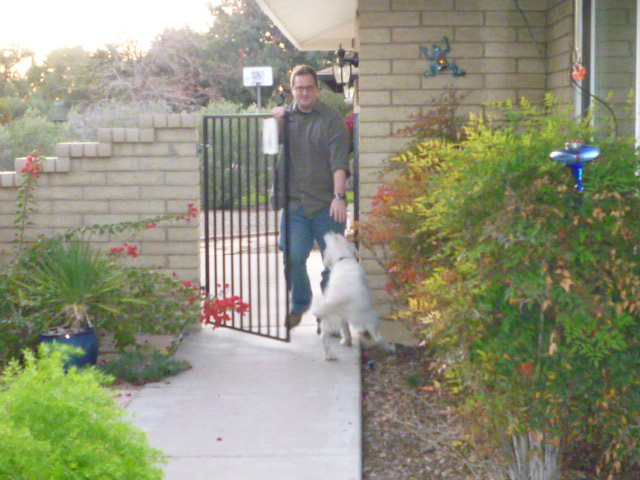
Come evening, Charley sits by the front door or out in the courtyard waiting for M’hijito to get off work and come pick him up. He stares at every passing car, in hopes that the next one will be His Human’s.

And when at last the Human gets here, we have an explosion of doggy joy…

Mare’s tails riding ahead of a storm system made for a gaudy sunset last night. A friend who lives about 35 miles from the Reno wildfire says they’re hoping for enough rain to douse the flames.

And so it goes.


Debt Consolidation: Proceed with Caution

Every time I get an offer from some feckless freelance writer trying to “give” me a “free” article plugging her customer, yet another debt consolidation service, I’m quietly amused. Well…no. I’m amazed: obviously some PF bloggers are publishing articles on debt consolidation that don’t give the whole story.

Debt consolidators negotiate with your creditors so that you make a single monthly payment to the consolidator, which then disburses small amounts and skims off a nice finance charge for itself. This may be useful for those who truly do not have the self-discipline to pay their bills and to snowflake them down with every small windfall that comes along. But for most people, it’s an expensive way to go. The FDIC notes that even though a consolidator may lower your monthly payments, the resulting plan will take longer to pay off your debts, and that the use of debt counseling is likely to show up on your credit report.

Some of these outfits are very smarmy. The Consumerist reports, for example, on the case of a “debt relief law firm” that collected $450 a month from a mark’s checking account, supposedly to pay down $23,000 worth of credit card debt. Not until the victim applied to rent an apartment did he discover the “debt relief” was actually theft, and that nary a dime had been paid toward his cards.

Some debt consolidators or alleged law firms charge excessive fees, often collected up front. These lead consumers even deeper into debt, failing to relieve their problems and even landing them in bankruptcy court. Although most debt consolidation companies claim to be nonprofits, they make a great deal of money at customers’ expense.

A number of years ago, while I was teaching at the Great Desert University’s westside campus and wishing I could earn more for less work, I applied for a job at a so-called nonprofit debt advising company. Starting pay for a job that required me to write lessons and conduct training in budgeting and personal finance was about $90,000—a phenomenal amount in a right-to-work state like Arizona. Various bonuses and perks were also promised. Companies don’t pay low-level executives that kind of money unless they’re making plenty of it.

Debt consolidation companies profit from their customers’ woes in a number of ways. One is simply to deduct a percentage of the payments passed along to creditors. Another is to engross one or two entire payments for “administrative costs,” dealing a blow to the borrower’s credit report when no  part of the payment ever reaches the creditors.

You don’t need a third party to settle your bills. Whatever these outfits do, you can do for yourself, and then some—at no extra cost.

First, call your creditors and try to negotiate a better interest rate or payment plan. They don’t want you to default, because that costs them money. Many will work with you to pay down your debt.

If you’re behind on your payments because of a documented personal disaster, such as a health crisis or loss of a job, lenders will sometimes negotiate a reduced balance. This is far preferable for them than having you declare bankruptcy and pay them nothing.

Next, always pay more than the minimum due. A minimum payment applies only about one or two percent toward the balance; your goal is to pay down the principal.

Most car loans and mortgages allow you to pay extra specifically toward principal. You may have to go in to the bank in person to accomplish this, but it’s worth the trip. The more of your money that goes toward the principal, the faster you pay down the debt.

Establish a budget and stick to it. This budget should be designed to keep you from running up more debt. Stop charging stuff. Easier said than done, but that’s why you make a plan and stay with it.

Create a sidestream income and pay all of the net proceeds toward the debt. If this means delivering pizzas after work in the evenings and on weekends, so be it. A side job is one of the most effective tools for paying down debt and building savings.

Pay every extra penny that comes your way toward the debt. Got a rebate? Tax refund? A few bucks from a yard sale? Pay it straight into the debt, no matter how tiny it is. Every little bit helps. It’s surprising how quickly you can whittle down debt this way.

Decide which works best for you psychologically: to attack the largest debt first or to go after the one with the largest interest rate. From a practical point of view, it’s usually best to get rid of high-interest debt first, since that costs you the most money over the long term. Some people, however, feel most oppressed by larger debts, even if the interest is low relative to a smaller debt.

By “larger,” I don’t mean your mortgage. This should be the last debt you decide to pay off. Get rid of revolving debt first. The small tax advantage given to mortgage holders defrays the actual cost of interest on these loans, and so the most urgent debt is represented by credit card and automobile loans.

Pay off debts in an organized, systematic way. Establish a monthly amount you can disburse toward existing debts. Devote the largest part of it toward the account you decide to liquidate first, while paying something more than the minimum toward other debts. When that account is paid off, move your largest payment to the next account, and so on until, one after another, all the debts are settled.

None of it is rocket science. You don’t have to fork over any of your money to someone else to do these things. You can do them for yourself—for free!

If you still feel the need to talk with someone about your debt problems, the National Foundation for Credit Counseling can refer you to free or low-cost counseling and offers a number of consumer tools on its website.

Chase Bank Credit Card Frolic

My little S-corporation has its own Chase Bank credit card, issued through the credit union. Well: make that “had.” Honestly, I don’t know why state agencies and credit unions do business with Chase: what a nuisance it is to deal with those huge, faceless banks. Chase has let my corporate credit card expire: no sign of a new card, no word from the bank…just notices from vendors who get paid by the card that they’re going to quit providing their various products and services because the card expires this month.

So yesterday I gathered all my psychological reserve of patience and plunged into Chase’s telephone punch-a-button maze. After a lengthy, aggravating wait spent listening to advertising pumped into my ear, a 20ish-sounding CSR got on the phone. Jumped through hoop after hoop after hoop with her, delivering every personal piece of identifying data the bank’s telephone script-writers could dream up, and then, just as I was opening my mouth to ask why they haven’t renewed the card, she says, “The information you’ve given doesn’t match the information we have.”

Oh shit. I forgot: When they ask “What is your date of birth,” they mean “What date was your company incorporated.”

So I say, “Hang on, I’ll have to get into my file and pull out the incorporation papers.”

“No,” says she, “Once I’ve entered your answers, I can’t enter any other answer.”

Say what?

You don’t get a second chance, if you’ve made a mistake in saying who and what you are. Just to get to the point where I would have the privilege of asking my question, now I have to waste another 15 minutes plodding through their FLICKING PUNCH-A-BUTTON MAZE AGAIN!

I just about went ballistic.

“All right, then,” said I. “Let’s just cancel the card.”

Of course, there was nothing she could do in that direction, either, because according to her records, the card was issued to a person who is two years old. And that, obviously, wasn’t me.

What excuse is there to treat customers like that?

So, I called the New York Times, which extracts its monthly subscription fee through that card, and switched them to American Express.

Then wrote to the customer disservice address on the Chase bill and told them to cancel the card (and yes, I do know that’s a hit on the corporation’s credit report, and I don’t care!!!!). Next, wrote a dear-sir-you-cur to the president of the credit union, enclosing the rant to Chase detailing what happened and suggesting the credit union might want to deal with some other rapacious organization:

Sam Wheeler
Chairman
Arizona State Credit Union
2355 W. Pinnacle Peak Rd.
Phoenix, AZ 85027

Dear Mr. Wheeler:

I’m canceling my corporate credit card, which is associated with my business account at the credit union, for the reasons described in the attached letter.

This is the second extremely annoying runaround I’ve had from Chase. Prior experience shows the customer service representatives and management at the credit union are helpless to intervene with Chase, so I have not bothered them this time.

You know, Mr. Wheeler, the reason I do business with a credit union is specifically so that I will not have to do business with despotic monoliths like Chase Bank.

I will find another credit-card vendor for The Copyeditor’s Desk. Since my credit is sterling, I expect no problem will arise. But I would suggest that the credit union has a problem: it’s called “Chase.” You might want to consider finding a better organization with which to ally the credit union, one that will not jack members around.

Thank you for your consideration.

Sincerely, (etc.)

And finally, speaking of outfits that call its customers “members,” it was off to Costco, where I learned to my delight that even though I have the low-rent business membership, Costco will indeed issue a second American Express card to me, set up in the name of my business.

Even though, as Free Money Finance recently noted, Costco’s AMEX card is cutting its benefits, it still provides a substantial kickback on the kinds of purchases I usually make. Most of what I purchase on the S-corp’s card is office supplies, and what AMEX is cutting is the 3 percent kickback on restaurant meals. IMHO, a 1 percent difference on something I rarely buy is hardly worth canceling a card with a company that does provide pretty fair customer service.

Costco’s AMEX card kicks back 3 percent on gasoline, which, when combined with Costco’s low prices, is pretty respectable. The Costco near me consistently provides the lowest prices within reasonable driving distance, and AMEX is the only credit card their pumps will take. Although some cards will give you 5 percent back, they also are issued by despotic monoliths. I’d rather deal with just one monolith, thank you.

In the near future, I’ll be charging about $3,000 in computer equipment on this new American Express card. So, at 2 percent, that will generate a $60 rebate, right out of the hustings.

Chase owes The Copyeditor’s Desk a few pennies in customer reward kickbacks. Unlike AMEX, they don’t just send you a check.  You have to screw around and jump through hoops to get it. I’ve never bothered, since it’s loose change. No doubt I’ll never see that money. Such as it was.