Coffee heat rising

Stress-Free Finances: Cultivate Minimalism

As we’ll see in this series, the key to stress-free finances is to live not within your means but under your means. Your goal is to live comfortably on less than you earn. Preferably, on lots less. If you’re bringing home, say, $3,000 a month, you would like to live on $2,000 or, at most, $2,500.

It’s not very difficult. The strategy is to determine what you really need and what you want, and then pare back the junk and the services to a level that’s as close as you can get to the need level, within reason.

I say “within reason” because I don’t believe it’s necessary to live like an anchorite to stabilize your finances and keep financial worries under control. Nor do we have to live like robber barons to be comfortable. What we’re looking for is a happy medium. To find that, you quietly engineer your expenses so that your cost of living is significantly less than your income, and then keep those costs as steady as possible—or even cut them—as your income rises.

The surest way to cut regular, unavoidable costs is to pay off debt and then, once free of it, to stay out of debt by never charging more than you have coming in during a specific period. At first, this strategy may require you to increase outgo, as you pay more than the minimum toward charge cards, student loans, and auto payments. But keep the faith: obviously after a time you’ll get this albatross off your neck, and then the amount you were paying toward it will no longer be going out the door. You have better things to do with this money; namely, saving it for a rainy day, for the kids’ education, and for your own retirement.

The second, surprisingly effective strategy is to pursue a minimalist lifestyle. Look around you: how much sheer junk do you own? Do you collect doodads that have their own collection—of dust? Does your closet shelter clothing that you haven’t worn in a year or more? Are the shelves groaning under decorator items waiting for you to dust them? Got an extra phone, computer, television, pair of skis that you really didn’t need in the first place? Subscribing to 110 premium cable channels when in fact you mostly watch only a dozen, or mostly rent movies? How many times this year did you use that boat in the side yard?

Declutter

Exercise Number One: lighten your load! Declutter the house and the yard. If you’re not using something, if it decoratively collects dust, or if serves no urgent purpose, get rid of it. Yard-sale it, Craig’s-List it, e-Bay it, donate it, recycle it!

As a first step, this process makes you feel amazingly liberated. Just getting rid of the junk makes your home look bigger and brighter, frees you of a bunch of stuff to take care of, and leaves you feeling about ten pounds lighter. Speaking of your home…

Right-size Your Home

If you’ve not locked yourself into an underwater mortgage, consider this fact: A house or apartment should suffice to fill your needs and only your needs. No extra rooms are needed. No empty basements need apply. All you need is enough space for you and your family to occupy.If you’re buying, try to avoid spending on more square feet than you need. With real estate still running upwards of $90 a square foot, one extra 10 x 10 “sun room,” “hobby room,” or “guest bedroom”can cost you $9,000. Or more. Plus tax. Plus insurance.

Houses that fit are back in style, and they were coming back long before the recession hit. Take a look at Sara Susanka and Kira Obolensky’s books on the not-so-big house for some ideas on how inviting and comfortable a human-sized dwelling can look. And if bungalow size is larger than you need, Little House on a Small Planet, by Shay Solomon, Nigel Valdez, and Frances Moore Lappe, will inspire a wealth of ideas about how to build your financial and spiritual wealth by living in the right space.

Rent, Don’t Buy

Consider renting instead of buying, at least until you can save up more than 20% of a house’s purchase price. By now most of us have come to understand that all the persuasive palaver to the effect that renting is pouring money down the drain and the mortgage deduction offers us all some vast tax advantage is just so much hooey. Too many Americans watched their money flow down the drain, all right—after they purchased homes guaranteed to increase in value with mortgages costing far more than they could afford when they lost their jobs.

Renting has several sterling advantages:

First, most of the time you’re not responsible for repairs. New homebuyers are often shocked to learn how much homeownership actually costs, once all those trips to Home Depot are factored in. Roof repairs, plumbing repairs, mold abatement, dead tree removal: yike! Let the landlord pay for it—he can take it as a tax deduction.

Second, renting gives you mobility. Consider the number of people who can’t pursue job offers in other cities because they’re locked into mortgages for more than their homes are worth. Renters can move pretty much any time they please.

And third, because a renter saves money on maintenance bills, your overall shelter costs are lower than a homeowner’s. Stash the savings in an investment account.

Select a Safe but Not Extravagant Neighborhood

Look for homes on the outer fringes of upscale areas. Often residents share the better schools of their more affluent neighbors but not the prices of the larger, gaudier homes. Before renting or buying, check the local crime reports. Google “Crime Reports” plus your city or state, or try CrimeReports.com.

Keep Transportation Costs within Reason

If you’re a couple, possibly you can get by with just one car. One person might car-pool to work, or one might drop off and pick up the other during the morning and evening commutes. By all means, if you’re lucky enough to live in a city with decent public transit, use it!

But if the adults in the house each really need a car, why buy new? Excellent late-model vehicles can be had at very reasonable costs—let someone else pay for that outlandish first-year depreciation. Once you’ve driven a new car off the lot, it’s an instant used car, anyway. Insurance and registration costs are lower on older cars, making them a much better buy for anyone even faintly interested in building wealth.

In considering the cost of a place to live, keep in mind the cost of commuting. Gasoline, upkeep, and wear and tear on a vehicle are real costs to living in the suburbs. One Lifehacker writer reckons that over ten years, a 40-minute commute—considered by many to be within reason—will set the driver back $125,000. You can figure it out for yourself with this handy calculator. Though a more centrally located home may cost more than a stick-and-styrofoam number halfway to the Timbuktu, the expense of commuting may outweigh the higher rent or mortgage. And the savings in time and stress provided by a shorter commute are huge.

Note, too, that a car for a teenager is really not a need. Let the kids wait until they can afford the payments and the insurance (to say nothing of the speeding tickets) before they take off on wheels.

Dress Modestly

Where does it say you have to wear Ralph Lauren or Banana Republic to work? Attractive, generic clothing is to be found at Penney’s, Target, even Costco. If you’ll feel just too, too humiliated appearing in public in anything less than Armani, try shopping in upscale thrift shops. I just found my second St. John outfit at My Sister’s Closet. Looks like it was made for me! The store is awash in designer labels for men as well as women, ranging from professional attire to dressy and casual.

Select Friends Who Live Modestly

High-living peers exert an outrageous amount of pressure on us to spend more than we need: eating out, shopping at unnecessarily expensive stores, traveling to places we don’t need to go, driving expensive cars we don’t need to drive.

I used to hang out with a woman who had a million-dollar appetite. Even though her present husband was a mid-level bureaucrat, she still lived as though she were married to the one who owned the thoroughbred ranch in Kentucky—yeah, the place where she once entertained Queen Elizabeth II. This lady liked company as she made the rounds of Saks and the various boutiques she favored. Just being with her in a store virtually guaranteed that I would buy a new Eileen Fisher or some such…even as I knew very well that 99.9% of the places I went did not require me to surface in a designer costume. I exaggerate not: after a couple of these shopping junkets, I developed the habit of returning everything I bought a day or two later!

Today I prefer the company of people with more common sense.

Eat Great Food—at Home

Cooking is not very hard. Neither is shopping for food. Even if your idea of a home-cooked dinner is something that comes out of a microwave, dining at home is many, many times more economical than eating out. And nine times out of ten, you can prepare a meal that’s far superior to what you can get in any but the most expensive restaurants.

Last night I had prime sirloin tips (purchased at Costco at a dollar less per pound than the choice ribeyes), scalloped potatoes, glorious corn on the cob, a glass of very palatable wine, and a bowl of fresh strawberries. The whole meal cost about what one glass of Cabernet would have run at the sort of place that serves prime beef sautéed in butter. You understand…I eat like that every night. And I live on less than 30 grand a year.

Resist Filling Your Life with Junk

Who doesn’t need this…and this…and this…?

Imagine having to take care of it all!

And imagine the cost, over time, involved in collecting all that junk. He who restrains himself wins the jackpot.

Do It Yourself

Some of us are handier than others. But most people can drive a nail or turn a screwdriver. Changing the oil in your car is not nuclear physics. Neither is sewing flat-panel curtains or replacing a toilet handle. Try to learn how to do at least some of the things around the house. The savings can be significant.

Sometimes, too, one discovers the truth of the old saw that if you want something done right, you should do it yourself. When I was employed, I could afford cleaning ladies. Occasionally I would hire them. One wrecked a parquet floor by applying undiluted Murphy’s Oil Soap with a janitorial dustmop. Another pair created several weekends of hands-and-knees work for me when they smeared undiluted Simple Green all over 1860 square feet of tile, thinking they were mopping. Gerardo the Yard Dude, who handles physical work I can no longer do, has a sidekick who breaks parts of the irrigation system and then, to stay out of trouble, hides the parts so that I don’t find out about it until some plant dies.

The frugal life is a lot less stressful than the heedless one. You end up with less real estate to clean and maintain, less junk to find places for and keep clean, better food, nicer clothing, cheaper wheels, fewer messes created by other people, less debt, and more money.

And as they say…money isn’t everything, but it sure beats whatever’s in second place.

The Frugal Joy of Big Batches and a Freezer

It’s 10:35 p.m. I spent two hours plowing through an excruciatingly bad student paper, trying to make SOME sort of sense of it, assigning a score of 35/100, feeling bad, the guy’s probably dyslexic, feeling frikkin’ frustrated, sick and tired of explaining the same grade-school trivia over and over and over and over and over and over and over to adults who didn’t learn it in 13 years of K-12 schooling and certainly aren’t going to learn it now and truly I remember why I said all those years ago that I’d rather go on welfare than ever teach freshman comp again.

Then presto-changeo, the next paper is almost perfect!

What happens that some people never manage to learn the most basic writing skills? And some, stuck pointlessly in English 101/102, perform on a near-professional level?

Another 12-hour day. I’m whipped. The dog hasn’t been fed, I haven’t been fed, and it’s past bed-time if I imagine that even under the influence of a pair of Benadryl I’m gonna get more than four hours of sleep. Nose has been so stuffed up I’m not hungry, but Cassie the Corgi certainly is hungry.

Unclog the nose with a toxic medicinal spray. Realize I really should eat something. But there’s precious little, we having run out of food and out of money near the end of the budget cycle.

But…

But YES! There’s a freezer!

Dive to the bottom of the chest and resurface with a container of home-made stew, redolent of onions, carrots, celery, and wine. And a smaller plastic box containing one serving of lovely comfort food: Costco’s excellent scalloped potatoes!

And there’s exactly one glass of wine left in the bottle of plonk on the kitchen counter.

Not only did I save a great deal of money frugally building a delicious stew and squirreling away one-person portions of the lifetime supply of potatoes, last winter’s me rescued this evening’s sickly overworked little me from a miserable dinner of cheese rinds and stale crackers.

Frugality! There’s more to it than meets the eye.

Pound-wise, Penny-foolish?

A new J. Jill catalogue arrived the other day. I’ve been planning to buy another of their sleeveless short dresses in the “Wearever” line, since they’ve finally come out with an actual color—blue. Well, they had an actual color last year—old-lady mulberry—and I bought one of those. So now I have two: the regulation black and the mulberry number.

They’re incredible pieces for women who resent having to have decent-looking clothes dry-cleaned and who also resent having to spend an hour fiddling with their grooming before they can get out the door. All you have to do is pull the thing over your head, throw on some jewelry and a decent pair of shoes, and voila! You’re dressed!

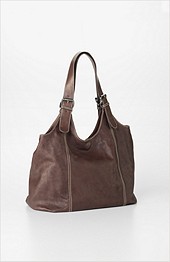
So while I was leafing through the catalog, I came across this hobo bag:

Exactly what I’ve been looking for to replace the pricey bag I bought in a fit of depression, when my dear boss invited me to an expensive luncheon to celebrate my longevity at the Great Desert University a few days after she informed me that I and all five of my staff were to be canned. I’ve been carrying that purse about every day for almost two and a half years, and it’s only just beginning to look a little tired.

The red bag I picked up in Yarnell earlier this year, which was relatively cheap, is already acting like it’s about seen its duty, and I’ve only carried it a dozen times—if that much. The faux leather is starting to sag, and where the purse is supposed to stand up, it flops over. Still fine for casual wear, but it’s not a purse you can carry with you everywhere, in every venue but the ballroom.

Well, so I filed the existence of the J. Jill purse away in the labyrinth of my mind, figuring that if I went out to Fashion Square in hopes of finding a sale there over the Labor Day weekend, maybe I’d buy the purse along with the dress. Especially if they’d give me a break on the price.

But…fortunately before I could get myself to a brick-and-mortar store, I made a little discovery.

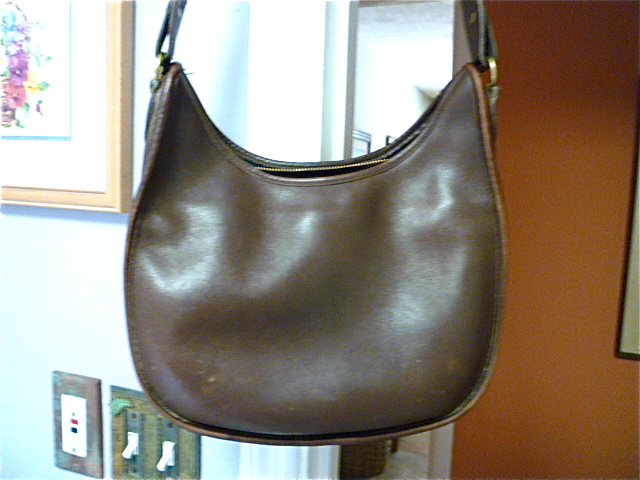
Poking around a closet in search of a light bed throw that might be a little less linty than the one I’m using just now, what should I come across but this:

CoachBagWhaa? I’d forgotten I still had the thing. It’s amazingly aged. But y’know what? It’s a Coach bag.

It was covered in dust. I’d stashed it on the top closet shelf because its rolled edges were getting a little worn, and as I recall I’d decided to switch over to another purse. Yea verily, probably the exit-party purse.

After a good dusting and thorough oiling with leather conditioner, what you see above is what I got. Looks an awful lot like that J. Jill bag, doesn’t it? Matter of fact, I like the design a lot better.

I think I paid about $200 for it, so long ago that the Memory of Person does not stretch back that far. Quite some time ago I quit buying Coach bags, to my regret. They got rid of their beautiful classic styles—no doubt because when you have a classic purse that never wears out, you don’t keep coming back to buy more purses. They started plastering their logo, Gucci-bag style, all over their products. And I just hate that. My feeling is that if you expect me to be your walking billboard, you pay me, not the other way around. But they think otherwise: in exchange for the privilege of hauling the Coach corporate logo everywhere you go, they expected customers to pay even higher prices.

Nine West, Fossil, and J. Jill produce comparable bags for a lot less money, without the requirement that you provide free advertising, so I said good-bye to Coach.

Luckily, though, I hadn’t said good-bye to this particular pricey Coach bag. That’s $149 that I will not have to pay to J. Jill for a new purse.

My point here, money-wise, is that sometimes it’s worth spending what seems like a lot to get an item that you use all the time and that will hold up under that kind of wear. The purse I bought over two years ago has been dragged from pillar to post and back again. It’s been used to carry computer gear. It’s been sat upon. It’s been rained upon. It’s been threatened by a chewing puppy. It’s been hauled through the desert. It’s been set on the floor in public bathroom stalls where the management has removed the coat hooks. It’s been searched by security guards time and again. And when I put it away and forget about it, two or three years from now it will be resuscitated and hauled around for another two years.

Same thing with the dresses. J. Jill’s Wearever line is not cheap, and the stuff hardly ever comes on sale. However, the little dresses in that line cover my paunch so I look nowhere near as fat as I am. They’re easy to wear. They wash like a charm and come out looking brand-new. They’re ideal for church, they’re perfect for teaching, and—accessorized properly—they’d probably work for a job interview. I wear one of them at least once a week.

When you’re going to get a lot of use out of something, in my opinion it’s worth the extra money to get something that will last. Cheap junk, like the red purse from Yarnell, wears out long before its time. If you have to replace a $60 item in a year or less, you’re a lot better off paying $200 for something that will last longer than three years.


Alley Treasures

Lenten thanks, Day 10

Thanks, God, for leading the late, great tax lawyer to shuck me off her rolls and for moving a tax accountant into Dave’s (former) Used Car Lot, Marina, and Weed Arboretum. She and her husband not only are splendid neighbors, she saved me a ton of money on this year’s taxes and charged a fraction of what the lawyer’s been billing.

If this doesn’t warm the cockles of Frugal Scholar‘s heart, nothing will.

So I’ve been building a berm around the north side of the biggest orange tree, where the grade slopes enough to draw the irrigation water away from the tree and direct it under the gate and out into the alley. This has been a longstanding annoyance, but I’ve been too lazy to do much about it.

Having dug a couple of deep holes for a pair of new roses, I finally had some nice, clayey, sticky dirt with which to form a low semicircle that I hope will trap the water…without my having to find enough dirt to build an entire circle. That’s the plan. To shore up this mound, I want to cobble its surface with river rock. I do not wish to purchase the river rock.

Luckily, the alleys around here are full of loose rock, quite a lot of it just what I have in mind. So I spent half a morning walking up and down the alleys scavenging stones. As I’m skulking around, what should I find but a big framed giclée print, brand-new, still in its Costco cardboard protectors, just sitting there next to the garbage can.

Why is it in the alley?

Its glass is cracked.

Somebody paid $29.99 for this thing, marked down from $39.99. Think of that.

First, it means one of my neighbors can afford to throw $29.99 directly into the trash. Second, it means they don’t have enough sense or craftsiness to schlep to the nearest glass shop, ask them to cut a piece big enough to replace the broken pane, deconstruct the cheapie frame, and fix it themselves.

Granted, Aaron Brothers or Michael’s will charge more to replace the glass than the junk print is worth. But a glass shop will charge just a few dollars. And taking a picture frame apart is just not very difficult.

The thing is an awful cliché, of course. But I couldn’t leave it to die in the alley. My plan is to replace the glass and then hang it on the back patio, well in under the overhang where it can’t get wet. In time it’ll fade, of course. But for the nonce…hey! Free décor!

Moving on, the rock quarrying endeavor is slowly yielding a nice variety of stones and rip-rap. I found some thick broken slices of unpolished milled granite (??? what do you do with that?), a few pieces of flagstone, and many, many desert stones and river rocks. Here’s the nascent project; it’s much further along now than it was here. I expect another two or three alley expeditions will retrieve enough rocks to cover the entire semicircle.

I hope this works. Sometimes my berming schemes succeed, sometimes not. An awful lot of water pours out of that tree’s bubbler. This mound may not be tall enough to contain it, or it may flow downhill toward the gate fast enough to wash the dirt away, stone paving or no stone paving.

We shall see.

How to Make Sustainable, Ecofriendly Household Cleansers

The conversation over how to strategize a more sustainable lifestyle kicks off still more of what passes for thinking around my household. In a comment, Frugal Scholar pointed out the irony that discussions of sustainability often entail buying things.

That certainly does seem to be the truth! Case in point: after learning that CFLs are supposed to save bundles on power bills, I went out and bought enough for every lamp in the house. That, we might add, was not cheap. Used them for a couple of years and finally had to conclude that I really dislike the quality of the light they emit; that their initial dimness, which gets longer as the bulb ages, is profoundly annoying; and that the truth is my power bills did not drop significantly as a result of this exercise because I don’t leave all the lights burning all the time. Not only an expensive buy, but a bad buy.

So, item 1 in buying sustainable: proceed with caution. Buy a small amount (or number), try the product for a substantial while, and assess whether it’s really worth replacing the old eco-unfriendly version with new stuff.

Second, look around you and see if  you already have something in the house that will substitute for both the old ecologically incorrect product and the new (expensive, not very effective) “natural,” “sustainable,” “ecofriendly” product. Household cleaning is a rich field for this kind of trade. Here are a few ideas that have been tried around my house and found true:

DIY Glass Cleaner and All-Around Disinfectant

Windex is really nothing more than alcohol, water, a dash of ammonia, and a few drops of artificial coloring. Here’s how to make glass cleaner that works every bit as well as the expensive stuff:

Rubbing alcohol
White vinegar
Ammonia
Water

Fill a good squirt bottle about 1/3 full of rubbing alcohol, available cheaply at pharmacies and grocery stores. Add enough vinegar to bring the level up to about half-full. Add a tablespoon or two of ammonia. Fill with water. Shake gently to mix.

That’s it! It even smells like Windex. If you want it blue (or whatever), add a drop or two of food coloring…but first ask yourself why. Works well on mirrors, windows, tile, not-too-dirty bathroom sinks, and other hard surfaces. It’s a decent spot remover for color-fast fabrics, too. Obviously, don’t use it on paint or finished wood.

Scouring Powder

Baking soda. That’s it. Baking soda. Substitute baking soda, which you can buy in lifetime supplies from warehouse stores, for scouring powder. It’s mildly abrasive, contains no contaminating chlorine, and does a decent job at scouring sinks, tubs, and toilets. To sanitize afterwards: spray on some of your DIY glass cleaner—both ammonia and alcohol are germicidal. Wipe sinks and brightwork dry with a soft rag. To sanitize the toilet, be sure there is no chlorine in the water and pour in a little ammonia. Remember: never combine chlorine bleach or any product containing chlorine with any other chemical, especially not ammonia!

Bleach

Hydrogen peroxide is oxygen bleach. You can treat many stains with H2O2 , also available for very cheap at your corner drugstore or market. It probably has a mild disinfectant quality, but I wouldn’t rely on it for heavy-duty disinfecting. You may have to let peroxide sit on a surface for a while to do its action.

Want a free source of bleach? It’s called sunshine. Place a stained piece of clothing in the freezer for a few hours or overnight. Then take it outside, still frozen, and place it in full sun. Let it sit there all day. Amazingly, this will fade or even remove some very tough stains. I’ve had it get bloodstains out of white garments.

Hanging sheets and white clothes to dry on a line in the midday sun will whiten them and make them smell wonderful. Conversely, if at all possible colored items should be hung in the shade. They still smell great from the fresh air, but are less likely to fade when kept out of direct sunlight.

Dishwasher Rinse Agent

Plain ordinary old white vinegar. Pour a cup of vinegar into the washer right before turning it on. Glasses come out sparkling.

Some people substitute vinegar for JetDry and competitor products in the rinse aid dispenser. I haven’t tried this; vinegar is quite acetic, and I’m concerned that having it sit there indefinitely could damage the machine. It’s not at all hard to splash a little vinegar into the washer at the last minute. The stainless steel tub in my five-year-old washer is still spotless and shiny, and I never have a problem with clogged spouts on the washer arms.

Fabric Softener

Hair conditioner contains the same chemical that’s in fabric softener. It smells a lot less obnoxious, and there’s no need to buy two products.

Get a squeeze bottle (see below). Dilute one part hair conditioner to ten parts warm water. Stir or shake well. Store the stuff in a squeeze bottle to dispense into your laundry.

Dryer Fabric-softener Cloths

Dedicate an old, clean washcloth to this job. Dampen and wring out the washcloth. Dribble a little of your home-made fabric softener onto the washcloth and squeeze to distribute it through the fabric. Toss it in the dryer with your clothes. If I have a large load of dog-hair-laden laundry, I sometimes put two of these in the dryer. Gets rid of dog hair like a charm.

Furniture Oil

Did you know that mineral oil will work to polish and refresh oil-rubbed finishes? It’s cheap and it’s odorless. Just wipe on a thin film with a clean, soft, slightly dampened and wrung-out cloth. Take another clean soft cloth and buff dry.

Garbage Disposal Cleaner/Deodorant

Ice
Baking soda

Place a few pieces of ice in the garbage disposal followed by a half-cup or more of baking soda. Turn on the garbage disposal. Run cold water through to rinse well.

Another strategy is to drop half a lemon into the disposal, then run and rinse the disposal thoroughly.

Detergent?

Occasionally you do need some actual commercial detergent. Some folks make their own laundry detergent, but IMHO this is more trouble and mess than it’s worth. Instead, be aware of two things:

1. You can use a lot less detergent than most of us are accustomed to using, and still get things just as clean.

2. You don’t need different cleansers for different jobs. One all-purpose cleanser will suffice.

Dish detergents are sold in squeeze bottles so that consumers will use more than necessary. The packaging is designed to help you splash the stuff around with élan and without thought. Transfer dish detergent out of its squeeze bottle into some other container that make it easier for you to measure it out. I use a heavy-duty squirt bottle, available inexpensively at places like Home Depot, Target, or Walmart. One squirt is all it takes to suds up a sinkful of water or to saturate a sponge with enough detergent to do a messy job.

Also, you can dilute dish detergent. When transferring it to its new bottle, add a little water, rubbing alcohol, or ammonia (don’t use ammonia if you’re likely to use the detergent around chlorine bleach). This will make the detergent less viscous, but the viscosity of the stuff seems only to be an illusion designed to make you think the detergent is somehow more detergenty. Think about it: the stuff gets diluted the minute you scrub it around with water in a dirty pan or pour it into a sink, anyway! Diluting detergent makes a bottle of the stuff last a lot longer.

Don’t throw out the plastic squeeze bottle. Use it to hold the home-made fabric softener described above. Washed thoroughly, these bottles are great for holding houseplant fertilizers mixed up from dry granules, and also for dispensing weed killer (don’t use the same bottle for weed killer and then later for fertilizer!).

In the laundry, you can use about half as much detergent as the maker recommends, especially on lightly soiled garments. Use spot cleaner for stains. Your clothes will come out clean, and your laundry dollar will stretch twice as far.

Elsewhere, there’s no reason to use bathroom cleanser to clean the bathroom sinks, floor cleaner to mop the tile or vinyl, and kitchen cleaner to clean the kitchen sink. The stuff is all the same!

Get yourself an all-purpose cleaner whose odor does not annoy you. I happen to be partial to Simple Green, but Mr. Clean, Lysol, Fantastik, Seventh Generation, Mrs. Meyers, Method, or any of a number of others will do the job just fine. Put some of it in a squirt bottle for use in the bathrooms and kitchen. Often these products come as concentrates, and so remember to dilute it when you dispense it into a bottle. Add a little to warm water in a bucket and use it to mop your floors or clean the walls and woodwork.

That’s about the extent of what I have. What are some of your favorite DIY and sustainable household products?

Images:

Rubbing Alcohol. Craig Spurrier. Creative Commons Attribution 2.5 Generic license.
Sodium Bicarbonate (Baking Soda). Thavox. Public domain.
Ball & Stick Model of Hydrogen Peroxide. Public domain.
Detergents. Nordelch.
GNU Free Documentation License.

Gasoline Costs Putting a Crimp on Life

{sigh} I had to turn down an invite to meet SDXB and NG in the West Valley on Friday. They want to go to some goofy event at the Ben Avery Range where enthusiasts of antique guns get dressed up in Wild West clothes. I’m sure it’ll be fun, but I just can’t afford the gasoline to drive out there.

Gas is now over $3.25 a gallon here. I paid $3.29 for an emergency purchase, shelling out $15 to get to where I needed to go before I could afford to fill up the tank. When this month’s budget cycle restarted, on Monday, Costco was charging just $3.11 at the outlet where I filled up; that racked up $40.

I’ve budgeted $100 a month for gasoline, but that would normally cover only trips to and from the college and the four trips to Scottsdale I have to make each month. But this week I’ve had an extraordinary number of schleps to the East Valley: Earlier this week to Scottsdale Fashion Square to pick up a little ottoman I’d ordered months ago from Crate & Barrel; then today to the Mayo at 140th Street and Shea, an unholy long drive that will be stretched because I have to come back by way of McDowell Road, many many miles south of Shea Boulevard; then out to Scottsdale again tomorrow to give a dog & pony show to my business group, then race to the client’s to pick up some work, then fly back up to the campus at 32nd Street and Union Hills.

Ugh. Most of today and tomorrow will be spent driving, and I’m guessing all those junkets will burn half to three-quarters of a tank of gas.

This morning’s journey to the Mayo will take place during the darkest rush hour (driving into the sun, naturally), and so hypermiling will be pretty much out of the question. In a culture where normal people charge up to signals at 45 mph and then jam on the brakes at the red light, drifting toward a light with your foot off the gas freaking drives your fellow homicidal roadhogs screaming insane.

Some of our fellow citizens around here are literally homicidal, so one has to be careful.

You’ll recall “hypermiling” from the 2008 run-up in gas prices, right? The idea is to get around using as little gas as possible by applying an array of conservation techniques to your car and driving habits:

Try to avoid applying the brakes any more than absolutely necessary. Watch the traffic flow ahead and, when red lights start to glow, coast to decelerate. Try to reach traffic stopped at the light as it’s beginning to move, so you don’t have to start up from a dead stop.

Accelerate from a stop slowly. It’s a car, not a jackrabbit.

When starting from a dead stop, allow the car to idle forward for a second before stepping on the gas.

Use the cruise control to maintain speed on the freeway and on steadily moving surface streets, and use it to accelerate and decelerate. Use the “coast” and “acc” functions to slow and speed gently. Try to keep your foot off the gas pedal as much as possible. But n.b.: don’t use cruise control on an uphill grade.

When approaching a grade, speed up a little (stay sane about this) to build momentum; then allow the car to slow as it climbs. Use the downhill grade to get back up to your cruising speed before resuming the cruise control.

Never drive faster than 60 mph on an urban freeway. Try to keep your speed at around 55 mph. Stay in the slow lane and take it easy.

If it looks like you will have to stand for more than 30 seconds (for example, at a long stoplight, in a gas station line, at a railroad crossing), turn off the engine.

Using these techniques, I’ve managed to extract about 25 mpg from my aged Toyota Sienna. That’s not bad, since it normally makes about 16 mpg in the city, and maybe 20 on the open road. But it’s still expensive to drive to Hell and back every day.

The real trick to hypermiling? Stay out of your car!

😉