Spring has sprung in these parts. The weather—never bad this winter, really—has been spectacular for the past several weeks. Everything is in blossom. At this time of year, the citrus perfumes the air like frangipani in the South Pacific islands. It reminds us that our strange, abstract human constructs of “wealth” are so silly as to be meaningless. Does losing a quarter million bucks in real estate and the stock market really matter when far more believable riches surround us?
Click on the image for a full-size view.Click again for a mega-view.Captions show only at the site, not in the RSS feed.
Wonderful as flowers are, I’m planting a lot more vegetables in the garden. That chard borders the pool, and probably will grow there through the summer. Soon its neighbors, the beets and carrots, will be ready to harvest. Meanwhile, yesterday in a part of the yard that gets more sun I put in some cantaloupe and some butternut squash, which I hope will grow from grocery-scavenged seeds.As times grow even harder, food is going to be more expensive; possibly even scarce. So, the flowers will have to make way for things that can be eaten.
The yard already has plenty of that: I’ve been scarfing tree-ripened oranges for the past two and a half months, and now the oranges, lemon, and lime are all covered with new blossoms. Next winter will see another bumper crop of citrus, I think.
Those oranges are sweet as candy. Eat your heart out, Warren Buffett!
Some months ago, a commenter on someone’s blog (don’t recall who on whose: sorry!) remarked that she had filled in the cracks between her patio flagstones with (expensive!) black stones, to good effect. At the time, I thought there’s an interesting idea! Filed the thought away but did nothing about it.
Over the summer I cast wildflower seeds between the flags in the front courtyard. This worked to interesting effect…lots of bright, strange-looking, probably invasive blossoms. All very sweet. But the truth is, one person’s wildflower is the next person’s…well, weed. What I had left after the wildflowers had blown was a rangy tangle of straw with tap roots headed for the center of the earth. This, I realized, was not a practical idea.
When Richard the Landscaper installed the flagstones on dirt, the plan was to cultivate dichondra in the cracks between the pavers. Great plan. Except that in Arizona, two other varieties of groundcover are endemic: burr clover and bermudagrass (known in some parts of the country as “crabgrass” and in others as “devilgrass”). Burr clover has a certain charm: it makes pretty little yellow blossoms, and it doesn’t seem to grow burrs. But bermudagrass is as horrid an invader as you can imagine: steel wire with ugly scrawny leaves attached. Left to its own devices, it will grow as high as your hind end. People cultivate it as lawn grass here, because it’s about the only grass that will survive a 115-degree summer. All you need to make it grow is water. It loves heat and water. The more water you dump on it, the thicker it will grow. It has, however, a somewhat contrary personality: this is a plant that thrives wherever you don’t want it and dies wherever you do want it.
Where I did not want it was between the flagstones. Consequently, that’s where I had a fine stand of the stuff. Between the bermudagrass and the burr clover, the dichondra was snuffed out and the whole place looked pretty grungy.
So, last fall I decided to dig all the tired, wiry, failed ground cover out from between the flagstones and fill the spaces with stones. A few trips to nurseries and warehouse stores confirmed that black rocks were well beyond the price range, and besides, I wasn’t sure I wanted black. It’s plenty hot in that brick oven during the summer without paving the ground in black stone. Another discovery: occasionally, Michael’s sells decorative polished stones at incredible markdowns. But even on sale, these would cost way too much to fill in an entire patio’s worth of flagstones. And contemplating the number of little mesh bags of such stones that would be required boggled the brain.
However, this neighborhood is full of river rocks: polished multicolored stones used as decorative landscaping accents. People buy too many of them or get tired of them and dump them in the alleys behind their houses. When I pulled a bunch out of my old yard, two blocks to the north, that was exactly what I did with them: tossed them on the ground in the alley. Lo! A quick reconnoiter confirmed the things were still there.
And they’re scattered all over the other alleys throughout the neighborhood. Free for the taking!
So: for the past many weeks, I’ve been slowly digging out the weeds and roots from between the flagstones, collecting stones from points far-flung, and redecorating the front courtyard. A week or so ago, I got tired of hauling bagsful of stone around the neighborhood (I’ve burned off eight pounds in this endeavor!) and capitulated: drove up to a quarry not far from my neighborhood and bought two big plastic binsful of stone for all of five bucks.
As of this weekend all but one corner of the patio was done. Today I dug out all the rest of the weeds and sand between the stones, and also dug out the burr clover growing under the olive tree on the patio. Around that tree, I planted about a zillion anemone bulbs. Love anemones. A couple of other unknown bulbs had managed to push their way though the clover, and so I’m hoping that with some cultivation these will join the anemones and fill in the basin under the tree with lots of color.
At this point, it should only take another four or five bags of stones quarried from the alleys to fill between the rest of the flagstones. I should be able to gather those in another week or two.
Meanwhile, I think the overall effect is pretty nice, especially considering what I paid for it. Sprinkling on a few polished stones from the craft store really zings up the river stones, and when they’re wet after a rainfall, they all look like they’ve been through a polisher. It will take some doing to beat back the bermudagrass and burr clover until they give up, but a weekly application of Roundup to each new sprig should do the trick, after a summer or so. And no, I don’t like Roundup…but it is biodegradable, it can be applied with a dropper (I use an old Spray & Wash bottle with one of those squirter nipples) to the target’s leaves only, and it’s better than any of the alternatives. Including a yardful of weeds.
So far this project cost me about $15 or $20 plus four months of sporadic work, not a bad price! And it should save on water, because I won’t be trying to cultivate dichondra, wildflowers, or clover.
Yayyy! It’s wintertime and everything is in bloom.
Well, not everything, but a lot of stuff that prefers cool weather to the blast-furnace effect of a globally warmed Sonoran desert. Roses, for example, are very fond of winter here…
The big lavender plant that would like to shove the Myer lemon tree out of its way has recovered from its fall haircut, it having wearied during the summer. It will stay in bloom all winter, all spring, and through most of the summer.
The bougainvillea doesn’t much care what time of year it is: as long as we avoid a freeze, it blooms all year round. Right now it’s pretty vigorous.
Something—probably burr clover, not dichondra—is struggling back to life between the flagstones in back. Gerardo hollered at me because he thought I wasn’t watering enough. But I don’t think that was the problem. It acts more like pearl mites, a rugged little parasite that devastates lawns in these parts. Right now it’s cool enough to drive them dormant, and so the walk-on-me plants between the stones are coming back to life.
The bush peas I put in a few weeks ago are blossoming, and here’s our first baby pea pod! Yum.
Several other veggies are thriving. Ready now: the Swiss chard:
No need for Christmas decorations around here. The orange trees come with their own ornaments:
Over the weekend, Cassie and I hung out in the front courtyard, where I read endless pages of copy about medieval and Renaissance history and she took the afternoon air, watched hummingbirds, and barked in harmony with Biker Boob’s yapping pit bull:
So it goes. Like Dilsey, summer or winter, hard times or good, some things endure.
Okay, so the bee dude showed up yesterday noon. He looked at the composter and said the bees had taken up residence in there, and that normally in an object shaped like that, they’ll attach their hive to the top (as in the top of a cave). This meant, in his humble opinion, the bees had built a colony on the backside of the compost lid.
He felt the only thing to do was to exterminate them.
Shit.
One of my quirks is that I hate, loathe, and despise insect sprays. Exterminators are not allowed near my house. Though I’ll use some boric acid and, in extreme cases, traps on ants or roaches, I don’t allow spraying. Instead, I keep attractions away from the living quarters and encourage insectivorous birds to visit frequently. And, except for the mosquitoes from the swamp behind Dave’s Used Car Lot, Marina, and Weed Arboretum, I never have any insect issues.
It took a while to reach that harmony. When I moved in to The House from Hell, Satan and Proserpine’s* pet ants had built an ant metropolis that I’m sure extended all the way down to Satan’s favorite throne in Hades. The place had roaches, too, although not in the gay profusion characteristic of other dwellings I’ve enjoyed. Oddly, there wasn’t a single black widow or scorpion to be found.
The place was barren: no trees except for two young willow acacias, a ridiculous sort of tree whose branches aren’t really strong enough to support the weight of a roosting bird or a bird nest. The one in back was planted directly upwind of the pool, so that summer monsoon gales blow bushels and bushels of Devil Pods (I call the thing the Devil Pod Tree, in honor of the previous homeowner) and stringy, pool-cleaner-clogging leaves directly into the water.
As soon as I got moved in, I planted four new trees in the backyard, buying the largest specimen trees my budget would tolerate. I also cultivated a number of bird-attractive shrubs. Although most birds will eat ants, what I really needed were thrashers, towhees, and woodpeckers, plus a nice tribe of geckos. A mockingbird or two would help, too. I put up two big bird feeders, knowing that insectivorous birds will usually come along for the ride if they see a lot of seed-eaters around. ThenI planted some roses and mulched them with a thick layer of bark chips, a substance much favored by small bug-eating lizards.Before long a pair of towhees took up residence. A woodpecker showed up and made short work ofthe cockroaches residing in the detestable palm trees. It took a year or two, but in time the birds and the geckos brought the ant situation under control—you hardly ever see an ant nest in the yard anymore,and when you do, it’s a normal, healthy ant colony, not a berserk ant empire.
Applying insect spray in the backyard will disrupt that equilibrium, and before you know it, all sorts of problems will arise. No bees, no pollinated flowers. No pollinated flowers, no seeds. No seeds, no birds. No birds: ants, crickets, grasshoppers, and roaches coming out the wazoo!
It’s interesting that even a guy who cultivates bee colonies in his backyard assumes it’s normal for people to be afraid of insects. He very clearly thought I was and should be frightened of the bees foraging for pollen in the acacia tree.
What is it with that? What about something that’s an inch long should scare you? For crying out loud. Yeah, it’s true that some insects will bite you—most annoyingly, fleas and mosquitoes—and that some carry disease. But there are relatively easy ways to deal with that, not the least of which is getting rid of swamplike puddles on the bottom of drained swimming poools.
And yes, bees do sting if you piss them off. Duh! The trick is don’t piss them off!
The term “killer bees” is an obscenity coined by the infotainment media, who sell papers on the “if it bleeds it leads” theory. Long before Africanized bees came along, plain old boring European-style honeybees were known to swarm humans, dogs, and horses, and working together they also can deliver fatal doses of venom. The difference is that the African strain of honeybee is a little crankier than the variety that evolved when the ice ages chilled Europe, cooling the temper of the bee along with the climate. Also, European bees are less likely than African bees to build their nests near the ground, where humans and pets can mess with them.
The bee dude seemed set on eliminating the bees not only from the composter beneath the willow acacia but also from the acacia itself. No amount of explaining that I like bees humming around the puffball blossoms festooning the willow acacia in back seemed to make him understand that I didn’t see a problem with the bees in the acacia, especially since he stated the foragers were not the builders of the hive.
If the new residents had settled into some out-of-the-way spot, I probably would have sent our boy on his way. But the fact is, they had occupied a device I use several times a week, located in a place where the dog and I both move around all the time. Being that they were no doubt Africanized, sooner or later we were going to piss them off.
Well, he said he’d apply a powdered pyrethrin to the composter and this would do in the hive. It also would do in a year’s worth of organic compost. Then he goes on about how the surviving bees will still be clustering around the hive area for three days to a week and I should be careful to keep the dog away from there and stay away from it myself, and so forth.
Unhappily, I agreed to this, since I figured a colony of potentially touchy bees near the ground in an area where the dog and I are likely to disturb them did pose a hazard.
So he went off to do his thing.
Pretty quick he shows up and informs me that he’s finished, and I’ll be pleased to know there was no hive inside the composter.
Huh?
No. They were foraging for something in the composter.
That’s when I remembered I’d dropped some old toast that had a bit of honey in there. Sumbitch. Well, say I, then you didn’t have to kill them?
Oh, no, he said proudly, he had dumped pyrethin powder all over everything and all over the inside of the composter. They’re all dead.
Uhm…so my compost is ruined?
Oh yes. In a few days you’ll want to put on some gloves, get rid of the compost, and scour the composter inside and out first with detergent and then with bleach.
Well…uhm…if there was no hive inside there, why did you dump insecticide all over it?
Because, said he, he didn’t realize they hadn’t built a hive until after he’d already applied the stuff.
Ducky.
Well, this morning there’s not one bee anywhere near the acacia. You’ve heard of Silent Spring? In Arizona, fall is spring. What we have in my backyard is Silent Autumn. It’s dead quiet out there. And I use the word advisedly.
Sometime this weekend I will have to roll the compost barrel out to the alley. Being an old bat, I don’t have the physical strength to scour a thing like that inside and out, first with detergent and then with bleach. So I guess it’s done for, along with 40 pounds of beautifully ripened compost that I was about to use to build a new vegetable garden. I’ll just have to roll it into the alley and leave the whole arrangement for the trash pickup.
Lhudly sing goddam!
*Satan and Proserpine: the previous owners
Gecko: ZooFari
Towhee: Alan D. Wilson
Thrasher: Charles & Clint
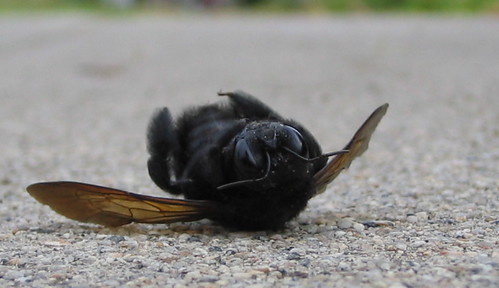
Dead bee: jilldoughtie
Well, darn it! My camera won’t export my most recent veggie photos into iPhoto. But trust me: the garden is lookin’ good. Click on these thumbnails (twice!) for some older photos of the tiny babies…
Everything is much bigger now. I’ve thinned the chard and beets. The tiny pea plants are now pea toddlers, as it were, and are beginning to put out tendrils. I haven’t gotten around to thinning the carrots, mostly because they’re so thick it’s sorta daunting to figure out how to thin them without damaging the survivors—must do that today.
Having watched Jim’s summer-long gardening project at Blueprint for Financial Prosperity, I drew a few conclusions…well, more like theories…relevant to my own craving for garden-fresh veggies.
First, I think it’s probably best to plant in the ground rather than to continue the container-gardening strategy. I’ve always liked to grow things in pots. However, plants seem to prefer being in real dirt in the real ground. In Arizona, too, you have to use a lot more water to keep a plant alive in a pot: once the weather hits about 95 degrees, you have to water every morning or your plants will fry by midafternoon. Less water is needed when plants are in the actual earth. And pots, potting soil, and the extra fertilizer needed to replace nutrients washed out by frequent watering are expensive.
Second, also related to the local weather: fall and winter seem to be the best growing seasons here. Anything leafy bolts to seed when the ambient temperature reaches about 80 degrees, which is most of the time. Between October and March, though, lettuce, chard, and spinach seem to last forever. They can take a light frost with no damage, and you can pick off enough leaves for a salad or a side dish, letting the plant continue to produce more for you through the winter and early spring. Some tomatoes will bear fruit before the frost (they hate getting cold-nipped, though, and generally die in December).
Third: grow from seed. Buying plants at the nursery quickly turns into a pricey proposition. If you get started early enough, you can get a nice healthy crop in just as the weather turns perfect. Seeds are very cheap and produce a zillion plants.
And fourth: don’t think you’re going to save much on this project. Think of it instead as a way to get especially delicious, vine-ripened produce that you know to be as chemical-free as possible. And think of it as a stress-relieving hobby that brings you some pleasure, gets you outdoors, and on the side presents you with something good to eat.
This winter’s Grand Experiment is bush peas. Casting about for a place to plant them (my yard is xeriscaped and doesn’t have many unoccupied planting beds), I realized the basin around the queen palm gets watered a couple times a week by the overflow from the Meyer lemon tree. So I excavated some holes in the gravel, digging down to the dirt, and filled the holes with commercial garden soil plus some compost from my own compost bin. Stuck a pea or two in each prepared hole. If they want to climb at all, they can go up the palm tree’s trunk. These are doing quite well today.
I still had more than half a package of peas after this, though. So I found an old plastic plant pot and filled that with the rest of the bag of garden soil I’d bought to improve the flowerbed near the pool (which now hosts chard, beets, carrots, herbs, and a tomato plant). Not ideal, but better than nothing. The ones I put in that are kind of crowded—probably also need to be thinned—but just now are doing very well. I love fresh peas! And they never show up in grocery stores any more. On the rare occasions that I’ve found them, the price is well beyond my budget. So I do hope these grow and produce. 🙂
Last evening Cassie and I walked past the proprietorship of an eight-year-old entrepreneur, who sells garden flowers out of a sidewalk stand built of his mom’s card table and some paper signs. Turns out the kid has made about $70 from his various projects, which also include peddling the citrus from the backyard trees and handing out gift cards to relatives. Kid and a half!
Chatting with his mom, I learned the family had recently moved in, after her mother-in-law, the home’s original owner, had passed. Sad though they were to lose the grandmother, they were thrilled to be in the house, which they’ve begun to renovate.
Among several things she revealed, the young mother told me that her mother-in-law had demarcated certain parts of the yard as outdoor living areas; other parts she simply wrote off. This explained why half the front yard was green and happy, and half was mostly bare dirt. The parts of the large lot that she didn’t personally use as living space did not get water wasted on them.
Click! Here I am sitting here wondering how the heck to cut some of the amazing costs of living in my quite desirable house, one of which is the astonishing water bill, which rises apace.
My house has an advantage over the mother-in-law’s, in that it’s already desert-landscaped. Where no plants grow, rock mulch covers the ground. But the problem is, I don’t take advantage of it: the place isn’t a desert…it’s a jungle!
The frontyard west of the driveway is overwatered, because I couldn’t make the landscaper understand that the potted plants around the westside deck need to be watered every day in summer and so they needed to be on their own valve. Disregarding the Female Voice, he linked the front west with the irrigation lines that water the potted plants. This means that all summer long a half-a-yardful of xeriscapic desert plants get watered every day. Needless to say, I’ve quite the thicket out there.
There’s no reason I can’t have about two-thirds of the berserk plants removed and then simply put plugs in every one of the drippers. Let those xeriscapic plants fend for themselves during the summer, or haul a sprinkler out to them about once a month. That would cut a substantial part of the water bill.
Ditto the useless plants along the outside of the eastside back wall, whose main purpose seems to be to block pedestrians from strolling along the sidewalk and to provide cover for the bums who use that wall as their public toilet. Why am I watering plants that don’t populate my living space? There, too, Gerardo could yank out the plants and we could plug all the drippers: more water saved!
Most of the plants in the east front yard are highly xeriscapic. Several of those—a palo brea tree, a vitex, a yellow oleander, a cassia, and a Mexican bird of paradise—were installed to create a visual screen between my front windows and Dave’s Used Car Lot, Marina, and Weed Arboretum. That they do, effectively…and a little weirdly, given that they’ve grown into something that resembles a huge green bunker instead of a screen. Now that they’re firmly established, they also shouldn’t need to be watered more than once or twice a week. Plug up their drippers, for hevvinsake, and drag a sprinkler out there every two or three weeks during the driest part of summer. And get the darn things trimmed!
The weeds between the flagstones in the front courtyard have crowded out the dichondra, are always out of control and usually overrun with hated bermudagrass. Dig out the dirt between those pavers, fill the spaces with river rock, and turn off the sprinklers. Connect octopus heads to the sprinklers and run dripper hose to just a few ornamentals, thereby bringing a stop to a great deal of water wastage there, too.
I’ll bet that by mapping out three relatively small outdoor living areas—the back porch, the westside deck, and the front courtyard with its backdrop of xeriscapic shrubbery—and cutting off the water to everything else except the fruit trees, I could save $40 or $50 a month on water. More, maybe: the base water, sewer, and trash bill is about $60; my bills have been more than twice that. Whatever dies gets pulled out. The yard would look better because it would be less overgrown, and my checking account would also look a lot better.