Coffee heat rising

Survivors and Succumbers

P1020031LOL! Is there such a word as “succumber”? I couldn’t think of a noun antonym to “survivor” that ended in -er or -or, so made that one up. Possibly, though, it’s more closely related to “cucumber”?

Spent most of the day yesterday thrashing around the yard. The late frost was one of the strangest climatic episodes I’ve seen here in the low desert. Plants I expected would die made it through just fine, and plants I thought were pretty cold-hardy croaked right over.

The orange and lemon trees suffered more damage than they did in the harder frost we had several years ago, when they were less mature. About half the harvest of candy-sweet oranges is ruined — some pieces are still juicy and good; others are dried out. The Meyer lemon is dropping all its big, ripe fruit into the mud. I’ve tried to give them away to friends but don’t know whether anything remaining can be salvaged. If the hardier oranges are parched, the inside of those lemons must be sawdust.

The lime tree may be lost. Though I hung a couple of shop lights on its limbs, there was nothing I could do to cover it — the tree had grown taller than the roof. At least half of it froze back; it remains to be seen how much more will die.

P1020024

Click on the images for higher resolution.

I picked the wrong time to have the trees pruned! The parts of the lime that survived were the areas sheltered by the adjacent devil-pod tree. Just a few days before the freeze, the arborist removed a large limb that hovered menacingly over the house — and that also overhung the lime tree. Probably less of the lime would have been blighted had that big limb still been in place.

It will have to stay untrimmed until well after the heat comes up. It will be weeks, maybe months, before we know how much it it will come back.

The yellow oleander also looks like a goner:

P1020038

Weirdly, this tree did much better in the last frost, which was colder and lasted longer. This year we only had a couple of nights in the low thirties and high twenties. The last frost seemed to go on and on, and as I recall it came and went through several episodes.

On the other hand, that last big frost came with rain. This year has been droughtier than droughty — not a drop of rain in sight. So the plants probably were stressed to begin with, since I cut back the irrigation (which isn’t very effective to begin with) in the winter.

I hope the yellow oleander doesn’t die. It’s a pretty little tree that’s covered with bright yellow blossoms all spring and summer. Most of its limbs are still springy, giving some hope that the leaves may come back. However, with no viable leaves at all, right now it can’t photosynthesize, so my sense is that what we have here is very slim hope, indeed.

Even highly xeric plants, including these agaves and cacti, died back:

P1020039

Ouch! We’ll be paying Gerardo a nice bonus for shoveling out that mess.

The bougainvillea back there only looks dead. Bougs hate frost and instantly convert themselves to dried arrangements at the first sign of cold. But they’ll come back. The trick is to leave them looking like that, without pruning off the dead stuff, until the weather is good and hot. Along about May, we’ll be able to see which limbs are really dead and which are just hibernating.

Some plants that I covered also died back. Everyplace the sheets and towels touched the potted ficus tree’s leaves, it fried:

P1020007

Ficus are notoriously touchy about environmental changes, though. Some of these limbs may regrow their leaves, so here, too, I’ll have to wait until the weather has been warm for awhile to see how much needs to be cut back.

I knew the red salvia would freeze, despite being covered. What I didn’t expect, though, is that most of the eight plants that went in last summer would survive! When I went to pull them out yesterday, what should I discover but new growth at the base of the dead sticks:

P1020008

This was quite a surprise — I’ve rarely seen salvia live through a frost.

I was certain the new gardens I’ve planted over the past few weeks would be flattened, and that all the new bulbs would be frozen underground. But no! In front, the only loss was a lovely little lavender plant. Everything else, even the mint, made it.

P1020029

Some of the bulbs I planted out there have even started to grow!

P1020033

I think these are lilies of the valley. But am not sure. Whatever…they look promising. And their appearance bodes well for the survival of the other bulbs lurking in that bed.

Turns out to have been a good thing I pulled the four unwaterable roses out of the front flowerbed and the two in the light-starved westside bed. I’m getting too old to cope with 89 gerjillion rose bushes. Yesterday I pruned the three in back and was just done in by the job. The back, legs, and foot hurt something awful after what seemed like not much exertion.

Though it must be allowed that “not much exertion” did entail hoeing and shoveling 50 or 100 pounds of damp gravel back from one rose to build an enlarged watering pan, hauling rocks over to line it, emptying the new stuff out of the compost bin and digging the fully composted material from the bottom of the bin, shoveling it into the wheelbarrow, and depositing it around two of the roses, and then refilling the compost bin with the uncomposted stuff. That was a bit of a job, I suppose.

P1020020

This very pretty rose has been struggling with only one piddly little dripper and with the crushed granite top dressing right up against its trunk. It makes a beautiful orange and red flower, but they never last long because the plant is perennially heat- and drought-stressed.

turtle figurine🙂 Found that piece of flagstone buried under the crushed granite. Next time I’m at Baker’s or Summerwinds, I’ll look for a kitsch frog or some such to set on there. Though I have a Talavera frog pot with a cactus in it, Gerardo’s underlings invariably break anything made of pottery that’s left in their way. Baker’s sells molded resin turtles that are amazingly lifelike, and of course cast frogs are a dime a dozen.

At any rate, this pushes the broiling hot granite back from the rose, and it also gives the rose some new and very rich compost.

Also dug in some systemic fertilizer/disease control, since all three plants are showing signs of blackspot and something that’s turning leaves yellow and stunting them.

Closer to the house, a vigorous, large perfumed delight rose struggles through the hot summer.

P1020021

The trees don’t block enough of the fierce afternoon sun to save it from fricasseeing, and the stupid drippers, even with the largest gallons-per-minute gadget available, don’t give it enough water. It’s a bit out of the way, too, and so I often forget to drag the hose to it when I’m adding extra water to the other plants. That notwithstanding, over a summer it’ll grow as tall as me.

I didn’t prune either of these back as far as I probably should have, because they’re so stressed it’s hard to tell which canes are likely to live and which not. So I removed the diseased and damaged foliage and the canes that obviously were already dead, but tried to leave enough healthy-looking stuff for the plants to keep puttering along as it gets warmer — which is happening very rapidly.

The unruly, ferally beautiful blue plumbago morphed into a gawdawful haystack.

P1020028

I was about to cut it back to the ground, but thought better of it after having googled care of frost-bitten blue plumbago. While the site linked above says plumbago responds well to pruning, another site says it’s best to wait and see what parts of the plant come back after a frost before pruning.

After the last frost, it died all the way back, and I thought it was gone. As in gone gone. And in fact, the plant that had been put in the flowerbed was gone. This thing sprouted from roots that had extended outside the bed — it actually is growing (or was growing…) just on the other side of the decrepit railroad tie some long-previous owner used to build that bed.

{sigh} There’s going to be a lot of dead foliage sitting around the yard this spring, then. Not only the walloped plumbago but five hammered bougainvilleas, the decimated lime tree, the slammed yellow oleander….lovely.

Oh well. At least some survived. And of course the deciduous vitex and desert willow soon will be back in their full glory.

 desertwillowflower_2

 Desert willow image: Stan ShebsCreative Commons Attribution-Share Alike 3.0 Unported license.

The Garden Shaft…

Wouldncha know it? We haven’t had a hard frost in years. But now that I’ve stuck all those plants in the ground, temps are supposed to drop into the high twenties. Wunderground says 27° tonight, 32° tomorrow, 30° Sunday, 30° Monday, 34° Tuesday. Weather Channel says 27°, 23°, 23°, and 28°.

Naturally.

That means four dead bougainvillea, four dead lantana, two dead yellowbells (really dead, as in pull them out), one dead blue plumbago, and almost certainly all those little plants I put in the new flower beds: dead dead dead.

Also dead as in have to replace them: all the salvia, the surviving basil, a fair amount of the little ornamentals around the back porch. {sigh}

The yellowbells won’t make it through a hard frost at all. I moved the potted hibiscus out from under the deck roof on the side, where it never thrived, to the front courtyard, where it could get a little more light and water. It’s heavy and has to be hauled around on a dolly. So if it’s still alive now (last night I think the thermometer didn’t drop much below 40), I’ll have to wrestle that thing into the house.

The potted ficus tree  will have to be untied from its mooring (it’s roped to a patio roof upright so it won’t blow over in a stiff wind) and dragged further under the roof. Before I replaced the last of the old 1971 windows, I could protect the ficus by pushing it up against the back window, which leaked enough heat to keep it from freezing. No more of that!

The Perils of Pauline phenomenon persists. Finally got rid of most of the six-month-long back pain by sleeping on a heating pad for a couple of nights (don’t try that at home, folks!). Next? TMJ flared up yesterday! I can barely close my mouth and I’ve gone deaf in one ear. Is this shit ever gonna stop?

Interestingly, the muscle relaxant the Mayo doc prescribed, the one I refused to take for the back pain because it supposedly can cause hallucinations in old bats, is sometimes prescribed for TMJ pain. I suppose it’s just another form of muscle spasm…so…why not? I’m going to try it today and hope I don’t fall in the drink running away from little blue men.

Pre-Spring Gardening

Lily commander in chiefHere in Global Warming Central, boosterishly known as the Valley of the (We-Do-Mean) Sun, spring comes early. Very early. As in, ohhh, along about now. My poor little house has been massively neglected over the past several months, and that includes its several small gardens, tiny oases in the quarter-acre expanse of gravel and crushed granite that Phoenicians imagine is “desert landscaping.”

So, I’ve spent most of the day working.

A number of pre-spring chores need to be done at this time of year. Foremost among them is pruning roses, if you’re foolish enough to have them. As I mentioned a little earlier, I had Gerardo the Wonder Yard Dude make his underlings take out the moribund roses in front, which I simply haven’t been able to keep alive.

So I installed a bunch of fine bargain plants from Home Depot in front, took a couple of them back, planted about half the bulbs I’d bought there. We shall see how that turns out…however, it can’t be much worse than the perennially sick roses.

On the west side, the lovely climbing roses that in the past have made the Leafy Bower such a sweet place to sit for breakfast and lunch and…well, for blogging on one’s laptop…have been struggling. Last summer I thought they were dying and figured that come January, when the local nurseries trot out their treasury of rose plants, I’d have to pull them up and go buy some new ones.

But…

In the first place, I really didn’t want to kill those wonderful plants. I’m a sucker for plants and have a hard time bringing myself to commit planticide.

And in the second place, last summer it finally dawned on me that what ailed the sickly orange tree was pretty obvious: not enough water.

We’re in…what? the tenth year of drought here. This past twelve months have been ridiculous. We’ve barely seen a drop of rain. Once again, the summer monsoons never materialized, and the winter rainy season brought maybe one shower.  And you know, on its own, a drip irrigation system just isn’t enough to keep landscape planting alive through a 115-degree summer.

No.

Not even desert landscaping.

Which climbing roses decidedly are not.

When Richard the Landscaping Dude put in the “desert landscaping,” (I use the scare quotes advisedly), he provided two tiny little rock-lined wells for the climbing roses. These sufficed for a while, and they could be ignored in years when we had normal rainfall. But of late, the roses have needed a lot more water than I’ve been giving them. We haven’t had a “normal” rainfall in three years. Or more…I’ve lost count.

Setting the sprinkler on them and letting it run until the water bill was like to bankrupt me helped. They put out some new growth and showed signs of trying to fight their way back to health.

So I figured come wintertime, when the weather is cool enough for a human to slam around outside, I would treat the roses to the same strategy that worked so well on the orange tree (which has recovered and this winter has produced astonishingly wonderful fruit). To wit: hoe, shovel, and scrape back the crushed granite ground cover, pull up the fabric weed barrier, rebuild the irrigation well, add new compost and garden soil, and WATER the damn things. Deep and often.

It’s not a job I’ve been looking forward to.

But today was the day. It occupied all the morning and about half the afternoon. And just now I hurt allll over my bodddeeee.

The job was not as difficult as expected. But it still was a bitch of a job.

Started the morning by trimming the considerable deadwood out of the roses. There wasn’t as much as I figured (hence “not as difficult as…”), because many of the dead branches and twigs came from a single dead stem, and there were only a few of these. So what looked like a hideous amount of work was really just a matter of trimming back and trimming back until one came to a central dead branch, and then cutting that back to its base.

Quite a bit of the plants remained, thank goodness:

P1010953

(Click on the images for a better view.)

It left enough of both roses that, assuming they spring back, by next summer they should provide plenty of shade and, with any luck, lots of coral-red blooms.

The big job entailed scraping back the “desert landscaping” — about four inches of crushed granite — to expand each rose’s watering well, re-edging each one with large (heavy!) rocks, laying down rose fertilizer, filling the enlarged wells with compost and planting soil, digging the new dirt in with the rose fertilizer and the caliche, and finally finding places for the many bulbs left over from last week’s front-yard planting frenzy.

This, naturally, required yet another trip to Home Depot.

Returned $24 worth of plants and junk; spent $30 on systemic rose fertilizer/disease treatment/insecticide and plastic-wrapped dirt.

Yes, I do have some compost in the bin, but recently I added a thick layer of new stuff, which isn’t ready to go, and my back just simply hurts too goddamn much to dump all that stuff and filter out the finished compost. So I bought one bag of allegedly organic compost and two bags of garden soil.

Yeah.

I know.

Screw it. If I waited to do it right, it would never get done, because the likelihood that I’ll work up the energy to finish this job anytime in the near or distant future is nil.

Dry? Lemme tell you dry. The ground beneath those roses was so dry that when I’d set a shovel to it, the shovel would go cho-i-i-i-i-i-ng!!!! and bounce back in my face. That the roses are still alive at all is amazing.

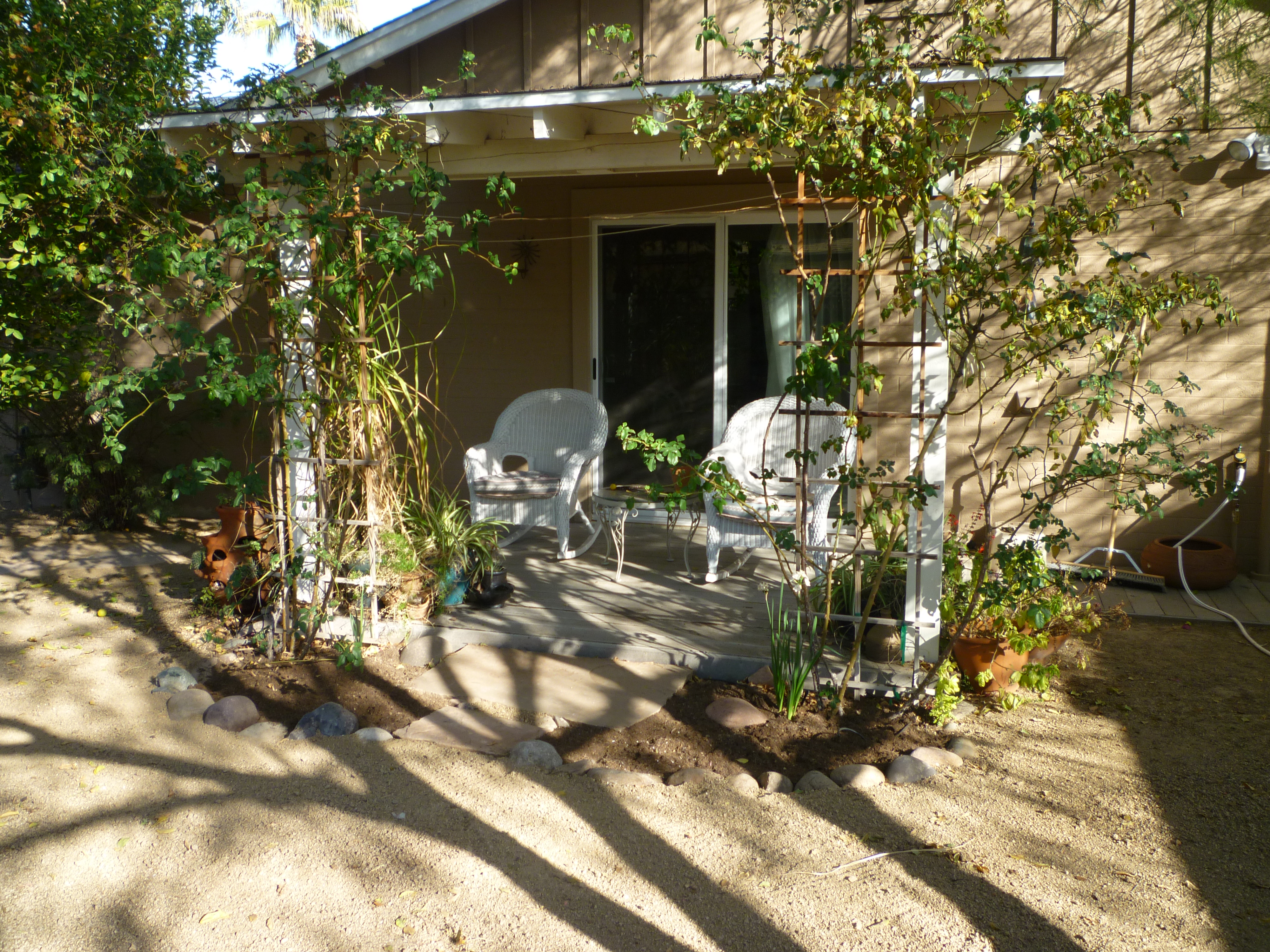
Dragged a piece of flagstone around from the backyard to add to the single stone Satan had placed there when he built the ersatz wood deck. This made the larger irrigation wells look like someone had planned them (heh!) and provided little spaces for some kewl bulbs. An Asiatic lily dubbed “Commander in Chief” occupies one corner. The other: dahlias. A lot of dahlias now reside in these flowerbeds. And lilies of the valley.

P1010952

It’s not huge, but it’s big enough to give some space to dig in rose fertilizer a few times a year, and it’s low enough to hold a fair amount of water. Those blossoms pictured at the top of this post are “Commander in Chief” lilies. We’ll see if they grow here in lovely uptown Phoenix.

And, soon enough, we’ll see if this scheme rescues the belovèd climbing roses.

Image at the top: “Commander in Chief” lily, shamelessly ripped off the Internet.


And so a new year begins…

Baby, it’s cold out there…

P1010934Click on the pix for a better view.

Nowhere near as cold as in other parts of the country, but crisp. For us, lows in the 30s are mighty chilly.

SDXB’s central air-conditioning/heating system crapped out: naturally, over the New Year’s holiday; naturally, on one of the coldest days of the year. It was 18 or 20 years old and needed to be replaced. Cost? Five thousand dollah.

Over here, I’ve spent the past three weeks working on a complicated and difficult project that turned into a much, much bigger job than planned. The thing finally went to press today, meaning there’s nothing more we can do on it.

It expanded to fill virtually all time available. The only days the client and I weren’t each spending eight, ten, or more hours on it were Christmas Eve and Christmas Day. So that delayed the much-anticipated “retirement” by quite a while…and it’s why I haven’t been posting much here.

So many things I want to do and need to do!

Yesterday I finally got around to starting on the windows. The front windows of this house haven’t been cleaned in years. Truly. Sounds like an exaggeration, but it’s not. I tend to put off jobs I dislike, and cleaning windows is one of my most disliked jobs. I’ve put it off…forever. 😀

However, when Gerardo was here, he got rid of one of my best excuses: he took out the sickly roses in front, which formed a conveniently vicious barrier to climbing up on the ladder and scrubbing the glass.

The roses seemed like a good idea when I put them in six or eight years ago. But I must say…I just can’t face another finger-stabbing, arm-scratching pruning session! In my old age, I’m just flat out of patience with unpleasant chores, and that’s one that also has expanded to fill all space available. Counting the climbing roses — which need some serious work this winter — the house had 11 rose plants until I took out the perennially peakèd numbers on the west side and replaced them with a succulent garden. That dropped the number to nine.

As the trees in front grew, they blocked the light to the roses in front, plus I just could not get enough water on those things. The drippers alone never sufficed. I built a trench to water them, which worked but required me to drag a hose out there several times a week in the summer…not a task I was likely to remember to do. And when I did put the hose on them, I’d often wander off and forget.

So I put a timer on the hose. A whole succession of timers, actually. Invariably, the damn things leak. I go off and forget — also invariably — and the thing drips for two days before I notice. No wonder the water bills are through the stratosphere! The city about doubled the rates to begin with, and then having the shut-off valve leak has resulted in water bills almost as high as the summer power bills.

Out with that.

Tomorrow afternoon the arborist is slated to come by and thin out the trees. Once he’s done tromping around out there and the worst of the cold snap passes — Saturday, probably — I’m going to plant a new garden with cacti and succulents slips from the plants around the yard, like these wild maroon Easter lily cacti…

easterlilies

And a bunch of plants I’ve picked up at Home Depot and Summerwinds over the past week:

P1010943Not that broad-leafed thing — it’s a potted plant that does fine outdoors in the summer but is wintering in the living room. Among the others, though, are a butterfly iris and a blue agapanthus, a lavender plant, a yellow rain lily, a kalanchoe, a little variegated sedum, a couple of hens-&-chicks, a mint plant, a-a-a-n-d-d…

P1010942 A pile of BULBS!!!

I love bulbs. They’re so mysterious…you never know when they’re going to pop up, and they look so strange.

Conveniently, these are labeled “early,” “mid,” and “late.” What exactly any of these translate to here in the Valley of the We-Do-Mean Sun remains to be seen — some paperwhites are thriving in the frost-ridden backyard as we scribble, as are a couple of amaryllis. But I expect when one isn’t blooming, another will be.

Dahlias grow well here. I’ve never tried to grow those purple things, clematis. Should be interesting to see what develops. Calla lilies grow nicely in shaded spots here, given some water — La Maya has a great pot full of them. The lily of the valley looks like it may live in that flowerbed pretty well, too. That red “commander in chief” lily is said to be bright red and to stay that way, and not to need vast quantities of water.

I bought a couple packages of sprinkler thingies for the irrigation system. They distribute a lot more water than the drippers; I figure four or five of them will probably eliminate the need to drag the hose out there next summer.

So that’s one project already under way.

Others remaining to do:

Finish cleaning the windows (the ones in back haven’t slid into quite such a desperate state).

Finish writing the e-book that’s 3/4 done; get it formatted and published.

Restart the CE Desk marketing plan that fell by the wayside while I was sick and stumbling through the last of the semester.

Prune the climbing roses.

Hoe the gravel away from the base of the climbing roses; cut out the ground cloth; build river-rock borders around the enlarged beds; dig compost and fertilizer into the ground; water well.

Ditto the tea roses in the back yard.

Dig (or persuade Gerardo to dig…) French wells in the two low spots where water floods onto the patio; line with screen; fill with rip-rap and top with river rock.

Dig (or persuade Gerardo to dig…) another French well in the far northwest corner of the yard, allowing me to backwash the pool legally, without risk of a $1200 fine.

Really clean the house from stem to stern; then…

Create a cleaning schedule allowing me to do one task per day, so that after this the place doesn’t go to hell on a handcart, and so that it doesn’t freaking kill me to clean it after it’s become uninhabitable.

Walk the dog at least once a day; preferably twice.

Hike the local hills three or four times a week.

Make more beaded necklaces.

Eat a lot better. Cook actual food, and consume more fruits and veggies.

And finally,

Figure out how to get a life.

New Little Garden!

So Gerardo, at my behest, pulled out the two struggling roses that have just barely stayed alive in the hot, deep shade that is the north side of the wall between the front and back yards on the westside of the house. For lo! these eight or ten years I’ve poured water and fertilizer on the things, to no avail. It’s just too broiling hot and too dark up against that wall for roses to thrive. In fact, it’s amazing they’ve even managed to hang on as the half-naked sticks that they were.

I conceived the idea of putting a little rock garden in there, mostly cobbled together with cuttings from plants around the yard or from $1.99 succulents from Home Depot.

From a large and fierce agave that graces the south side of said wall, I pulled off a pup and stuck it in a big pot:

(Click on the images for larger, higher-resolution versions.)

This flowerbed, such as it is, houses the valves for the watering system. Sooner or later, these will need maintenance and repair, and so, in a rare moment of clarity, it occurred to me that planting a large, sculptural agave with barbed, sword-sharp leaves next to the valve boxes might not be the brightest move in the history of gardening. In a pot, it’ll be (relatively) easy to move when the time comes to work on the irrigation system.

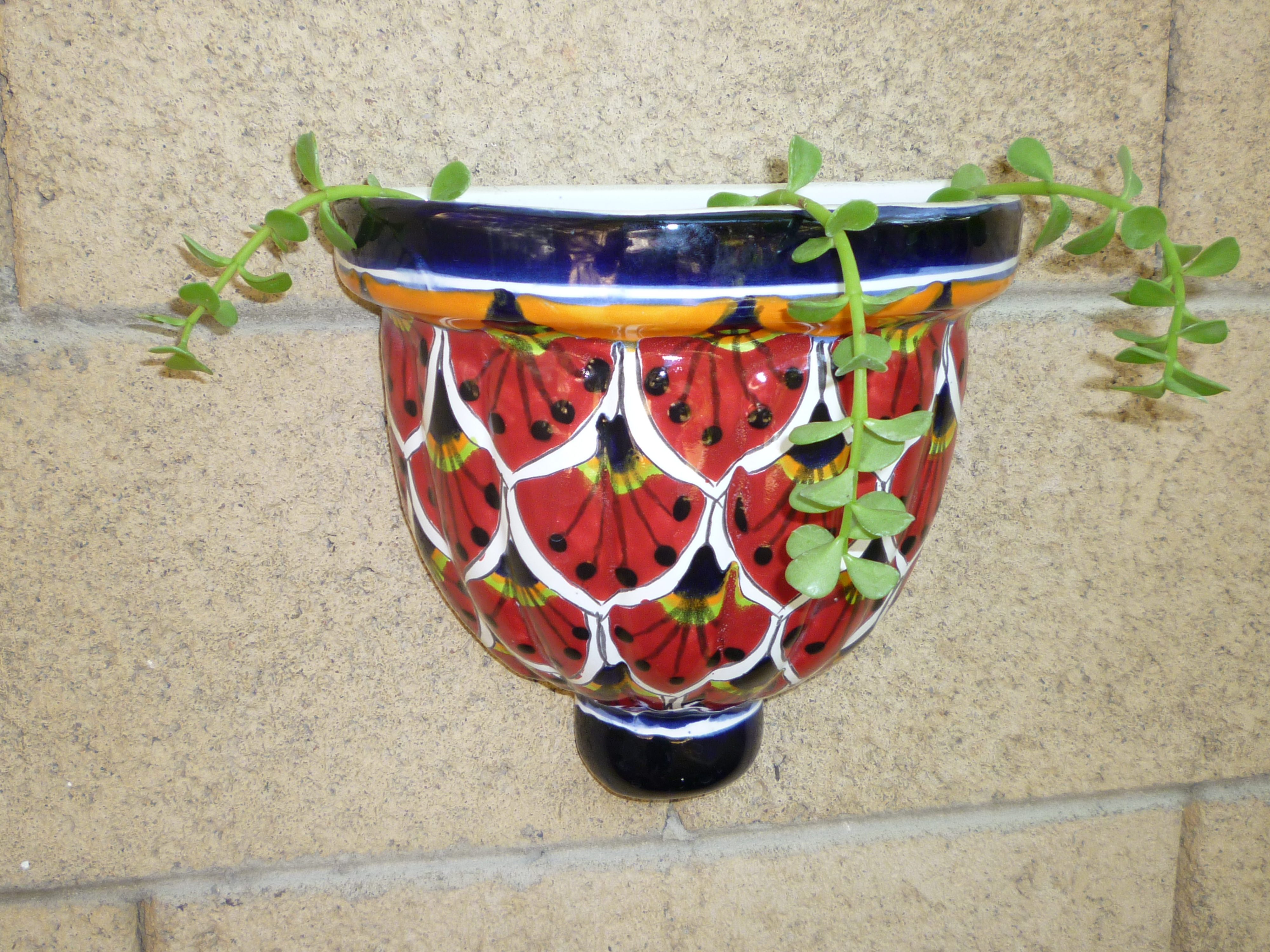
On the way home from the college, I stopped by a down-at-the-heels Mexican import shop, not visited since the time its erstwhile owner put up signs saying it was going out of business. Either someone bought it or the guy changed his mind, because it’s still there. And it still sells these pretty wall pots:

Those sprigs are cuttings of elephant’s-food plant, which grows in abundance around here. Eventually I hope it will look like this plant, growing in a pot nabbed from the same seedy store some years ago:

It’s growing on the east face of the west wall, mostly in the shade. I think the red pot’s cuttings will grow up to be rangier and leggier, because that corner by the front wall is really very dim.

The day’s extravagance was this sweet little Talavera-style sun face, spotted at an upscale local nursery where everything costs about three times what it’s worth:

Overpriced, without a doubt. But who could resist her?

The cactus in the Talavera frog was dragged around from the back yard, as was the stuff in the blue pot, which had become submerged in a sea of overgrown spider plants:

The blue pot has been colonized by a society garlic and a volunteer spider plant, which I may (or may not) pull out. The flat pots holding the hens-&-chicks and the baby cacti were laying around the potting shelves. The little cactus buds are from magenta and pink Easter lily cacti in the yard. Doubt if they’ll grow, because it may be too wet there, but nothing ventured… Can you believe coleus (those red things) will actually grow in Arizona? I doubt if they’ll last long, especially if we get a freeze this winter. But they’re kind of pretty for the nonce.

Here’s another old pot, this one stuffed with spider plant cuttings.

Three is probably overkill. But I’ve found that only about one in three baby spiders takes root and grows, so this is an attempt to get at least one of them to take ahold.

I stacked that pot into an old plant stand that’s been sitting empty in that corner for years—mysteriously not rusting. The plan is that once the spider plant(s) get growing, they’ll cascade down over the sides to add a dramatic touch to the garden. So, here we are in our nascent splendor:

The grassy-looking thing is an African iris or fortnight lily, which makes a pretty little flower now and again. It’s a bulb-like plant. Next to it is a real bulb, an amaryllis that I couldn’t resist grabbing out of a Home Depot bin. I kind of doubt that the African iris is gonna like it there—probably too shady. But one never knows. If it seems to hate it too much, I’ll try to transplant it.

Those metal spikes are there to support a length of nylon mesh cloth, thrown over the plants to protect the infant succulents from The Yanker, who loves to pull up the things. The plants are usually OK after they’ve established themselves, but until they get well set in the ground, The Yanker will yank them out.

The Yanker is a curved-bill thrasher. If you’re an insect, this orange-eyed little winged dinosaur is meaner than a junkyard dog. It’s a fine, insectivorous critter, about the size of a mockingbird and, I think, a distant relative.

Yankers are good to have around the yard, because they eat ants in vast quantities. Very good for holding the Armies of the Ant Queen at bay. I expect they pull up little succulents in search of bugs. Or…who knows? Maybe they just like to chew on juicy green leaves.

So, we shall see. It’s probably not the best time of year to plant a rock garden. But it may be no worse than any other season.

Image: Curve-billed thrasher. Peter Wallack. Creative Commons Attribution-Share Alike 3.0 Unported license.
 

Day at the Botanical Garden

The amazing Desert Botanical Garden, located in a small desert park on the south side of Scottsdale, is in full bloom at this time of year. Our friend KJG has a pass and invited me and mutual friend VickyC for a day in the garden. It is just gorgeous.

Check it out. I think if you click on these images, they should enlarge in all their glory. Click once on an image to isolate it from the gallery and then again for a larger, higher-resolution (ad-free!!) view. Then hit your browser’s back arrow twice to return to this page.