Coffee heat rising

Back in Hock Again

Added up the bills yesterday. That’s always a thrill a minute! The cost of pulling out the hated devil-pod tree, replacing it with four new plants, blocking off the dug-up muddy area with wire fencing so Charley can’t excavate everything, repairing the damage done to Harvey the Hayward Pool Cleaner by the tree’s last blast of gunky pollen, and while we were at it having Gerardo pull out a couple of ugglified superannuated plants in front and replacing those ran me over $600 into the hole.

🙁

Luckily, there’s some $1700 in the short-term emergency fund, so I’ll still have a thousand bucks to keep the car running or fix the plumbing or deal with whatever damnfool thing happens next.

Ran all these bills up on the AMEX credit card, which gives me a kickback once a year. A single big-ticket item can make that little bonus add up to $400 or $600, which is nice. Usually, though, I just think of it as ultimately cutting the cost of gasoline by a few percentage points. Doesn’t help at the gas pump, but when the money comes in, it goes right straight back into the survival fund, extending the time I can live on post-tax savings as long as possible.

Of course, the kickback come-on would avail you naught if you didn’t pay off your credit card every month. Obviously, having some lender give you two cents back for every five bucks you have to cough up in interest is, shall we say, not in your interest. However, if you’re in the habit of paying your bills every month, it’s an easy way to pick up some free money.

Other kinds of cards might work to your advantage if you always run a tab or are trying to pay down existing debt so you can get in the habit of paying in full—a zero percent card, for example, would be useful in either of those instances. Depending on your needs, it’s crucial to shop around for the best credit card deals. The last time I got peeved at Chase, I checked into a number of options for the S-corporation’s card before finally deciding that Costco’s AMEX card was the best choice for the business as well as for the personal card—interestingly, they’ll issue a corporate card in addition to a personal card, even if your personal card is associated with the so-called “business” membership.

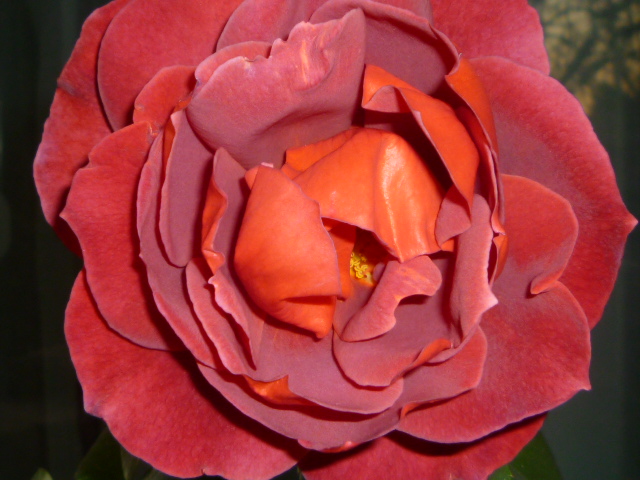
At any rate, the yard should start to look pretty good once it warms up. Amazingly, the big cocoa-red rose that guards my office window survived last summer’s unholy heat (only two others in front made it through). I decided not to prune it back this winter because it suffered so violently–give it a chance to rest. But some fertilizer and water produced this:
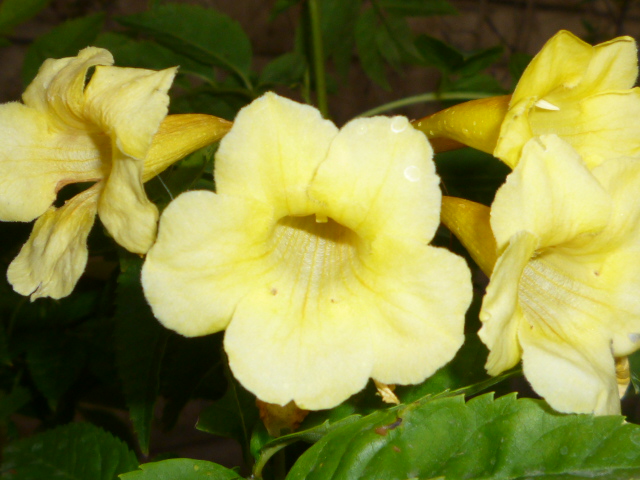
To help drive myself into bankruptcy, I hired Gerardo and his sidekick to hack out two overgrown and shabby-looking plants on the front patio, pull up a root from the deceased tree that once again was heaving the brick pavement in back, help me wrestle with pool equipment, and generally clean up the Funny Farm. They came trotting right over at my electronic beck, and the job was godawful, so as usual when he does a lot of extra work for me, I paid him a chunk of extra money. He replaced one of the uglies with a Texas yellowbell, which is already in bloom:
Charley decided an overgrown, invasive wad of bunch grass growing in the front courtyard made a nice mattress. He probably did find the highest and best use of that plant…but if it was tired-looking before, it was fully uglified by the time he rolled in it a few times. Running low on money, I asked Gerardo to try planting a yellow bird of paradise that had volunteered in a pot, where it’s never done well:
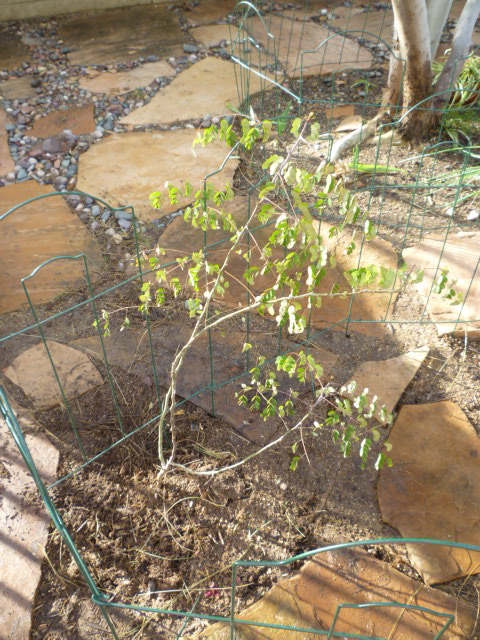
It looks pretty peakèd here, but it’s a hot-weather plant. If it survives, it should fill out when summer gets here. May even bloom. They have a spectacular flower, and they have the strange habit of tossing their seed pods into the air with a funny POP sound.

Come evening, Charley sits by the front door or out in the courtyard waiting for M’hijito to get off work and come pick him up. He stares at every passing car, in hopes that the next one will be His Human’s.

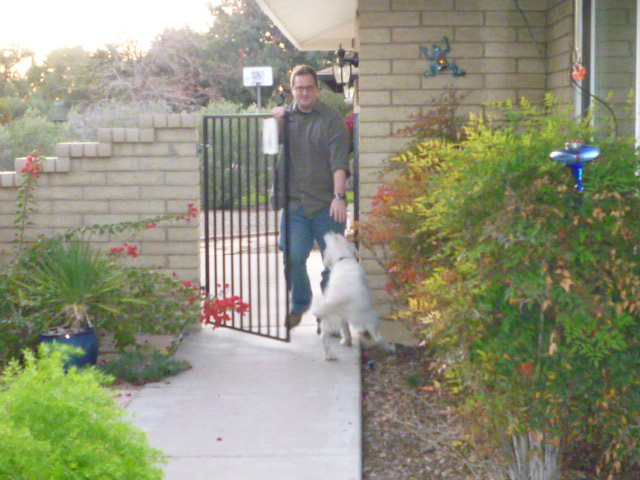
And when at last the Human gets here, we have an explosion of doggy joy…
Mare’s tails riding ahead of a storm system made for a gaudy sunset last night. A friend who lives about 35 miles from the Reno wildfire says they’re hoping for enough rain to douse the flames.

And so it goes.
 

I Don’t Wanna Know…

Today I’ve GOT to stuff the numbers into Quickbooks. That, as part of a day of general housecleaning. But really…I don’t want to know how desperate the dollar situation is.

$450 for the tree extermination and cleanup.
$150+ (when all is said and done, probably more like $225) for plants and gear to barricade the excavating puppy from digging up the proposed new shade screen
$158 for the water bill, the cost of refilling the pool whose water chemistry was again put out of whack by the devil-pod tree
$35 for a bag of dog food, moi having run out of patience with begging my son to keep me supplied with dog food for Charley

Ugh. During the winter, when utility bills are low, I can usually go about $300 over budget without breaking the bank. But this is ridiculous. Clearly, I’ll have to drain short-term emergency savings to cover half or more of those costs. What a bummer.

Oh well. At least I have some emergency savings. So can’t complain too much.

Ah, lovely. I’ve lost another earring. Ugh and ugh.

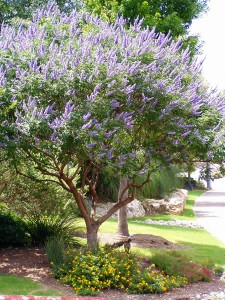
If pruned right, vitex can get to be a fair-sized tree

Returned the trellises I’d planned to use to block the view into the backyard while the vitex and hopseed bushes grow, retrieving about $50.

On reflection, I realized it would be a lot less hassle and expense simply to wear clothes while swimming next summer than to cobble together a jury-rigged privacy screen. Costco is selling light T-shirts in the underwear department. They’re apparently intended as underwear, but they come in bright colors—from a distance they’ll look like clothes. Two pairs of my jeans are fraying around the cuffs, so I can convert those into cut-offs.

Truly, I loathe squishing my body into a Spandex girdle so I can take a five-minute dip in my own backyard pool. At least with cut-offs and a cheap T-shirt, I won’t have to break my fingernails, cut off my respiration, and resort to cussing just to go swimming.

Charley is excited about the excavation possibilities in the area where I’ve dug up the soil—had not only to dig holes for four new plants but to dig trenches and run new irrigation  line, and while I was at it, trench and irrigate around the existing vitex, which I hope will flourish in the absence of the devil-pod tree. This required me to wet down the entire area, since the dirt here in Arizona has the consistency of cured concrete.

So now Charley not only has a nice patch of sticky mud in which to frolic, much of that mud is nicely tilled and ripe for some serious digging. For the nonce it’s barricaded off with old, decrepit trellises, yard furniture, and a big trash can laid on edge. That’s a mess, and so this afternoon while I’m out to meet the client, I’ll need to stop by a Home Depot and pick up some more wire fencing. The stuff works nicely to deflect the dog, but two more lengths of it will cost almost as much as the returned trellises.

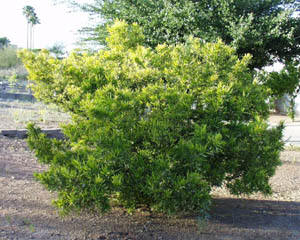
Hopseed: Unspectacular but useful

By the end of the summer, the hopseed bushes should be high enough to top the wall, and with any luck at all, the vitex will have filled out enough that by the summer of 2013 the combined jungle should restore my solitude. Except for the swarms of helicopters, of course…but as for those guys, they shouldn’t be peering into my yard, the SOBs, so if their eyes are put out when they see a hideous old lady paddling around, they deserve what they get.

While digging up the ground, I discovered why the vitex has been struggling. To soften the dirt, I ran the sprinkler on the area around the tree for about a half-hour. Let the water soak in…and discovered that only about two inches of soil was dampened. The ground all around the vitex is so dry the water just ran off. It hasn’t gotten city water in years. The little tree must have been getting by on rain, at least until this year, when we’ve had hardly any rain at all.

So I fed it, installed a couple of sprinkler heads near it and also on the feeble cat’s-claw vine whose failure to thrive I’d blamed on the devil-pod tree—like the vitex, it, too, was getting virtually no water. Reminded myself that I’ll need to drag the hose over there about once a month in winter and once a week in summer.

Must prepare an estimate for the client, clean up this pigpen, fix the pool chemistry, clean the pump pot, schlep Harvey to the repair shop,  and go buy enough gas to make it out to the Scottsdale meeting with said client.

And so, to work.

Images:

Vitex: Ripped off from PlantAnswers.com
Hopseed: Ripped off from Arizona Living Landscape and Design

The $600 Trade-Off

devil-pod-tree
The late devil-pod tree, towering over the house

{gronk!} Well, if it has to be a trade-off between shade and gunk in the pool, I’ll sacrifice the shade. And, to the tune of six Cs, that’s exactly what I just did: it cost almost $600 to get rid of the devil-pod tree and to score four plants and two 7½-foot trellises to fill in the vacant space.

To be fair, the guys also did a fair amount of trimming and thinning of the overgrown olive, palobrea, and vitex trees, too. They charged $465, when all was said and done, and then the bill from Home Depot was $111.

Well, I did pick up a few small things besides the garden stuff: a sanding block, a hose timer, some wire to tie the trellises to the wall.

Mike and Sidekick preparing to wrestle with the corpse

It took two men in climbing gear about three hours to pull down the monster. Really, I do feel bad about killing a tree, particularly a large shade tree. However, it’s nice to know I’ve hauled my last bushel of devil-pods and strap-like devil-pod leaves out of a ten-foot-deep pond of expensively chlorinated water.

The arboricide is a day late and a dollar short for Harvey the Hayward Pool Cleaner, though. The devil-pod tree killed him. One last massive blast of yellow polleny puffball stuff so clogged the pool’s system that the gunk broke apart both the pump pot basket and the skimmer basket. It also shattered the plastic filter on Harvey’s backside. He’s still staggering along, but not well. And that thing doesn’t look like a separate part: it appears to be one with his molded carapace. Tomorrow I’ll take him in to the Leslie’s guy but don’t have much hope of getting him fixed.

Cost for a new pool cleaner? $350, when it’s on sale.

So, that’s been one expensive goddamn devil-pod tree!

This operation left that corner of the yard pretty bare. The wall that borders the street, as you can see, is about five feet high on my side, but on the exterior, where people walk past on the sidewalk, it’s about six feet high (i.e., the grade inside the wall is a foot higher than the grade outside). The city forbids walls higher than six feet, a rule best honored in the flouting. However, because it’s right on the street and easy for prowling city employees to spot, I’m not willing to invite a citation and an order to tear down an added row of block. And as you may be able to tell, the neighbor across the street can see right into my backyard.

But I have a plan. The city does nothing to prevent you from growing tall shrubbery where it prohibits tall walls, and so the view-blocking tree needs only to be replaced by view-blocking shrubs. Preferably xeric, low-litter, cold-hardy shrubs.

As it develops the green hopseed bush fits that description handsomely. It does make some papery seed pods, but they don’t look any more menacing that bougainvillea blossoms, which do litter the pool but which the cleaning system handles easily. These things get to be 12 to 15 feet high and are said to grow fast. So within a year or so, the foliage privacy screen should be back, only this time with a fraction of the pool litter.

I bought three of them (maybe one too many…), and then to brighten up the corner, a Texas yellowbell, which also gets to be a good-sized plant and is very pretty. These freeze back in the winter here, and so it probably won’t get out of hand unless we go several years without a hard freeze.

That naked shrub on the left in the backyard snapshot above is a vitex. It’s deciduous. In the summer it develops pretty blue flowers, which will contrast nicely with the yellowbells, which seem to bloom all the time. The yellowbell is going in front of the tree stump, which I couldn’t afford to have taken out. Soon enough it should hide that thing.

The vitex was quite a handsome specimen tree when I had it planted at the time I moved in here. However, over the past five years or so, the devil-pod tree, which grows as fast as a eucalyptus, has shaded it so much it quit growing and became all distorted. Mike (arborist) thinks it will recover now that it can get some light.

The one in the front yard has grown into a full-sized tree, and so presumably when this stunted one in back takes ahold, it will provide some nice shade to the pool and help to block the view in back. Although it does drop its leaves in winter, they’re small enough not to clog Harvey (or his descendant…) but large enough to be caught by the skimmer and pump pot filters.

And speaking of blocking the view of passers-by and nosy neighbors, that’s what the 14 feet of trellises are for. I’m going to wire them horizontally to the top row of decorative blocks and staple shade cloth to them. They can come down after the plants get big enough to do their job, but until then, they should protect my privacy a little.

First thing Charley did after the men left was attempt to excavate the tree stump. My god that animal can dig! And he’s fast, very very fast.

Couldn’t get very annoyed with him, though, because he unearthed a long-lost irrigation hose. I thought there was a dripper somewhere near that tree, but it’s been hidden under the debris for years. This is good. Very, very good.

It’ll make it easy for me to run water to all four new plants and to rejigger the water for the vitex. So I won’t have to worry too much about forgetting to water all this new foliage, which you can bet I will do.

Tomorrow’s project: pull this thing apart, connect it to lengths of hosing, and attach a half-dozen emitters. Then dig holes and plant shrubs!

Exeunt the Devil-Pod Tree, Pursued by a Chain-Saw

devil-pod-treeOne of the Funny Farm’s sources of eternal labor is the Devil-Pod Tree, a vast weeping acacia planted in the backyard, just upwind of the swimming pool, by the previous owners Satan and Proserpine. This unholy plant, now a couple of years older than it was in the photo to the right, towers three times as high as the roof.

And it sheds stuff. It sheds stuff All. The. Time. All year round, I haul bushels of crud from that tree out of the pool.

In the winter, it makes fuzzballs, wads of pollen that cover the earth and clog the pool’s filters. In spring and fall, it drops long, strappy leaves that choke Harvey the Hayward Pool Cleaner and clog the pool’s filters. And all summer long, it produces devil pods, beans that stain the plaster, bring Harvey to a dead stop, and clog the pool’s filters.

And I finally figured out why the pool water is as acid as pickling solution, when I never add a drop of muriatic to it: Acacia trees poison the soil around them by dropping highly acetic debris on the ground, thereby discouraging competition from neighboring plants. So much crud from that damn tree drops in the pool that not only do I have to dump in PhosFree by the gallon, it turns the water to vinegar.

This week I had just replaced the pump pot basket that split in four pieces from the weight and pressure of being clogged by Devil-Pod pollen, had just drained the acid water out and refilled the pool with 18,000 gallons of treated city water, when another rainstorm came in. Not much wind: just rain, mostly fairly gentle.

So much of that pollen crud floated into the drink that once again both the pump pot basket and the skimmer basket were packed so tight the pump could barely push water through them. A great mound of pollen accrued in a pollen dune on the bottom of the pool. Before I could shock-treat and condition the new water, I had to get all the crud out. Again.

Last night the skimmer basket was perfectly clean. By the time the arborist—ah, yes, the arborist!—showed up along about 3:00 p.m., it was more than half full of packed-down pollen. Again.

To frost the cookies, the tree is right next to the house. Like other acacias, it has a reputation for dropping large branches onto (and through) roofs. What with the now-unmistakable climate change, the winds get fiercer here every summer. Matter of fact, as I write this, a stiff breeze is blowing. I’d just as soon be rid of the tree before it lands in my bedroom.

What has given me pause about taking that tree down—other than the slight amount of shade it casts on the northeast corner of the house and my general reluctance to kill plants, especially trees—is the potential cost. Neighbors around here have had house-dwarfing trees removed, to the tune of around a thousand dollars.

Well, I finally figured a thousand bucks is less than it would cost me to move and less than it would cost to fill in the pool and relandscape the backyard. So I’d called Mike of South Mountain Landscaping, a premier arborist, to discuss the tree’s demise.

It is, he says, not a tree he recommends to his clients. Too bad he wasn’t here to restrain Satan and Proserpine from shopping at Moon Valley Nursery, where the staff specialize in high-pressuring people into buying “packages” of “bargain” trees that are totally inappropriate for their yards.

He offered to take the damn thing out for $350.

I couldn’t believe it! So, that is a job that is SOLD! For another $150, he’ll trim up the people-eating palo brea in front, untangle the jungle formed by ongoing battle among the palo brea, the olive tree, and the vitex, and do a little other light cleanup.

For privacy, he suggested orange jubilee. Those things are, however, pretty frost-sensitive around here. My inclination is to go for something like a Lady Banks on the outside of the east wall and maybe a Mexican bird of paradise on the inside. Lady Banks will hold up against the cold weather and gets huge enough to block the view of idle passers-by, while Mexican birds are very pretty and call hummingbirds. There might even be room in that space for a little creosote bush, which emits a lovely scent every time it rains.

Three hundred and fifty dollah! What a bargain…that’s going to be a large, difficult job.

Condo Gardening

Yesterday’s Declaration of Independence from Vegetable Gardening elicited some interesting responses from readers who have come to suspect the gardening bug is a disease, not an inspiration.  Two commenters, Carol and SherryH, describe their responses to the challenges of trying to maintain ornamental or vegetable container gardens in apartment-house conditions.

Boy, can I sympathize with their adventures! I also used to lug water out to a balcony (heh…once the downstairs neighbor was out there when I accidentally dumped too much on a big pot—the water overflowed and spilled off the balcony onto her noggin!).  The same issue—lugging heavy, sloppy containers of water—arises when you decide nothing will do but you must decorate your home with a forest of ficus, potted palms, pothos, creeping Charley, begonias, purple plants, spider plants, and Christmas cactus, with a few orchids thrown in for good measure.

Contemplating Carol’s strategy (get rid of the darned plants once and for all) and Sherry’s decision (keep gardening, but the stuff all has to be edible) reminded me of indoor garden hoses I used to see advertised occasionally when stacks of catalogues would arrive in the mail. The idea is that you’ll attach the hose to your kitchen or bathroom sink faucet and then all you have to drag is a hose with a shut-off sprinkler on the end. Did a little search, and lo! They still exist, and Amazon carries them! By golly, just look at that happy plant lover in the picture.

Some of the reviewers seem less than euphoric, though. As it develops, to make this gadget work you need to get an adapter. Claber makes a connector for indoor hoses, but apparently you need to be sure it actually will fit one of the fixtures in your house. Read the reviews by way of figuring that out. 

There’s also an indoor plant watering kit, which seems to be better received by reviewers. It has one of those coil hoses, allegedly forty feet long, and it includes a sprinkling wand.

If wrestling a hose on and off your kitchen faucet looks like more trouble than it’s worth, Claber makes a gadget that pumps water from a reservoir through a drip system for plants. It doesn’t obviate the problem of having to haul water, but at least it might cut down the number of watering expeditions to once every week or two.
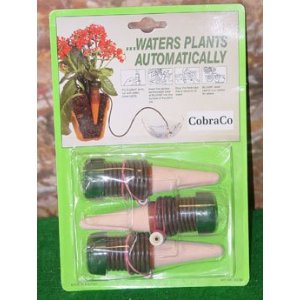

Then there’s this doo-dad: the Plant Sitter automatic watering sensor. Looks like you attach it to a bottle of water and let it osmose (is there such a word?) into the plants for a week or so at a time. If you got some of the kind of decorative plastic bottles that come from overpriced water vendors and if your plants were pretty bushy so they’d hide the plasticware, these could reduce the hauling quotient, too. Note one reviewer says that to make it work properly you not only have to fill the cone thingie with water, you also have to prime the hose by filling it with water, too. Hmmm…this thing looks pretty interesting. Around here, it sure could save a lot on water bills in the summer, if it works. 

I’ve tried these water globe things. They’re pretty, but they don’t work well, because they either dump all their water in one swell foop or the potting soil plugs them up. Ninety-one people have had better luck than I, so I must be doing something wrong. Evidently before you insert it in the soil, you have to have watered the plant well (kind of counterproductive, no?); this will prevent the thing from emptying immediately. Also it occurs to me that you could simply rubber-band or tie a little gauze or fine mesh over the nozzle end to prevent chunks of potting soil from plugging it. Even then, though, some reviewers found them problematic.
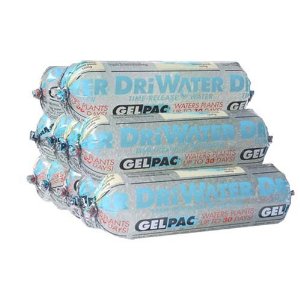
And finally, here’s another ingenious approach that could be useful: gel-packs that leach water into the plant’s soil.  This lash-up is supposed to last 30 days. In view of the one very powerfully negative review among a fistful of raves, I’d be sure to test this a long time before going on vacation—remembering that product reviews are now liberally laced with comments from paid shills. These days I take ecstatic exclamations of joy about a product with a large tablespoonful of salt. Could be worth trying, though.
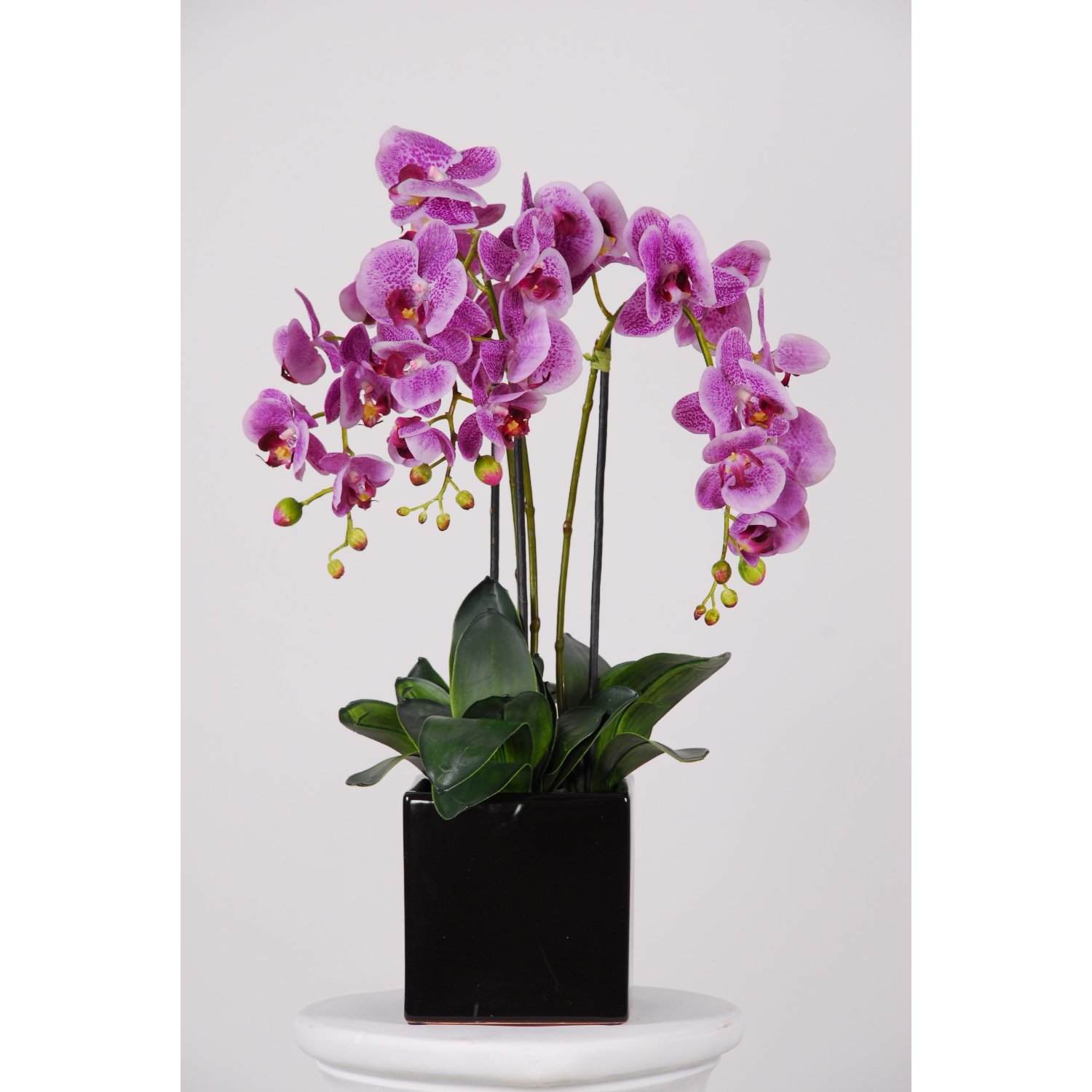
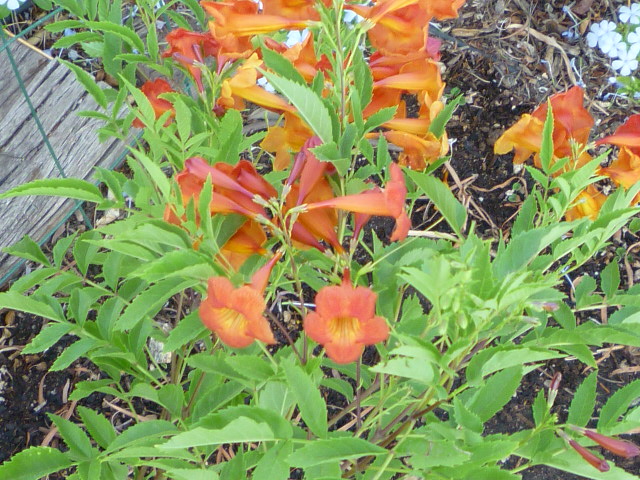
Welp, it’s pretty clear from all these better mousetraps that we’re not alone in suspecting that under certain conditions gardening is more trouble than it’s worth. As for indoor gardening, I have a better plan: silk flowers!

Fall has sprung! Time to garden

Even though temps are still in the low 100s and the pool is still swimmable, it looks like the worst of the heat is over. In Arizona’s low desert, this means spring is here. Again.

Yay! At last plants will start to grow again!

We had the hottest, driest August on record, and several days in July were pretty extreme—in the 118-degree range. Despite my having set the watering system to come on every day, about half the ornamentals died. The cape honeysuckle, first whacked by last winter’s 21-degree nights and then fricasseed in the withering heat, is pretty well done in. I think I’ll have the last four of those dug out this winter. The roses, which usually make it through the summer peakèd but alive, look like they’re at their last gasp. At least two of those will have to go, maybe more. The Lady Banks rose I planted last spring to help hide the pool equipment enclosure did OK—it looks a little tired, but it’s very heat-resistant. Of course, the fact that I covered it up with shade cloth may have had something to do with that. All the little companion plants that went in next to it and formed a pretty pocket garden there burned right up.

This year I’ve decided not to put in a vegetable garden. Most veggies just don’t grow very well out there. The only decent flower bed is bordered by an old creosote-soaked railroad tie, and I suspect it’s probably not healthy to eat food grown in soil where creosote has been leaching. Besides, the nearby lemon tree is now large enough that it casts enough shade to make about half that flowerbed too dark for most veggies.

And further besides, I find I don’t eat them. The only veggies that have truly grown well out there have been chard and lettuce. The chard goes berserk. But how much of the stuff can one person eat? Last spring I reached the point where I just could not look at another plateful of chard. Had to have something else!

Otherwise, edible things grow poorly out there. Tomatoes are pathetic, the carrots and beets puny, the bok choy sad… Toward the end of the season I wondered why on earth I’d put so much work and money into a garden when for the cost I could have filled the fridge with a wide variety of organic vegetables and fruit. If I’d bought the stuff at Whole Paycheck I still wouldn’t have spent as much as I did on the feckless vegetable garden.

So this year the only edibles will be herbs, grown in pots. That poolside flowerbed is gonna be filled with flowers, lots and lots of flowers.

Dropped by Baker’s last week, since it was on the way home from the client’s. There I grabbed a Tecoma x Bells of Fire, which is basically a small (I’m told) variant of Texas yellowbell with bright orange flowers. The excruciatingly frost-sensitive cape honeysuckle is also in the tecoma family, but I do know Texas yellowbells are pretty cold-hardy. I’ve never had one freeze back like the cape honeysuckle does. Every. single. winter.

So I put that into the ground near the blue plumbago, which just now is covered in sky-blue blossoms.

As for the rest of it: seeds. I’ve had it with investing dollars and backaches in plant sets. I just cleaned up the flowerbeds, mixed seed in with some potting soil to scatter the things (more or less in groups) and then mulched the top with a bunch more potting soil, which I’d got on sale at HD.

So, down in the shady area near the porch roof and the Meyer lemon, we’ll have a patch of yellow columbine and some blue penstemon. That’s assuming the seeds germinate.

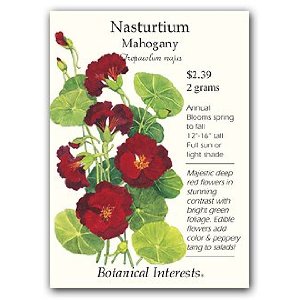
Then some mixed pansies, with a band of cute little violas in front of them. Then a packet or two of Mexican primrose, which eventually will spread to fill that flowerbed, which crowds out bermudagrass, and which when happy makes a spectacular, endlessly long-lasting spread of blooms. For the continuing nonce, though, we’ll also have a few carnations and some deep red nasturtiums.

Nasturtiums, it develops, are edible. They’re apparently frost-sensitive, so I expect they won’t make it much past mid-December. But a packet only costs a buck, so it’s worth a try.

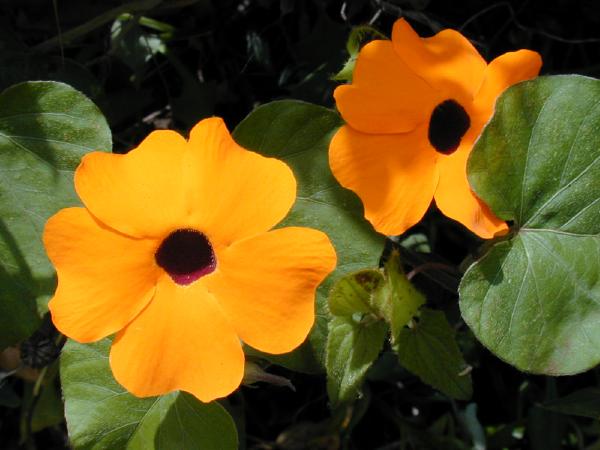
I found seeds for something called a black-eyed Susan vine. It’s apparently a vigorous tropical weed that, from the sound of it, can grow as berserk as cat’s claw. Before I looked it up and learned just how aggressive it can be, I’d already put the seeds in the ground where the Lady Banks is not covering the pool equipment enclosure well, thinking it would complement Lady Banks’s pale cream-colored blossoms nicely. Well…it may try to eat Lady Banks… We shall see.

At any rate, it could be a nice replacement for the cape honeysuckle I intend to have Gerardo dig up. The four struggling plants there soften the severity of the ugly block wall between my yard and my neighbor’s.

And so, to work.

Images

The Sun, Lykaestria, Wikipedia Commons

Black-eyed Susan vine, Thunbergia alata. Jeffdelonge. Creative Commons Attribution 3.0 Unported license.