Coffee heat rising

Auughhh, Part II: Gaaaaaaaaahhh!

This morning after I got home from class, I called Mr. L., the Plumber par Excellence, and he met me casa M’hijito, where of late a geyser was said to have erupted in the laundry room.

He decided pretty quick that the problem was a clog in the drain line. However, he had a time figuring out exactly how the lines were configured because of where the leak seemed to be coming from. He called his sidekick, who appeared in due course, parking a second large plumber’s truck in front of the house.

Studying the situation, they think the drain drops straight down from where you can see the fixtures into the ground, where it courses under the foundation, under the patio slab, and eventually connects with the line to the sewer. The reason the water is pouring out from under the workroom’s west wall is that the workroom floor is designed so water will drain down toward the door, should a washer overflow. So the water bubbling up from the clog is simply seeping toward the west wall, building up there, and then surging out from under the plaster.

The reason it’s doing that, they believe, is that there’s a small crack along a pipe seam. When there’s no clog, the water flows so fast through the pipe that little or no water leaks from it, and what does drip out simply soaks down into the soil beneath the slab.

“Uhmmmm…. Won’t this eventually lift the slab?”

“No,” says Mr. L. “It’s OK for a little water to seep under a slab.” In fact, he says, the way the house’s shower is built, with dirt directly under the pan, is ideal, because if the shower pan leaks it will do no harm. The problem was, the clog was pretty solid and so water was backing up and actually coming UP in an exuberant way. A washerful of water has a lot of force as it’s backwashing upward. And so on.

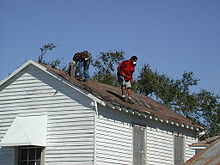
So the men get up onto the roof and run a rotorooter line through the standpipe, planning to ream out the pipe all the way to the connection with the sewer line. They’ve determined that the water from the kitchen and  bathrooms is getting through to the drainout line just fine.

They run this thing and run it and run it and run it and run it and run it and it is hotter than goddamned HELL and after about a half-hour or forty minutes of this torment both men are drenched and literally dripping with sweat. They persist, continuing to run the thing until finally they break through and then they haul many, many yards of metal cable back up out of the plumbing.

That’s when the sidekick appears in the house with a report on what they found. Hang onto your hat:  Mr. L. hauled a dead rat up out of the drainpipe!

Summbiche.

He said that was a first for him. He looked a little green around the gills, because apparently the vic’ had been there for a few days. He said the little guy was not only disintegrating, he had created enough of a plug that with the grease and lint that flowed in after him, the mess had completely plugged the drainpipe.

Oookayyyy… So, how do we think Ratty got into the drain?

He said the standpipe on the roof has another pipe that connects to it at a right angle, high enough that a good-sized critter, which this one was, could reach up and wiggle its way into the top of the pipe. Probably the rat was searching for water, the scent of which it could smell around the standpipe. By way of seeking water, the little fellow probably lost his footing and fell down in there.

But Mr. L said he was very concerned about the possibility of rats getting into the attic. He asked if M’hijito has heard any scuttling around in the attic or walls at night. He says they’ll wreak real havoc if they get inside the attic, and they must be kept out of there at all costs. Once they get into an attic, they chew up the electric wiring, and that’s a very expensive fix.

They can’t get into the attic through the standpipe and vents, because those don’t open inside the attic. But all openings around the attic larger than the size of a nickel have gotta be closed tight. Also, he urged that we get the trees trimmed a good long way from the house, because this particular variety of Rattus is pretty acrobatic and can jump several feet.

After all that work and a very unpleasant development to deal with, Mr. L. only charged $120. He was there more than two hours—closer to three, come to think of it.

Gerardo, who promised to come remove the sheared-off paloverde tree, was in mañana mode today, a not unusual development with him. As his excuse, he trotted out the grand old classic, “My Truck Broke Down.” With that truck, it’s possible. Since it behooves us for one of us (i.e., the one who’s not working 9 to 6) to keep an eye on Gerardo’s ministrations, that will eat up all of tomorrow afternoon!

Meanwhile, we have three practical pieces of plumbing-maintenance advice from the redoubtable Mr. L:

1. Continue trying to keep washer lint out of the drain. At both houses, the washer hose drains into a utility sink. We each attach those nylon mesh bags that lemons and other veggies are sold in, using wire bag ties to secure them tightly to the end of the hose. Mr. L. thought that was a great idea, as long as they’re changed out frequently. Don’t, however, try this if you hook your washer hose directly into the drain standpipe.

2. Do everything you possibly can to keep grease of any kind out of the kitchen drain. He says it was a combination of lint and grease that built up against the Deceased to create an almost impenetrable clog. He says NOTHING should go down that drain that has any grease in it, and he remarked that even spaghetti sauce is toxic to drains. Take a few paper towels and wipe out a pan before washing it in the sink.

3. Once a week, fill both sinks with water. Cold water is as good as hot. Fill them to the top and then open both drains at once. This will push water down through the pipes with a fair amount of force, and that will help to clear whatever has collected in the drain over the week.

To the latter, I will add a bit of huswifery that I learned during my youth in the Cretaceous: Before you fill the sinks, run hot water down the drains. Then pour a cup of ammonia in there, and plug the drain tight. This strategy melts and loosens the grease down in there, without doing the kind of damage that a chemical like Drano commits. Let the ammonia sit in there for at least a half hour or an hour—or, preferably, overnight. THEN fill both sinks with water and blast the drains with that.

When last seen,
the plumbers were discussing what they would have to drink at Happy Hour…

Pool! When spending a little extra makes a big difference

I didn’t wanna do it. Resisted until resistance was futile. But last winter the pool guys’ pleas won out, and I finally got around to draining and refilling the pool.

Two hundred bucks, plus the cost of 18,000 gallons of water.

The pool-draining pitch has always struck me as another way for the pool company to lighten the pool owner’s wallet. Pool guys will tell you that you should drain the pool about once every two or three years. Right. My ex- and I lived in the gigantic house off Central Avenue for ten years and never drained the pool, with no noticeable ill effect.

Old-timers at this space know I expend a great deal of energy bellyaching about taking care of the pool. I’ve even gone so far as to consider converting it into a trout pond. Each summer the work entailed in keeping the thing clean and beating back the ravening hordes of algae has grown more baroque and expensive, culminating last summer, when the pH fell into the sulfuric range, with the Great Soda Ash Frolic. With the chemical balance no longer maintainable, it was clear that when the weather cooled enough that draining wouldn’t crack the plaster, I was gunna have to change out the water.

Well. Despite all the grousing, the result is that this summer the pool has hardly required any maintenance work at all!

No gallons of acid or pounds of soda ash
No visits from the Leslie’s dude to disassemble and clean out the filter
No scrubbing or spraying down the walls and steps
No razor-blading the white gunk off the tiles

It’s all been pretty much nothing but enjoying the water.

devil-pod-tree

Now, it must be said that we haven’t had many monsoon storms. Those that we’ve seen came in from the north or the west, blowing the leaves and plaster-staining pods from Satan’s accursed devil-pod tree away from the pool, instead of dumping the trash directly into the pool. So I’ve only had to clean that mess out a couple of times this summer. The stress level has been helped by not having the job that required me to race through the clean-up at dawn so as to get dressed and plunge into the homicidal rush-hour traffic between here and the office.

The savings in chemicals and service calls have more than made up for the cost of draining and refilling the pool. One trip charge from Leslie’s is about $100. Muriatic acid is cheap, but chlorine decidedly is not. This spring I bought a giant bucket of Costco swimming pool tablets, which also costs $100, and I’ve only gone through about half of them. Last year they were gone before the summer ended. One shock treatment has lasted two or three weeks, so I haven’t been buying bags of shock treatment every time I turn around. Clearly, too, keeping the pool water chemically balanced will delay the need for replastering, an $8,000 job.

It’s totally changed my life and my attitude toward the pool. It’s been a pleasure to have instead of a daily burden. After this, I plan to change out the water every second winter, come Hell or high water. Really, if I were up for the hassle, I’d probably do it every year. Probably if you refilled every year, you’d never have to replaster.

Believe it or not, in spite of the continuing 110-degree days, the pool is beginning to cool down. The nights are longer and a little cooler. We’ve had  some rain and cloudy days that cut the number of hours the sun bakes the water. So the water again is refreshing—even a little cool for an early-morning or late-evening plunge. I love it!

Crickets and Bug Spray, Oh My!

Spent half the morning paying some more dumb tax. 🙄 Last night not one but two amorous gentleman crickets took up residence in the family room, where they filled the night air with serenades to every lady cricket within miles. At night, when it’s quiet and still, these elegant little bugs sound less cheery than they do in the daytime and more, well…like they’re screaming.

Even with the bedroom door shut, way down at the other end of the house, their shrill fiddling kept me awake. Wide awake.

Interestingly, they can sense you approaching, even if you sneak up on them quiet as a stalking cat. As soon as you get close enough to maybe spot where they’re hiding, they clam up. So I couldn’t find them…were they in the fireplace? in the cracks around the Arcadia door? in the plant pots? They were impossible to find.

Finally I gave up, tromped out to the garage, and grabbed a can of bug spray.

I hate bug spray. I hate the stink of the stuff, hate the way it makes my stomach upset, hate having it anywhere near the dog, hate using it near the bug-eating geckos around the yard, and especially hate using it inside the house. But the hour was growing later and later, I wasn’t getting any sleep, and I couldn’t see any other way to shut the critters up. So I tried to restrain  myself, spraying it only where I thought they probably were ensconced.

Even a little of a bad thing is too much of a bad thing. What a stench!

The dog and I raced to the bedroom and slammed the door, hoping to keep the fumes out. This worked marginally. We were trapped, but at least we weren’t gagging in there. And the noise quieted down enough for me to get to sleep.

Come this morning, though…ugh! The front part of the house still stank to high heaven.

So, by dawn’s early light I was throwing open all the windows and doors, turning the fans to “tornado,” and scrubbing the floor on hands and knees. Scrubbed the floor twice with Simple Green and vinegar but still didn’t get all the stinky stuff up.

The smell still lingers, to some degree. It’ll be a day or two, I suppose, before it’s no longer noticeable to the human schnozz. Who knows how long a dog can smell it?

So annoying. I wish there was a better way to do in a noisy cricket. If you can’t catch it, swat it, or vacuum it, you’re kinda stuck with applying noxious chemicals.

One site I found said diatomaceous earth will kill the little guys. The pool filter uses that stuff. I’m less than thrilled about getting it around the dog—it’s irritating to the nose and dangerous if you breathe it into your lungs. And it’s really messy…sprinkling it around the house seems kinda counterproductive.

Here’s some folksy-sounding advice: pour a little pile of cornmeal in the middle of a glue board, the type you use to catch mice and rats. Comes from the University of Nebraska, so who am I to argue? Still, it takes a couple of days. What does one do for sleep while waiting for the cricket to stroll onto the glue board?

For that matter, Rattie wasn’t fooled by glue boards. Is there a reason to expect a cricket is any less wiley than a roof rat?

Anybody got any better ideas?

Image: Gryllus assimilis (common black cricket), from Robert E. Snodgrass,
Insects: Their Ways and Means of Living. New York: Smithsonian Institution, 1930. Public domain.

Hotter Than a Two-Dollar Cookstove!

Thank heaven the air conditioning guy showed up today—and by midmorning. By midafternoon the thermometer in the shade of the back porch read 115 degrees.

The unit has been laboring almost nonstop, all day long, just to keep the house at 85 degrees.

When I consider how my cash is spent…

The guy charged me $275 to replace a part that may or may not have been shot. I have no way of knowing, of course, what was wrong. He could have sold me a new air-conditioner if he’d felt so inclined…I wouldn’t have known any better.

Matter of fact, he did try to sell me a new air conditioner.

The owner of my longtime air-conditioning company, which over the past couple of years has been stumbling badly through the depression, finally sold out to someone else. He’s still around; whether as a part-owner or as an employee is unclear. But the new outfit? Not good.

First thing that happened was just a day or so ago I got a phone solicitation from someone who pretended to be “with” the company (i.e., “they hired me here in the boiler room and gave me this script”). He tried to high-pressure me into renewing the annual service contract, which I had long ago decided not to renew, because it’s such a waste of money. All it does is pay for two service calls up front, one in the spring and one in the fall, to inspect the equipment. It gives you no leg up on service when your unit craps out and no discount on products or service during the effective period.

Because he presented himself as someone who worked for Jim and Carol (owners), I wasn’t scorchingly rude to him as I would be to someone I perceived to be a phone solicitor. But I should’ve been. It took three repetitions of the fact that I’m unemployed and can’t afford to pay for a service contract before I got him off the phone!

Now today comes this new service guy—not the usual guy. Very slick sort of a fellow, not the amiably disheveled type that is our usual AC repairman.

I’d run out to Ace to pick up a nonprogrammable thermostat before he showed up. When I told him I’d learned the Braeburn unit that had been installed wasn’t meant to operate a heat pump, he demanded to know who told me that! A bit taken aback, I said I’m a big girl and can use the Internet. I looked up the unit and the model number and learned that it’s incompatible with heat pumps, which probably explains why my power bill went through the roof the instant it was installed.

He then tried to convince me that the immediate jump in the power bill had nothing to do with the incompatible thermostat but that my unit is out of date and needs to be replaced.

I said I’m unemployed and can barely afford to have him come in and fix the thing, much less pony up $5,000 for a new one!

He then tried to persuade me two more times that I should buy a new air conditioner. When I told him rather strenuously that i. don’t. have. the. money to buy a new HVAC unit, he suggested that I should take out a loan.

Then he pitched me for a service contract. He gave me the usual slippery hustle: if I had a service contract I could get the expensive new part for a discount. The contract would only be $150….

“Look,” said I, “How much will it be to buy a contract and install the part?”

“Three hundred and fifty dollars,” said he.

“Good. And how much would it cost just to install the part, without the service contract?”

“Two hundred and seventy-five dollars.”

“There you have it! Just install the part, please.”

So he won’t be coming back.

I should’ve called Sally’s guy a month or more ago, but just haven’t gotten around to it. He services both parts of the heating/cooling unit in one $65 trip in the spring (the way these guys justify $150 is by claiming they have to come inspect the AC in the springtime before you start it up and then heater in the fall before you start using that, which is clear and present ridiculousness).

Anyway, the nonprogrammable thermostat is a little easier to use than the programmable model. At least I don’t have to dig out the encyclopedic instructions and study them for 15 minutes every time I want to change the settings. It has one of those “save” buttons that causes it to reset the temp 5 degrees higher (in summer; 5 degrees lower in winter) until you tap it again to turn it off. This means that if the temp is set at a sleepable 79 degrees (about as warm as I can stand a cooped-up house and still sleep at night), when I get up in the morning I can press one button to move the temperature up to 84 degrees. That’s a degree off my normal setting, but one degree, I expect, will not make enough difference to bankrupt me.

Any more than I’m already going to be bankrupted. Literally, the unit has run all day long, barely stopping more than five or ten minutes at any time. It’s almost 9:00 p.m. and the thing is roaring away. It’s still 99 degrees outdoors.

And a good thing it is that I just went out there to look at the thermometer. For some reason the timer on the hose didn’t kick off, and the tap was still gushing into the pool!

Luckily, the water level was pretty far down, so after two hours of the hose running full-bore, it’s still an inch or two below the coping.

It needs to be backwashed, because of all the gunk the damn palm trees dropped in there. Tomorrow morning. Really. That will pull the water level back down to where it was and I’ll have to refill it again tomorrow.

Cripes. I’ll be lucky if the water bill is only $225. And the power bill a mere $300.

Endless Costs of Homeownership: Palm Trees

Palm-tree-trimmer

Well, it’s past time to have the hideous Mexican fan palms cut back. In the late spring and early summer, these towering poles sprout long, husky rods packed with billions of brittle, sharp, pointy little flowers. These they shed all over the ground and into your pool, along with vast quantities of hard, BB-sized seeds designed to break pool equipment.

Every year, anyone who has a palm tree has to get the thing cut back. Otherwise the mess becomes intolerable. And they harbor insects. Right now they’re feeding the birds with legions of flesh-pink caterpillars. Cockroaches also love palm trees.

Some wise prior homeowner took it upon himself to plant four Mexican fans plus a desperately thirsty queen palm right next to the pool. Most guys charge $45 a tree to do the nasty, dangerous job of trimming them (every year at least one man is killed trying to do this job). That would be $225 that I don’t have.

Palm-tree-debris

Gerardo put up one of his pals to do the job. They not only cut back the four Mexican fan palms (I decided to leave the queen, because I can’t afford to trim all five trees), they also did some degree of “skinning”: cutting off the frond stumps often left on the trunk. When they’re left on there, they drop off in every high wind, and so all summer and half the winter the homeowner gets to pick them up out of the yard and off the street. They only charged $165. Couldn’t afford that, either, but it’s a lot better than two and a quarter.

It is incredible that the men will work that hard for so little pay. It takes several men to do the job: not only the athletic, tough fellow who climbs up the tree and hacks back the heavy, thorned fronds, but a man to spot him on the ground and another to pick up and haul the debris falling out of the tree.

The palm tree is one of the messiest, nastiest plants anyone could possibly be misguided enough to introduce into a yard. Mexican fan palms are particularly egregious, because they make neither shade nor edible fruit. It’s a critter that Easterners and Midwesterners think is quaint and exotic, so when they move here, they stupidly stick the things in the ground. Only after a few years do they realize what a monster they’ve adopted. An expensive, messy monster.

My neighbor Terri was grousing about having to get hers done, too. Like everyone, she’s feeling broke, and the annual cost of palm-tree grooming strikes her as onerous. Every year, the natives inveigh against palm trees, and every year, those of us who’ve inherited them with a piece of real estate consider chopping the darn things down. Terri remarked that she thought it would cost too much to have hers taken out. She did pay a lot to get rid of the rickety eucalyptus, which was threatening to cave in her roof.

I don’t know what it would take to remove a palm. For me, the problem is there’s only a few feet of room between the pool and the block wall along the lot line, which is where my trees reside. If they’re taken out, what on earth could take their place? A shade tree would need a lot more space—crammed into that tiny strip, it would quickly heave the wall and probably would break through the pool, too. It’s hard to picture what could tolerate the heat and cramped space, and without the palm trees, the pool area would look mighty bare.

Houses are sure expensive to own. Mine has been quiescent for awhile—just a couple of minor plumbing bills over the past year. But still, there are the regular costs of ordinary maintenance: trim the trees; cut back the palms; drain and replace the stale, mineral-thick pool water; get the yard guy in here to beat back the weeds every couple of months; touch up the paint; maintain the central heating & cooling unit; maintain the pool filter and pump.

As usual, the fronds dropped into the pool. As usual, the palm tree guys broke one of my aluminum pool wands fishing heavy, ungainly fronds out of the drink. And as usual, they left an ungodly mess in the water.

Gerardo helped me clean out the pool—he ran the hose bonnet and got out all the pieces of junk that would choke the pool cleaner. And then some: he really went above and beyond the call of duty, retrieving almost all the small stuff that settled to the bottom. Offered to pay him, but he wouldn’t take a dime.

So now the pool is cleaned out, Harvey the Hayward Pool Cleaner has swept up the last of the litter, and the water has been hyperchlorinated, turning the thing into a puddle of Clorox. The stains from the seeds, dust, pollen, and flowers that sifted into the deep end have bleached away. And maybe by this evening or tomorrow I’ll be able to go swimming again.

The pool is cleaned out. So is my wallet.

Arboricide

Cézanne, The Big Trees

My neighbor Sally did in the vast Aleppo pine that she’s hated with verve for many years.

I understand her issue: they’re radically messy. Aleppo pines, which were very popular here when our houses were built in the 1970s, are fast-growing and more or less xeric. They tolerate heat and drought pretty well. But they get to be huge, and in the powerful winds that roar through here in the summertime, limbs the size of a whole tree will snap off and land on people’s homes.

The house that was flattened during the late, great tornado was smushed by an Aleppo.

The other drawback to this vastly shady tree is that it sheds copiously. In the summer when the monsoon winds blow through, a mature tree will cover your yard, your neighbors’ yards, the sidewalks, and the street for half-a-block around in a layer of sharp brown dead pine needles. It’s a huge mess to clean up, and neighbors of the less laid-back variety can get quite irked, especially when the mess falls into their pools.

Sally has wanted to be rid of that tree for a long time, but her companion of many years, Katherine, would have none of it. Katherine finally passed, after an unholy long, slow death from the awful aftereffects of a stroke. Sally cared for her during the decade it took for her to die, a crushing job. Sally used to say that there were many things she wanted to do to improve the house, but she couldn’t, because having workers around would upset Katherine, as would any significant change in their environment. So she’s let things go for a long time.

Tree-killers-at-work

With Katherine gone and herself finally recovered from the exhaustion brought on by caring for an invalid, Sally has gone to town with fixing up the house. She tiled the back patio and pulled out a decrepit hot tub, replacing it with new patio space. And, alas, she got rid of the tree.

The other day three huge trucks pulled up in front of my house, and the forewoman jumped out and started eyeballing Carlos and Inez’s equally gigantic Aleppo. That tree has been well cared for—if you have them thinned once every few years, they pose little threat to surrounding structures—so I was surprised when it looked like they were going to cut it down. Soon enough, though, Carlos and Inez’s daughter came out and chased them off.

They were on the wrong street. This street and the one just to the north, where Sally lives, have the same name; one’s an avenue and one’s a lane. So they drove around the block and alit where they belonged.

At first I hoped maybe she was only having them cut out the dead branches, because that’s where they started. The tree had quite a lot of dead growth. Although they’re xeric, even an Aleppo can’t tolerate the kind of heat and drought we’ve had over the past several years. They do need to be deep-watered when temperatures get ridiculous, as they did last summer when we had a long string of 118-degree days. Quite a few Aleppos in this area have started to die back, because people just can’t afford to let the hose run on the ground for eight or ten hours and then turn around a week later and do it again.

It probably was so stressed it would have died anyway. But it’s too bad. I loved that tree. From my backyard, it filled about a third of the sky. And although it was too far away to cast shade (or pine needles) on my lot, it did soften the glare.

By mid-afternoon, the was gone. And glare was what was left: enough hot, eye-squinching sky to make your head hurt. No joke: it was actually painful to look out from under the patio cover toward the heat-soaked blank spot in the sky.

It’s not cheap to take down a tree like that. One of my neighbors at the old house had two of them taken out of her front yard, to the tune of a thousand bucks apiece. I don’t think Sally is exactly rolling in money…the reason they were living together, from what I can tell, was not that they were lovers but that they had thrown in together to pool their resources so they could spend their old age in a safe neighborhood, a pre-Baby Boom co-housing arrangement. Catherine had been a choir director; I don’t know what Sally did, but it’s pretty clear neither of them earned a lot of money during their working years.

To spend a thousand bucks to lose a big, beautiful old tree…gosh. And wait’ll she sees next month’s power bill! In this climate, a tree like that can save as much as 30 percent on air conditioning. Even at my house, the additional glare and heat pouring in through the empty space where the tree was will probably push the up the bill some.

Wish she’d at least tried cutting out the dead branches before she chopped it down.