Coffee heat rising

Gunfire? Reconsidering the suburbs…

Carol (accountant/neighbor right across the street) e-mailed to ask if I’d heard Sunday morning’s gunshot fusillade. She was awakened by the racket, too (for me, it was just another sleepless night; she actually has work she needs to be awake for), and she called the cops. They told her several other people had called in a shots-fired report.

Hm. I thought it was firecrackers. Our idiot legislators have legalized fireworks, and so every one of their fellow morons—and we have more than our share of those in this state—has run out and stocked up on every incendiary device one can now get one’s hands on. The Safeway, if you can imagine, is selling fireworks that will blow your fingers off and scorch your eyes blind. But by golly, we wouldn’t want Big Brother robbing our kids of a nostalgic childhood experience!

Oh. Sorry. Back on topic:

Firecrackers. Pretty Daughter‘s teenage kids were outside—I could hear them laughing when I got up to investigate. And an  unmuffled car with a boombox, exactly the description of Pretty Daughter’s girl child’s boyfriend’s vehicle, roared off down the street forthwith.

The gangbangers around here favor automatic and semiautomatic weapons. This was not one of those. If it was a gun, the person was using an old-fashioned six-shooter, and that is so unlikely in this neighborhood as to defy credibility. Also, the reports—about twenty of them—were not as sharp as pistol shots.

But Carol is pretty sure it was a gun. And Sally was up that night, too—her lights were on; she turned them off and apparently went back to bed after the dust settled. I imagine Sally, who’s been around the block a few times, also called 911.

Damn, but sometimes one tires of living in…shall we say, a socioecomically mixed neighborhood. Those slums west of 19th and north of Dunlap really do affect the quality of life in adjacent middle- and working-class neighborhoods. And as the economy slides deeper into actual depression for low-income workers, who now comprise the largest numbers of permanently unemployed Americans, the area to the west is getting worse and worse. Really, none of the grocery stores and other retail establishments that serve our neighborhood are safe to patronize now. The Albertson’s has been hopeless for a long time, but the Sprouts across the road from it used to be OK. Now I won’t go into either shopping center. The Ranch market has taken the place of the defunct Food City in serving the Latino population—it feels a little safer because most of the customers are families, and because the proprietors have hired a security guard to patrol the parking lot.

But really: who wants to do their grocery shopping under the gaze of an armed guard?

I love my house, I love my immediate neighborhood, and I love my life in the central city. BUT… Do I really want to spend my old age dodging bullets?

This brings me back to the possibility of buying one of the hugely devalued houses in the new tracts up against the White Tanks mountains. One thing you have to say about an old folks’ “community” (snark) in a new settlement occupied entirely by middle-class whites: not a lot of gunfire will be going on there. Consequently, not a lot of cop helicopters will be rending the quiet of the evening hours (you can set your clock by the 11:00 p.m. cop fly-by here).

I’d love to have a beautiful new house like the models out there. But on the other hand, how could I live without choir, without my friends, and without seeing my son at the drop of a hat? And how could I get by without enough adjunct teaching income to take up the financial slack?

By way of wasting time when I should be working, I tricked out a little pro-and-con analysis. Listed twelve items in favor of living in Trilogy and twelve agin’ it. Then assigned a value to each, according to how important it is to me, subjectively. The result was a little surprising:
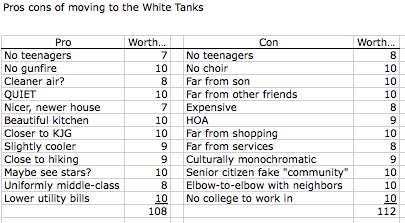
I expected the point spread between the pro’s and the cons would be a lot wider, much heavier in favor of staying put where I’m as happy as I’m ever likely to get. But there’s only a four-point difference between the reasons to move out there and the reasons not to move out there.

Some items, of course, are huge: dodging automatic fire stacks up just as heavily as being able to see my son on short notice. Others are more ambiguous: I don’t consider a new house to be especially important, especially given the solid construction and pleasant ambience of the 40-year-old house I’m living in. To my mind, the absence of rambunctious, noisy teenagers is not necessarily a good thing; hence the relatively low “7” on the pro side.

Judging by these dozen criteria, it’s almost a toss-up whether I stay in the increasingly violent inner city or follow my kind to the Holsum Bread suburbs.

Realistically? I can’t afford to live out there. Certainly not while I’m tethered to the upside-down house M’hijito and I got ourselves into: to pay that bill, I have to have a job, and the only work I can hope to get is part-time adjunct community college teaching. There are no community colleges within sane driving distance of the White Tank mountains. Plus no matter how much “greener” construction might save on the utility bills, a $218/month homeowner’s association fee is out of the question.

Which, yea verily, brings us to the homeowner’s association. Notwithstanding phenomena like Dave’s Marina, Used Car Lot, and Weed Arboretum (now mercifully replaced by the tidy accountants across the street), I do not want to live in an HOA. I like to hang my laundry on the line…the last thing I need is some supercilious association telling me I can’t put my sheets out on the back porch. Or, more to the point, that I have to spend $350 to $500 I can’t afford to replace a dryer I don’t really  need or, now, even want.

Guess I’m your basic trailer trash, eh? Looks like this is where I belong.

😉
Real Estate, 2011

Yesterday KJG and I took it into our pretty little heads to spend the day looking at real estate. More specifically, we killed several hours touring the models at Trilogy, a Shea Homes tract in Vistancia, itself a sprawling development halfway to Las Vegas. Entertaining experience.

Prices have come down so far that I actually could afford a base house in one of the low-end models out there. Well. That’s assuming I put in no landscaping, no window coverings, and no furniture.

Some of the houses are very pretty—one thing you have to say for today’s developers, they finally have design down pat. I’m partial to the Monaco, which unlike some of the other models doesn’t waste space with a hall-like entry “foyer” for you to keep clean. It has a decent-sized kitchen, nice bedrooms, and an easy-to-care-for layout. The “den” (a sort of second breakfast nook) could serve as an office, if I could stir myself to pick up the litter off my desk.

The problem is, even though the property the developers purchased and bladed is vast and so far out from the city they must have bought it for a song, the houses are built right on top of each other. The gorgeous ceiling-to-floor windows that grace the back end of the house look straight into the back porch and windows of the neighbor’s house. You couldn’t walk into the kitchen to brew a cup of coffee in the morning without being fully dressed! The side windows on some of these models, which often have small side patios, peer right into the windows or patios of the neighbors’ houses.

Want privacy? Encase your yard in a six-foot block wall! That’s exactly what everybody out there eventually will do. So instead of looking into your neighbor’s windows, your pretty little breakfast nook or den will have a view of an ugly cement wall, three feet outside.

If you could persuade Shea homes to build one of these houses on a larger lot—say, a nice boulder-strewn number with a view of the Bradshaws  up in Yarnell—you would have the house from heaven. The Monaco would be my choice for the dream small house in the middle of 40 acres. But elbow-to-elbow with the guy next door and his kids, cats, and dogs? Don’t think so.

For the privilege of living on top of your neighbor, you’ll pay $218 a month in association fees. That’s for starters: you know the amount will never go down! The fee supports a vast community center with two pools, a spa, a restaurant, and a golf course. Plus the city of Peoria has divested itself of responsibility for the roads: homeowners also have to maintain the streets. In other words, you’re paying a $218 a month tax on top of the county taxes, and every now and again you’ll be assessed to cover the astronomical cost of repairing and repaving the roads.

Makes the slums across the road look pretty good, doesn’t it?

Last night shortly after we crawled into the sack, Cassie and I were rousted by the sound of an explosion. Couldn’t see any flames nearby, so I figured it probably came from the source of the late, great fumes, over to the west of us. Mwa ha ha: another meth house bites the dust!

{sigh} If my son and the choir and most of my friends weren’t located in the middle of the city, the excessively neighborly Vistancia would look pretty good. Realistically, of course, I can’t afford $218+++ in fees to support a golf course (I don’t golf), swimming pools (I dislike swimming in public pools), a restaurant (I can barely afford to eat out now and certainly couldn’t if I had to choke up over two C-bills a month!), a spa, and roads that ought to be maintained by the municipality that’s extracting taxes from me.

LOL! I guess I could afford a forty-year-old trailer in Yarnell, though!

🙂


Brand New Dead Things (community center in Yarnell)


Real Estate: Catastrophic

Lenten Thanks: Day 1

I thank God for my beautiful son, who has grown into a hard-working man with great common sense, a wide-ranging intellectual curiosity, and deep loyalty for his loved ones.

The dominant Realtor in the neighborhood just sent out her occasional newsletter. A house in the area just to the north, which is starting to look pretty blighted, sold for $58,900.

In my neighborhood, the best price was $222,000. But that was for a 2,013-square-foot house. Apply the square-foot price to my shack and you get $203,277. Not good, considering that I paid $232,000…before the bubble started to bloat.

At the time I decided to pay off the mortgage on my last house—the sale of which made it possible for me to pay for this house in cash—my financial advisers had their predictable litter of kittens. Conventional wisdom so values the tax write-off on residential mortgages that most people are convinced it’s best to be in debt up to their teeth, as long as it’s so-called “good debt.”

Well, one thing the present depression has shown us is that there is no such thing as “good debt.” Debt is debt, and it’s all bad for your financial health, unless you’re a major corporation or a government, in which case leveraged debt is a characteristic of the alternate universe in which you dwell. For the homeowner, mortgage debt is no better than credit card debt; in fact, it’s probably worse, because it’s so much more massive and because its collateral is the roof over your head.

If I owed on this house, heaven only knows how far underwater I’d be…and that wouldn’t count the $61,000 loss we’re taking on the downtown house’s mortgage. And of course, 61 grand isn’t the half of it: it’s not the difference between how much you owe and how much the house is really worth that counts; it’s the phenomenal amount of mortgage interest that’s swirling down the drain for every underwater homeowner in the country. If we end up stuck with the downtown house for 30 years, until the mortgage is paid off, we will have paid twice the amount of the loan for a house that’s worth about 64 percent its sale price.

We certainly will lose that house and all the money we’ve put into it. Unless a miracle happens very soon, we won’t have much choice other than to walk.

But at least I can say this: I’m not going to lose my own house, and it’s not costing anything in mortgage payments. Thank God I made that seemingly “foolish” decision, all those years ago.

LOL! Now, if only She had been watching out over us when we jumped off the cliff to buy the downtown house.

🙂

Another week, comin’ our way…

Gone fishin'

…And I don’t have to work! Nyah nyah!

Well, not much: student papers will come in on Thursday, needing to be turned around by the following Tuesday. But all things said and done, reading 50 comp papers is one heckuva lot better than hauling back and forth across the freeways to Tempe ten times in the cheery company of my fellow homicidal drivers.

Spent the better part of the weekend in the company of my friend KJG, now also a certified escapee from the Great Desert University. She went over the wall a few months ago, and like me is only just beginning to fully unwind from the stress of working in a psychologically crushing environment. It truly takes a good year to recover from the effects of spending eight or ten hours a day in a place where management works at making everyone miserable.

You realize…? There are therapists in this city who specialize in counseling GDU employees. Is that or is that not amazing?

Saturday I drove out to her house, way on the far west side (halfway to California). She and her husband, a firefighter, have built a lovely home on an acre of land out there. She’s very, very good at gardening and housekeeping; now that she’s home all the time, the place looks gorgeous.

KJG worried, as the opportunity for her to retire approached, about no longer contributing to the household income. She actually felt guilty about the prospect. Yesterday, though, she remarked that she no longer feels that way: “We have plenty,” she observed.

Indeed. And as a matter of fact, to pay for the gardening, housekeeping, cooking, and homemaking services she does could cost them more than she was earning at GDU. Sometimes having one member of a couple not work costs the household a great deal less than it would appear at first glance.

We took the dogs for a hike in the White Tank Mountains, which was quite an adventure for Cassie the Short-legged Little Corgi. KJG has a well trained and mellow doberman, one of whose steps equals about ten of a corgi’s.

The day was so gorgeous, there were quite a few people out, although not so many that the trail seemed as crowded as those in town. We did run into one chucklehead with a gigantic bulldoggy looking critter, probably a mastiff mix. He stood aside and cooed, “Don’t worry, he’s fine!” Of course the instant KJG approached to pass them, his huge dog lunged for the dobe, who, though generally a laid-back sort, wasn’t inclined to take any guff. Fortunately, Kathy is a good dog handler and managed to get by without contact. As she and her dog reached the other side of this obstacle, the doberman turned around, glared back at the guy and his mutt, and emitted a deep, alarming growl: Make my day!

And so we see again the uses of a small dog that can be picked up. Because Cassie only weighs 25 pounds, I could pick her up, climb off the trail, and wait for the guy and He’s Just Fine to go on their way.

Why do people take animals like that on narrow public paths?

That notwithstanding, it really was a beautiful morning and a nice hike.

Later we junketed around to several big nurseries on the westside—the area still has surviving pockets of agricultural land, some of which are occupied by wholesale nurseries whose proprietors will allow the general public to wander around. Then we took it into our heads to look at model homes in the very few surviving new-home developments.

And that was something to see. If you’re in the market for a new home in the Southwest, now is the time to buy! They’re practically giving the things away. We went into a set of Shea Homes models—Shea is reputed to be one of the better tract builders in Arizona—where we found several very attractive designs in what appeared to be pretty decent construction. Interestingly, the lots in this tract were sized for human beings living in single-family homes, with enough space between the houses to allow air to circulate. For $177,000, you can buy a large, intelligently laid out house with lots of big, bright, airy rooms, a kitchen to die for, and a master bathroom best described as “sybaritic.” Of course, by the time you added the amenities that made the models desirable, you’d be pushing three hundred grand… But it was clear that for about what my house would sell for, you could get the basic floor plan plus a few upgrades that would be hard to retrofit—the top-quality cabinetry, for example—and then over the next few years make the improvements you’d like as you could afford them.

For me, the disadvantage (besides the noise from the F-16s flying out of the nearby Air Force base) is the enormous distance from everything I like to do. It’s almost an hour’s drive from the central city. Moving out there would mean the end of choir participation, the end of the regular jaunts to AJs and Whole Foods, and the beginning of impossible drives to the nearest community college.

But it was fun to look at the houses. It really would be perfect if you could get Shea to build one of those places on an infill lot.

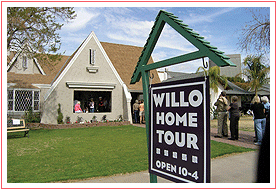
Sunday KJG drove into town, because we wanted to go on the Willo Historic District tour. This has become quite a shindig! They’d blocked off the feeder streets one street south of where I used to live, and the street where my son’s two babysitters used to live was filled with vendors’ booths. We came across one of my choir coconspirators, a lovely alto who owns Ecocentricity, an environmentally conscious shop right in the middle of the Willo commercial fringe.

She was selling a big purple purse one of her suppliers had made from a 1970s leather skirt. It was incredibly cute, and the leather was so soft and light the thing hardly seemed to weigh anything. The price was a bit stiff, though—ninety bucks. Coveting it, I set it aside to think it over while we were walking.

The day grew warm, though, and before we could get back to the Ecocentricity booth, we faded. Ended up going to lunch at our favorite uptown restaurant instead of wandering back whence we’d come.

In the real estate department, I really do miss my beautiful old house in Willo. Occasionally, I think I’d like to move back there. However, the historic district designation and the huge demand from affluent DINKs has pushed the prices out of my range. Oh well. It’s a lot of work to keep those old places up, anyway.

At Evensong my choir friend told me that the  purse had almost sold three times, but she still has it! So I’ll probably drive down to Ecocentricity today, after I call the arborist to see what he can do about the trees damaged by the idiot roofers.

I intend to bill Crown Roofing for the cost, and also to post a report about the tree assault on Angie’s List. Every time I look at my poor tree in front, I could just cry.

The afternoon rising to the high 70s, had a nice snooze on the hammock before heading out to Evensong, where we listened to another of our music director’s awe-inspiring organ recitals and then sang a couple of really nice pieces for the service. That was fun.

After Evensong I went to the wine and cheese reception, where whom should I meet but a fellow who works for Pearson Publishing. This outfit contracts to my partner in business crime, Tina, who does project management for them. Turns out this guy writes science and tech textbooks for Pearson—he’s got a fulltime job with them, but because they allow him to work from home three days a week, he’s able to live in town, instead of out in the sea of houses that is Chandler, where the megapublisher’s Arizona quarters are located.

The guy started as a high-school teacher in one of the top science and technical high-schools in the Washington, D.C. suburbs. He says the school was outperforming most other schools and had a nationally top-ranking science program. When the No Child Left Behind legislation kicked in, the faculty were informed that they had to stand down from what they were doing and instead focus on getting their kids to pass the standardized exams—whose standards were lower than what the kids were already achieving.

This lock-step dumbing-down degraded the school’s quality—it no longer ranks at all in science and technology—and so demoralized staff that many people quit. He said that the year he left, 25 other teachers also departed.

Pearson pays quite nicely…given the cost of textbooks, they can afford it. You can be sure this guy is earning more than he did at teaching, and pretty clearly America’s school system lost some talent. Ohh well.

Anyway, the guy has a fair amount of music background. Maybe he can be persuaded to join the choir. He seemed like a nice man who’d fit in well.

Then it was back to the Funny Farm for a 9:00 p.m. stroll through the neighborhood with Cassie, a nice wrap-up for a fun weekend.

Ain’t retirement grand?

Images:

Angler at Devizes, England. Arpingstone. Public Domain.
White Tank Mountain. Roger Hall.
Creative Commons Attribution-ShareAlike 2.5 License.
Garden Hammock.
Dennis Mojado. Creative Commons Attribution 2.0 Generic license.

Mortgage Mod

The American Nightmare

Speaking of the downtown house, as we were in a comment to yesterday’s post, late last week M’hijito and I finally came to an agreement with the credit union over the renegotiated mortgage on the downtown house. Though it’s not what we feel would make sense, it’s better than we feared.

As some will recall, when the Great Desert University canned me and all of my staff, we wheedled a loan modification from the credit union, whose loan officers temporarily gave us a 40-year term at 4 percent. This brought our payments down into the more or less affordable range, but of course it meant that each monthly check paid pennies toward principal.

Not that it mattered, because the house is some $56,000 underwater. One would prefer not to pay $206,000 (the amount owing on the loan) toward a house whose value is now, at best, $150,000.

The loan modification was only good for a year. This month, it came time to renegotiate.

We asked, as we pictured a committee of loan and credit-union executives rolling on the floor in helpless laughter, for a principal reduction. We did not expect to get it. And of course, we didn’t.

What we got was a 40-year loan (39, actually, with a year now gone) at 4.75 percent, with the same old balloon payment that comes due now in 12 years. We were not pleased with the balloon. M’hijito used the Male Voice to try to persuade them to drop that clause. Didn’t work.

So, there we are: if values stay flat until 2023, we will be screwed, screwed, ge-screwed.

However…

This arrangement drops our payment by about $300, lowering my share by $200 and M’hijito’s by $100 a month (he owns 1/3 of the investment). For him, it means he gets to live in a nice house for about what rent on a box in a people warren would cost him. For me, it means my 2011 income will cover my share with so much to spare that I can run the air-conditioning at 71 degrees all next summer!

🙂

What more could a person ask?

Actually, for me it means that I not only get to have a life, I also may be able to save enough to buy a new (to me) car in about two years. Should our payment arrangement continue past the time when I can no longer work, the present monthly amount will not require me to draw down an excessive amount from retirement savings.

It also means, I believe, that when M’hijito finishes graduate school and wants to return to San Francisco, we will be able to rent the house for enough to cover the mortgage payments. He can leave at any time, and when we have renters in there, I won’t have to draw down anything pay the mortgage.

What will happen in 12 years, when the balloon comes due? Well, we’ll have to deal with that when it happens. I’m not very worried, though. By 2023, we will have paid the principal down to around $177,000.

If the worst happens and the most pessimistic prediction comes true, the house will lose another 16 percent this year. Assuming it begins to rise after that, at a rate of around 3 percent, in 2023 its value will be $174,400, a shortfall of about $3,000—not an unacceptable amount to have to bring to the table to get rid of it.

If real estate drops 16 percent this year, stays stagnant a year, and then starts to rise at a modest rate, then in 2023 the house will be worth around $169,000. That won’t be good, but even then, it’s less than a $10,000 difference—not an intolerable loss. Over a 12-year period, we could easily set aside that much to buy ourselves out of the place.

Personally, I don’t think values actually will drop that far in 2011. My crystal ball says central-city values will drop about 6 percent this year, stay stagnant in 2012, and then start to rise at about 3 percent a year. Three percent is a pretty modest rate; in normal times, real estate here has appreciated at around 3 to 5 percent per annum, over the long haul. Averaging the annual home appreciation rates between 1980 and 2000 gives you a figure of 3.66 percent.

It’s going to take a long time for Arizona’s economy to recover, because jobs are gone and, with our dunderheaded leaders doing all they can to shoot every one of us in the foot, it will be several decades before employment returns. However, eight in ten Arizonans still have jobs.

Those jobs are ill-paid and getting iller-paid. Meanwhile gasoline prices are soaring—some stations are already selling gas at over $3 a gallon, and we’re told to expect $4 a gallon by next summer.

Think of that. If you earn $10 an hour, a pretty typical wage around here, you will have to work an hour to buy 2½ gallons of gas. The drive from my house to lovely downtown Tempe, not a long commute compared to the drive from the ghost suburbs of Litchfield Park, Laveen, and Maricopa, is 36 miles round trip. My car gets 18 miles to the gallon, and no, on $10 an hour I most certainly could not afford to buy a new vehicle. That means it would cost me 8 bucks a day, $40 a week, just to drive to work—not counting junkets to grocery stores, clothing stores, the kids’ schools, Home Depot, Costco… For a $10-an-hour worker, half a day of every work week will be consumed by the cost of driving to work. And if you lived in one of those bankrupt new suburbs, you could easily double that commute cost.

The legislature has targeted the public school system for destruction. Thus it won’t matter where you live—the local schools out by the White Tanks will be no better than the ghetto schools in the central city.

Everyone who still has a job is gunna want to live closer to work, preferably near the light-rail…which passes within walking distance of the adorable little house. In the past, that impetus has pushed up values in the central city, and it will again in the future.

So, I feel fairly confident that if values drop 16 percent anywhere, it will happen in the outlying suburbs, which all along have absorbed the worst of the real estate losses.

The problem with our downtown house is that there are four foreclosures within a block of it. The house across the street appears to be vacant and also probably has been foreclosed. That’s what’s driving down prices there, compared to other North Central neighborhoods, which have lost value but on a much lesser scale. Because of the neighborhood’s central location, the presence of the new lightrail, the proximity of a very upscale area, and the extreme cuteness of the midcentury houses (which appeals to both straight and gay DINKs), buying there during the bubble was highly speculative. A lot of flippers bought houses with no intention of living in them, and most of those speculators had no real funding behind them.

A half-dozen forfeited properties have already been practically given away by the banks. My guess is there’s no more than another half-dozen to go. They’ll be off the market in a year or 18 months. Give things another year to settle down, and then values will start to float back to where they were before the bubble started to inflate. If the rate of increase is anemic compared to normal real estate growth rates, it’ll be around 3 percent.

That’s what my crystal ball says, anyway.

Magic 8-ball

Image: Magic 8-ball. Mostlyrecords. Public Domain

What Will Your House Be Worth in 15 Years?

Okay, CPAs and math whizzes, tell me this:

Am I right in thinking that projecting the value of a piece of real estate into the future is roughly akin to figuring compound interest? That is, the two calculations are similar in that they entail repeatedly adding a percentage back onto a base value, which increases periodically at that rate?

If this scheme is correct, to estimate the value of the house after 15 years you would guess at a projected annual increase (say, 3%) and then plug that rate and the current value into a compound interest calculator. This is the simplest scenario, of course: it assumes the starting value will increase. We know that the value of real estate, at least in my part of the country, will not increase and in fact is projected to fall another 6 percent in 2011. However, there’s an easy adjustment for that: simply plug a negative number into your formula for each year you expect values to tumble.

M’hijito and I have to renegotiate our mortgage, which was modified a year ago after I was laid off. To have even the vaguest idea what we’re doing, we need to have some idea what that place will be worth in 15 or 20 years. We’re pretty much resigned to the certainty that we’re going to be in the landlord business—when he’s ready to move on, we won’t be able to sell it, because we owe at least a hundred thousand more than we paid for it. So, we’ll be forced to rent it either until it regains some value or until we’ve paid off the mortgage.

Two Realtors have told us the house is worth $140,000 to $150,000. We owe $206,000.

I tried this first with an online calculator, using 3%, and then on my fingers and came up with the same figure: in 15 years at a 3% growth rate, it should be worth $211,763 to $233,695. Lovely. In the best-case scenario, that will be only $1,305 less than we paid for it. But at least it’s more than we owe on it. We won’t think about what the dollar will be worth in 15 years. 🙄

We know it’s unlikely the house’s value will go up by 3%, the typical rate of inflation, in 2011 or 2012. But it could (I suppose) start to rise after a couple of years. If you calculate a negative interest rate of, say, 6% next year and 4% the following year, then add on 3% a year, after 15 years the house’s value is $185,528 if it’s worth $140,000 now, or $190,829 if it’s worth $150,000 today. That’s $15,171 to $20,472 less than what we owe on it.

But of course, 15 years of payments at a low rate will have knocked the principal down to some degree.

Using an online amortization calculator rel=”nofollow”, I estimate we will owe $132,958 in 15 years, if we can get the credit union to come down to a 4% interest rate. In 15 years, assuming values drop 6% in 2011 and 3% in 2012, then rise at 3% a year, the house will be worth $185,528 to $190,820.

In five years, we will owe $186,322 on a house that will be worth $138,050 to $141,944.

In ten years, we will owe $162,295 on a house that will be worth $160,038 to $164,610.

This means the soonest we can get out of the loan without having to cough up tens of thousands of dollars will be in about 2021. That’s if we’re extremely lucky.

Our plan is to ask for a 30-year loan at a ridiculously low interest rate. Right now the original loan, which will come back to haunt us in February, is a 30/15 deal at something over 6%. The loan modification temporarily gave us the terms of a 40-year loan at 4%. With me unemployed, even the payments on that are too high—I’m using everything I earn at the college to cover my share, and I won’t be able to work more than about another four years. Some people are getting 2% interest on reincarnated loans, so that’s what we’re going to ask for. I think we’ll be lucky to get a 30-year loan at 4%.

Again assuming values drop 6% in 2011 and 4% in 2012 and then slowly begin to rise: In 30 years the house will be worth $289,047 to $297,306. Of course, by then he (or his renters) will have paid a great deal more than that for the privilege of holding it. I’ll be long gone by then, and presumably in 30 years what is now a 60-year-old tract house will have crumbled into the ground. With our luck, some developer will have decided to turn the whole area into a low-rent shopping mall, persuaded the city to condemn the entire tract, and bought the houses for 50 cents on the dollar.