Today is the first day for not one but two new classes, a section of English 101 and the new online magazine writing course. Well, actually, the mag course officially started yesterday, but not much is going on other than to answer the occasional plaintive “I can’t make Blackboard work” message.
LOL! Neither can I, kiddo!
These eight-week courses are great. Because they move right along, you don’t have to pad them with a lot of time-wasting busywork (if it’s busywork for them, it’s busywork for you, too—you end up having to read the stuff!), so you get through the essential course material in a timely way. If the section that just ended is representative, the shorter format attracts more ambitious and motivated students, so you have better retention and overall better effort on the part of classmates. And if one of them turns out to be a shade on the troublesome side, you get them out of your hair quickly, instead of having to deal with a problem child through 16 long weeks.
Offer letters were supposed to have gone out yesterday, so when I get to campus one should be waiting for me. We’ll see if the Boss has granted me the much-needed three sections next semester, and if more than one of them will be in the eight-week format. We’re doing a repeat of the magazine writing course in the spring, the current one having filled right up. So I’m hoping he’ll clone my fall schedule, which has been pretty easy to deal with, work-wise.
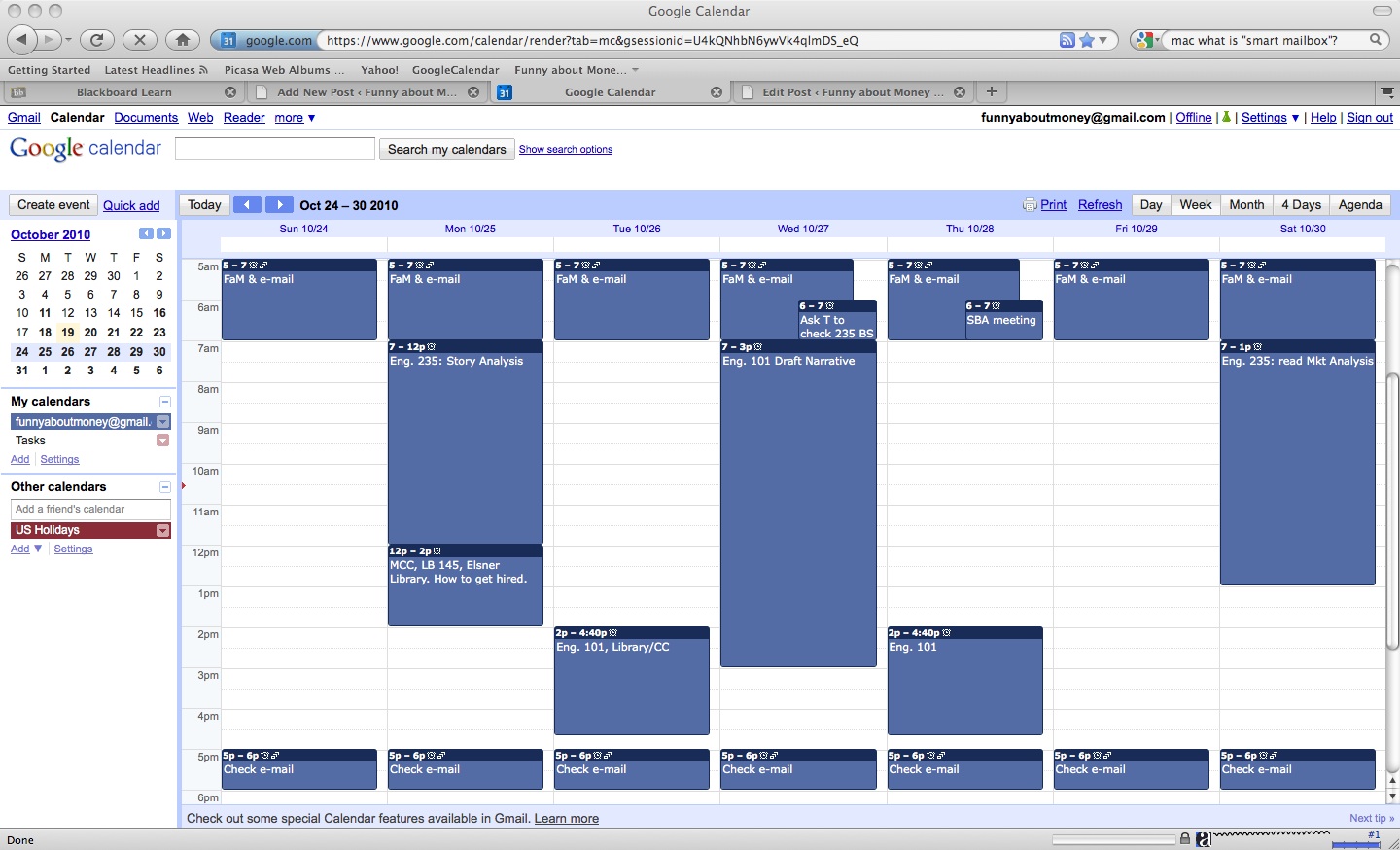
Some time back I came up with the idea of managing time by blocks dedicated to specific activities. This weekend I engaged a new tool for the purpose—offspring of a Doh! Why didn’t I think of this before moment. Google’s calendar is perfect for dedicating chunks of time to particular types. You don’t have to be logged in to an Outlook account to get it to give you a reminder; it’ll ping you through any e-mail address. And the calendar, IMHO, is somewhat easier to use than Outlook’s.
Over the weekend, I went through my semester calendar, noted each due date, estimated the amount of time required to grade each assignment, figured out when I could devote that much time to it, and then entered the assigned slabs of grading time into Google Calendar. The result:
(Click on it for an image large enough to see details)
It remains to be seen, of course, whether I’ll actually stick to this scheme. If I can, it should help to get the workload under control.
One way or another, though, it presents an interesting little revelation. Look at how much time is left free after I’ve supposedly done all the work associated with these two courses and FaM!
What, one wonders, have I been doing sitting in front of a computer 14 hours a day?
Well, one thing is answering the e-mail. Five new messages have come in during the ten minutes or fifteen minutes it’s taken me to write this much copy and upload that image. I’m constantly diddling with the e-mail. So I’ve decided that I should take a leaf from other bloggers’ books and limit e-mail reading to early morning and late afternoon. And just this moment, it’s {click!} Off with MacMail! Command-Q: Quit Mail!
The other vast time-waster for me is cruising the Internet. It’s hypnotic. I spend way too much time cruising news sites (CBS Marketwatch: Dow is down 1.2 at 11,010, but eek! it was down below 11,000 earlier today) and reading other people’s blogs. When I’m working during the school year, I need to get a grip on that. There have to be better ways to spend those nice clear spans of free time!
Well, I probably won’t be writing much here for the next week or so.
You’ll recall that I spent half the g.d. summer creating an elaborate online course in magazine writing for the college. Since I was paid to do so, I worked pretty hard at it; the job occupied end-to-end seven-day weeks of 14- to 16-hour days.
Yesterday I learned that Blackboard blocks student access to almost all of the presentations I built during all those hours of mind-numbing work. I’m going to have to take down most of the course, rebuild the presentations at a website students can access, only without voice (so everything has to be written out!), and rewrite the entire flicking course! This has to be done in six weeks, while I’m reading 75,000 words of brain-banging freshman babble, first in draft, then in progress, then in final form.
How the hell this is going to happen escapes me. There’s no way I can redo the entire course while I’m trying to handle an intense eight-week section of composition, one that’s filled with new freshmen, some of whom need a great deal of help with their writing.
I’m so angry I can barely speak. Certainly can’t sleep. Was up until 2:00 a.m. and then reawoke and started working again at 5:00.
As appealing as the idea of teaching online is, of not having to trudge out to campus and entertain a roomful of people who doze through 80 percent of what you say, you can be sure that I will never do this again.
What a flicking disaster Blackboard is! In its new Version 9, developers replaced functions that did work—such as the Digital Drop Box—with complicated systems such as “Assignments” whose benefits are outweighed by the confusion they inflict on students and the hassle they present to instructors. It has added a vast selection of features that look like they should bring real substance and versatility to the online environment. Indeed, they would…if they operated as advertised. But they don’t. We’re presented with podcast functions that offer twenty minutes of space but won’t operate if you speak longer than three minutes, carrying capacity that won’t hold video files or more than a few still images, and nonintuitive functions that require students as well as faculty to climb a learning curve the height of Mt. Everest. The result of these upgrades, such as they are, appears to be a system that is so unstable it crashes in flames the instant classes begin and students start using it.
Blackboard is largely bloatware. If the school is to offer online courses at all, it needs a software infrastructure that can support online instruction. It can’t be a system that appears to offer this resource and that resource, only to yank the rug out from under the instructor, who belatedly discovers that none of those resources can handle so much as a 20-minute lecture or the briefest of PowerPoint presentations. If you’re a college instructor and your institution is trying to woo you to put part or all of your course online through Blackboard, RUN AWAY!
Run away as fast as you can! Do not convert your courses to this system in its current incarnation. It is a huge, bloated tick on the corpus of higher education.
{sigh}If anyone would like to contribute another guest post, it would be nice to keep this site going while I’m working on something else 18 or 20 hours a day…
Okay, so one train of thought that’s been going on here at Funny about Money has to do with the dawning realization that I’m spending too many hours on work that doesn’t pay a living wage and too few hours on actual…well, living.
In a good month, FaM returns about two hundred bucks, and that’s fine, because it’s exactly the amount I need to get out of one section of freshman comp a year. Or, more to the point, to make up for an assigned section that doesn’t gel.
And I normally make $200 or $250 a month reading detective novels (!) for my favorite client, Poisoned Pen Press. This amount covers a second freshman comp section each year, and of course it’s pay for play.
So, between them these two piddling sources of income either give me the option of teaching two and two (i.e., two courses a semester) instead of three and three or provide a safety net should one of three assigned sections not gather enough students to fly.
For both these income streams, pay per hour is beneath laughable. FaM earns about $6.67 a day, on average; spending two hours on a post and another hour on blog-related web-surfing yields a pay rate of $2.19 an hour. Earnings for editing the novels are somewhat better: $12 an hour.
Usually, those novels serve as bed-time reading, so the work I do on them doesn’t occupy productive daytime hours.
After a little experimentation, I’ve found that if I get up off my rear end in the morning and do some yardwork, housework, dog walking, or socializing before settling in to paying work, I can put off writing blog posts until the evening. It’s something that can be done, as it was in the beginning, from an overstuffed chair in front of the television. That strategy defuses the blogging work by moving it out of daytime hours that should be better paid or at least should provide some fun, exercise, or relaxation time.
Now. What about the teaching?
What, really, does it pay by the hour? And is there a way to manage time used in teaching to ensure a decent hourly wage?
Well, I did a little English-major math and made some interesting discoveries. First, I posited that a “decent” rate would be about $30 an hour, approximately what I was earning at GDU before the layoff. Second, I established that I should work no more than five days a week—I should get weekends off to sing in the choir, schmooze with my son, and do whatever I feel like doing. A community college course here in Maricopa County, Arizona, pays $2,400. With those as givens, let us ask…
How many hours can you put into a community college course and still earn a decent wage?
Okay, so what we see here is that no matter how many weeks the course spans, the maximum number of hours you can work on the course to keep the pay rate at $30/hour or better is 80. Next area of inquiry: is that realistic?
To keep your rate at $30/hour, what is the maximum number of hours you could spend on a course working outside of class meeting time?
Well, if you add up the number of hours per period and multiply by the number of class meetings, you find that an eight-week course meets about 42 hours; a sixteen-week course meets 40 hours. Since the excessively long meeting time for the short-form course requires several breaks, you could (sort of) argue that class meeting time for the eight-week course is actually about 40 hours, too.
A fully online course, by definition, has no class meetings, but it requires a great deal more course preparation time.
To keep your pay rate at $30 an hour for an eight-week course, you could spend no more than five hours a week outside of class, giving you one hour a day of grading and interaction time.
With no face-to-face (F2F) time, an online course provides a full ten hours a week for grading and online interaction with students.
For a 16-week F2F course, you could spend no more than two and a half hours a week outside of class. That’s only a half an hour a day, five days a week.
On the face of it, this doesn’t look very practical; realistically, one spends many hours a week reading student papers and answering e-mails. However, it’s not as dire as the figures above suggest, because you can manipulate due dates so that some weeks pass with no incoming. So, let’s look at this from a slightly different perspective:
How many hours does it really take to grade student papers?
The community college district requires four papers for English 101 and three papers for English 102. A typical set of freshman comp papers takes four to six hours to grade.
Okay, an hour an a half is still not long enough to grade a set of papers. However, assuming one doesn’t have to grade a set of papers every single week, then what? In fact, with 40 hours of in-class time, you have another 40 hours, at $30/hour, available to read student papers. That provides plenty of leeway to perform 24 hours’ worth of grading!
This optimistic conclusion, alas, leaves out the untold numbers of hours one spends in course preparation.
How much time could you spend on course prep and still gross $30 an hour?
In reality, it takes about four or five full-time, eight-hour days to prep a composition course, especially in the semesters when a new edition of the overpriced textbook comes out.
Thus, to make this work, prep time would have to be cut to no more than sixteen to twenty-two hours. All scutwork—that is, all checking and scoring of in-class exercises, drafts, and homework—would have to be foisted on a teaching assistant, so that all the instructor had to read would be the required, final full-length papers. Assuming about 15 or 16 hours of scutwork, I could afford to pay a T.A. $10 an hour and still be left with enough to buy groceries.
If all one read were the required papers and a T.A. scored the other student activities, how many hours would you spend on a course and what would you earn per hour?
It works out. Of course, about fifteen of those hours would actually earn only $20/hour, but the $10/hour wage for one’s T.A. would be tax-deductible.
In its strange way, this perspective starts to make things look a little better. First, what we see is that teaching, even adjunct, is my best and steadiest source of income. And on inspection, we see that I’m actually grossing approximately what I earned, per hour, at GDU. It explains why I seem to have plenty of cash during the nine months of the school year, and it suggests that even one course over the summer would chase away the summertime budgetary doldrums.
What can be done to bring course preparation time under control?
There, too, I have a plan.
The base content (such as it is) of freshman composition has not changed since I started teaching the subject about 40 years ago. There are only so many ways you can explain what an essay is, what a research paper is, and how to write them. This means that every newly adopted textbook and every new edition of an existing textbook is just another rehash of the same material.
So, prep time could be cut by creating fungible modules that can be plugged in to each new semester’s sections to fit time available. We might call such modules “learning module templates.” These would key reading assignments to subject matter, and writing assignments to specific patterns of development, not to chapters in the current textbook. Thus if in a given week you want to teach students a specific mode of discourse, you simply take whatever textbook you’re handed and look for the chapters or passages that discuss that.
To avoid having to create new assignments for each new textbook edition, you would have to be sure never to key a writing assignment to a reading selection (i.e., a sample essay) printed in the text, since these tend to change as new editions are churned out. You could require students to use the book’s selections as source material for their essay citations; this wouldn’t stop plagiarism, but at least students would feel they were using the textbooks more fully.
Each module could contain the following
• The module’s learning goals • Subject matter that should be addressed in reading • Homework, related to this subject matter but independent of specific reading matter • In-class lectures, discussions, and activities • Writing assignment, if any (depending on the number of weeks/course)
If you made the modules generic enough, it would be very easy to pick and choose to fit your timeframe, and quick to plug in new reading material and resources to make the broad choices specific.
It would take some time to create these things, but once they were in place, each semester’s prep time would drop to a few hours.
So what does it all mean for Working Smarter?
In the first place, sideline enterprises that earn less than a living wage should be relegated to the status of hobbies. They should not be permitted to consume time that could be spent more profitably, nor should they be allowed to morph into work.
Blogging, for example, should be as entertaining as reading detective novels. It should never be treated as a job. In other words, I should not be trudging in to my office every morning, there dutifully to crank out another post. I should not be checking e-mail every few hours to screen out spam and accept comments from real humans—instead, do this at the end of the day. Adsense? Alexis? Google Analytics? Awstats? Is there some point in tracking data whose significance is negligible, except as gratification for a hobby? Obviously not. These should be ignored; certainly never checked more than once a week.
In the second place, the number of hours put into decently paying work should be tightly controlled so that the per-hour wage never drops below a minimum threshold.
With teaching, it appears this is eminently possible. Medicare keeps overhead down so that, given enough sections, $30 an hour amounts to a middle-class wage. The only drawback to focusing solely on teaching as the “real” source of income is that it doesn’t pay enough to add to savings. However, next year I should be able to get some summer courses, and in that case, any editing and blogging income can be rolled into savings. That would fund my Roth each year, as long as I can dodder into a classroom or sit in front of computer to teach an online course.
And there really is no third place. It’s pretty simple.
• Move the hobby income out of the center of one’s field of vision. • Focus on the endeavor that earns the most money. • Control time spent on that endeavor to maximize per-hour income.
Students can be such a pain sometimes, you tend to forget how splendid they are, even the ones whose minds your subject escapes.
Early this semester I winced when Disability Resources sent a notice saying a student with Asperger’s Syndrome had signed up for one of my classes. Ungraciously, selfishly I thought, “Argh! More work, less pay!”
We must stop with the ungraciousness and the selfishness.
This extraordinary young man, who does indeed face some daunting challenges, has made himself one of my all-time favorite students. Polite, sweet-natured, attentive, and observant, he is an altogether brillliant young person. He turns in meticulously edited, meticulously organized, yea verily meticulously perfect papers. No, they’re not plagiarized (trust me: I checked). The things are works of art. His final paper almost reaches the professional level in quality; he’s certainly writing on the graduate school level. He wants to be a physicist, or maybe an astronomer. The kid’s a natural: let’s hope he makes it.
Then there’s Joe the Plumber. Yeah: a real plumber. A big, bluff red-necked bruiser in his late 30s or early 40s, this guy realized there had to be a better way to make a living than fixing pipes, so he’s come back to school for a degree or two in business. English will never be his strong suit, but by steady persistence (and a bodacious sense of humor) he’s nailed an A in the class. As yesterday’s final session was wrapping up, he wanted to be sure every item in the online grade sheet was filled in correctly, because, he said, “My mother is not gunna believe this!”
“Why?” I asked.
“I never got an A in high school.”
🙂 “Well. Tell her you’re a late bloomer.”
And we have Sally Bowles, a pole dancer. Her mother thinks she’s a cocktail waitress in a chain restaurant and highly disapproves of that. Little does she know the girl supports her three-year-old by taking off her clothes in men’s clubs.
You can make a lot of money taking off your clothes in men’s clubs, even without having to perform any extracurricular services. She earns more in a single evening than I do teaching her English course over two weeks. Women we think of as “hard” are surprisingly fragile, though. Her toughness is a façade hiding a dangerous vulnerability.
Men can be vulnerable, too. The ex-Marine planning to re-up in the Army after he finishes at the junior college carries his fierceness as a Roman soldier carried his shield, something to bounce off the arrows, swords, and lances of disappointment and careless humanity.
They’re all like that, one way or another: dodging the slings and arrows. Gotta lov’em!
w00t! I’m never going back to work at GDU again. Over at the community college, the last of the student papers are graded, and all that remains is to meet one class this afternoon to return their papers. I’m waiting till this evening to post grades, because there’s still a shot my marvelously brilliant but distracted Asperger’s student will turn in a final draft (I gave a couple of foot-draggers until today to finish).
LOL! This kid is so amazing that even if I grade from the work-in-progress he turned in by way of proving that he is working on it, he’ll finish with a strong B.
Moving on: by this evening, I am going to be free of any sort of slave labor (except for copyediting another detective novel….heh heh heh heh!) for an ENTIRE MONTH.
Yesh.
I had forgotten how lovely winter breaks and summer vacations are. The only thing hanging over my head between now and the middle of January will be designing next semester’s courses. And I’m actually looking forward to that, because I have some highly creative new ideas.
Springing free from the Great Desert University is an enormous relief. One of the other things I’d lost sight of is how toxic that place is. I do not know one soul who works there who is happy in her or his job. At least one therapist in the city has a practice that consists almost entirely of GDU employees.
Imagine: a shrink who specializes in treating employees of a single organization. Does that tell you something, or does that tell you something?
The god of Sleep has returned to my precincts. I’m sleeping through almost every night undisturbed! It’s literally been years since I’ve had a full night’s sleep, one that wasn’t interrupted by a spate of wakefulness between 1:00 and 3:00 a.m. Matter of fact, that was the genesis of Funny about Money: nothin’ else to do in the wee hours but read blog posts and write a few of my own.
And since, for the first time since the memory of Person runneth not to the contrary, I feel rested when I wake up in the morning, I’m not irritable and on edge all day, I feel no desire for a drink every afternoon, and navigating our homicidal streets no longer reduces me to screaming rage.
Do I worry about money? A little. But I know I’ll get by at least through 2010. By this time next year, I should be well accustomed to living on a third of what I earned at GDU, and if that’s the case, I can go along forever on Social Security, part-time teaching, editing, and a very small drawdown (if any!) from savings.
Yesterday’s guest post by Revanche struck a chord, when she remarked on her surprise at realizing how much she revels in freedom from the workplace. Right on, lady!
I think a lot of wage slaves who trudge into an office, factory, or retail store stay on the gerbil wheel for one reason and one reason only: health insurance. It certainly was true for me: shortly after I divorced I realized that once the COBRA ran out (my ex- covered that, as part of the agreement), I would be uninsured and unable to afford my own insurance. That mooted the prospect of freelancing, which, in my financial naïveté at the time, I imagined would support me. Several times during my tenure at GDU, I thought I should quit the damn job and go back to freelance writing and editing, but the reality was that I could not get insurance to cover me fully and even if I could, nothing was affordable.
Insurers dream up every reason from Hell to short you on coverage. In my case, I was told that because I had a “diagnosis” that I had never heard of—something a doctor had innocently noted on my record but thought so minor he didn’t bother to tell me about it—Blue Cross would not cover any broken bones, back pain, or muscle spasms. This meant that a good car wreck would bankrupt me. And good car wrecks are commonplace around here. In any event, the cost was prohibitive. If I wanted to be able to go to a doctor, I had to keep working for GDU. Which of course was what was sending me to doctors…
Starting in January, the discounted COBRA will carry me through to Medicare. Though Medicare costs about 11 times more than GDU’s EPO does, it still is not beyond reason. The state of Arizona’s health insurance is so cheap (and you get what you pay for, BTW) that it far underprices what most Americans pay for group insurance, and so Medicare probably looks like a bargain for most folks.
Once government-provided health insurance is in place (if it ever gets past the retrograde types who are resisting it), I wonder what effect that will have on the labor force.
I suspect a lot of people figure they could get by with self-employment or in part-time jobs, but keep trudging because they can’t afford health insurance and are unwilling to go bare. How many workers who dream of jumping off the treadmill will do it, once that barrier falls?
I know I would have left GDU a long time ago if affordable public insurance had been an option. Why would anyone put herself through a lifetime of misery if there were a reasonable way to get out of it?
Maybe this is the reason the right-wingers oppose a public option: they know darned well the more self-starting wage slaves will flee if we don’t have to stay in the traces to get medical care when we’re sick.
What’s freedom worth to you? If you had access to decent, affordable health insurance and you could earn enough to cover your living costs on your own or through light part-time work, would you quit your full-time job—even if it meant cutting back on your lifestyle a bit?
Image: Pierre-Narcisse Guérin, Morpheus and Iris. Public Domain.