Coffee heat rising

Why I Hate Teaching

It’s not just because it’s stupidly underpaid.

Not because you have to establish a Roman emperor’s dominion over teenagers who are disrespectful to everyone around them.

Not so much because the benighted ignorance with which American students pass out of secondary schools leaves one weeping for one’s country and for its hapless children.

Not because reading their drivel is excruciatingly time-consuming and excruciatingly boring.

Not even because spending one’s time trying to assess said drivel intelligently and trying to advise its authors in ways to write less idiotic pap is a heartbreaking waste of energy and hours.

No. Not necessarily those things.

It is because no matter how much effort you put into them, no matter how much faith and hope you invest in your students, sooner or later they will disappoint you.

And you will be disappointed not just in them but in yourself and in your profession and in the entire flicking society around you.

They cheat. They lie and they cheat. And they do it all the time. It is so routine as to be unremarkable. And it’s not the ones who are so hopelessly dense that they have to cheat to pass a lightweight course like freshman comp. No. Half the time, God help us, it’s the smart ones.

I just returned (and forwarded to the division chair) a 300-point paper that failed because a good third of it is a copy-and-paste job.

Annoyingly, the author is one of my favorite students. She’s bright and gregarious and funny and she even seems to be paying attention in class. And, even more annoyingly, she’s no young kid who might be expected not to know better. This is a grown woman, thirty-five…maybe even pushing forty. And she’s a pretty typical plagiarist: smart, articulate, and full of potential.

Why do they do this? They’re not cheating anybody but themselves. They’re not cheating me. They’re not even cheating their classmates, since every person who enrolls in a college course gains from it as much as she or he individually puts into it. Why would you pay for something and then waste your time and energy on it? Is it arrogance—are they so smart they think they don’t need to be bothered?

When I was a kid, I was too terrorized to do this kind of thing. I would get caught (for sure!), and then I would be thrown out of school. My mother would weep and my father would disown me. I would spend the rest of my life in abject disgrace. So socialized was I to believe that you could not get away with cheating, lying, stealing, embezzling, arson, or murder that it wasn’t until I reached my mid-40s that I began to realize how much people do get away with. It was about then that I met a young woman who had spent a fair amount of her adult life committing insurance fraud.

She was minting money and new cars. Even whole new houses—twice she got insurance companies to tear out and rebuild the interiors of entire dwellings! That was an eye-opener.

By then I was on a university faculty. Informed by my young friend’s revelations, I began to notice the number of colleagues who pretended to serve on committees. They’d show up (sometimes) at meetings, do exactly nothing, and at the end of the day take credit for the work two or three other people on the committee actually did.

Should I mention the associate dean who arrived at his elevated position (and salary) on the strength of a three-volume magnum opus? When you opened the covers, as apparently few of his colleagues ever did, you discovered it consisted of offprints from the Congressional Record! Yes. In three volumes, the only parts he’d written were a short introduction and a series of two- or three-paragraph headnotes: maybe 35 or 40 pages in total.

How about the associate professor who was asked, three years running, to write a proposal to establish a program for which funding and administrative intent already existed and who never could manage to choke out anything acceptable, and how the program didn’t happen until a certain non-tenure-track lecturer of your acquaintance sat down and wrote the damn thing?

The search committee that was determined to hire a minority to its faculty, even though they openly admitted that a WASP woman was by far the best of the applicants? When the single African-American applicant accepted a job elsewhere, they closed the search rather than hire a better-qualified white candidate, and they conspired to flamboozle the Affirmative Action office with a set of phony reasons for rejecting her.

Dishonesty and cheating and devil-take-the-hindmost ethics are endemic to our culture, from the kid who pastes a web page into a term paper to the merchant who sells second-rate goods at first-rate prices to the manufacturer who fills “NEW!” packaging with less product at the same price to the pharmaceutical industries that foist unnecessary and even harmful drugs on “patients” who shouldn’t even be patients to bankers who entrap borrowers in loans everyone knows they can’t repay to crusading politicians who think the end justifies the means to presidents who lie to get us into unjust wars.

No. It’s not because they’re arrogant that the cleverest students cheat. It’s because they’re smarter than I was at their age. They’ve already learned they can get away with it, because everyone gets away with it. It’s the thing to do.

That is why I hate teaching. It is, in a word, profoundly demoralizing.

Quit the Day Job? How’s about PART of the Day Job?

The two-year small-business development program for which I’ve applied—and it now looks like we have a fair chance of acceptance—has a four-month “boot camp” period in the fall, requiring a once-weekly meeting that conflicts with one of my afternoon courses. Adjunct teaching can’t be called a “day job” by any stretch of the imagination, but it’s the closest thing to it that I have on my plate just now. Of the three enterprises at which I labor, the part-time teaching job brings in the most cash on a quasi-regular basis.

We will not know until just before the semester starts whether the AAAME program will accept The Copyeditor’s Desk. If we don’t get in, I sure don’t want to forego that munificent $2,400 paid over four months. 🙄 However, I didn’t feel I could wait until the day before class begins to tell the departmental chair, who has been very generous with me, that I’m walking out on a section.

So, I made up my mind to quit part of the day job: to drop the afternoon class that would overlap the AAAME meetings. It’s not like I don’t have $2,400 in my long-term survival savings account, after all.

Actually, over the past couple of months, enough work has come in to The Copyeditor’s Desk that the business could pay me that much next fall without doing itself any harm. Matter of fact, it owes me a little over $3,000 in the form of a loan for start-up capitalization, made way back in two thousand and aught-ten. So I could simply withdraw the equivalent of my net pay, which doesn’t come anywhere near $2,400, as a tax-free loan repayment.

Sounds good, doesn’t it?

Well. When I went to meet with the chair, he suggested that instead of dropping the third course altogether, I pick up an early-morning Tuesday-Thursday section. That would hedge my bets, and I wouldn’t have to draw down funds from the business to cover base living expenses.

Unenthusiastically, I agreed to this; then realized that at 7:30 every Thursday morning, I’m supposed to be in Scottsdale! It would be counterproductive to enroll in a business development program that’s supposed to be showing you how to market your company while, at the same time, dropping out of one’s main networking group, eh?

So he countered that I should take on a Monday-Wednesday section, at the same ungodly hour.

Ugh. I sure don’t relish traipsing to campus at 6:45 in the morning. Nor do I especially welcome a “full” course load (which it ain’t , but it’s the most the junior college district will allow adjuncts to teach) while I’m devoting a minimum of 16 hours a week to the AAAME project and hustling business and, with any luck at all, actually doing business.

On the other hand…

We do not know that we will continue to get the kind of work we’ve seen this summer. It’s a never-rains-but-it-pours sort of business: you can go for months without seeing a single assignment, and then all of a sudden a bevy of nice jobs lands on your desk. There’s no guarantee that we’ll get any work this fall, to say nothing of enough to keep the wolf from the door.

And, if we do get enough work that I actually could pay myself a little salary and take a little dividend…think of that! Another three to five thousand dollars of income would mean I could live almost like a normal human being!

That would be refreshing.

Even the unholy hour presents an advantage: it will force me to get up, get dressed, leave the house, and meet some live human beings before the real workday starts. Right now, the weekly Scottsdale Business Association meeting is the only thing that makes me do that. Since I routinely get up at 4 or 5 a.m., I often roll out of the sack, walk the two steps across the hall, and plop into a chair in front of the computer. There I will sit, all. day. long, often without getting up to so much as bathe and brush my teeth. I’m getting so little exercise that my back and hips have started to hurt from sitting in a desk chair for hours on end without moving.

Later in the semester, when the mornings cool off a bit, I could throw my hiking boots in the car and stop by the mountain preserve on the way home, getting in a mile of walking before parking myself in front of the monitor. This would help a great deal with the aching joints and the avoirdupois.

As unpleasant as it sounds, having to get up and get going at that hour will actually be a good thing.

Sooo…. Now I’m scheduled to teach a 101 section at 7:30 in the morning Mondays & Wednesdays, a 102 section at noon Tuesdays and Thursdays, and the magazine-writing course online in the second half of the semester. It’s far from ideal—my dream is to quit the “day job” (such as it is) altogether—but it has some things to recommend it.

I guess.

🙁


One Down, a Million More to Go…

Last night we had the final exam for the real estate course. I felt like I was walking into the Jaws of Doom, so convinced was I that I was gonna bomb the thing. I was totally unprepared, and so exhausted I could hardly walk. The past 5 weeks have devolved into one time-consuming, headache-inducing screw-up, hassle, bugaboo and freaking catastrophe after another, and so I’ve had almost no time to study the content. I figured I was going to fail for sure.

Well.

When our Realtor friend said getting the license was “easy,” he wasn’t kidding. Of the 80 questions, I’d be surprised if I missed 10. Most of them were factoid questions, and of those most were so intuitive you probably could answer a good 80% of them without ever reading the book. There were five or six math questions, which of course I’m incompetent to do. Of those, I know I got three correct; I made a good guess at one, leaving two almost certainly wrong. So: two or three of the math questions wrong. Three or four of the factoid questions concerned material not covered in our textbook (the instructor draws on two texts for his questions)—had to make guesses on those. So I’m estimating I missed about six or seven questions.

To get 75%, you’d have to get twenty questions wrong! And…to get twenty of those see-Dick-run questions wrong, you’d have to be so far out in left field you’d qualify as mentally retarded.

All of which is neither here nor there, because on Tuesday, when he reminded us that because it’s a five-week course the final was scheduled for last night, not next week during the regular final exam period and I realized that on Wednesday I wouldn’t have a chance of finding time to review 14 chapters, I asked him what would happen if I failed this exam after having scored a 96 on the mid-term. And…brace yourself…at that point he said not to worry, everyone in the course would get an A or a B. No one would get less than a B in the course.

Heh.

Anyway. It is ridiculously easy. And it’s pretty interesting. You certainly learn a lot of things that you should have known before ever setting a pen to a purchase contract, a mortgage agreement, or an apartment lease.

Bitch of a week here. I told you we fired the client who converses with the dead, right? That leaves us without work, which has Tina agitated. Two incoming queries appeared today; one looking for someone to edit his thesis, another from some outfit trolling for slave labor. Last week of instruction—finals coming up next week. Students are also agitated, lobbying for hurried return of their gigantic final papers. Much nagging, whining, and nail-biting in those precincts.

This morning I’m going out to Tempe to drop by and sign some paperwork at the new insurance agent’s office. Thence to the credit union branch on the main campus. Then over to the GDU library to scour Literary Market Place for leads to publishing houses Tina and I can hit up for freelance work, and then it’s off to meet Tina for a nice lunch to celebrate the end of the semester and, more to the point, to calculate a strategy to bring in some more (and better) work. Back to the house to write up an exam for my own students and send that off to the copy center. Then have to translate their grades out of my spreadsheet into the hated Blackboard so they can view their final score, a process that takes about eight times as long as it should because it has to be done manually and because BB screws around with you as you enter Each. And. Every. Score.

So that will fill absorb every moment of productive time today, I expect.

Discovered a $1230 discrepancy in my checking account and can NOT find the error(s), so had to make a balance adjustment in that amount. Fortunately it’s in my favor; otherwise I’d have ended this month with about a $300 balance. But it looks like I’ll have to hire the accountant to untangle whatever mess I made there.

Noticed last night that the pool is busted again. Gotta get up from writing this post and go fix that, or else turn off the power and leave the thing to grow algae while I’m racing around the city today.

Had to buy a new toilet, the facility in the middle bathroom having given up the ghost. Actually, neither that one nor the one in the so-called master bathroom had a very strong grip on the ghost when I inherited them from Satan and Proserpine. I like this new one so much, I may have WonderPlumber come back after I recover from the summer’s penury and replace the one in the alleged master bathroom.

Told him about my idea to turn the fourth bedroom (now the unused TV room) into a luxurious spa, complete with vast bathtub and a walk-through into the closet-like master bathroom. He thought it was a great idea. Estimated it would cost around 10 grand.

Well…when I’m a rich old real estate agent, eh?

It’s Raining Money!

HOLY mackerel! The January statement for the IRAs came from the financial management firm. The large IRA earned as much in January as I make all year when I’m teaching the maximum load the District permits adjuncts to take on. Raining money, indeed. Wow…

In the past, when times were good (remember those times?), it would occasionally earn ten grand in a month. But this is ridiculous.

So why am I even being bothered to teach, or to do anything else, for that matter? As we’ve seen, it’s a question I’ve taken to asking myself more and more often.

Well, for one thing, under decent conditions I like teaching. I enjoy young people, and even though I don’t delude myself that I “teach” them anything (no one teaches anyone anything: you can take the horse to water…etc. The best you can do is serve as Virgil to the student’s Dante), I find it entertaining to watch them develop when challenged by whatever wacky stuff I throw at them.

And of course, the problem with a sixteen-thousand-dollar windfall is that it comes along once in a blue moon. Stock market investments can’t be relied on to generate any returns on a regular basis, and as a matter of fact for most months since the Crash of the Bush Economy (heeeee! :-D), returns have been negative. You can’t be pulling down what it takes to live on while your nest egg is steadily shrinking.

Hm. Speaking of money management, there’s still a chunk of money sitting in an old whole life policy. I’ve delayed rolling it over into a brokerage account because I haven’t wanted to trigger the tax on it. Plus it does provide my son with almost 40 grand worth of insurance, which would make him right-side up in the upside-down mortgage I got him into.

Financial Advisor and I have been engaged in a long-running disagreement over this little pot of gold. He wants me to draw it down to live on. I want to roll it into a brokerage account and put it to work, even though I’ll have to pay tax on it. Matter of fact, once the tax is paid, it could be used to fund the Roth IRA, which I’m not going to be able to contribute to for many more years.

Or, of course, I could use some of it to buy a much-needed new car.

Either of those, IMHO, would be better than letting it sit in the insurance policy, where it earns about as much as a bank savings account does. The thing returned $1,128 in 2011, plus an $888 cash dividend. LOL! I’ll never get out of the 99 percent at that rate!

When DO i get my life back?

Finally sent the Eng. 102 and Eng. 235 syllabi off to the chair and his redoubtable admin, along about 12:30 a.m. That would be, yes, this morning.

Though I’m pleased with what I came up with, my God it was a lot of work! It took the better part of a week of the usual 12-hour days to rewrite the 102 course. And the desktop, because it’s so antiquated, runs with the speed of a stumbling snail. So last night it took a full half-hour to e-mail the 235 syllabus and calendar (which, thanks to the MacBook, I wrote while sitting on the sofa) over to the desktop, watch it grind away and grind away trying to open MacMail, watch it grind some more trying to open the files in Word, watch it grind more and more trying to open Acrobat Professional, watch it gasp and wheeze and grind some more at saving the files from Word to PDF, watch it grind and grind and grind merging the PDFs into a single document, watch it slooooooowwwwwwllllllllllyyyyyyyyyy upload the 102 and then the 235 syllabus-calendar lash-ups, and finally, and at half-past twelve, manage to send the damn things into the ether.

Still have to save the stuff down to the backup drive, but since the files now reside safely in MacMail’s “sent” folder, I gave up and went to bed.

The chair has decided he wants to see detailed week-by-week calendars with learning goals and activities for each section. This stuff would normally be on my websites—posts outlining learning goals and assignments go up automatically on Saturday mornings. To convert from WordPress posts to something that can fit in a table set up as a calendar takes freaking HOURS, even though I don’t have to write all new stuff.

Except…I did write all new stuff for the 102s.

{cackle!}

This is so cruel! I just love it. Half the students will flee to other sections when they see what the course will entail this spring. Then I’ll only have about 20 papers to grade.

The idea is to give them specific subject  matter to write about. Last semester I did this by coming up with three general topics (the Great Depression in Arizona; communities [ethnic and otherwise] in Arizona; and urbanization and the environment, pertaining to Arizona).

They hated this, because it precludes recycling the puerile ramblings they’ve already written for other courses. And while the approach worked in the short summer term, which attracts brighter students, the fall bunch struggled (three of them confessed to not knowing what the word “urbanization” means, and one of them never did figure it out). The library’s resources are rather limited when it comes to local issues (electronic databases focus on national and international scholarship). And because most American students know so little about their country’s history and don’t want to know (some people are utterly lacking in intellectual curiosity), many failed to come up with workable paper topics. This, despite days of in-class brainstorming and coaching.

So, this semester they will have one large topic—Prohibition and the Great Depression—and instead of having to craft their own topics, they will choose topics of my devising.

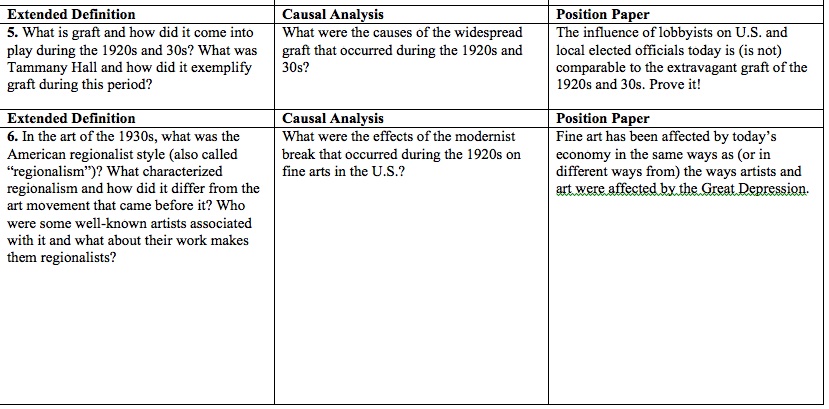
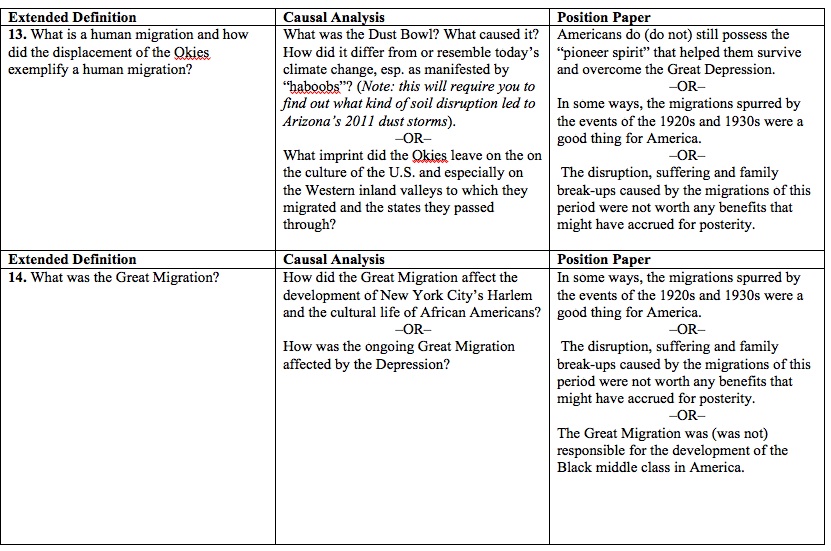
What took so long to rebuild the 102 course, then, was coming up with 90 workable paper topics about U.S. and international history of that period. Make that 90 linked paper topics, so that each student can write three papers on roughly the same subject, the issue being that unless they’ve done some of their research for the 2,500-word position paper early in the semester, they don’t have a chance of coping with a ten-page end-of-term paper. Videlicet:

Click on the image to get a readable view.

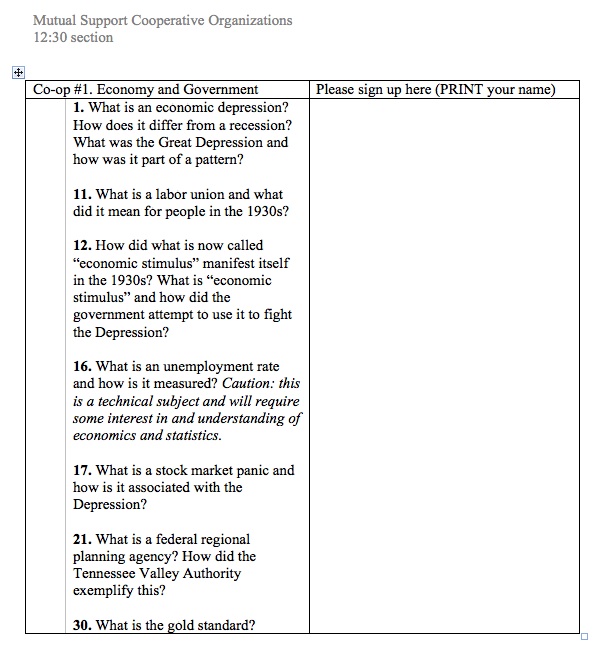
Mwa ha hah!!!!  I ended up with four pages of this stuff, which I printed out and scissored apart, horizontally across the landscape page. Come the first week of class, I’m going to hand out the sliced-apart topics and each student will get to pick one. With that in hand, she’ll have topics for all three papers assigned before the end of Week 1. They’ll have a sign-up sheet on which to record which set of topics they reeled in, so I also will know what they will be writing about all semester long.

Will they hate this? Ohhh, you have no idea how much they will hate it.

Will it mean I don’t have to read any post-adolescent ramblings about how the drinking age should be lowered to 18, how beauty is an internal thing, how medical marijuana should be made legal with no questions asked, how we should build an electrified fence along the entire US-Mexico border? Oh, yes.

Will they do a half-baked job on these papers? Of course. They’re just kids. But at least they’ll try. Some of them may actually learn something.

Better they should do a half-baked job on a paper that requires them to do some research, learn something about the world, and actually think about it than that they should barf out still more uninformed teenage drivel based on breathtaking ignorance and eye-glazing clichés. Or turn in their senior social studies paper for credit, for the eleventh time.

The drafts, comments upon which they ignore, are going away. They will have just one draft, for the first paper. Since even fewer of them have ever written an extended definition than have ever written a sourced paper (no joke!), the first paper of the semester is actually the most difficult for them, even though it’s only 750 words.

So we’ll do a draft on the first paper—no peer review, a pointless waste of time. This draft will be graded according to the same rubrics that will be applied to the final version, but since it will be worth only 50 points, a failing grade will have less effect on their final semester score than a flunking grade on a regular paper. I will then tell them that they now see what the standards are and how the papers will be assessed, and so henceforth it will be their responsibility, not mine, to put together a decent paper.

And that will bring a stop to the frustration of spending hours trying to help them succeed, only to have them paste the original clumsy draft into a Word file and turn it in unedited. It also will cut the grading workload in half.

Collaborative groups will go away (another waste of time!), except insofar as we’ll set up informal groups of people with roughly similar topics to function as mutual support groups. In keeping with the Depression-era theme, I’m calling them “co-ops.” They can commiserate with each other, help each other with research (to the extent that they figure out how to do research), and ask each other out on dates.

So. That was a bitch to design and write.

Naturally, I created some extra work for myself in the Eng. 235 department, too. Ruminating over the course schedule, I realized the order of the assignments was kind of self-defeating. It should go from the easiest-to-write type of magazine feature to the toughest, ending with something short that I can handle while coping with fifty 2,500-word research papers from the 102s. In fact it went from middling easy to difficult to simple to middling easy to the shortie. Reorganizing the order in which those papers occur entails rewriting the entire course. That didn’t take anywhere near as many hours, but it still ate up an entire day.

And now I still have to redo both courses’ websites. That probably will consume another three days. You understand, all of this work is done off the clock. The semester is over, and whatever I do for the college when class is not actually in session amounts to free labor.

Before I get to that, though, I’ve got to shovel the mountain of incoming paperwork off my desk and catch up with the bookkeeping I’ve neglected for the past month.

Is there a question as to why I never get around to writing the e-books I’d like to spin off this site?

Personal Finance, Academics, and the Perpetual Recession

Yesterday I came across a shiny new blog over at WordPress.com by a young academic working in the South. She calls it Budget Glamorous: Living Well on Less. (hmmm… What is it about academia that leads its denizens to write personal finance blogs?)

BG, it develops, is presently working in exactly the same position at her university where I started at the Great Desert University: as a full-time non-tenure-track lecturer.  Apparently the idea is considered relatively innovative in Appalachia, as it was here (more or less) when I hired on at GDU, said idea being that the school would hire a small cadre of moderately paid Ph.D.’s and M.A.’s to teach four-and-four or five-and-five, with no research & publishing expectation.

These jobs are paid one helluva lot better than ordinary adjunct gigs: you get a full year’s contract at pay that would be laughable in the corporate world but that looks pretty darned good to an unemployed wretch fresh out of six years in graduate school. I started at the same figure as the assistant professors in my cohort. By the time I left to found and direct the editorial office on the main campus, I was earning the median annual salary for Arizonans—not very much, but as a lecturer I was paid for only nine months of work. My pay, however, most certainly did not keep up with my cohort’s, by then at the associate level.

GDU already had a full-time non-tenurable position, which they called “instructor” and for which they paid shamefully. These were held mostly by ABDs and by women hangers-on, academic groupies who were having affairs with faculty members or who simply wanted a career on a university campus but for one reason or another could not get a position elsewhere. Once an incumbent finished the Ph.D., he or she was out of a job. So in effect, accepting such a position brought your academic career to a halt, in real terms.

The lecturership, by contrast, may be held indefinitely—one colleague at the West campus retired after about 20 years on the job. It has no future: you are not going to get a promotion, you are never going to get a shot at a tenurable position, and the only raises you will get will be COLAs, except that when times are tough (which is most of the time) there are no COLA increases. GDU lecturers earn about half of what a community college instructor here earns, with a comparable course load and much larger classes. To frost the cookies, you have no job security whatsoever: annoy a dean, and you’re canned with no appeal. The university can refuse to renew your contract and does not have to give a reason. No joke: this happened to a friend who got crosswise with a dean.

The advantages for the university are obvious: One lecturer can be made to teach two or two-and-a-half times the number of lower-division students that can be foisted on a tenure-track faculty member. Accrediting agencies look askance at large numbers of undergraduate courses taught by part-time adjuncts, and so hiring anyone at “full-time” status helps hugely at accreditation time. This handles the scut-work courses at a little higher cost than hiring adjuncts who will work for sweat-shop wages and no benefits, but the crucial importance of accreditation overrides that added cost. A lecturer in a non-tenure-track position can be canned at will, giving administrators a little more control over department, division, and college budgets…and a convenient political shilelagh. This came in handy at GDU when, as the current economic depression reached its height, some 550 employees were laid off, and as the layoffs continue to this day.

The advantage to the budding academic? A job. Even before higher education was pinched by the fall of the Bush economy, graduate schools were turning out many more Ph.D.’s in the humanities than there were jobs to accommodate them. There simply are not enough jobs to go around. A full-time junior-college opening can attract two or three hundred qualified candidates. So, obviously, unless you enjoy waiting tables or cleaning house, it’s much to your benefit to grab whatever academic job you can get, if it pays anything like a living wage.

Like BG, I enjoyed teaching as a full-time nontenurable lecturer, at first. I like students and in time found ways to mitigate the obscene workload. It was great for the first seven years. After that, political infighting led to the disintegration of our department and morale went south, fast. I started looking for other work, in and out of academe; it was three years before I managed to get myself into an administrative position on the Main campus.

The question is, if you know what you’re getting into, can one of these exploitive jobs be made to work to your advantage?

Possibly so.

If I were starting that position now, knowing what I know today, I would use the job as a springboard to another job, and I would work as hard and as fast as I could to find that other job. I would not delay just because I liked the teaching or felt grateful to have broken into academia.

If I wanted to stay in the university environment, I’d be angling for an administrative position, even it it meant getting another degree. The Ph.D. in an academic subject may or may not help you get into administration, but certain vocational doctorates indeed will.

You can get these degrees online or in low-residency programs. At GDU, I watched people move from underpaid nontenurable jobs to administrative positions after obtaining advanced degrees in educational administration or online course design. Most of the coursework was done online. An Ed.D., it develops, is as good as a Ph.D. in the job market—maybe better, if it has something to do with administration or marketing.

Meanwhile, I would apply for every tenure-track position advertised in the Chronicle, no matter where it is. I also would not be too proud to apply in the community colleges, where the same workload is rewarded with better pay and job security.

If I wanted to work in the real world, I would be looking all the time for any job I could convince an employer I could do. And classroom skills translate magnificently to the real world:

Communications
Publications
Management
Human resources (here, too, think online courses: get an online degree in human resources or management)
Personnel training
Online personnel training course design (where do you think they get people to build those see-Dick-run employee tutorials—and those annoying courses for traffic schools?)
Translator jobs (if you’re fluent in a second language)
Executive director of nonprofit
Development officer for nonprofit

Some industries that seem far afield of academia welcome academics as they welcome any smart, self-starting, ambitious individual. A friend of mine went into real estate as she neared the end of the doctoral program. She had a long and lucrative career selling spectacular high-end houses to the ridiculously rich. Another went to work for Peter Bogdanovich and became an executive vice president of Paramount Pictures. Two others went to law school—today one is a prominent immigration lawyer; the other went to work in the AG’s office. Another left a tenured associate professorship in communication to found a very successful personnel training business, for which she simply transferred what she had been teaching in the classroom into the corporate workplace.

And if getting a real-world job meant I had to walk from a nontenurable academic contract in mid-semester, that’s exactly what I’d do. A university feels no loyalty to its NTTT faculty (it’s an institution: it feels nothing), and so there’s no rational or moral reason not to move on when a less exploitive opportunity comes your way.