Two nice little checks for The Copyeditor’s Desk just came in: a payment from Google and a handsomer remittance from an editorial client. This brings the corporation’s bottom line to almost six grand, plenty to buy a new computer, which I’m going to have to do one of these days. When I tried the credit union’s new electronic deposit tool, it worked with no problem. So today I can deposit the cash that fell off those money trees without having to burn gas or time.
Time. Yes. We could all do with an infusion of that. One fiasco after another here: I’m working 18- to 20-hour days again, trying to cope with the avalanche of little disasters.
The misbegotten Blackboard has done it again. OMG, how I hate Blackboard; hate to the nth power! After half the world has upgraded to IE9 or Firefox 4, now IT sends out a notice that neither of these is compatible with Blackboard.
Actually, we might more accurately put it the other way around: Blackboard is incompatible with IE9 and Firefox 4.
Either way you look at it, it means a bunch of my students can’t get into my course sites unless they download Chrome or Safari. And one of those is a 100% online course!
I recently upgraded Firefox myself, but for reasons unknown, it only updated to 3.9, and so at least I can still get into the courses. If the upgrade prompt had installed 4.0, I would be screwed. The only way I could access the online course at all and manage the incoming papers from the face-to-face students would be to sit in the campus library, in a miasma of rhinoviruses floating on the air, for hour after hour after hour.
Well, no. Actually, I could get in with Safari, but it’s much less convenient. Compared to Firefox, Safari is a pain in the butt to use.
Yesterday I worked from three in the morning to after midnight, with a hiatus to stand in front of two f2f sections, creating new a website on WordPress.com to accommodate the online course. As some of you may recall, building the course in Blackboard took several months—indeed, the school paid me the equivalent of an entire course’s stipend to do that large amount of work. So, trying to move the course (and the two freshman comp sections) to a new platform in a matter of days is no joke.
I think, however, that it’s going to work.
The “Journalist” template will accommodate a lot of pages in the right sidebar. That’s good, because moving all the course materials over here involves posting 26 pages. That’s right. Twenty-six.
Below those, there are 15 sets of external links to sites ranging from examples of different article types to trade groups and job boards. The sidebar, in short, is toilet paper.
However, two students have said the material is more accessible than it is in Blackboard. That tells you something about Blackboard! 😉
The “subscribe” function will allow students to receive e-mail pings when new announcements go online, which BB doesn’t provide…well, actually, it does have an RSS function, but the District disabled it. Students have to proactively go TO their Blackboard site and physically scan up and down the front page looking for new posts. The straight, conventional blog format in WordPress allows new announcements to appear at the top of the page; if you post a “permanent” announcement in BB, it sticks to the top of the page and the weekly learning module updates get pushed below the fold, giving students the impression that no new announcements have come up.
Of course, WP lacks the assignment submission function and the grade sheet function. However, those are easily replaced. My plan is to set up a separate Gmail account dedicated exclusively to the online course, which will segregate student papers from the flood of spam that pours in from the community colleges. It will be easy to return graded student papers as “replies” to incoming Gmail. And as for their grades: a one-line spreadsheet with the functions built in will tell students what their current score is and show their percentage of total points. I’ll e-mail a blank spreadsheet to them and let them enter their own scores in their own little spreadsheets.
Meanwhile, two clients imagine I’m working on their stuff. One has an arcane problem with Word, which I may not be able to fix from my Mac.
Three sets of student papers are pouring in as we speak.
The Book Publisher’s Association thinks I’m going to mount their March newsletter, which is now three weeks late, in the arcane web publishing platform they use.
Now, don’t get me wrong. I love students. And I’m thrilled to meet the 52 new and returning freshpersons in this semester’s composition courses. But let’s be frank: reading student papers is something that causes one’s attention to wander. Easily.
It’s the brain’s self-preservation strategy: focus on this stuff nonstop and your synapses clog. You fall on the floor beneath your desk, unconscious. Inexorably, the attention wanders, the Internet beckons, the fingers wish to occupy themselves with, ohhh…knitting or paper-doll construction.
Blackboard, that all-but-ubiquitous collegiate course management system, is one of the great time-wasters of all creation. Feeling bored with reading student writing? Turn to Blackboard. There’s nothing like watching a page load for five minutes to instruct you on what boredom really means.
BB’s endlessly meddling administrators took it upon themselves to install new “blog” software (the function doesn’t really mount blogs, but it apes them in an oblique way). Was anything wrong with the old “blog” function? No. They just wanted to add a little bloatware, complicate our lives, waste a bit more of our time. Mission, we might add, accomplished.
After having strained every gut to get my spring courses built and online by the end of fall semester, what do I find when I reopen my BB courses by way of revving up for the first day of class? Yes. They’ve disabled all my blogs, which form a central part of each of my three courses. To get them back online, I have to sit through an endless “synchronizing” process…for each and every separate single individual goddamn redundant blog! Over and over!
Okay. Did that a week ago.
Get online today and find…what? Every blog I open goes through the same endless (“This may take a few minutes”) process…AND once the execrable things finally do load, there’s no way for users to create the entries they need to build for their assignments. So, send an inquiry to the admin who has been assigned to struggle with this program for us.
Go back to reading student papers.
Brain boggles. Cruise the local Play-Nooz sites, killing time by clicking thumbs-up or thumbs-down on the commentary. Gratified to see that Gabrielle Giffords is improving beyond what anyone could imagine.
Re-engage Blackboard on the blogging battlefield. Finally force it to bring up a “New Entry” button. Write new instructions for how to use the blog function; post these on all three course sites. Over and over and over again…
Read e-mail. Review the 46 college & district messages MacMail has already relegated to the trash; find that MacMail is right about all of them.
Learn from BB admin that now you have to instruct students to “save” and THEN “save and submit” to post a BB blog entry. Rewrite and repost instructions. Over and over and over again.
Begin reviewing intro papers and entering attendance and participation scores. By way of speeding the interminable grading process, I’ve learned to make a hard-copy notecard for each student, listing all the assignments with places to enter their scores. This is much easier and faster when you’re plowing through a random set of papers than trying to plod up and down BB’s endlessly reloading pages (which take you back up to the top of the grade sheet, over and over and over again…never stop saying you’re bored…). Once you’ve finished reading all the papers, all you’ve got to do is alphabetize the cards (easy to do when you’ve also numbered them) and then enter the scores quickly from top to bottom.
Problem: This entails handwriting 12 assignment titles 52 times; that would mean writing the same 23 mind-numbing words 624 brain-deadening times.
But wait! I recall I have a ream of heavy card stock, liberated from the Great Desert University when I abandoned ship. If I can recreate a set of 3 x 5 cards with a table, I can enter the semester’s assignments once and then just copy them to create a page of identical cells, which can then be printed out 26 times. It means I’ll have to cut these things apart with scissors, but somehow that seems less onerous than writing 23 mind-numbing words 624 brain-deadening times.
A lot like cutting out paper dolls.
Persuading Word to build a table with cells that measure exactly 3 inches by 5 inches without dorking things up is not as easy as it seems. Mind-numbing.
Enter in Google the following search string:
I hate Blackboard.
Dozens and dozens of sites come up. I quit scanning them after five pages of hits.
Enter in Google the following search string:
I love Blackboard.
Three sites come up, one of them titled “I love Blackboard—NOT.” One reports the results of a poll asking people whether they love or hate Blackboard; 7 percent report they love it, implying that 93 percent hate it. The third emanates from a site called blackboard.com.
Take scissors and cut out 52 notecards word-processed onto heavy stock. Fill in names and scores. Alphabetize and number cards. Enter students’ scores in Blackboard. Discover that in each spreadsheet, the endlessly redundant, space-and-time-consuming unwanted columns I marked as “hidden” have all come “UNhidden.” Click “hide” again. Over and over and over again (never stop saying you’re bored…). Hit “enter” to submit a grade and what happens? All the hidden columns get UNhidden. Again.
Other first-rate procrastination strategies: Google “evil Blackboard,” “useless Blackboard,” “frustrating Blackboard,” “annoying Blackboard,” “fu¢king Blackboard” (fill in the obvious character there), “farking Blackboard,” “godawful Blackboard,” “demonic Blackboard,” “accursed Blackboard,” and so on.
At last, you finish your work. A two-hour job has only taken you about five hours.
You have now killed a substantial part of the day. It is unclear whether you have wasted more time trying to do your job with an impossibly clumsy tool or whether you have wasted more time trying to distract yourself from the tedium of trying to do your job with an impossibly clumsy tool. Whatever. It’s time to get up, feed the dog, fix dinner, and go to choir practice.
One dares not reproduce this fine graphic, for fear of lawsuits from its creator or, more likely, from the megacorporation that promulgates Blackboard. But it expresses one’s sentiments nicely, after a day of educational time-wasting:
That’s it. This year I have one goal and only one goal: find a way to manage my time so as to get most or all of my work done and engineer several hours every day for exercise and healthy relaxation.
I’ve suspected for quite a while that one reason the belly has been a mess is the 12 to 17 hours a day I sit in front of a computer screen, seven days a week. As I sit here coping with the cascades of chores that each and every action spawns—and following my whim across the hills and dales of the Internet—the house gets dirtier and dirtier, the dog grows shaggy and shabby, the yard goes feral, and, on days that I don’t have to go out the door, I neglect even to take a shower or brush my teeth.
When M’hijito came over to spend the afternoon and evening on Christmas Eve, I had to get up and race around the minute my feet hit the ground. Along about 6:30, the dog threw up all over the bed and me—merry Christmas! So first crack off the bat, it was haul all the bedding out to the washer, scrub the barf off myself, clean the floor, and treat the sickly dog.
Since I’d managed to get a fair amount of housework done the previous day, the time between dawn and my son’s arrival was occupied with preparing the elaborate Mayan bean recipe I planned to take to the Christmas Eve choir potluck, which takes place between the 8:30 service and the midnight service, and then with a little light cleaning and dinner prep. This was all surprisingly relaxing, and for the first time in God only knows how long, my stomach didn’t hurt.
That confirmed my suspicion: getting off my duff, walking away from the computer early in the day and not going back to it has serious curative powers. The kind of work I do is endlessly frustrating, the sort of niggling little tasks that seem to beget scores of new tasks before a job can get done. Christmas Eve, for example, I sat down to do one little chore associated with next semester’s courses: enter in Google Calendar the dates and times I’d devote to grading next semester’s student papers. Ought to take about ten minutes, right? An hour and a half later I was still at it.
Fooling with a computer is like eating Crackerjacks. You can’t just do one thing. You start on task A and then discover that you need to do task B before you can complete task A, but task B leads to task C, which you know you’d better do right now or else you’re going to forget it, but task C entails task D, which you now have to do to make task C work and then you’re reminded you did forget task E so you’d better do that while you’re at it and…before you know it, three hours have passed, a beautiful afternoon is gone, you haven’t brushed your teeth or fed the dog or even pulled on a pair of bluejeans, and you’re running late for whatever you’re supposed to be doing in the real world. Like Crackerjacks, it’s bad for your teeth.
To say nothing of bad for your health and bad for your sanity. This has got to stop.
The question is, HOW? Except for about six hours a week spent standing in front of a classroom, almost all my work is done online. So I don’t do anything unless I sit down in front of a computer, and because of the self-replicating effect of computer tasks, the minute I do sit down in front of a computer, I’m trapped like a bug in flypaper.
It seems to me the solutions fall into two categories: drastic and not-so-drastic.
Drastic:
a. Quit blogging. I love to write and it’s gratifying to know that somewhere out there someone wants to read my maunderings. But it’s obscenely time-consuming, and the sense that you’re in some sort of competition for page rank, Alexa rankings, traffic, ad revenues, and whatnot is absurd and destructive.
b. Take my classes completely offline. Abandon the online magazine writing course and stick with freshman comp. Junk the monstrously time-consuming, brain-blasting, hair-ripping Blackboard and do everything on paper. Don’t let students anywhere near a computer, and refuse to answer e-mail from the little darlings.
Not-so-drastic:
a. Never turn on the computer until after the dog is fed, the human is washed and fed, the house is picked up, and the human and the dog get at least an hour of exercise. In personal finance terms, this would be like paying yourself first—retrieving some healthy savings out of your budget before you start spending.
b. Set an alarm clock to go off after about two hours of crack-of-dawn work. At that point, stop working, get up and get going. If a blog post doesn’t go up in the morning, it just doesn’t go up.
c. Schedule blocks of time to do specific tasks.
We know that scheduling blocks of time for specific tasks works only marginally. If I’m not done with something by the end of its scheduled period, I’ll keep on working, consuming the planned free time with…yes, more bug-in-the-flypaper time! We know that if I finish a task before a block of time ends, it’s far more likely that I’ll start Stumbling or pick up some other computer-oriented project than that I’ll get up and clean house, clean me, or go out for some fresh air. So that’s off the list right now.
I suspect the alarm clock ruse will have the same effect: I’ll just turn the nuisance off and continue with whatever I’m doing.
The idea of resisting the computer until healthier things are done has its blandishments. The problem there is that it will cut into the number of hours left to plow through the daily 12 or 14 hours of work. This will lead to more impossibly late hours, which grows tedious. By 10:00 or 11:00 p.m., I’m so sick of working I start to hate the work itself.
I’m not real thrilled with the idea of junking Funny about Money. But it has to be said: that would return two or three hours a day to my life. Often I ask myself what else I’d be doing. But the answer is obvious: cleaning the Funny Farm, taking care of the garden and pool (which as we scribble needs to be backwashed), bicycling around the neighborhood, walking the dog, or climbing a mountain.
As for taking all my classes offline…hmmmm…. Grading papers electronically hugely speeds that dreary task; when I first started using Word’s “track changes” and “comments” functions, I found it took about 30% less time to read a set of papers online than it does to grade them by hand. At the time, however, my institution used FirstClass, a much simpler course management program than the bloatware that is Blackboard, and at one point I even built my own website in MS FrontPage and had students submit papers by e-mail. Blackboard should be renamed Blackhole, because that’s what it is: a black hole for instructor time. It vacuums up hours like a warp in the space-time continuum.
This semester instead of having the freshmen do most of their work online, I sent every one of their learning assignments over to the copy center and had them printed out as a gigantic course packet—59 pages, not counting the 12-page syllabus and the three-page calendar. Instead of having them do all that busywork…uhm, all those learning experiences through Blackboard, which requires me to look at the junk and pay students to do it in the currency of the classroom (grades), I’m going to make them do this stuff in the classroom and then go over it in class, forcing them to LOOK at it and discuss it. This will occupy a great deal of otherwise vacant class time and make them look twice at the exercises (when under normal circumstances they glance at the stuff once, through glazed eyes).
Instead of grading the stuff, I’m going to collect exercises at random, so they never know when they may or may not get a score for what they do in class. Raw fear should keep a few of them awake. And as the University of Phoenix does, I’m going to tell them that the exercises are there to help them succeed in the course, and that those who do the exercises will perform better on the (much more heavily!) graded assignments. This strategy cuts the number of columns in my grade book from 21 to 11. So that may be useful.
How to engineer this for a course that’s completely online, I don’t know. Because my tenured colleague, whose course this really is, wanted me to assign four full-length magazine articles instead of the two plus exploratory projects I’d built into the eight-week course, I dropped the drafting and peer reviewing stages, the cumulative daily brainstorming exercise, and the in-depth market research project. However, having discovered that like most beginning freelance writers these folks are stunningly stupid about crafting an article to fit a market, I had to build and include a market research assignment for each article. This left, despite the cuts, exactly the same number of assignments to grade as last semester: 15.
The solution to that, obviously, is to drop the online course. This would cut the total number of papers to grade from 36 to 31; the trade-off would be an extra three hours a week in class, plus commute time. Probably not worth it.
What to do?
Overall, I think the most conservative and reasonable strategy to try first is staying away from the computer until a few hours of living a life get done.
This will mandate that on some days, blog posts will not happen, or they won’t happen until late evening. But that may be a good thing: more readers seem to see and comment on posts that sit online for a couple of days. While content may still be king, when you’re cranking a post or more a day, you may actually be losing your readers in a fog of copy.
If that doesn’t work, then I’ll have to make a major change in the way things happen around here.
Image:
J. C. Leyndecker, Saturday Evening Post covers. Public domain. Layout found at Lines and Colors. Father Time with Baby New Year. Illustration from Frolic & Fun, 1897. Believed to be in the public domain.
Hurrah! Finally finished grading papers last night! The papers are read and semester grades are online, and after about two more days needed to wrestle three new sections into Blackboard, I won’t have to think about school for a whole month! Mirabilis!
Like most things that are any fun, teaching is poorly paid. But it sure is a hoot! I love students, even when they’re up to no good. This semester the 101s were full of mischief. We had not one but two hilarious ringleaders, one a young woman whose mouth absolutely refused to stay shut no matter how hard she tried to keep it under control, and the other a boisterous young man whose lifelong job title, clearly, will be “Life of the Party.” In these circumstances, I don’t bother trying to suppress them; instead I play along with them and use their energy to drive one teaching moment after another. Though this requires more work, it’s entertaining. Makes for a very noisy classroom, but my theory is that when they’re too quiet they’re asleep.
The online magazine-writing course went reasonably well. A great deal more boring to teach, alas—but at least it doesn’t require any driving. Or any shushing of bouncing blondes! Quite a few students dropped, but those who survived did pretty well. Some of them were actually writing at a publishable or near-publishable level by the end of the term. My co-conspirator taught a hybrid version of the same course in first eight weeks of the semester, and she reports that a lot of her students dropped, too. She made them write five articles, which is quite a few for such a short course. I inflicted only two on mine, but made them do market research, write queries, and jump through one prewriting hoop after another. If we’d had sixteen weeks, I probably would have made them write four feature-length articles and a brite. But eight weeks is, IMHO, too little time for a nonprofessional writer to get a running head start on more than two or three 800- to 1,500-word pieces with queries, interviews, and other research, plus exams on the reading material.
Now it’s time to go sing. Hallelujah, brothers and sisters!
😀
Image: Interior of the Francis M. Drexel School, from John Trevor Custis,The Public Schools of Philadelphia. Public Domain. Says the contributor who posted this
on Wikipedia:
The interior of the Francis M. Drexel School in Philadelphia from the Custis book, published in 1897, p. 435 (original numbering) – out of copyright. Available at Google Books. I’ve downloaded a jpg format (rather than pdf format) taken from http://www.thedrexelschool.com/ sub page “History from 1888” (clearly the same photo from the same source). Notice the gaslights in the classrooms and the moveable classroom walls that have been folded up and stored.
Am I the only unemployed person on the planet who’s working like an animal so as to get a break from working like an animal?
Under normal circumstances, I’ve been working 14 to 17 hours a day on my various underpaid enterprises. Since Fall semester began, I’ve had to let FaM slide, simply because there aren’t enough hours in the day to do all the work I was doing on the blog and keep up with three classes and edit arcane copy from the academic set. It’s all I can do to crank one idle essay, not very personal-financeish, each day; I’ve minimized the Alexis toolbar; and I never did figure out how on earth to get into the Yakezi site, so I’ve presumably fallen off that outfit’s rolls. People keep tweeting me that they’re following me on Twitter, and if they’re clearly PF bloggers, I’ll return the favor…but who has time to post on Twitter and Facebook???
{whine!}
So, by way of resolving this whine, I’m determined to give myself a vacation during the winter break, instead of spending the entire month between mid-December and mid-January working nonstop to prepare courses. It takes days to get one of these things lined up, each day planned for, a 15-page syllabus written, a three-page calendar constructed, and everything set up in the endlessly difficult Blackboard.
I’m almost done with the spring English 102 sections, both of which are in-class face-to-face sections. I’ve come up with a number of strategies:
1. Make almost all the learning exercises and quizzes zero-credit affairs. Tell students it’s their responsibility to learn the material, that they’re expected to demonstrate mastery of the skills and knowledge imparted, and that if they expect to get decent grades on the papers they’ll be well-advised to do these things.
This will relieve me of a vast amount of ditzy grading and score-keeping. It cuts the number of grade-book columns from twenty to nine.
2. Convert the exercises and quizzes from open-book homework to in-class activities. Have students spend half the endless class period working them and then use the rest of the time to discuss them.
This turns every no-credit exercise into about 75 teaching moments. It relieves me from having to figure out how to keep them entertained to fill 40 hours with lecture.
3. See to it that the only graded assignments are those that are required by the district: the drafts, the peer reviews, and the final papers, representing the so-called “recursive process” applied to three required papers.
Why give myself extra work if it’s not required? Especially since I’m not paid to do extra work!
4. Load the final paper, which is 2,500 words long, with three times the credit of the two shorter papers, each of which is 750 words. Their final paper will carry 300 points and the two lesser papers 100 points.
Believe me when I say this will get their attention.
5. Require that drafts for the two shorter papers be at least 300 words long, and the draft for the final paper be at least 500 words.
This will eliminate the conundrum of what to do with students who slop together half a paragraph or a crude outline and expect me to waste my time assessing it.
6. Up the score value of the peer review exercise to 50 points, the same as the drafts themselves. Require students to follow a page-long set peer review guidelines to get full credit.
This will make it clear that I don’t have to assess the classic one-line “peer review” that says, succinctly, “This is very good. I saw a few grammer [sic] mistakes.”
7. Create a simplified grading rubric for drafts and peer reviews:
50 points: author does an honest job of filling the assignment; peer reviewer follows the entire set of guidelines.
40 points: author comes somewhere close to 300 words and at least looks like she or he is trying to get a decent start on the assignment; peer reviewer follows most of the guidelines.
35 points: half-baked job.
30 points: inadequate, but at least the person turned in a few words.
0 points: couldn’t be bothered to turn in anything.
8. Lose the computers delivered to the classroom. Limit in-class computer activities to drafting and peer reviewing, cutting the number of computer days from thirty-two to nine.
Having laptops delivered to the classroom turned out to be quite a hassle. And if the class consists entirely of 18- and 19-year-olds and does not have the counterbalance of older students, laptops in the classroom represent an invitation to party.
9. Remove all due dates from listings and descriptions of assignments online.
Contrary to what we’re taught by our course designers and urged to do by the administration, posting elaborate “modules” does little for the students, who don’t read them, and creates vast amounts of extra work for instructors. To recycle a Blackboard course, you have to spend untold numbers of hours combing through each section, subsection, and sub-subsection finding and changing the dates you stupidly inserted.
After this, there’ll be only two places where dates will be visible: the syllabus, and a week-by-week calendar. I have to rewrite those each semester anyway. This will make it simple to recycle courses; effectively all I’ll have to do is copy content from one BB shell to the next and then add the current syllabus and calendar.
10. Lose the endlessly annoying G.D. Blackboard quizzes! Convert them to ungraded in-class exercises.
These hateful things, while they conveniently provide machine-generated grades, are difficult or impossible to copy over and take hour after hour after interminable mind-numbing hour to reproduce each semester. Turning them into hand-outs to be used as the basis of in-class discussion will bring a stop, also, to the quibbling over scores on the things.
11. Combine the entire semester’s worth of hand-outs, quizzes, exercises, syllabus, and calendar into one gigantic PDF package, and send it to the copy center before the start of the semester.
This will eliminate countless fillings-out of copy center forms and countless trudges up and down the stairs to the copy center.
I can’t even count the number of hours I’ve spent trying to accomplish these steps—hours crammed in around the other hours devoted to keeping up with the courses, editing, and blogging. But I think it’ll be worth it: massive simplification should cut the amount of time I have to spend on teaching next semester, with little or no effect on the students’ learning. If anything, it may actually improve learning, since the students will have to focus on learning exercises in-class, rather than flaking off with them whenever they feel like it. Over time, too, it will cut the amount of work needed for course prep, since it effectively puts the courses in tin cans—all I’ll need to do in the future is write a calendar and change the due dates in the syllabus.
Hope it works.
Meanwhile…time to grade papers!
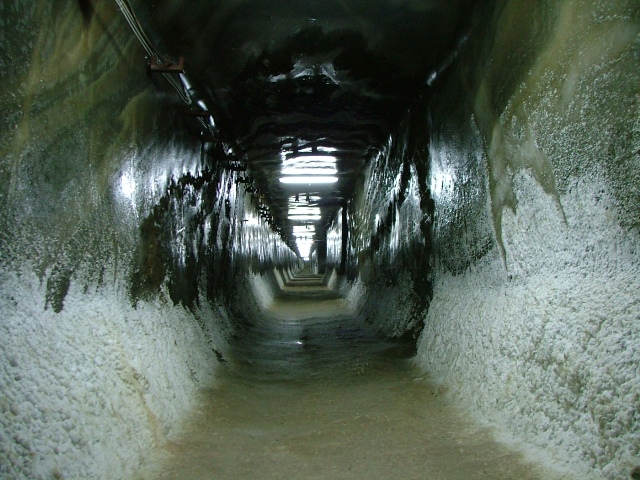
Image: Turda Salt Mine, Turda, Poland. Roamata. Public Domain.
Welp, my pay statement went online this morning. Thanks to PeopleSoft’s accursed lagging pay system, it only goes to the 15th. So I don’t get paid for this past week of teaching two sections.
The fine grand total? $448.87.
With Social Security confiscating an entire month’s pay for the crime of earning enough to owe $340 in extra taxes, I had to eat way into my catastrophic emergency fund to pay this month’s bills—and this month isn’t over! Next month SS will deduct $222 instead of $111 for Medicare, leaving me with just barely enough to cover basic living expenses…assuming PeopleSoft bestirs itself to pay out what the College will owe me for both November pay periods. I’m $70 in the black right now, if you don’t count the fact that I transferred money from tax & insurance self-escrow savings to get that way, but I’m going to have to come up with about $555 to cover food and gasoline charged on AMEX. So in fact at the moment I’m $485 in the red.
Truth is, I couldn’t have made it anyway. The amount I transferred out of tax & insurance savings was $18 more than the amount of my net Social Security income.
Except for one lunch out and $5.88 for some gardening supplies, I’ve bought nothing other than food, gasoline, and a couple of small pool maintenance items. We had the hottest September on record, the power bill was $174, probably low compared to what others around here pay—while my neighbors’ units thump way 24/7, I sit in my house and swelter all day, turning the air-conditioning down to 79 at night so I can sort of sleep.
In November, by transferring over the second of three monthly prorations of net summer stipend money and pushing the accounting for October AMEX charges forward a month (this month’s bill isn’t due until the 11th), I’ll just have enough to pay bills. It’s robbing Peter to pay Paul again—October’s charge account bills should be paid with October income, not with November income. But if I buy nothing but food and gasoline in November—say goodbye to Thanksgiving dinner and Christmas gifts—by the end of November I should have caught up. In December I will not get two full paychecks, and so I’ll sink below the waves again then.
This is happening because the long summer with no teaching income drew the excess that I collected through the spring semester of penny-pinching down to almost nothing. Income from one course in the first eight weeks of the fall semester, even though paychecks were doubled up because that course extended over eight weeks instead of sixteen, was not enough to cover expenses, and so the amount available to spend dwindled into the negative numbers.
Meanwhile, I’ve got to go to the doctor. Six weeks of self-medicating and waiting have not helped whatever ails me. I have no idea what that’s going to cost, but I’m afraid that anything will be more than I can afford. Whatever expenses come from that also will have to come out of savings. Plus any tests or treatment that require time away from the classroom will result in pay being docked.
Adjunct teaching plus Social Security just simply won’t support me. I’m going to have to start drawing money out of retirement savings, which at this point is still about as contraindicated as contraindicated can get.
Well, I guess I should start looking for some sort of work that will pay a pittance year-round. I can answer phones and do secretarial work. With the arm out, I can’t stock shelves or do any other very physical work. I need about $20,000, but that’s what full-time secretarial work pays around here. If you can get it.