
Have you seen this amazing story in the Times? In short, it reports on the custom of drugging kids who have no attention deficits or psychological disorders in order to make them sit still in class. Says one doctor who advocates this practice: “I don’t have a whole lot of choice. . . . We’ve decided as a society that it’s too expensive to modify the kid’s environment. So we have to modify the kid.”
We already know that rich kids dope themselves with stimulants to enhance already perfectly fine grade averages, so as to up their chances of getting into elite universities. Now, though, as if that weren’t stupid enough, we’re talking about drugging all the rest of the kiddies…why? So they can get into the local community college? Or more to the point, so they’ll sit down and shut up while their teachers try fruitlessly to wrangle “classes” of thirty or more grade-school children?
As a culture, we now drug our citizens from nativity to senility.
What do you take at this point in your life? Dollars to donuts, you’re on something. It’s not surprising: 90 percent of Americans take drugs for one or more ailments, most of them described as “chronic.”
If you’re not swallowing pills every day, you’re an odd duck. I speak from experience. Because of a familial tendency to stay away from doctors unless I’m sick or hurt, I’m not on any medication. And every time I go into a new doctor or dentist’s office or talk to a new insurance agent, where they make me fill out a two-page checklist confessing to any of scores of diagnoses and then list the prescription drugs and OTC nostrums I’m supposedly gulping down, the staff invariably expresses astonishment.
“You’re not taking anything?”
“Uh…no.”
“That’s amazing!”
I’m sure.
Yesterday an insurance agent called to try to talk me into changing my Medicare supplemental carrier. She said I would have to undergo low-level underwriting, since, after your first enrollment period, Medicare supplement insurers do not have to accept Medicare recipients willy-nilly. She explained, as if to a child, that I would be asked to answer several questions about my health problems. What were they, by the way?
“None.”
“None? You don’t take any medications for anything?”
“No.”
“You don’t have diabetes?” (Flabbergasted tone.)
“Well, no.”
Jayzus.
This kind of thing started when I was about 40. At first, no one could believe I wasn’t on hormone replacement therapy. Being a skeptic, I willfully refused, despite my gynecologist’s assurance that if I would just take these nifty little estrogen pills I would be protected against cardiac disease for the rest of my life, I would be able to screw anything that wore pants until I toppled over into the grave, and my face would never get wrinkles.
No joke. He bought the HRT salesman’s pitch, hook, line, and proverbial sinker.
Soon no one could believe I wasn’t on beta blockers, Drano in a pill (that would be the stuff they foist on you to prevent osteoporosis, which of course you’re going to get because you’re a postmenopausal woman), antidepressants, cholesterol meds, blood pressure meds, megavitamin supplements, estrogen, calcium supplements, vitamin D supplements, or any of the myriad woo-woo herbal snake oil concoctions that grace every grocery store and drugstore’s shelves.
Do you realize that Benadryl is routinely used to sedate and “calm” elderly residents of care and nursing homes? I take it myself, on evenings I think I’d like to sleep past 3:00 a.m., when the internal alarm clock goes off. It knocks you out quickly and effectively. But the stuff isn’t used in care homes to help people sleep; it’s used to keep the inmates under control, because when you’re not sleeping after you’ve dropped one of those nifty little pink tablets, you’re in a haze. And it has a particularly dire side effect for the elderly: it can cause cognitive dysfunction (we of an earlier generation call that “senile dementia”) or aggravate it if the person already suffers underlying dysfunction.
It’s used on old people who don’t need it for the same reason Adderall and the like are used on kids who don’t need it: to make them compliant within an institutional setting.
And why is any of that stuff used routinely? To enrich pharmaceutical companies, by and large.
Particularly telling, I think, is the cost of prescription meds in this, the most overmedicated country of a medicated world: U.S. residents pay six times what Canadians pay for the same drugs, and many times more than that for the same drugs sold in in other countries. Big Pharma has a vested interest in seeing to it that every one of us gulps down as many pills as possible. All the time. And Big Pharma has deep enough pockets to make that happen.
I suspect that about 90 percent of the drugs we’re all expected to take—to get on at a certain age and stay on for the rest of our lives—yes, about 90 percent of it is unnecessary. Some of these chemicals no doubt are not even very good for us—witness the late, great miracle of HRT. We have got to be the most overmedicated population in the history of humanity!
Do they keep us alive longer?
I’ll bet not. Not unless you have a truly life-threatening disease such as diabetes or cancer, one that can be treated successfully with long-term pharmaceutical therapy.
My great-aunt and great-grandmother were Christian Scientists, a little wacky in the head about what God would and would not elect to do. Their peculiar religious beliefs led them to abjure doctors and medications—not such a strange idea for a couple of women who grew up in the late 19th century, when the practice of medicine was akin to the practice of voodoo. Neither of them ever took a medication in her life. And they each lived to their mid-90s. Great-Granma hosted a dinner party for a dozen people, scrubbed the kitchen floor at midnight, and then went to bed and died in her sleep. Great-Auntie died a few days after returning from a trip to Hawai’i.
My father, who smoked and drank and had what people in our time would regard as a pretty hard life, lived to 85, as did both of his brothers. They did not take pills. My father’s idea of medication was a dram of Scotch. His brother Ed did not smoke, did not drink, and had a quiet enough life with a quiet enough wife in a quiet enough Dallas suburb. His brother Charles smoked and drank and had what people in our time would regard as a damn hard life. They all lived to exactly the same ripe old age, kicking vigorously right up to the end.
If you needed to take drugs to stay well and alive, then my father, my uncles, my aunt, and my great-grandmother should have croaked over at about 50, no?
It’s a brave new world, my friends, a brave and dystopic one where all of us think we need to gulp down pills to make it through our days to the end of our God-given lives.
If there is a God, may She help us all.
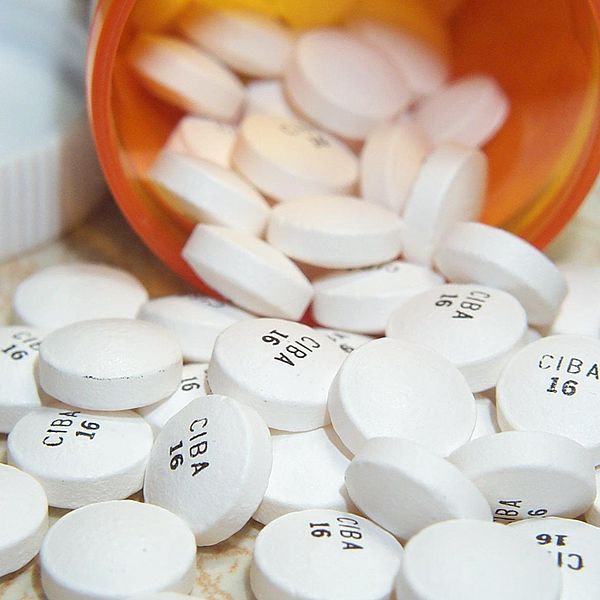
Image: Ritalin. Sponge. GNU Free Documentation License.
I think you need to be careful about generalizations. Just because three of your relatives lived to a ripe old age doesn’t mean that medication is unnecessary in the majority of cases. It means that they were very lucky.
Humans tend to take the anecdotal over the obvious. Few people muse about all the people who DO die of heart attacks because they didn’t take care of themselves. Just like we don’t mention all the heavy smokers who die of lung cancer. What we recall are the cases where someone smoked and drank until age 90+ without issue. We remember the cases where the person with lung cancer never smoked a day in his/her life.
I’m not saying this society doesn’t have too many pills. We shouldn’t be doping kids, and our first step shouldn’t be shoving pills down anyone’s throat, unless there’s an imminent risk to their life (diabetes, suicidality, etc).
That said, I’m on medication for being Bipolar II. I will be for the rest of my life. I could (probably) survive without it, occasional suicidal spell aside, but I don’t want to.
And there are depressives out there who won’t even reach the suicidal point. But you’d better believe their lives are better for it. And some women may not need meds to guard against osteoporosis, but something like that… Well, I understand taking preventative measures.
@ Abigail: Well, I’d say if you’re depressed enough that you seriously contemplate suicide, that comes under the heading of “a truly life-threatening disease.” Thus the meds you’d be taking clearly are NOT unnecessary–assuming they actually do help you to pull out of the depths of a depressive episode. Under those circumstances, an effective psychotropic drug would be as necessary as insulin is to a person with diabetes.
The question is, should we be putting 9.5 percent of America’s school children (that’s the figure now, and it’s growing) on pharmaceuticals so as to make them sit still in a classroom, making them adapt to the institutional environment that is our educational system, or should we be adapting our educational system to accommodate children, for whom it may actually be normal to feel bored and restless when cooped up in a classroom? Should we be putting women on drugs that have serious potential side effects because they might (or might not) become osteoporotic? Should we have been trying to put premenopausal women on estrogen because we imagined it would free them from the normal manifestations of menopause and magically keep them “young”?
Science and medicine has given us so much, but the pharmaceutical approach to living is a mixed blessing. I believe that many docs are very quick to pull out the prescription pad.
I’m 45, and I’m taking two prescription drugs on a regular basis: Thyroid and B-12. The thyroid medication is, I think, pretty self-evident: without it I drag around in a fog, constantly fatigued and with painful joints. The B-12 is a prescription because I have to inject it every week; although I eat plenty of food with B-12 and have tried oral supplements (including the drops and oral solubles), the only way my B-12 level stays in the healthy range is with regular injections. (Sadly I seem to have lost the ability to digest B-12, and while this is pretty common in much older people, I’m not sure how I ended up here in my early 40s).
The frustrating thing for me, though, is that I had to drag along for a year until I was directed to a doc that would sit down, listen to me, and really *work with me* to figure out what was going on. My in-network primary care doc to whom I went when I was first having symptoms of low B-12 and thyroid deficiency ran blood tests, but missed the thyroid result somehow. (B-12 was never tested, nor was D until I went to an allergist in an attempt to figure out WTF was going on.) That doc was very quick to offer me an SSRI (anti-depressant), suggested I go to WW for the weight I was gaining, and told me to basically take Claritin D every day because I *probably* had allergies. I declined the SSRI and finally went to the allergist on my own ’cause I was fed up with having to visit the pharmacy so damn often to show my ID, sign for, and buy the little packages of Claritin D (thanks meth-heads for that!). It was the allergist who started me on the way to regaining my health. He tested me for much more than allergies and found that was barely allergic to common things (dust, dust mites, mold), but severely B-12 and D deficient and borderline thyroid deficient. Bless that man!
My current (out of network and more expensive) doc believes in less pharma, too. She suggested the non-synthetic approach to thyroid replacement (thank you pigs for giving me your thyroids!) and besides trusting me to inject the B-12 myself, she has me on mega-doses of Vitamin D since my levels fall to the bottom of the range without it (pale-skinned office worker in a northern city…kind of expected). I guess I could quit my well-paying office job and get one that has me laboring outside and I may be able to drop the D supplement. 😉
My BF, on the other hand, is on a whack of meds. Yes, it does bother me a bit since I think some of them are prescribed for overly cautious reasons and for things that could be better controlled through exercise and diet (yes, he’s on a beta blocker…sigh). His choice is to take the pills, though.
@ Linda: We’re told that most Americans who live in northerly latitudes are likely to be vitamin D-deficient, especially now that we’re taught to slather ourselves with sunscreen (which blocks the natural synthesis of vitamin D as a reaction to sunlight). Apparently darker-skinned people are even more at risk of this deficiency in northern climes, since the melanin that protects the person’s skin in the tropics also blocks sunlight to a degree. That’s why I refuse to use sunscreen, too.
Like you, I don’t wear sunscreen unless I’m in extreme conditions. Working in my backyard garden, I don’t put anything on. But on a recent trip where I spent a lot of time in the California sun, I put some sunscreen on since I was getting very red. Sunscreen is another blessing/curse. I think routinely slathering it on to avoid wrinkles and signs of aging is just vain. If I ever have cancerous growths removed (like my fair-haired mother) I may change my mind, though.
@ Linda: My skin is fairly dark–“olive,” I believe, is the term. Until I started taking the birth control pill, I rarely would sunburn, and today, after 35 years away from it, that’s more or less true again. Now that I’m old, though, my skin is more fragile. I swim in the early morning and after dark, and generally will wear a hat when I’m gardening. But I don’t wear clothes that cover every inch when I’m outside. Plus I live in one of the sunniest regions on the globe.
If I were blonde or red-headed, or one of those brunettes with a porcelain complexion, I think I’d be a lot more careful, though, especially around here.
I agree. It’s ridiculous. People are all hopped up on meds and get their kids taking all that crap too. I think if people would take care of themselves and not get overweight, they wouldn’t need so many bp, heart, diabetes, etc pills. Do people realize that back in the day no one took any pills? And somehow humans made it! People are wussies and they believe anything they see on TV. It’s ridiculous. I agree.
Well, we do have a slightly longer life expectancy overall that we did, say, a century ago. However, it’s not as much longer as it appears, because those statistics are influenced by infant and child mortality rates, which were much higher before the discovery of antibiotics.
Diabetes is extremely serious, and it’s unclear whether this is truly a lifestyle disease. My other great-grandmother, for example, died of late-onset diabetes, long before there was any such thing as insulin to be had. They lived on a subsistence farm in upstate New York, so you can be sure they did a lot of heavy physical work. My mother (who was mostly raised in their household), said about all they had to eat came from their garden and flock of chickens. So probably they didn’t have a lot of rich food. In this part of the country, members of Indian tribes of the low desert tend to have astonishingly high rates of diabetes, possibly because their bodies are adapted to feast-and-famine environmental conditions and a steady diet of grocery-store foods throws their metabolism out of whack–pretty clearly there’s a genetic component that has little to do with what you choose or don’t choose to eat.
It’s not the life-saving drugs that seem to me to be unnecessary. It’s things designed to alter non-life-threatening behavioral issues, minor comfort issues that one could adapt to easily, and ailments that really are not going to stick with you for the rest of your life or that will pass on their own without wacking them with a drug.
Count me in as one who is generally non-prescription-medicated, at least currently. I had been on a couple rounds of prescribed anti-inflammatory for a chest condition (Mobic, I think), but it’s done exactly bupkis for results. I’m now experimenting with controlling aspects of diet, and see if that has any effect: less omega-6s, less dairy, etc. Probably will work as well or not.
As for other types of medications, I’m on board with your Dad: now on the way to get properly medicated with a dram or two. 🙂
When I read that article this morning I couldn’t believe it. I got so incensed. Medicating kids so they behave isn’t good – if a babysitter gives your kid benadryl to go to sleep (this happens!) you wouldn’t hire them again. Why let an MD do something not that different?
That said, I am on way too many meds – and I’m still *young*.
I take the “no-baby” pills, no arguments there.
But growing up without humidity, I became “allergic” to mold. Enter 2 Rx nasal sprays to deal with my relatively rare hyper-reactivity to mold. Now I can breathe, great!
Except one of the nasal sprays gives me cystic acne. So I have an Rx to apply to my chin for that.
And I just recently started using a Rx topical cream (actually used for arthritis!) to help relieve the chronic inflammation from disc damage from a car accident.
With the exception of the “no-baby” pills, I use 1/3 or so of the amount that is prescribed for each of the meds – but I still can’t believe that over the last 18 months I somehow ended up on 5 Rx meds. And I am NOT what you would consider unhealthy.
Craziness.
I did the “no-baby” pills for many years, but then I came to the conclusion that there would never be a baby. So I had that permanently addressed and went off the meds. I understand you can also get an IUD to control fertility temporarily. I suspect that 20 years of hormonal birth control had some detrimental affects on my body and would encourage anyone wanting to control fertility for more than 2-3 years to look to non-hormonal options. My GYN was very discouraging about a an IUD, but I understand many are not. http://drjengunter.wordpress.com/2011/04/22/4-common-iud-myths-dispelled/
@ Linda: I used one of the early contraceptive pills, Ovulen 21, for seven years. It caused my skin to become photosensitive, caused amazing two- and three-day-long headaches that were so blinding I could barely force myself to function, and made my boobs chronically sore. When I would complain to the gynecologist about the skin thing (I didn’t make the connection between the headaches and the pill, because we were told the pill had no side effects), I was little-womaned. Later I tried an IUD: that lasted about four months. The pain was just astonishing! And it never went away.
I’d love to be able to use one of those topical creams; unfortunately after years of taking aspirin, ibuprofen, and acetaminophen for every little ache and pain, I’ve developed an allergy to all three of them and, my doctor thinks, probably to all drugs in those classes…and that’s what’s in the creams. Another good reason not to take OTC or prescription drugs unless you really, TRULY need them: save them for the day when you do need them.
Linda is right: IUDs are pretty common. They don’t *love* giving them to women who haven’t already had kids, but it’s still pretty common. And many of the IUDs are non hormonal, plus easy to remove when/if you decide you are ready. In the meantime, you have up to 5 years of no no-baby pills.
Funny, your posts don’t make your Christian Science relatives sound “wacky” at all. On the contrary, when you mention them, they sound vibrant, active and excited about Life. When I read your brief references to them, it seems we might all want to aspire to be their kind of wacky!
(Although as a CS student, I would feel that way — can’t say what God would or would not elect to do — just what seems the nearest right for me.
@ Martha’s Child: They were remarkable women, particularly my great-aunt. Their failing, where CS was concerned, was that they didn’t understand that you really can’t project your faith onto another person, even if that person is your child. My cousin’s foot was run over by a streetcar–he was saved from being killed when a passerby managed to leap into the path of the train and push the little boy out of the way, but his foot lagged and was horribly mangled. Doctors advised her to let them amputate the foot at the ankle, but she would have nothing of it. So the child suffered for years. Finally in middle age he went in and had the foot taken off, relieving himself of a great deal of crippling pain.
However…where they themselves were concerned, they did some amazing things by the sheer power of faith. My great-grandmother had some kind of arthritic condition that had her pretty much confined to her rocking chair most of the time. She managed to pray herself out of it…by the time I knew her, she was in her 80s and she was a powerhouse, maintaining their house and walking to the top of a steep hill several times a week to shop for groceries, which she hauled in one of those granny carts. She had another ailment, apparently some sort of post-partum thing, that she somehow prayed herself out of, although for all I know that might have been something that would have resolved itself in time anyway.
On the other hand, my grandmother died of uterine cancer because she didn’t go into a doctor until it was too late to treat her.
When I read articles like the one you linked to, and then the generalizations that are said about how ADHD isn’t ‘real’ and parents criticized for drugging their children with Ritalin or Adderall – I get worried.
Yes, there are people who abuse these drugs – but there are children (and adults) who absolutely have ADHD or ADD and for whom these drugs are a necessity in order to function.
My brother has been on Ritalin for for about 24 years now, and Wellbutrin for about 14 years. When he doesn’t take his medication, he cannot focus, has major problems with impulse control and behavior problems.
My brother is the youngest of 4 kids – each of whom was different in personality and behavior – she knew her youngest was different from the time he was 3 weeks old – and while she had concerns about medicating her kid – it was clear that he needs these drugs.
People like to make sweeping statements about what ‘should’ or ‘should not’ be done – but every case is different. My concern when these stories come out, is that there will be a backlash, and children who need these medications, won’t be able to get them – or that there will be a stigma associated with them, and parents won’t be willing or able to get what their kids need.
@ spiffi: The post doesn’t deny that ADHD and ADD are “real.” It addresses the point made in the NYT article that people are dosing perfectly healthy children with drugs so as to make them compliant in an admittedly less than perfect educational environment and to force them to conform.
These drugs are not without side effects. Because of the potential health repercussions, it seems ill-advised to administer them for no other reason than that it’s too much work for parents, teachers, and administrators to attend properly to the children’s education.
And even if the children escape any side effects from the drugs themselves, one has to wonder what message is being given to the kids and their classmates: straighten up, fly right, or we’ll drug you…bored witless? we’ve got a pill for that! How will a child see the road to success when the keys to the vehicle he uses to drive on it come in the form of drugs? How will she see herself when it appears that she can’t “succeed” without the use of pharmaceuticals? What psychological effect will the practice have on those kids as they reach adulthood?
Then there’s the ethical issue: if it’s not OK for Lance Armstrong and other athletes to rev themselves up with pharmaceuticals so they can perform at high levels, why is it OK for grade school and high school kids to do so?
I was prescribed Ritalin from the age of 13 till I took myself off of it at age 18ish…it would 100% change who I was when on it but my grades and attitude shot up! There is no doubt that I have ADHD, but the side effects from the drugs are just not worth it imo
While I agree with your conclusion – we, as Americans, medicate WAYYYYYYY too much but as usually how we get there is different. You again like to blame
“And why is any of that stuff used routinely? To enrich pharmaceutical companies, by and large.”
Whereas, I am always in the camp of personal responsibility. Americans by and large do not want to work to change themselves. For example, 90% (note: made up number) of type 2 diabetes insulin takers could get off of it by putting down the F’in soda and go for a run.
So as usual that is a long winded way of saying I agree but disagree lol
LOL! Really, Evan, once again it looks suspiciously like our thinking is more similar than we’re willing to admit. 😀
Absolutely agree that people should their own minds about what drugs, lifestyle, financial decisions, moral decisions (etc.) they’ll take and accept the consequences in the case of bull-headed behavior that harms them.
On the other hand — and maybe here we find the difference between us — I think most of us are influenced by outside interests far more than we realize.
Consider: you take your eight-year-old to the pediatrician for a routine check-up and while there you remark that he doesn’t seem to be doing well in his inner-city school because an overworked, harassed, underpaid teacher isn’t engaging his attention, he’s bored, he’s restless, and he hates school. The doctor — whom you take as an expert, after all, he having spent upwards of a hundred grand and many years in medical school to become an expert — says “there’s a pill for that!!” You figure he knows what he’s talking about, so you try it out, and yea verily, even though he’s not an ADD/HDD kidlet, the little guy’s grades improve because the drug takes the ginger out of him. What really is normal, bright, energetic little-boy ginger that probably should be engaged, not suppressed. Gratified at the improvement, you conclude that Doctor Knows Best.
As for the soda pop, let’s bear in mind a) that most varieties of pop available in this country are heavily dosed with caffeine, which is addictive. When you give an addictive drug to a little kid (pop starts out a kiddie drink, after all), you naturally get an addicted kid who grows up into an addicted adult. Kicking an addiction is easier said than done. And b) soda pop, like other junk food, as massively, heavily, and appealingly marketed. Television, print, and radio advertising has been shown to influence the way people think and the way they develop their tastes. That’s why political candidates spend millions of dollars on advertising…and why chances are if you clicked on this post you saw an advertisement for Adderall or something like it.
So, while yes, I do agree with you that people have the free will to make a choice — drug the kiddies or don’t drug them; quaff that soda or don’t quaff it; amble out to the refrigerator or go get on the bike — I think those decisions are influenced by forces we’re only vaguely aware of, or even altogether unaware of.
Only when we’re aware of those influences and skeptical of them can we really engage our free will to make the right (or wrong) decisions.
For what its worth as a non-american visiting your shores, the impression I get is that big Pharma has you by the balls – I couldn’t believe the amount of advertising on TV every night exorting viewers to double check they weren’t suffering from [insert syndrome name here ] with the implication is that even if you DON”T think you have it , you may be wrong so why take the risk ? – see your Doctor NOW. I came away thinking how difficult it must be as a consumer to have the mental resilience to ignore all this crap.
Secondly, your pharmacies are HUGE – its like shelf after shelf of pills for absolutely anything, again making this the new normal – got milk -check; got bread – check; got anxiety pills – check.
You guys need to attack the vast obesity that is attacking your nation and start to rethink routes to happiness. It sure isn’t chemical and doesn’t come out of a Giant Whopper that’s for sure.
“While America holds about 5 percent of the WORLD’s adult population, it accounts for about a third of the WORLD’s excess weight because of obesity.” BMC Public Health
Get a grip America.
@ MikeB: It’s difficult even for those of us who are skeptical to avoid the constant brainwashing that comes at us from all directions. Advertising is an extremely powerful medium, and Americans are inundated with it. I imagine that’s true in other English-speaking nations, too. Ever counted all the ads that you’re exposed to? Include billboards, business signs, the little ad inside the grocery cart, the ads in (and on) buses and subways (as I recall, the Underground had plenty of them), the ads on television and radio (even NPR and PBS now, damn it), the advertising that supports what remains of the print media, the telephone pestering, the logos on your clothing and shoes, and the constant gush of advertising on the Internet. Americans are literally never free of the constant bombardment of advertising messages — I imagine our dreams are probably brought to us by some megacorporation.
Most people will believe something that’s repeated enough times, even if it’s untrue. Often people will think something is true even if the message they have heard states it’s untrue! Advertisers know this, and they take advantage of it; this is one reason pharmacies are huge.
And…for what it’s worth :-)…I am not obese. I do not eat Whoppers or any other fast foods — I find them loathsome. Nor do I drink soda pop — again, not out of righteousness but because it does not taste good. Of the many friends I have, only one is obese, and she is genetically inclined that way: native American tribes of the Southwest are adapted to live in a desert environment, and when exposed to Western foods, they balloon up. What is unhealthy for a European is triply so for an American Indian; what is neutral for a European is also likely to be unhealthy for her. She eats exceptionally well and does not indulge herself with sweets and junk food.
The alleged obesity epidemic (highly overblown, IMHO) is, to the extent it exists, also a function of the power of advertising: people have been convinced that bad food tastes good, when, objectively, it does not. You can fool some of the people all of the time, and all of the people some of the time…
Can you say G-O-O-D G-E-N-E-S? Lucky you. Sounds like youshouldn’t be worried about drug costs, since you won’t need ’em and probably won’t take ’em if you ever do need ’em.
@ Casey: So far, I’ve been lucky in that department. Two women two generations ago lived into their mid-nineties with no — zero-point-zero-zero — medical care. They were Christian Scientists…didn’t drink, didn’t smoke, probably didn’t consume caffeine, didn’t drive, and lived at the foot of a hill so they had to walk uphill to get anywhere. I’m sure the combination of clean living and daily light exercise helped a lot.
But…my mother died of cancer at 64; both her parents were dead of it in their early 40s. Though my father lived to be 84, he was a cardiac invalid in the last years of his life, not a very pleasant fate.
You never know what’s going to happen. When you need decent decent medical care, you’d like to be sure it’s going to be there for you.