Coffee heat rising

Good News for the Neighborhood

Fix Me Up...
Fix Me Up…

…maybe not the greatest good news for my neighbor, but it looks like the ’hood is on its way to major gentrification. At worst, our property values are likely to stay stable no matter what the overall Phoenix-area market does; at best, they’re poised to head for the stratosphere.

Turns out a young couple has bought my neighbor Maria’s house. They have four kids, and Dad is a bright-eyed and bushy-tailed young fellow.

This is good: it’s what happened in the Encanto District back in the day, when my then-young husband and I bought a beautiful old house down there. We were among the first to buy in a neighborhood called Willo, where unique and solidly built houses dating back as far as 1929 stood in stark contrast to the seas of ticky-tacky stick-built tracts sprouting in the suburbs.

At that time, the area was just being discovered by young professionals — mostly lawyers and doctors — who didn’t want to commute an hour each way from some look-alike tract of stucco throw-aways. A buying frenzy ensued. And a fix-up frenzy ensued. The area is still gorgeous, and now if you earn a median Arizona income, you can’t afford to buy a two- or three-bedroom house down there for love nor money. These were folks who could afford to put their kids in private schools, mooting the problem posed by the dreadful inner-city schools that served the area. Or disserved it. 😉

Well, the area where I’m now living presents an almost exact parallel to the Willo of 35 or 40 years ago: it’s centrally located; houses are solidly built of block (not sticks and styrofoam) with mature trees and landscaping; it abuts a very upscale neighborhood on one side (similar to Willo’s neighboring tract, Palmcroft) and a very downscale area on the other side; schools suck but a number of good private preschools and K-12 schools are nearby.
Fixed me up!
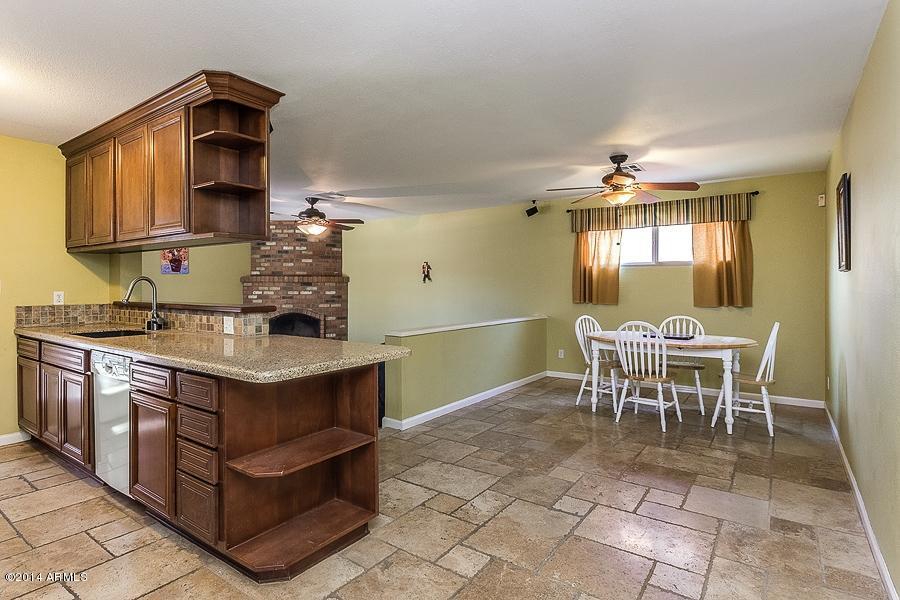
Fixed me up!

The centrally located part is huge. Not only are we fifteen minutes from downtown (law offices, courts, two enormous regional medical centers, baseball stadium, increasingly vibrant downtown cultural life), the lightrail is being built within walking distance. Read: doctors and lawyers.

The young man I met yesterday when I strolled across the street to pick up the vacationing Carol & Tom’s newspaper was so excited about getting the house! And he was delighted to hear that the place is filling up fast with growing families. His will be the fourth on the block to move in with small kids — and two of those families have twins! 😀

It really is extremely good news. Young, upwardly mobile buyers will fix up the homes, become active in the neighborhood association, and most of them will stay here for at least ten years. As their careers mature and they build affluence, they also will acquire political clout, and that will go a very long way toward preserving and improving our area. The result? $$$$$

My DXH and I bought our house in the Willo district in 1969. We paid $33,000 for it — more than we could afford, but we were so enamored that we just had to have the place. Three months later, the doorbell rang and when I answered it, I found a real estate agent standing there. He offered me $100,000 on the spot.

I sent him away, because I loved the house so much that I wouldn’t have taken any amount of money for it. But…you get the picture. Housing in the area inflated that much, that fast, and with the exception of the Great Recession, values have really never dropped. They certainly never dropped proportionately: even during the GR, for what I could have gotten in a sale of this house, I couldn’t have afforded a two-bedroom fixer-upper in Willo.

The only loser here, I’m afraid, is Maria. Her agent listed the house for a good $30,000 under market. They asked $233,000, when two houses in the same or a similar model are on the market for $280,000. She was persuaded to go that low because the house does need some fix-up. She never got the roof replaced after the hailstorm — I suspect that, because she lost her job during the Recession That Was Not a Depression and is, like me, of an age that no one will  hire, she had probably dropped her homeowner’s insurance. The pool needs work. The trees could use some pruning. The lawn needs aerating and fertilizing. And I expect there’s probably stuff inside that needs renovation. But at base, the house is quite pretty: it has Saltillo tile flooring throughout, professionally designed (though aging) landscaping front and back, spectacular trees in front, and it still has grass.

Because of the roof and pool issues, Maria’s agent engineered a further discount. So these kids are practically stealing the house. It’s a very good deal for them. Not very good for her: the house was seriously underpriced when it went on the market just a few days ago (when something sells in less than a week, you know the price is too low), and pushing it down another 10 grand to pay for the roof is amazingly advantageous for the buyers and amazingly disadvantageous for the seller.

It will depress prices for other houses, temporarily: those two $280,000 shacks were overpriced from the git-go. One has been on the market for several months; the other for weeks. Probably about $260,000 is a fair price for a house here that’s been renovated and attractively updated; maybe $250,000 for one that could use some work (that would be Maria’s), and $230,000 to $240,000 for a fixer-upper.

Except for the roof, which was damaged in the hailstorm, Maria’s house is not a major fixer-upper. If she’d listed it for $250,000 and paid for a new roof and light pool renovation, she would have come away with $230,000 to $235,000 — her initial asking price. So she comes away with the short end of the stick.

The neighborhood loses Maria, a beloved neighbor. However, we gain a vibrant, lively young family with children who will play in front and parents who will upgrade the house and, from the looks of that guy, earn a good living.

These are good things. Very good.
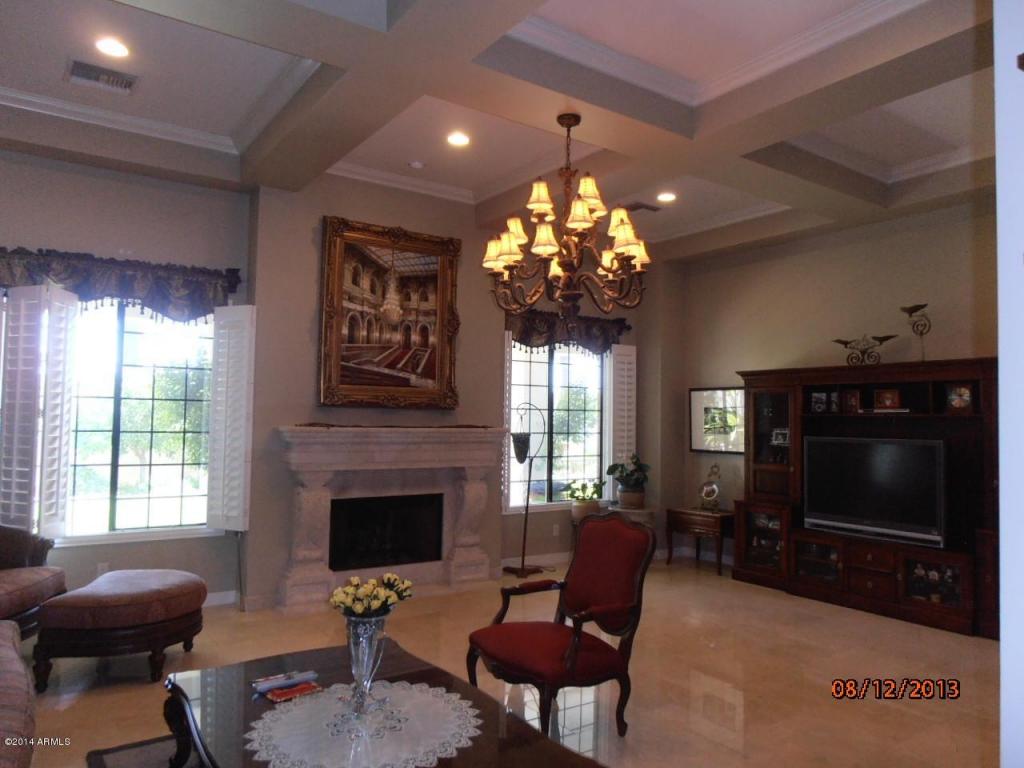
In Richistan...
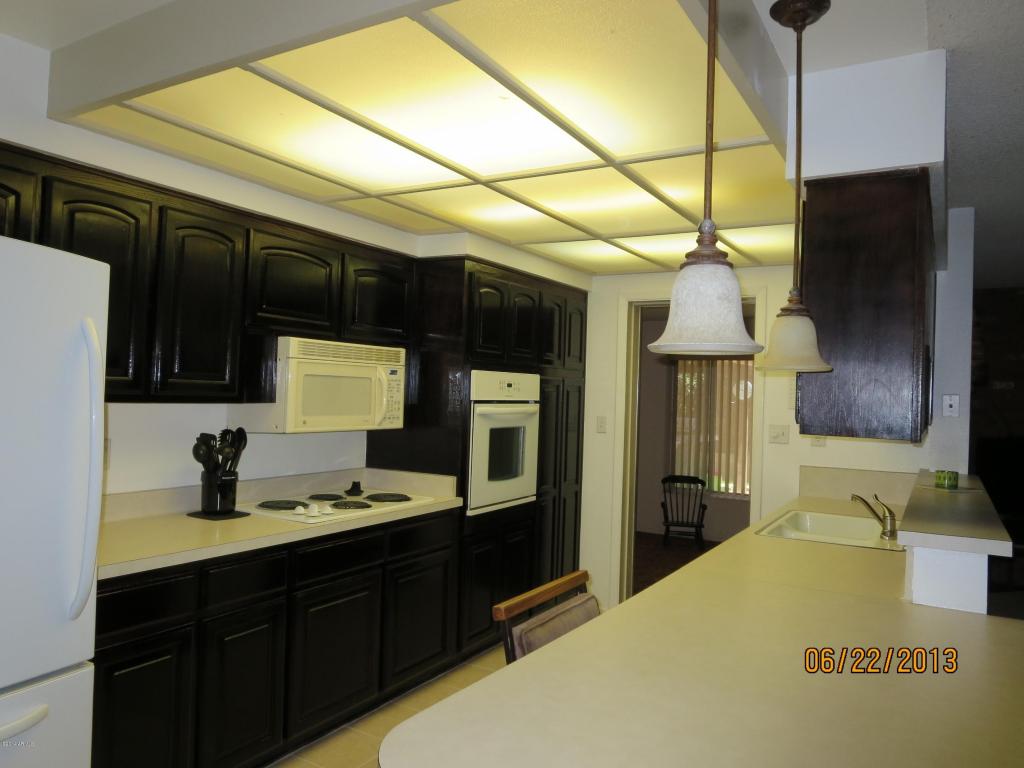
Home sweet home in Richistan…right around the corner

Click on the images for larger, higher resolution views.

Beautiful Rosaries!

The beading adventure has entered a new phase: I’m making rosaries (and therein lies a tale, below…) to help raise funds for the choir. Take a look!

Catholic Rosary Prayer Beads

The cross on the left — the triangular piece — is handcrafted glass made by choir member Doug Thomas. Among his many accomplishments, Doug is an artist in glass. He makes spectacular art bowls and plates that sell for startling amounts of monnaie. And the cross on the right is by Navajo artist Kee Nataani. I found that at the Heard Museum, also at a somewhat…surprising price.

The decade beads on the one with the glass cross are faceted red agate and the larger prayer beads are brecciated jasper. For the one with the silver cross, the decades are red agate and the larger beads are Swarovski pearls; the blue decorative accents are Swarovski crystal. The three-way connectors are TierraCast silver, the best-quality silver findings available, IMHO — they have an image of Mary on one side and of the spotless rose on the other.

Both of these are sold. But I have one more Nataani cross. Doug is on vacation and does not know about these antics, but we believe he can be prevailed upon to make more of his glass crosses. They really are very striking — much more so than is obvious in the image. So if you would like a unique, truly one-of-a-kind handmade rosary, e-mail me at vicky [at] thecopyeditorsdesk [dot] com, entering the usual symbol in place of the bracketed terms. Price is $50 each; if you would like to make it a tax-deductible donation in return for a FREE GIFT of a rosary, let me know and I’ll tell you how to make out the check. Either way, all proceeds go to the All Saints Episcopal Church Music Program.

Just now we have two others in hand: one made with greenish African jasper decades and red agate prayer beads, with Swarovski pearl accents and a different type of cross by Nataani, and another made with fairly large, highly polished nuggets (stone is unknown, but they have a pale reddish cast) and red agate.

The African jasper number is my favorite, and I’m surprised it didn’t sell on Sunday, when we put the things on display. It actually could be used as a necklace, if one chose. My photography is not as good as Nanette’s, but here’s a vague idea of how it looks:

P1030130And a close-up of the Nataani cross:

P1030132As usual, click on the images for larger, higher-resolution versions.

So, you might reasonably ask, how did the Prods come to be practicing their devotions on prayer beads that looks suspiciously like, oh…say, a Dominican rosary? Well, I personally have no idea. Presumably when Henry VIII decided to go his separate way and take the English with him, some of us were reluctant to part with old customs. Also, quite a few escaped RCs come to rest in the Anglican (Episcopal, in the US) church, and they also are comforted by their traditional ways.

A smaller, more Protestantly ascetic Anglican rosary does exist, but as it develops, the prayer group in our particular church prefers to use the Dominican rosary, and so that’s why we decided to try this more traditional style.

From what I’m told, a five-decade rosary for use by Episcopalians is more likely to have a plain cross (as above), rather than a crucifix.

These things make perfect confirmation, baptism, and first communion gifts, and also as Christmas or birthday gifts to the faithful and to rosary collectors. No two are alike.

My next effort, after filling a few orders for new ones with Doug’s glass cross, will use a lapis cross and lapis rondelles for the decades, with pearl prayer beads, pater beads, and accents. Here’s the cross I have in mind:

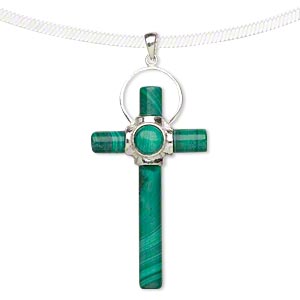
Lapis crossIs that gorgeous or is that not gorgeous? They make one in malachite, too, which may be even more arresting. Malachite and lapis are both pretty expensive, and so I don’t know whether to hold the price at $50 or not. As it is, $50 is about what it has cost to make the rosaries shown above, so we’re actually selling them at cost.

malachite

The accents on each of these are sterling silver. So the effect should be pleasing, whether one uses them for prayer and meditation or as jewelry.

At any rate, if you’re interested in buying one for a worthy cause, get in touch: funnyaboutmoney [at] gmail [dot] com  or leave an inquiry in the comments section below.

And please Pin this, Tweet it, Facebook it, and pass it along in any other way you can think of. If you would like to run a small display ad for these on your website, Funny about Money will offer $25/year for PR 3+ sites and $10/year for those with a page rank below 3. Get in touch at the same email.

And give a listen to the group you’ll be supporting:


How to Foil Child-proof Caps

 Hammer_ball_paneAmong the many annoying variants of consumer-proof packaging is the ubiquitous, infuriating child-proof cap, a nuisance that appears on everything from over-the-counter cough medicine to household cleansers to mouthwash. If you don’t have a kid, you do not need to be protected from yourself. If you do have a kid or three and are smart enough to stow toxic chemicals out of their reach, you and your kids do not need to be protected from yourself. And if you have arthritis, these things make it almost impossible to open your meds or any other product that you need in your day-to-day life.

Interestingly, there are simple ways to foil the damn things. Several years ago, Instructables posted a multi-pronged set of how-to’s covering the several varieties of adult-proof caps.

The first one — how to foil the accursed push-and-turn things by securing the spinning outer cap to the inside cap with a thumbtack — didn’t work for the simple reason that on all my bottles, the outer cap is too brittle to allow you to push a tack through the plastic. However, what you can do is take a hammer to the damned outer cap and SMASH IT TO BITS. This will leave you with an intact inner cap, which is made of a softer, more pliable plastic, and which, freed of the exterior spinner, functions as a normal cap.

Most of the caps that you squeeze and rotate have a small flange on the inside of the rim that you can nip off with a pair of wire-cutters or even a pair of nail clippers.

Line-up-the-arrows nuisances require you to risk life and limb to shave off the little tab that appears opposite the arrow.

Of course, the simplest and fastest way to get one of the things open is simply to hand it to small child, who will pop the lid off for you in about three seconds flat.

God, how I hate those things. There’s even a word for the hatred of overpackaging and stupid packaging. Did you realize that the Brits estimate some 60,000 of their people have to get hospital treatment for packaging injuries per year?

And I especially hate those damnable bubble-packed pills. In our parts, you no longer can get pseudoephedrine — generic-talk for the decongestant marketed at an inflated price under the name Sudafed — in a bottle full of loose pills, thanks to  our collective fear of the meth manufacturers. In addition to having to register yourself at the pharmacy counter and expect your purchase to be reported to the authorities, you have to take a pair of scissors to the damn packaging to get the pills out. I always cut the entire bunch out and drop them into an old spice jar.

One woman accidentally dropped a package of them into a dishwasher and discovered that if you get the backing wet, it will lift off easily. Who knows what water — or better yet, dishwasher detergent — will do to your allergy pills, though! 😆

Alternatives to trying to jimmy the caps or having to shatter plastic lids:

• Save spice jars (or buy new ones at Penzeys, which sells them for a modest price , as do Amazon and Cost Plus) and, after you’ve broken into a pill bottle or hacked apart a sheet of finger-slashing plastic & cardboard, transfer the pills.

• Leave the lids off, if and when you get them off the first time. This, of course, means that if a jar tips over, the meds will spill all over the place, especially annoying if the stuff is a liquid. Oh well.

• Use wine corks on glass liquid bottles, such as the ones that hold cough medicine.

• Save and reuse any inside caps that you do manage to break free from the whirling outer cap . Most of these are fungible — the seem to fit most bottles.

• Use a channel wrench to squish open the accursed squeeze-and-turn type. Keep a channel wrench in or near your medicine cabinet.

• Keep a pair of tin snips in or near your medicine cabinet, for hacking open bubble packs.

• Try to get the pharmacist to give you adult-friendly bottle caps (and good luck with that!)

channellock wrench

A Funny Little Find…

Lookit what I found!

P1030139

Yesh. So there I am, trying to find some old CDs to listen to for the first time in three or four eons. I find a drawer in the media cabinet. A drawer!!!! Jeez. Pull that open, and there’s a little box, stashed in there with a fistful of old strike matches (sulfur!). Grab the box. What IS it?

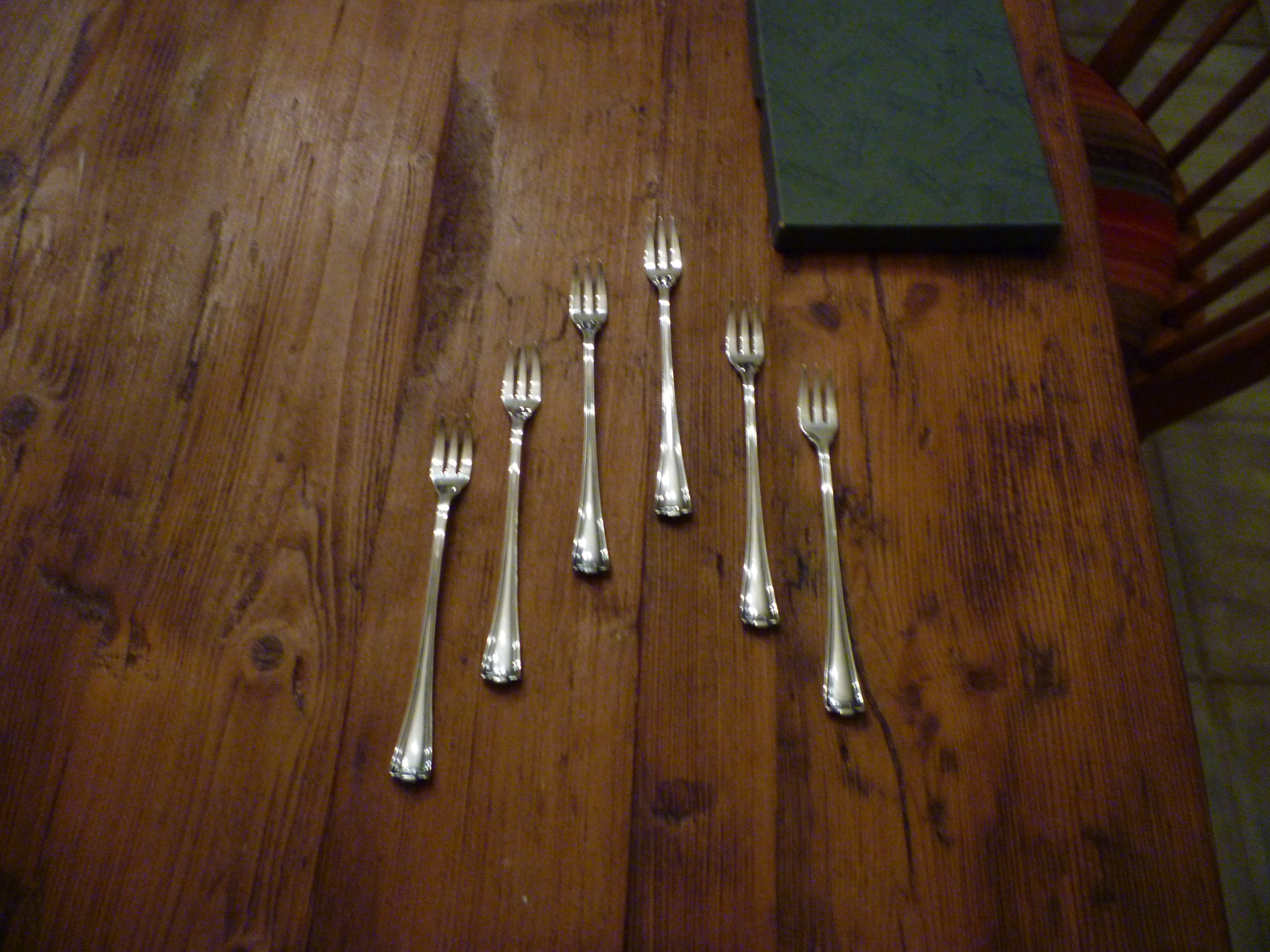
Open the box. Find a set of six black seafood forks.

Black forks? How quaint!

Study the black forks and eventually figure out that they’re prob’ly silver. Or silveroid: silver plate. Nothing in my house could be sterling. So they must be silver plate.

Break out the silver polish. Scrub. And scrub and scrub and scrub and scrub… Appears to be silver. Drop one of them on the floor. It goes clonkity clonk, not clingity cling. Plate.

The box is emblazoned with the logo “1847 Rogers.” The same logo appears on the back of the clonkiting forks.

Rogers Silver was founded in 1883. Apparently these objects were not made in 1847. Further googling reveals that they were made around 1914 (or thereabouts, give or take 30 years) and are worth about $3.20 apiece.

But aren’t they pretty little fellows? So simple, so plain as to qualify as “austere.” Apparently the Rogers company thought so: they called the pattern “Cromwell.”

😆

 I do not know where these came from. They could’ve come down from my mother. But…really? I don’t recall them. I recall the coin silver. I recall the ridiculous set of silverplate she bought with Green Stamps and presented to me as a wedding gift. I recall having to store those things in a dining-room buffet and break them out whenever she and my father came to dinner, the only time they were used. Argha.

But these things? Would my mother’s family have ever eaten seafood?

Well, yeah: they lived in the San Francisco Bay Area. But were they the sort who had special forks for seafood? Well, no. On the other hand, that branch of the family favored the minimalist, in the design department.

Would my father have allowed seafood forks in the house? Not a chance.

Possibly they came from Dear Ex-Husband? Perhaps I made off with them, unknowingly?

But DXH’s mother would never have been able to afford seafood, living in Colorado in extreme penury with a worthless husband. Her parents, though, were what we would call small-town gentry. Her dad owned a lumber shop and they lived well and her mother’s china came from Tiffany. Yeah, they were the sort who would have seafood forks. But…in Colorado? Not likely. And DXH’s grandmother’s taste ran to the ornate. “Austere” was not her style.

Maybe they came from Semi-Demi-Exboyfriend?

Huh. SDXB’s family were even less likely to decorate their dinner table with seafood forks than mine. Where we were working-class, they were working poor. Frou-frou, foolishness, and extravagance were beyond their ken.

Now Tootsie, SDXB’s late and honored and much-loved mother, was fully capable of classy and austere taste. But how on earth would she have come by such a thing? And why?

Unlikely.

So there we are: I have no idea where these things came from. But aren’t they charming?

P1030141

Here they are with a couple pieces of my remote ancestors’ coin-silver tableware:

P1030144

Could be, I suppose. Anything’s possible.

Click on the images for bigger, higher-res views.


Taking Care of Business…or Getting Rid of It?

So yesterday I managed to shuffle off a client whose project, I had finally come to recognize, I really did not want to do. Ever find yourself taking care of business simply by getting rid of business?

The job: a huge index. The subject matter: arcane. We are talkin’ 375 pages of Anglo-Saxon maritime history. The editors proposed to deliver this project to me last December, two months after I’d signed a contract. Making matters worse, I’d agreed to do the job for half the going rate. Because academic institutions are nonprofits, much research in the humanities would not take place or be published at all if individuals and organizations had to pay real-world prices, and besides, I’d annoyed my last client from this outfit and wanted a chance to redeem myself.

To compile an index, you take final page proofs and comb through them looking for important terms, facts, discussions, whatEVER a researcher might be looking for; cook up key words; find every reference to every key word (using your human judgment to filter out the chaff); arrange them under topics and subtopics; and alphabetize on at least two and sometimes three levels, meticulously following Chicago style. It is a mind-numbingly boring job, tedious, ditzy, and exacting. Indexes we’ve done for similar but shorter works have run to 30 or 40 MS pages.

I figured this job would take about 10 days or two weeks. Ten days or two weeks of excruciating tedium, for not very much money.

December came: no page proofs.

January. February. March.

I figured they’d forgotten me — must have found a graduate student to do it on an unpaid internship basis.

April. May. June. I forgot them.

Now, in the middle of July, they resurface. Both editors are junketing around Europe. And they want their index done right now.

Meanwhile, we have a big job in-house — an entire issue of a new client’s journal — and we are not in a position to drop what we’re doing and spend the next two weeks ditzing around with an index the size of a woolly mammoth.

My associate editor is swamped with work. Returned from China and had to turn around and go to another conference the next day. Teaching full-time. Running the world’s largest academic journal of organizational management , also full-time. She will be spending all of this weekend reading journal copy behind me.

Besides, indexing is not her forte to begin with and medieval history is far, far outside her field.

Vaguely part-time wannabe contract assistant: ditto, and probably frolicking in Colorado with her hubby and four kids as we scribble.

There’s not a full-time indexer on the planet who will do the job for what I agreed to do it for, mooting the idea of subcontracting to someone at ASI.

So I was about to play the Cancer Card, tell them sorry, folks, I’m sick, and back out. Then I thought of an old acquaintance who’s now living in another state and doing editorial work. She’s very smart, well organized, and efficient. Hm.

Thought she would laugh when I told her how much I’d agreed to take for the job, but to my amazement, she agreed to do it! I’m paying her the entire amount that I bill, so I’ll make nothing on it — not even a finder’s fee. But…it’s worth it, IMHO, to get that onerous job off my desk.

I’ve about reached the point of deciding there’s not enough time left on this earth to spend it doing work that makes my eyes glaze over.

Lessons Taken:

1. Do not accept jobs — any jobs — that make your eyes glaze over.

2. Do not agree to do work for less than your standard rate, no matter how worthy you think the cause is.

3. Don’t wait to fire clients who can’t keep a timely schedule.

4. “A$k and ye shall re¢eive” works both ways. Negotiate fees down as well as up.

She’s B-a-a-a-a-c-k!

We were off the air yesterday until about mid-morning local time. Internet service in Utah, where Funny is hosted, had crashed.

I started out the day with some brilliant idea for a post. Then discovered the dashboard was inaccessible. By the time Jesse got the site back online, I’d forgotten whatever the brilliant idea was. And by then I was engaged in whatever other busywork fricassees my little brainpan during the daylight hours.

And now, it’s off to Scottsdale, for the weekly meeting of our merry business group. I have a presentation to give, as well as chairing said shindig. And I believe my ride will be here within the minute.

Later!