Coffee heat rising

Loafing

My goodness, it’s nice to be able to loaf in the sack until after the sun comes up! All of the paying work got done toward the end of last week. And now the house is cleaned (and cleaned again), the bookkeeping done, and the mountain of paper shoveled off the desk.

Peace!

Cassie the Corgi has been blowing her coat for the past month, an activity that did not help the predicament caused by my failing to clean house for two months. Vast quantities of dog dunes have been shoveled up and dumped in the trash; the floors vacuumed, mopped, and steam-mopped; the sheets washed and pillowcases ironed; the bathrooms cleaned; the kitchen cleaned; the caked-on grease scoured off the stove; the nonfunctional stove burner repaired. YES!

What could be better?

It looks like the magazine writing course will not make. An enrollment of twelve is required to make it go. A week or so ago eight students had signed up, but since then a couple have withdrawn, and only six remain. And that’ll be fine — I can do without having to wrangle two online courses this semester. The Eng. 102 section will take up the slack if the writing course doesn’t materialize; otherwise income from said wanna-be Writers with a Capital W will come under the heading of “pure gravy.”

At any rate, until such time as I can believe that section will fly, I’m not putting in any more unpaid hours in course prep. LOAF!

Today’s income-inequality rant at The New York Times holds forth on the alleged upward skew of consumer spending — theoretically, as the rich get richer, fewer mass-market appliances and low-end restaurant meals are getting bought, presumably because the rich are getting a whole lot richer and the rest of us are getting a whole lot poorer. “Those consumers who have capital like real estate and stocks and are in the top 20 percent are feeling pretty good,” the reporter quotes a Price-Waterhouse-Coopers exec.

No kidding? If you count the savings drawdown and the Social Security and the teaching income as “earnings,” I’m in the top 50 percent, and I’m feeling pretty good.

O’course, that’s not counting the outrageous amounts the investments earned over the past several months, during the recent rabid bull market. Add  just three months of those proceeds into the AGI and you push me into the top 25 percent of US earners. Precious little of that is coming into reach of American Express and its retailer customers, of course — it’s banked against old age. Nor is it to be imagined that those are real figures: I think of that kind of thing as pretend money, easy come-easy go, poker chips on the craps table.

But for the nonce, at least, having made the 2014 drawdown before the hot air started to seep out of the stock market, I’m feeling moderately confident. In 2014, there should be plenty to live on, even if the current spate of outrageous unplanned expenses continues for several more months. Now, 2015 may be a different story. But we’ll get to that when we get to it.

At any rate, this year, thanks to the chair having come up with the online 102 section and my having volunteered serendipitously to take a summer section, teaching income will be more than normal even in the absence of this spring’s maga-writing course.

How on earth does that man do it? He seems to just BE there, every time I need a new way to earn a chunk of money. This has happened time after time. Someone upstairs must have appointed the guy to be my guardian angel.

So…what to do today?

1. Bill the two major clients, a project that will take a while since I haven’t kept up with billing.
2. Update the imaginary map for the novel and ship that off to the artist.
3. Organize the cookbook recipes in a sane sequence.
4. Delete images from Word recipe files; track down the jpegs and save them to a new subdirectory with numbered filenames that will make them appear in the order in which they need to be inserted in the layout.
5. Call the vet; arrange appointment to inspect new pup (just a month or so to go!) and get new shots for Cassie.
6. Figure out a way to ask the vet about how to feed real food to a pup, or when to start.
7. Go for a dog-and-human walk.
8. If any time remains, continue chapter 1 of the novel’s sequel.

Huh. I suppose this means I’m going to have to get up and do something, eh?

Staying on Top of Things

Growing into a wise old grizzled old bestower of the culture’s lore has its privileges. And it has its drawbacks.

One of the latter is that you take to change less and less as you devolve further into the wisdom of maturity. That’s another way of saying you get to a point where you can’t stand it when people change things up on you!!!!

Argha.

All of which is to lead in to the tale of yesterday’s trip to downtown Phoenix, a place I’ve managed to stay out of for a good long time. Once again this year, I agreed to participate in a mock trial for the County Prosecutor’s office, a device used to train young lawyers and an activity that’s a bit of a hoot.

However, they changed the venue from the seedy offices where one would expect a prosecutor to reside to the courtroom set-ups at a proprietary law school that occupies many floors of a new highrise downtown. And in doing so, they changed parking garages, too.

Holy sh!t.

Parking garages now share space with things like…oh, a bowling alley. I had one hell of a time finding the entrance to the parking cave, causing me to have to navigate and renavigate the frenzied, spaghetti-like maze of one-way streets that they’ve installed downtown. What a mess!

I’d elected to go down Central Avenue because you can’t turn left off Seventh and Seventh during the rush hour. Though I thought the reverse lane ended somewhere north of downtown, I wasn’t sure where and didn’t want to go right, right, and right to turn left to get to the promised parking garage.

Everyone else had the same idea: Central was a commuter’s nightmare even north of where the accursed train turns onto that formerly beautiful urban boulevard. The train not only has massively uglified what was once the only really pretty street in central Phoenix, it’s made a horror show of driving.

Finally I had to cut off a few of my fellow homicidal drivers and slam my way into a right-turn lane so I could go west to Seventh Avenue, which was virtually empty because everyone was on Central. On Seventh I cruised downtown without a problem, but by then I’d turned a 20-minute drive into a 40-minute drive.

So I was late by the time I hit downtown, and then it took forever to find the parking garage with its well-disguised entrances.

Fortunately I wasn’t the only one — others also straggled in even later, having encountered the same mess.

Part of the problem is age — one adjusts to change with increasing difficulty as time passes — and part is CHANGE. The city and its grasping developers have transformed our formerly down-at-the-heels downtown, largely for the better.

What used to be a nature conservancy for drug addicts, alcoholics, and the homeless mentally ill has turned into a vibrant, active, busy central-city core. New high-rises now dominate the skyline, and old historic high-rise buildings — now mid-rises in the new landscape — have been elegantly restored. The place is buzzing with activity.

Problem is, the centerpiece of this redevelopment, a large, expensive, and ugly stadium, took up so much space that they had to reroute a couple of main drags and turn a bunch of two-way streets into one-ways, with no discernible logic or good sense.

Adding to the mystification, the damn train has made an unholy mess of the roads and traffic lights a half-mile in either direction of the rails. Timed lights have gone away, so you sit through two or three red signals to get past an intersection, and you never know which way you can turn and what lane you can safely enter. Bizarre arrows are painted in lanes directing you out of this or that lane, for no apparent reason; these are sometimes ignored and often senseless. Literally I have seen intersections with signs reading

NO LEFT TURN
NO RIGHT TURN
DO NOT ENTER

As you can imagine, then, a drive to a downtown destination makes for a confusing, unpleasant trip.

Adding to the confusion is that what’s in my head as  I think of the downtown map is the grid I knew when I worked down there in my 20s. That was a long, long time ago. Today’s map is a whole lot different. And i. don’t. like. it.

So we see how incumbent it is upon the aging city dweller to bloody keep up with the changes in her or his city!

I think what I’m gunna do, while the weather’s still nice, is get on the train at AJ’s, attired in some costume with comfortable shoes, and ride downtown. Then I’m going to get off the train at Washington or Jefferson, with a Mapquest printout in hand, and spend two or three hours just walking around.

This, I hope, will revise the internal map of the place. And it’ll be a good way to get the day’s exercise.

Images:

Downtown Phoenix at night. JCordova. Public domain.
Exquisite train stop in downtown Phoenix. 2008. Ixnayonthetimmay. Creative Commons Attribution-Share Alike 3.0 Unported, 2.5 Generic, 2.0 Generic and 1.0 Generic license.

Work, Community Service, Argh!

Worked like a horse all day yesterday: first to the morning networking meeting, then some light yardwork, then until 8 p.m. on a client’s book. It’s good…I hope he likes the final edits.

Now must race — it’s already quarter to six!! — to get down to the law school: mock trial for the country prosecutor’s office. Last year I got “volunteered” by one of my former TAs, who graduated from law school and was interning for the prosecutor, into serving on a mock jury for a project put together to train young litigators. It was fun, so I said I’d do it again.

Hence, all the work pushed up a day.

And now, it’s off and running again. Hope your Friday is grand!

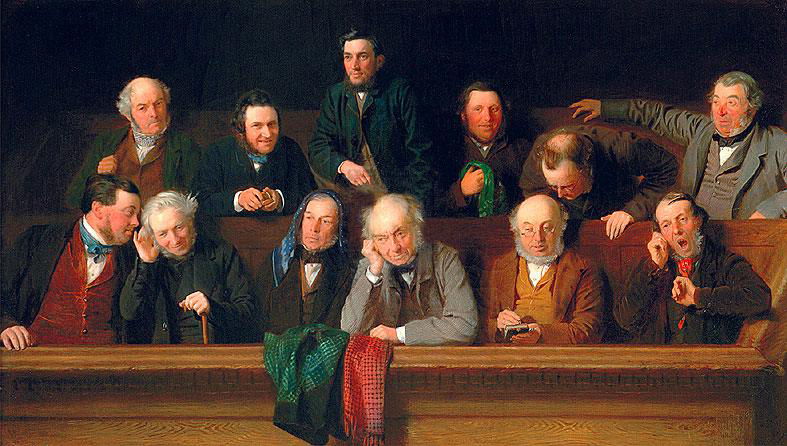
The_Jury_by_John_Morgan

The Jury, by John Morgan. 1861. Bucks County Museum, England.


Why Is It So Much Cheaper to Be Skinny?

Down to 128.8 this morning: hot dang. Exactly on target.

We’re now at the end of January. I hit the 130-pound diet goal on September 26. Since then it’s been too cold to swim and I’ve been too busy to walk every single day (though usually do get some sort of activity in most days). But I’ve managed to stay right around 130 pounds, give or take a pound or two.

I haven’t run a Quickbooks report to prove it, but it’s my belief that I’m spending a LOT less on groceries, despite the mountains of fresh veggies and fruits and the “less meat but BETTER meat” strategy. I’ve spent about $250 on groceries this month — a far cry from the typical $350 to $400 of a year ago.

Why? In theory, it should cost more to eat nothing but whole foods. Are we not told that poor folks consume all that junk food because it’s cheaper, on the surface, to buy processed junk and fast-food? Is it not true that corn is subsidized and healthier vegetables are not? Do we not believe that grass-fed beef, free-range chicken, wild-caught fish, and humanely raised pork are astronomically expensive?

The key, I think, is that when you’re not thinking ahead about what you’re going to eat, you’ll buy anything that comes to hand. Also, when you’re not thinking about cuisine, you tend to eat more at any given time.  When you have a diet strategy in mind, you’re a lot more careful about what you buy, and of course you eat less per sitting.

Now that I’m in the habit of eating smaller portions, the loot hauled in the door from a grocery trip lasts a lot longer. A single stir-fry, for example, provides two or three meals instead of one or two meals. Before, I would scarf the whole delicious thing down and so would have to cook, say, seven separate dinners for a week instead of five or six.

Also, with what we might call “mindful dining,” one is much less inclined to the impulse buy. Before, if I was hungry and in the vicinity of a better AJ’s or a Whole Foods, I would run in and grab a large box of sushi (maybe two!) and, naturally, a beer. Or more likely, a four-pack or six-pack of dark, foamy, delicious stout. And by golly, look at that: real Stilton! And what’s this “white” tea? And ohhhhhh I do love those spectacular barbecued baby back ribs. You can’t have those without a giant twiced-baked potato slathered in cheddar cheese…

“Ma’am? May I rent that llama over there to haul this stuff out to the car?”

And speaking of foamy-delicious beer, although I haven’t quit swilling a potable once a day, my choice of alcoholic beverage has changed enormously.

Quit drinking beer pretty much altogether, except as a special treat: too calorific.

Wine proved to be highly problematic: I dearly love wine and will drink it like soda pop. And it’s too damn easy to pour like soda pop. You finish a glass of wine halfway through your meal, so what do you do? Tip the bottle into the glass to add “just a little more” to come out even. And then just a little more. And then just a little… Uh huh. By the time you’ve finished your diet feast, you’ve consumed half a bottle of $10 red. This not only was too calorific, it was too much to drink and too expensive: at $8 to $12 a bottle plus exorbitant taxes, if you’re buying two bottles of wine a week you’re ponying up around $80 a month — and that doesn’t include the beer you’re buying to go with the sushi and the barbecued ribs!

So the wine imbibulation had to go.

Interestingly, certain breeds of hard liquor contain significantly fewer calories per dose than does a glass of wine. And because I’m not averse to watering my booze down, I can make a shot of whiskey or gin go a lot further than a beer or a glass of wine will go. A single bottle of very good bourbon from Costco will last well upwards of a month, at half the price of eight $10 bottles of middling wine.

Hard liquor has as its advantage that you have to get up and mix another drink if you want another. This activity — get ice, get the bottle out of the cupboard, retrieve the jigger from the dishwasher, get cold water from the fridge — is enough to remind you that it’s time to stop, whereas “just a few drops” more wine encourages you to keep pouring.

In the booze + food department, one thing that soon became apparent is that once you hit your target weight, you can keep it down more effectively by eating larger meals earlier in the day and smaller meals or even just healthy snacks at dinner time. I like a drink with dinner. So, I wait to have a large, glorious mid-day meal until I’ve finished whatever running around needs to be done and know I don’t have to drive any more that day. Because this is likely to be around 2:00 or 3:00 in the afternoon, it means I have to eat a good breakfast that will last until after the noon hour.

This eating pattern, by sheer coincidence, turns out to be an effective weight-loss and blood-glucose management strategy! That’s nice. It also means, though, that if I’ve had a bourbon and water or a gin rickey at 2:00 p.m., I am not going to go back out to the grocery store in the afternoon. By two or three, I’m done with running around spending money.

So, in a lot of subtle ways that have nothing to do with personal finance, the diet plan also works to promote frugality.

Image: Nejmlez. Creative Commons Attribution-Share Alike 3.0 Unported license.

A Budget for Retirement: Annual, not Monthly?

God, for an English major I am too, too bizarrely fascinated with playing in Excel sandboxes! Just came up with a new budget scheme: instead of tracking expenditures by the month, why not track them over the course of a year? Since Fidelity will be sending savings drawdowns annually, and since one annual drawdown will, in theory, cover all my living expenses, who cares how much is left at the end of a month? When you’re living on retirement savings, the figure that matters is what’s left at the end of the year.

Annually, my living expenses — exclusive of taxes, insurance, and minor emergencies (which are covered by Social Security and teaching income) — come to $1721/month. That’s based on the maximum costs of air conditioning and water, which occur during the summer months; during the winter, total costs are somewhat less, because I rarely turn the heat on and I don’t have to water the yard or refill the pool much. That works out to $20,652 a year, just to get by.

So here’s a research question: If you tracked your budget by the year, would over-expenditures (such as I’m enjoying right now and expect to continue enjoying through March!) eventually balance out with under-expenditures? Well, in 2014, we’ll find out.

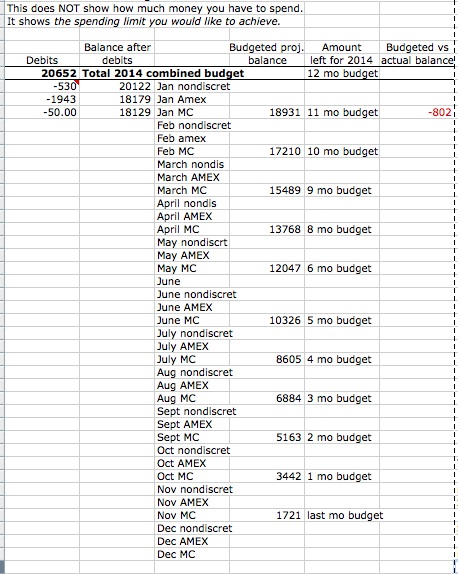
We have the research instrument:

AnnualBudgetBy subtracting $1721 for each month, I can easily see how much is left for the remainder of the year at any given time. This does not reveal the amount that’s actually in hand — or will be — for 2014. The teaching income will cover most of the tax and insurance charges, and Social Security will cover what obviously is likely to be a serious shortfall in the budgeting scheme, plus any major unexpected expenses.

If I subtract a) the balance after a given month’s debits (shown in the column titled “Balance after debits”) from b) the balance that the budget should show at the end of that month, were I managing to stay on budget (shown in the column titled “Budgeted proj. balance”), then I will see c) far how into the red or the black I happen to be at that time (shown in the column titled “Budgeted vs. actual balance”).

Budgeted projected balance – Balance after debits = Budgeted balance compared to current balance

Lovely. I’m already $802 in the hole. This includes the down payment on the four pairs of glasses, an accountant’s bill, a car repair bill, and $680 for the massive tree-pruning job. Plus the $135 to My Sister’s Closet for a little bonanza in second-hand clothing, purchased before I realized I was riding a waterslide into a pool of red ink.

That does not include another $430 owing toward the glasses, God only knows how much for contact lenses, God only knows how much for the visit to the ER, and the $800 still owing for the puppy, an amount I had stashed conveniently away before I got walloped with a new set of medical and vision bills. And of course we’re still faced with the fact that about the only rags in the closet that fit me are a few Costco bluejeans. And a couple of uncomfortable bras.

Welp. It certainly is a good thing Social Security is still operating.

🙄