Coffee heat rising

Puppy Love: How to tell if it’s the real thing

You want me:

“Walking vet bill”? Say what? What’s that supposed to mean? Have you taken leave of your senses?

Indeed. You don’t want me. You want two of me!

LOL! Yes, I’m afraid these little furballs are the objects of M’hijito’s affection. Well, not these specific furballs, but their soon-to-be future siblings, expected to appear on the scene in two litters along about mid-June.

For some time, my son has been taken by a variant of the golden retriever known as an “English” golden. Basically, it’s the same breed, only the English type has a preternaturally light coat. They’re white or white with a pale, pale blond top coat. The head, especially on the male, is blockier than the golden we all know and love, and breeders claim (without, it appears, much justification) that the animal is more sound than dogs from the American line. Whatever. You have to admit that it’s a very beautiful dog. Here’s a candid of Dad, a.k.a. Cabot, surveying his domain:

Here’s a more formal portrait of the other future dad (we hope): the breeder recently imported semen from Karvin, a Finnish megachampion. Check out the “don’t you wish you could look like this” pose…

Then we have the “drop dead, you!” pose of one future mom, Tesse:

The other, Daisy, is just as elegant:

The breeder we’ve settled on, Golden Reflection, has two sets of pups due in mid-June, one by Daisy and Cabot and the other by Tesse and Karvin. We’re leaning toward the Daisy-Cabot litter, mostly because the cost will be significantly less (don’t even ask what it costs to import frozen dog sperm from Scandinavia).

Sunday evening we hired a sherpa and trekked to outer Mongoli Mesa, where this outfit resides. We wanted to meet the proprietors, inspect the premises, and see the dogs before deciding on this breeder or another, located on the far side of the Apache Trail. That Cabot character is absolutely spectacular, every bit as gorgeous as he appears in the photo. Their females are very beautiful, too, and all the dogs have calm and friendly temperaments.

But far more important than the handsome dogs is what’s behind the handsome dogs. Big dogs like this certainly can be (and often are) walking vet bills, largely because of the hereditary health issues that come with years of careless breeding: hip dysplasia, elbow dysplasia, eye problems, heart failure—those are just the big ones. Treatment for hip dysplasia, for example, entails lifelong pain medication plus, depending on how inclined you are to impoverish yourself, surgery that can go all the way up to complete hip replacements, to the tune of $2,400 to $4,500 per hip, plus the follow-up evaluations at $200 to $300 a hit. Some breeders will tell you that elbow dysplasia is even more crippling and debilitating than the hip disorder.

So. Before  you fall in love with a cute little pup, you’re well advised to look into the background of the sire, the dam, the doggy aunts and uncles and grandparents going back as far as you can find them. Thanks to the Internet, this is no longer an impossible task.

The Orthopedic Foundation of America (OFA), an organization that tracks orthopedic and genetic problems among dogs, maintains databases showing the results for dogs that have been tested for a number of major hereditary ailments. Reputable breeders have their dogs tested, usually more than once, and they should take great care in selecting a sire or dame for their planned litters.

Many breeders, however, are not reputable. Never take a breeder’s word for it that a bitch or dog has no health problems in its background. Look it up for yourself.

Case in point: during our puppy search, we encountered the other breeder I mentioned, whose pups will be ready to go in a few weeks and who is anxious to get us to buy one. Nothing will do but what we must hurry to put down a $500 deposit, “before all the males are gone.” (What will it take to get you to drive this puppy off our lot today?)

Not in any rush to jump off that cliff, I entered the person’s sire and dam into the OFA database search function. And I entered the names of the ten other breeding females this breeder showed on its web page. The simplest way to mine the database is to enter the full name of the dog in a search box. If this doesn’t bring up any data, go to the dog’s pedigree, get the OFA or registration number, and enter that.

First warning bell: many of the dogs’ ancestors had never been tested for hips, elbows, eyes, and heart at all. The most recent testing I saw was dated 2008.

That, in the lifetime of a dog, is a long time ago. Breeding dogs need to be tested more often than that.

Looking further, I noted that one of the dam’s siblings had severe hip dysplasia. Neither of these are good signs.

Enough with that!

Returning to the Golden Reflections site, I copied and pasted Tesse’s long, involved official name into the database and discovered she’d been tested in 2009, 2010, and 2011. Her hips tested good, her cardiac condition was normal, and she passed an eye test. One of her offspring, still owned by Golden Reflections, showed similar test results. Her sire had a minor eye issue that is not thought to be heritable and probably has no effect on the dog’s vision. Cabot has been tested twice in 2009 and twice in 2010. Heart is normal; hips are normal; elbows are normal; eyes show a different condition whose heritability is not known, described as “common in goldens” and “not a concern.” Daisy was tested in 2006, 2007, and 2011: heart normal, hips good, elbows normal, eyes free of problems. Among Daisy’s half-siblings and forebears, I could find only one dog with an abnormal hip test: “preliminary borderline,” which means only that the test results were ambiguous and the dog needs to be tested again later—”most dogs with this grade (over 50%),” say the OFA guidelines, “show no change in hip conformation over time and receive a normal hip rating; usually a fair hip phenotype.” A half-sibling to Daisy’s sire, born in 2000, had degenerative joint disease in one elbow. Otherwise, none of the dogs that show in these records tested positive for the classic hereditary problems.

There’s a big difference between someone who’s breeding dogs that haven’t been tested in four years—or have never been tested at all—and a breeder whose dogs’ health records are complete and recent. And there’s an even bigger difference between one whose vague testing reveals a case of “severe” hip dysplasia (that is very bad) and one whose dogs show almost no ancestral background of hip, elbow, eye, or cardiac disorders.

In the purebred puppy biz, it’s caveat emptor from the git-go. The dog breeding business is infested by clueless amateurs, careless breeders, and downright shady operators. If you want to buy a dog with a fancy pedigree, it’s up to you to educate yourself not only about the breed’s nature and temperament, but also about the individual breeder’s stock.

Here are a few resources that can help:

Dog Breed Info Center
Wikipedia: Look up your desired breed
The ABC’s of Buying a Purebred Puppy
British Columbia Golden Retriever Club on whether you really want a puppy at all
American Kennel Club index of breeds
AKC Breeder Referral
AKC Breed Rescue Contacts
Pedigree Database
The specific pedigree database for your desired breed (Google the breed name + “pedigree database”)
Local breed clubs (Google them or ask your veterinarian)
Local breed rescue groups (Google, again)
Any discussion of a breeder on a breeders’ forum for your desired breed (Google the breeder’s name or the breeder’s name + the desired breed)

A reputable breeder should guarantee the puppy’s health and be willing to take the animal back if its health fails (note that many will say they’ll do this, but few actually will do it). The breeder should show a keen interest in your reasons for wanting the dog, your experience with the type of dog in question, where the dog will live, what you intend to feed it, and even who your veterinarian is. He or she also should ask you to return the dog if you find you can’t care for it.

Be careful out there!

😉

This post was featured in the 33rd Canadian Finance Carnival at Tom Drake’s Canadian Finance Blog and in the 16th Totally Money Carnival at StupidCents.


Sumer is y-cumin’ in…

Lenten thanks, Day 37 (or so):

…Lhudly sing huzzah!

Another set of student papers are read. Another 90-degree day. It’s still storming in the South; still cold in some parts of the country. But here spring (such as it is) has almost passed, and in just a couple of weeks the cool evenings will be over and the heat will rise.

With all the winter rain we’ve had, it’s been a spectacular spring. Check out a few sights from around the yard…

Intersections

Lenten thanks, Day 36

Somewhere out there, a little wilderness survives. Thank God.

Here’s an essay I came across while searching for something for my students. Short on ideas today and even shorter on time today, I offer this in lieu of anything even faintly related to personal finance. It was written a long time ago…

What happened the other day, I suppose, compares to meeting a coyote at ten paces. Your eyes touch the other’s impossibly yellow eyes, each of you at once shy and fascinated; neither of you can pull away, and you sink into each others’ gaze. When the spell lifts, you turn from each other, you go your own ways, and you wonder how much or how little time has passed.

It started as a routine day of idle exploration. I look at the photographs I took that afternoon, though—a gravestone marked “Epimento Martinez, Dec. 23, 1902—Jan. 18, 1991,” a wreath of red roses spelling out “DAD,” mist-gray clouds stacked over blue mountains—and they remind me that at rare moments we encounter extraordinary junctures of ordinary days, where one life intersects another. The connection is so short, the instant of a gnat’s wing brushing against your neck or a cicada’s song rising out of the brush. But that infinitesimal exchange subtly alters one life or the other, perhaps both. After that things are not the same.

People at the inn where I stayed in Santa Fe suggested I take the high road to Taos. A new friend, David Bandler, said he’d heard it called “the artist’s way”—for its scenic qualities, we imagined. Whatever the etymology, it sounded better than a freeway.

So that August morning I headed for Española in search of Highway 76. It wasn’t easy to find. Had to stop in Española’s photocopy-center-cum-bus-station to learn I’d overshot it at the Long John Silver’s. The counter clerk, a small-town girl not long out of high school, sent me back the way I had come. “You follow the signs to Chruchas,” she said. Pondering the AAA map in the car I realized that “Chruchas” is spelled “Truchas” and wondered whether the photocopy lady had a speech defect or whether the local version of Spanish has “tr” as “chr.”

Highway 76 made a tour of Española’s funkiest districts and then escaped into open pasturelands. Grassy vistas dotted with adobe structures spread on either side of the road to low cloud-mantled mountain ranges.  The road passed through rural villages whose main trade seemed to consist of farm produce stands and shops that bill themselves as “folk art galleries.”

As I climbed higher into the bucolic hills, I came across a tiny cemetery full of white crosses and concrete markers gaudy with plastic and silk flowers, each grave like those roadside shrines where someone’s memories of a daughter, a son, a parent, a spouse, a brother, or a sister are laid out for everyone to view. All together, the gathered stones made a place of striking beauty. If I came back this way, I decided, I would stop here and visit the dead.

At Chruchas I got lost again. I missed the main road and wandered down a lane where the people live. Narrow, old, and decrepit, the adobe-lined road looked medieval. You would imagine the common folk of thirteenth-century Spain lived in just such villages.

The place was populated by dogs. No people: only dogs, and they owned the town. Some, conservative burghers, promenaded along the roadside. Others sat in their front yards and watched their fellow citizens pass. Two delinquents hung out on a corner and played a game of bark-at-the-car. It came to me that Santa Fe, with its stucco-over-Styrofoam “adobes” mandated by law, is like a movie set: someone’s sanitized idea of how an adobe village ought to look.

When the single lane I was following dissolved into a narrow dirt path, I figured this couldn’t be the high road to Taos. So I turned around and passed back through the village.

The real high road ascended into the mountains, where a blue-black weather front was already beginning to spit rain. Part of me knows better than to drive into a Southwestern storm. Another part relishes the prospect—perhaps not so much the passage itself, but the bragging rights it’s likely to bring.

Before I reached Truchas, I had stopped at a tourist trap called Los Siete, where a family of artisans was selling woven rugs in colors a bit too bright for authenticity. But I bought a crudely made pottery Storyteller figure for only $35.00—a gift for my son’s new home.

A young man, the proprietor, told me how his family made the rugs—and that I believed. In the same sweet, relaxed tone he said the Storytellers were made by local people. Amazing, I thought unkindly, how close Taiwan can get to home. But he spoke gently and graciously, and he remarked that it looked like rain in the direction I was headed.

I’ve been wet before, I said, and I haven’t shrunk yet. After that trip from my Arizona ranch down Yarnell Hill—in those days something in excess of a 6 percent grade—when the rain sluiced down so hard I couldn’t see the end of my car’s hood, much less the void beyond the unfenced edge of the road, nothing much could faze me. So I decided to go on despite the dark clouds. Now in Truchas as the first raindrops fell, children spilled out of a slouching house and frisked in the early sprinkle. They danced, their arms spread wide to heaven, until someone called them inside.

Reassured that people lived in this place, that the population had not after all been enchanted into dogs by some rustic sorcerer, I started into the mountains. Passed a stretch where the grade rose sharply and the road twisted like a cord off its reel.

Then it began to rain.

No. It began to fire-hose.

Water gushed onto the road. Ahead, a dun mist rose from the pavement: rain was bouncing off the asphalt and blending back into the new water falling from the sky. A three-foot-deep tide of fog coated the highway. I could barely see the ground. Thank god, not many cars were coming my way.

The rain started to hammer the car’s sheet-metal shell, and I knew some of it was hail. The bounce-mist, impossibly, thickened. I groped for the defrost button as the windows fogged, fearful to take my eyes off the road or my hands off the wheel. Ice began to gather on the road, rivulets of rain braiding across it like water twisting down an arroyo. Quickly, though, the little streams froze, and beneath the vibrating haze a sheet of white, solid ice formed. As far as I could see through the forest—forest! Where had all those trees come from?—the ground looked like three inches of new snow had fallen.

Now hail was crashing onto the car. The windshield, already cracked, rattled and banged like a kettleful of popcorn. Been here before, done this before, I reminded myself. No more cars came down the mountain, nor was anyone coming up behind me. I shifted into low gear and crawled uphill as slowly as the car would go. My mood oscillated between artificially bored calm and the nausea of suppressed panic.

When a yellow “steep grade” sign materialized out of the falling ice, its toy truck rolling down an ironing board propped at a 45-degree angle, I knew the time had come to turn back. The last car that had passed coming down the mountain was running with its parking lights on; I didn’t see it until it was almost at my front bumper. But a fair stretch of uncurved road lay before me, and my car is white. I hoped any comer would spot it as I backed and filled to turn around without sliding off the slick pavement. Mercifully, no one came along. That was scary, too. What if my car broke down here? What if it slipped on the wet ice and careened off the mountainside? Who would place a cross by the road for me? Who would drape it with plastic flowers?

By the time I reached Truchas again, the hail had stopped and the rain slacked off, though the bruise-blue clouds were sliding down the mountain toward the town. Relieved, I headed back in the direction of Santa Fe.

Not a mile beyond the village, I came upon the cemetery again. A pickup sat by the gate, the kind of gate a rancher builds into his stock corral, and I could see a figure in the graveyard. A mourner, no doubt, or another tourist. I parked the car on the south-bound shoulder, grabbed my camera, and, leaving the engine running, crossed the road.

About when I reached the grass, a second truck hissed up the road and bounced across the oncoming lane and onto the margin. The driver seemed to take aim at a puddle, where his tires came to rest and sank up to their hubcaps.

He spun his wheels. His tires dug in. He threw it into reverse, gunned the motor, and rocked the vehicle back and forth. For a moment it looked like he was rocking himself toward the earth’s core. I worried: Was I going to have to help this clown?

Happily, not. He roared himself free. Then he took off down the road, as though wallowing in the mud were all he had in mind.

The bright graves beckoned. I stretched, stood on Birkenstocked tiptoe to clear the top strand of the barbed-wire fence, and snapped a couple of pictures. Inside the cemetery, a man watched. He started to walk toward me.

Must be the caretaker, I thought.

“I just about landed myself in a cemetery,” I said. “So I thought I should visit this place.” My word-sounds made excuses: surely he would think it disrespectful to snap souvenir shots of some family’s graves.

“Did you almost have an accident?” he asked. His voice was friendly. He had already reached the wire fence and stood, half a foot taller than me, looking amiable enough.

“No. Just got into a really bad hailstorm. I’ve been in some weather before, but that was a man’s hailstorm.”

He smiled. “It looks like rain,” he said redundantly. Slender as a cowboy, he carried himself like a working man. His face bore the carvings of maybe 50 years. His hair was still dark and thick, and he had eyes the color of strong black coffee.

“My name is Fred Martinez,” he said. He reached across the wire to shake my hand. His grip was firm, but gentler than most men’s. “I came over here to clean up,” he continued. “Going to clean off the graves, run a weed whacker.” Grass clumped knee-high around the markers. The uneven ground heaved too violently for any lawnmower.

“That’s going to be quite a job,” I said.

“Yes,” he agreed. “It will take me about two days.” He spoke with a Latin cadence.

Cold air sank out of the rolling blue clouds. “You’ll get wet before then,” I said.

“I take pictures, too. I like to take pictures of this country. Been doing it for years. Let me show you some.” He stepped easily between the strands of barbed wire. “I have some in my truck.”

He walked the few feet to the pickup and opened the passenger door. I followed him, as though that were not an insane thing to do. He had a little album full of photographs, color Kodachrome shots, neatly packaged in the book’s plastic pockets. He also had several developer’s envelopes full of unorganized pictures.

“You must be cold,” he said. A crisp wind ran down from the clouded mountains like Coyote trotting across the bajada. He gestured in a way that suggested I should take shelter behind the truck’s open door. I must have responded with some other gesture that said that although I was insane, I wasn’t crazy enough to climb into his truck, because he walked around to the driver’s side, opened the door, and spoke to me across the chaste distance of the cluttered plastic-covered bench seat.

“I lost my father. He died in 1966, when I was in the military,” he was saying. “Then my mother died, in 1976.” Thoughtless as a puppy, I neglected to ask if they lay in the graveyard. “I have seven brothers and sisters,” he added.

“At least you have them—brothers and sisters,” I remarked, thinking less of his sorrow than of my own aloneness.

“It’s not the same,” he said. “I was never that close to them.”

I wondered what it must be like to have a brother or a sister—let alone seven of them.

He opened the little album to display his artwork. “This is my cousin.” A late-thirtyish woman going to flab smiled self-consciously and lounged in a lawn chair. After a couple more shots of her, he turned to a series of pictures showing two or three men working on the footing and slab of a building.

“This is my brother’s house,” he said. “I built it. I built it for him in three months.” The pictures traced the birth of the adobe-look house, from the concrete slab to the raising of the pressboard walls and finally to the neatly stuccoed and painted finished structure. “My brother likes to hunt. We built two rooms for him, they have 24-foot-high ceilings. He uses them both, you know, to hang the meat. He calls them his game rooms.”

“Are you a contractor?” I asked.

“Yes,” he said. “I am. I have a piece of property in Colorado, near Durango.” He spoke the city’s name with a rolled “r” and a Spanish a. “I put this little building on it.” A snapshot showed a tiny but professionally finished shed-like structure. “It’s 24 acres. This is very small—but I can stay there for a few days.

“Here’s another house. It belongs to a friend,” he continued. “I built it, like my brother’s; they’re here in Truchas, and in Chimayó. It’s thirty-three hundred fifty square feet.” The early pictures in this series showed an enormous slab, the two men walking around on it at sea in a concrete prairie. “These are his children, his little son and daughter.” Two pretty children, about five and seven years old, peered curiously into a flashbulb glare.

“He lost his daughter,” he added. “She died in an accident.”

“Oh, no. You mean this little girl?”

“No. Her sister. She was driving a car.”

Was she a flowered cross by the roadside? Did she rest in the cemetery? Again I failed to ask. I could offer only a commonplace, pancake-flat: “I can’t imagine anything worse than losing a child.”

“You hope not to,” he said.

He turned to some pictures of the house’s finished interior. You could smell its newness: viga and latilla ceilings; a heavy, solid wood front door; light pouring through wood-framed windows. The house looked as magnificent as the $425,000 condo I had seen for sale on the north side of Santa Fe. Behind him, silver and white clouds mantled a range of forested peaks; long meadow grass bent to the clean wind.

What a wealthy man, rich in dignity, pride, and community, I thought, and then, no—awful cliché! He probably goes home and beats his wife. Then again, Does urban cynicism know no bounds? He showed me a snapshot of himself troweling the final touches on a long sidewalk that flanked his friend’s house, and he was saying that he had been a union cement-layer, worked with a union team in Arizona. Spreading the photos across the pickup’s worn seat, he let me peer through a kind of window into his life and the lives of his family. How caring he was of his family and his loved ones. Even the dead: coming here to tend the graves of parents gone 25 and 35 years. In my life, I never look back; I’ve never seen the mausoleum niches where my mother and father’s ashes reside. To do so would risk loss of control. Free as a wild animal on the desert, I have no cousins, no family but a son living far away, and if I did, I haven’t the generosity to build for them some lasting reminder of me. He imbued his labor with a kind of love. His hands caressed the photographs reverently. That sidewalk was a work of art, and something more. He talked on, explaining that it didn’t cost much to build the house.

“I collect the materials from old building sites.” He pointed to a picture that detailed beautifully variegated planks herringboned above a set of vigas, big peeled-log beams. The boards appeared to be made of different woods—walnut, maybe, or mahogany and teak mixed with pine. “You see that dark, like that?” A few boards were almost black. “You get that by laying the wood out, wetting it down, and letting it dry. You wet it and dry it outside, over and over. And it turns that color.”

“Doesn’t it warp?”

“No. You make sure to keep it flat.”

Fred showed me more pictures, photos of his family, of his building projects, of mountains and clouds and sunsets, and a couple of himself fishing. Finally, I remarked that I had to be going.

“Bueno!” he said. He reached across the truck’s cab to shake my hand again. “Drive carefully.”

“And you, too,” I replied. “Take care of yourself.”

He climbed back through the fence into the graveyard. I returned to my car, whose engine was still running. A rain-chilled gust of wind crossed the road, and I thought it was a good thing I’d brought my fleece jacket, which lay in the car’s back seat. Then I realized I’d never felt a need to put it on.

—30—

Images:
Sunset over Wheeler Peak, in the Sangre de Cristo Mountains.
Kbh3rd. GNU Free Documentation License.
Truchas, New Mexico. Bobak Ha’Eri. .Creative Commons Attribution-Share Alike 2.5 Generic license.
Flowering cactus at Southwestern cemetery. Jan Kronsell. Public domain.


Pots, Pans, and BKF to the Rescue

Lenten thanks, Day 35:

What could be better than an old friend who doesn’t forget you even after she leaves town? Thanks, Your Godship, for reminding her to call and come over while she’s visiting here.

While all that conversation was going on, a few days ago, at Frugal Scholar’s place and waypoints, about fancy pans and serviceable alternatives, I was crawling around the Net looking for talk on the subject and came across a thread on some forum (which, alas, I’ve now lost track of) in which people were talking about how to clean scorch and burn stains off their expensive cookware.

You know how if you go off and leave a good stainless pan on the burner and forget it long enough to let it burn dry, it will get dark brown flame marks seared into its shiny exterior? Well, I’ve done that to two very nice pieces, a teakettle and that little 8-inch frying pan whose apparent demise I reported during the aforementioned back-and-forth. One commenter described a way of removing those stains, which I thought were permanent.

Said he: Make a thick paste of Barkeeper’s Helper. Rub this into the stains and then leave it to dry. Leave it at least 10 minutes; longer if desired. Then apply some elbow grease.

Hmh. At the very time I was reading this, I’d pressed a beautiful Calphalon teakettle—very expensive, I’m sure—into service as a flower vase, having scorched and scarred it by, yes, going off and forgetting it on the stove. Calphalon had sent it as a replacement for my all-time favorite whistling teakettle, which a) had a lifetime warranty, b) had corroded through under the baleful influence of Arizona’s godawful water, and c) was no longer being made. I really need a whistling kettle, because the minute I wander off and look at a computer, I become utterly mesmerized and lose track of time as well as reality. That’s just what happened to this lovely, formerly shiny pot.

I’d scrubbed and soaked and done everything I could think of to get rid of the scorch, and finally figured the heat had altered the chemistry of the stainless and there was nothing to be done.

This actually is better than it was when I started the experiment with the Barkeeper’s Friend. What you see above is how it looked after the first application of BKF paste. This cleaned a lot of the stain off, leaving the marks visible here, much better than the state of the pot at the git-go.

Well! If once is good, twice must be better. Soooo…

I coated the whole darned thing with BKF worked together with water to form a slurry. Left it in the utility sink, where it sat for several hours until I had to run the clothes washer. Rubbed and scrubbed and polished with a soft Skoy cloth, and lo! Here’s the result:

Lookee there! It took all the stubborn scorch marks off—without a single scratch. The thing looks just like new.

Well. What would it do to the pitted, scorched little frying pan? This I managed to kill by allowing a strong solution of baking soda and water to boil dry and then leaving it to sit over high heat for an unknown length of time—probably about 45 minutes. The pan had the same dark brown scorch marks all over the exterior, and the interior appeared to be pitted. I’d tried cooking something in it, and it worked, so I figured I wouldn’t throw it away…but I was sad. Very sad.

After letting it sit with BKF paste all over it and then scrubbing like crazy, here’s what I got:

Dang! The interior is as smooth as it was before the little disaster! The slightly yellowish pitting apparently was…what? Baking soda burned on? WhatEVER…it’s gone now! That dark spot is a reflection of the camera. The exterior came pretty clean, too:

That mirror-like finish sure wasn’t there when the thing was covered with burnt-on grease and flame-shaped scorch marks! With one more application of BKF paste, that last little marred spot polished up, and now the entire exterior is shiny and bright.

So. With the help of a little water, a handful of Barkeeper’s Friend, a soft cloth, and a lot of scrubbing, a handsome teakettle and a fine frypan with a copper-core bottom are back in service. 🙂

The Joy of Ethnic Markets

Lenten thanks, Day 34

Great idea, God, to make us all different. Thanks for all the differences that human beings come in. Wellllll…except maybe for Them Republicans. 😉

Mwa ha ha! Calm down, little heffalumps: it’s a joke! Even God has a sense of humor. Oh, what the heck: maybe especially God has a sense of humor. She’d have to…it’s the only explanation for life on earth.

Yesterday I went up to the Ranch Market, an ethnic grocery store that replaced the old, crummy Fry’s, which some time ago fled the threatened lightrail construction. It’s a nice, compact supermarket, unabashedly Mexican. Walk in the front door and you’re greeted by light-hearted, catchy salsa music; check out and all you’ll hear in line is Spanish.

I love stores like this. Perused the fine selection of peppers, plantains, pork cut especially for posole, fresh-made tortillas, open bins of red, black, peruano, and pinto peans…yeah! Their pasillos were gorgeous. Definitely will be back for some of those. In the meantime, though, I went there specifically in search of some inexpensive meat for the little dog. As grocery prices have ballooned, the chicken and on-sale beef I’ve been buying have gone way out of reach, so I’ve begun looking for ways to get a grip on the food bills. One way is to buy cheaper, lower-grade meat for the hound.

In fact, they had rather little “lower-grade” meat. Most of what was on offer looked fresh and of fairly high quality. And cost. Finally I came across some skinned, boned chicken thighs: $1.99 a pound.

Not great, as prices go, but better than anything else I’ve seen lately.

Well, I just opened up the package to set the meat on the grill, there to cook over the lowest heat possible. What came out was not little three-bite pieces of thigh meat, but great big chunks of dark meat. Each piece is as large as a small steak.

Whaaa?

These aren’t thighs. What they’ve done is they’ve boned and skinned an entire leg plus most or all of the back quarter. Each piece equals most of the meat on a dark-meat quarter-chicken!

Yum!

That dog isn’t getting all of this. Whipped up a nice garlic vinaigrette with a bit of anchovy, rubbed that over the surface of one piece, and topped it with some herbes de provence. The whole mess of meat—enough to feed Cassie for almost a week and me for tonight and maybe tomorrow noon—is now slowly grilling over 200-degree heat.

How convenient to have this nifty Mexican market within walking distance!

Way over on the west side there’s another great ethnic store, the westside outlet of Lee-Lee, an awe-inspiring Asian market. Asian and Pacific, actually. This outfit organizes its aisles by country of origin: Indian, Chinese, Japanese, Pakistani, Arabic, Hawaiian, Latin American… OMG! This is the place to buy curries of any and all descriptions. The produce department defies belief. And you can pick out a live fish for your dinner. Prices are far lower than ordinary supermarkets, and you’ll find foods you never even heard of.

If you’re lucky enough to live in a city with some ethnic markets, don’t be too shy to check them out. And if you’re even more lucky and have a friend of that ethnicity, don’t go alone!

🙂

Images:

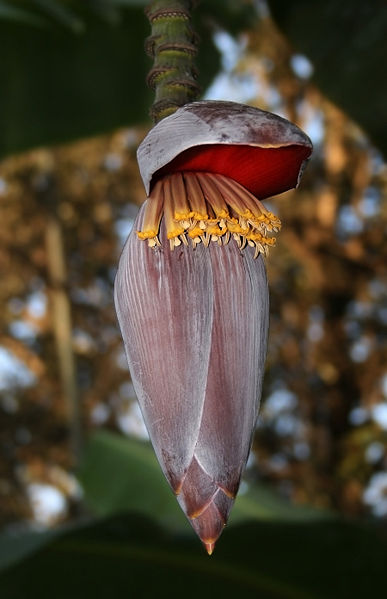
Banana flower. Derivative work: Muhammed Mahti Karim. Creative Commons Attribution-Share Alike 2.5 Generic, 2.0 Generic and 1.0 Generic license.
Mangosteen. KayEss. GNU Free Documentation License.

Are You Cutting Gas Use? CAN You?

Crude oil is selling at over $106 a barrel this morning. Yesterday one of my students reported that gasoline has reached $4.50 a gallon in L.A.; at least one station was charging $4.75.

Paradoxically, the Times observes that people don’t seem to be cutting back on driving this time around. That writer speculates it’s because the nation is better prepared for surging gas prices, thanks to more fuel-efficient vehicles.

Right. We all ran out and bought Priuses the minute the stock market crashed and we lost our jobs.

Au contraire, O Respected Journalistic Establishment… I suggest something quite different is at work: most people have already cut back driving and gasoline use as much as they can, and so there’s not much room for more savings. Most of us haven’t done it by buying new vehicles, because it’s not cost-effective to do so: add the increase in insurance premiums and registration taxes to the breathtaking cost of a car or truck, and it would take years for the junk to pay for itself in gas savings—even at five bucks a gallon.

Americans don’t change their driving habits much in response to fluctuations in gas prices— and IMHO, we don’t because we can’t. We have to get from point A to point B, and because most cities in this country have no useful public transportation, we’re forced to drive. Few of us are fond of driving, and we grow less fond as gas prices bite deeper into our wallets. The truth is, we’re already not driving any more than absolutely necessary.

Don’t know about you, but that’s certainly true in my precincts. When the economy crashed and I lost my job, one of the first things I did was to limit the number of days a week I’ll drive. And on those days, I carefully plan my route to hit the few stores I have to shop in: Costco, a grocery store, and Home Depot are on my way home from the campus, so I do all my shopping on the days when I have to teach.

In a normal semester, I teach two days a week: Monday-Wednesday or Tuesday-Thursday. So the bulk of my driving is done on those two days.

I have to attend choir rehearsal Wednesday nights, but the drive to the church is short and doesn’t consume much gas. Same drive has to be made Sunday morning; my son lives just a few blocks south of the church, so I often visit him after the Sunday songfest.

In fact, I’m now beginning to think I can bicycle down to the church on Sunday mornings, if I can find a place to lock up the bike. Won’t do it at night…but there is a bike path of sorts that would make it pretty easy to get down there in the daylight. That would limit routine driving to two days a week.

And I’ve reverted to the hypermiling techniques we learned way back in 2008, which can squeeze more than 25 mpg out of my 18-mpg clunker. Today is the 13th: only seven more days until the new budget cycle starts. On its second fill-up of the month, my car still has more than half a tank of gas left. That means I’ve got a fair shot at making it all the way through to the 20th without having to refill.

It’s now costing me $100 a month to run my car. That’s as much as I can afford to budget and still have enough to eat. With twice-monthly visits to the filling station, I have to cut off the pump at $50, whether it fills the tank or not. Lately, this has meant that in fact, I’m not buying enough to fill the tank. But that was sometimes true before the current run-up in oil prices.

Driving less? No, I’m not driving less…because I’ve already cut my driving back as far as possible!

What about you? Are you driving less? If not, why not?

Image: Oil well in Lubbock, Texas. Flcelloguy. GNU Free Documentation License.