So, after another long and amazingly workful day, I poured a tall bourbon & water to go with the (pretty remarkable!) spaghetti dinner I whipped up for myself. But could only get around half of it. Needing to take the dog for a walk, I stuck the rest of it in the freezer, thinking that after we got home, I could pour some very cold booze into a plastic cup and enjoy it while floating around the pool.
It was off to the park for some serious sniffing of doggy perfumes and then a tour around our corner of Richistan to admire the way our betters live. Back to the house to toss together a mess of beans with onion, celery, herbs, tomato sauce, and the dregs of a ten-days-open bottle of wine.
Finally, at last, it’s time to pull the chilled highball out of the fridge and head for the pool.
Chilled is an understatement. Booze iceberg, that’s what we had. Alas, I didn’t think of photographing it while it wouldn’t budge out of the upside-down glass. Here it’s mostly defrosted. But you get the general idea.
Who knew alcohol would form a boozicle? Next time I’ll drop a popsicle stick in the glass and have a handy little treat for nocturnal pool floating. 😉
Summertime, and the living is…darned scary! With no real steady pay flowing from the community college into the money bin, I get nervous, even when I know very well that the vast emergency fund sitting in the credit union will cover a full year’s worth of expenses. To start with, I don’t want to use the emergency fund for day-to-day expenses, and to end with, I’d really like to stay within the $5,739 budget (Social Security + Fidelity drawdown + leftover money from the low-cost winter months) I figure will cover me during the long, hungry summer. To do that, I see I’m going to have to revise my budget…mightily downward.
There’s not a thing I can do about the $1,240/month nondiscretionary budget: the utility bills aren’t going away, and they can’t go unpaid. And while during the winter costs came in way under that budget because utilities were low, this summer they probably will bust the budget. The highest bills will hit in August, when payment for July water and electric use comes due; I expect those costs to exceed the $125 and $225 I’ve budgeted for them, respectively. Last August I had a $257 power bill, and the utility company is socking us with an 8%+ increase this year.
The only part of the budget with any give at all is for nondiscretionary spending: food, household expenses, clothing, vet bills, dental bills, gasoline, yard and house repairs, and everything else.
After I was laid off, I cut that budget from $1,500 to $800 a month. So far, so good: since Canning Day, I’ve managed to stay on track every month but May, when I had to pay for the glasses and the clothing extravaganza.
Now the plan is to cut discretionary spending from $800 to $500.
Fifty-seven hundred and thirty-nine dollars—the amount I have to see me through the summer—amounts to $1,830 a month when prorated over the whole summer. But $1,240 nondiscretionary costs plus $800 discretionary spending come to a total $2,040 in monthly spending: a $210/month shortfall.
So, I figure if I can cut $300 a month from the discretionary budget, there should be enough to get by until teaching income returns. Even if I don’t reach that goal—which I probably won’t, because it’s pretty extreme and because every time you’re short of money every damn thing in sight breaks and the dog gets sick—if I can come close, I’ll make it through the summer without eating very far into the emergency fund.
Wow! A $300-a-month budget cut! How do I plan to accomplish this?
• Cut back on food. The beans are already soaking in the slow cooker’s crock pot. I have some beef in the freezer, a fair amount of frozen fish and shellfish, a lifetime supply of pasta, a giant container of rice, and a stack of canned salmon in the pantry. I will need to buy some fresh produce and dairy, but otherwise I mostly can get by for a month or two by eating what’s on the shelves and in the freezer.
• Conserve gasoline. I’m trying not to use the car except on the once-weekly day I have to schlep to the campus to for a course preparation meeting. On that day, I’ll do grocery shopping and any other errands that are along the homeward trail.
• Buy nothing other than food unless it absolutely can’t be avoided. No clothes, no booze, no gardening stuff, no meals out, no electronic doodads, no movies, no nothin’.
• Find free ways to entertain myself. This includes hikes, long doggy walks, swimming, TV (broadcast, o’course) and freebie video downloads, and socializing with friends.
{sigh}It’ll be a challenge. That’s about the best I can say for it.
Midnight. It’s been a long day and a rough evening.Finish working around 11 p.m. but don’t feel like going to bed so am cruising the Web, wasting time into the wee hours.
Doesn’t sound very auspicious, does it?
Well. No, it wasn’t. Closing in on one in the morning, I decide to shut down the computer. It’s running slower and slower, and besides, I can’t keep my eyes open much longer. Too many programs are up, so I’m closing Excel and Word and Acrobat Professional (where did that come from?) and Grab and Preview and iPhoto and Firefox… and… all of a sudden the iMac has a Big Mac Attack!
Suddenly the screen is bloated like it ate too many Big Macs, and it squiggles around when I move the mouse. The mouse being tireder than I am, its scroll wheel doesn’t work and for a while I can’t get any response to any clicks.
Finally it starts to function but the fat screen is still bobbing around, waltzing to the rodent’s tune. Shut down. Reboot. No difference.
Shut down. Unplug. Wait for awhile. {it’s getting later and later…} Reboot. No improvement.
Now I’m thinking
a) what is this? The behavior is so weird I don’t even know what it’s called! and b) godammit, now on top of the two meetings and lunch tomorrow (which is not tomorrow but actually now only a few hours later today) I’m going to have to tote this machine into the Apple store and what is that going to cost me and why do these things invariably happen when i’m broke and the damn pool equipment is broke, too?????
Shut down and figure I’d better go to bed, and then I think uh oh! When did I back all that trash up, anyway?
Boot back up. Time passes. Hours, I’m sure. The machine reboots sloooooowwwwlleeeeeeeee. Finally everything comes back up. Save three vast directories to the external hard drive. More hours pass, or so it seems. Long, very very long minutes, anyway.
As the world turns, I think…there’s gotta be a way. So, google enlarged + screen + moving. Hey. What else do I have to do at two in the morning?
Mirabilis! This delightful site comes up! About two years ago, the Design Watchdog encountered the same problem with her Mac. She being cleverer than I, she managed to figure it out:
The screen gets fat and wobbly when you hold down the Command key and scroll upward with the Mighty Mouse. (Well…I don’t recall even having my hands on the keyboard, much less depressing Command while fooling with the rodent.) The solution, says she, is to hold down Command and scroll down.
Hm. So I try that.
The scroll button on the Apple rodent hasn’t worked properly in years, almost since I bought it. The thing runs sometimes, sometimes not. In the wee hours? Not.
Undaunted, I retrieved a Microsoft Mobile Mouse from another room. Loaded its gadget into a USB port, told the Mac to quit bellyaching, and soon had it running.
And yes: hold down command and scroll downward, and the screen promptly returns to normal!
Was that a relief! Thanks, Trisha!
Well, of course by then I was too keyed up to go back to sleep so explored Watchdog‘s site (check out this Mighty Mouse hack) and then ambled off on roads leading away into the virtual forest from her place. You know how that goes. You arrive at places and have no idea how you got there.
This is amazing. Bizarrely entertaining, is what I’d say: who knew watching some guy enter code (like he spoke it from infancy) to create a web design would be fascinating? Run the video at “Click on how you can design a website with Thesis” (which yes, the guy appears to be selling). It’s a pretty long production, yet strangely interesting.
Moving on, at The Nerdist, don’t even think about stumbling off to bed before checking out this dissertation. And read the comments: in the “Who Knew” department, somewhere there’s a Costco that roasts its own coffee!
And naturally I couldn’t go to sleep without reading this mouthwatering recipe for cowboy beans (more like caballero beans, actually), being on poverty rations for the time being. Glorioski! Suddenly I don’t feel deprived at-tall.
Well, maybe sleep-deprived. After three hours of Z’s, it was out the door for a long and full day. Now it’s 8:20 at night, I just sat down to the keyboard, and neither the dog nor I have eaten.
And so, to dinner.
Image: Peter Nicolai Arbo (1831-1892), Nótt riding Hrímfaxi. Public Domain.
Leslie’s, the pool company I love to hate and hate to love, annoyed me again yesterday afternoon with its ridiculous prices.
They propose to charge $75 to fix Harvey the Hayward Pool Cleaner, whose wing sheared off when he hit the loose drain cover that the Leslie’s guy didn’t bolt on correctly. Given that I have exactly zero teaching income this summer and am in the process of cutting my monthly discretionary budget from $800 to $500 (or less, if I can manage it), seventy-five bucks was not about to flow from my wallet into Leslie’s coffers. Thanks, but I can vacuum the pool manually.
Problem is, though, thanks to Gov. Jan Brewer and the Band of Bigots at the legislature, all the Mexican palm tree trimmers are hiding out or deported. There are no gringo palm tree trimmers, to speak of: it’s a dangerous, dirty, hard job for which homeowners are accustomed to paying very little. Just now, for three blocks around my house only two yards have their trees trimmed—in the middle of June!
The palm trees are in full bloom, and they’re dropping billions of noxious little sharp-edged, pool-equipment-clogging blossoms and debris into the water. There are four Mexican palms out there. Gerardo the Lawn Dude is not answering the phone—he may be living in Mexico, too, these days. And I’m afraid to even ask the arborist how much he’d charge to climb up there and trim them. If he’d even do it (he probably would not), he’d no doubt charge seventy-five or a hundred dollars bucks apiece. Just now, I’m not willing to part with several hundred dollars of my emergency cushion. Not unless it’s for a real emergency. It doesn’t look like the palm trees are going to get cleaned up. Nor is Harvey going to get fixed anytime soon.
So, I had in mind to buy one of those in-line leaf canisters, figuring it wouldn’t cost much to plug the thing in to the vacuum hose, where it would run interference for the pump pot and spare some wear and tear on the pump itself while I’m manually vacuuming up the litter. It’ll mean I’ll have to vacuum the pool about every day this summer. But beggars can’t be choosers.
Leslie’s want’s $99 for one of these little guys. At $78, Amazon is underpricing Leslie’s. Not only that, but you can acquire a brand-new one here for the cost of refurbished at Amazon. Or so they say. So, I suppose I’m going to have to kill some time driving around the city searching for something like this. Tomorrow I’ll pass a Home Depot on the way home from campus, assuming I choose to drive the surface streets.
A much smaller one can be had for just $37, but given the amount of crud that drops into the pool, I suspect I’ll be needing the larger size. Something called the Aqua Superstore is selling the big one for a mere $64, but this outfit appears to exist mostly online.
{sigh} i can’t afford this…
If the feds don’t override Arizona’s draconian anti-Mexican law (and let’s be frank: it’s Mexicans we’re talking about…few illegal Canadians get picked up in Sheriff Joe’s dragnets), then I guess I’ll have to take the palm trees out. I hate to do that—they’re probably as old as the house, very tall and stately. And nothing else can go into the narrow strip of soil between the pool walls and the block fencing. But I sure can’t afford what white guys charge, nor do I care to deal with the class of men that I’ve run into in that category. The last time I hired gringos, they got into the garage and stole my tools.
Oh, no…wait! That was the pair before the clown who got mad when the German shepherd went after him because he was trying to break into the yard of the old house by jimmying the RV gate. Holy mackerel! I’d put that scumbag out of my mind. He came back after he knew I’d left and vandalized the trees in my backyard—one of the neighbors saw him re-entering the yard. Ripped about a third of the canopy down off the fig tree, and pulled a big limb off one of the ashes. The fig tree never recovered.
They’re just not guys you want to have around. If I can’t find Mexican workers, I’ll do the yard work myself and cut down everything I can’t take care of on my own. That’ll be quite a lot, because I’m too old to thrash around in 100-degree heat.
Guess I can shop around all I want…no matter what, I can’t afford to underwrite the consequences of the haters’ fear of immigrants.
The Alexatoolbar I added to the ineffable Firefox generates a fair amount of ego-boosting. Really. Where else, this side of Snow White, can you gaze into a mirror and have it murmur sweet nothings back at you?
According to this sweet cooing program, Funny is busting its seams with fattening popularity. (If only Adsense would get the message!) When I signed on to Alexa, sometime around the first of the month, Funny’s ranking was around 235,000. None of this striking me as very important, I didn’t note either the day or the exact figure. But there you have the same general idea as I do.
Fifteen days later, the ranking has risen to 170,881, easily busting through Yakezie’s challenge goal. (See, 1 is high, 87 gerjillion is low. Yakezie’s challenge is to break into the 100,000 range, assuming you’re one of the gerjillion.) According to my exquisitely sensitive calculations, Funny’s Alexa ranking increases at an average rate of 4,813 points a day.
Exciting, isn’t it?
Well, it would be, if we had a clue whether it has any meaning outside of Technoville.
We’re told we must jack up our rankings if we wish to monetize our site, because advertisers, for unknown reasons, attach high significance to Alexa rankings. And maybe Google uses Alexa in its rankings.
But what is it, anyway? Wikipedia reports that some folks classify it as a form of spyware or adware, possibly not something one would like knowingly to install in one’s system. I don’t know about that…and hope it’s not so, now that it’s lurking among the too-many-toolbars at the top of my screen. The thing is heavily skewed toward webmasters, the highly techie group that originated it and forms its base: apparently most people who have the toolbar installed are webmasterish. And even that set expresses some skepticism about its significance. But they swear that advertisers commonly use it as a gauge of how many viewers might see their pitches.
And it’s apparently pretty easy to game Alexa. If, that is, one wanted to diddle away a lot of one’s hours at such an activity, an activity about as meaningful as a game of Spider Solitaire.
Well, it does seem to me that if Alexa had a direct line to Google, Adsense revenues would rise in lockstep with Alexa. But that doesn’t seem to be happening. Not that I’m not grateful for the ego boost! Just sayin’, is all…
Over at Free Money Finance, FMF and his readers are having a field day excoriating a young woman, one Cortney Munna, and her family for having made the apparently stupid decision to borrow $97,000 to send her to an elite private school, where she took a double major in the liberal arts (religious and women’s studies). With a starting salary after graduation of $46,000—not bad, we might add, for any wet-behind-the-ears kid, even though she’s living in extravagantly pricey San Francisco—she now is looking at a lifetime of student loan payments.
The most generous of FMFs readers suggest that it’s difficult for young people to understand the implications of long-term debt, given the scarcity of practical education in personal finance and budgeting to be found in the public schools, or that the American public is being sold a bill of goods about higher education. Most, however, go in for the kill, ranting about the young woman’s naïveté and her family’s stupidity.
Well, you know… When I was a young thing and wanted a career in nonfiction writing —wanted to be the first female John McPhee—I worked like crazy at it and got published here, there, and everywhere, often in the national markets. And I got a Ph.D. from a state institution. After I’d been banging my head against the steel walls surrounding the top, high-paying U.S. markets, such as The New Yorker and The Atlantic, a fellow named Norman Sims published a book called The Literary Journalists. It was a study of the type of nonfiction I craved to publish, illuminated by selections from a group of authors that included my favorite role models plus a few up-and-comers.
The headnote for each article included some biographical details about the author. As I leafed through the book, I realized that an awful lot of those folks had gone to Ivy League or “public ivy” schools: Princeton, Berkeley, Yale, Vassar, Brandeis, Columbia, Harvard, Colgate. In fact, of the 14 senior, mid-career, and junior authors whose work was collected in Sims’s first book on literary nonfiction, only TWO had attended anything other than top-ranked prestigious schools (University of Texas and Union College), and one of those is a private liberal arts college.
As they used to say at Ms. Magazine, CLICK! The light went on. For entrée into a high-powered career, four years at an Ivy League trumps ten years at a public university. While it’s not impossible to break into the upper ranks with a degree from an ordinary, relatively inexpensive school, neither is it likely.
So one might want to think twice about criticizing this family for wanting to get their child into the “best” school possible. And as for blasting Cortney Munna’s choice of majors: At Union, 25% of students major in social sciences, 10% in psychology, 10% in the liberal arts, 10% in biology, and only 11% in the potentially more lucrative engineering. At Yale, the most popular degrees are in social sciences (25%), history (12%), interdisciplinary studies (10%), biology (8%), English (6%), visual and performing arts (6%), and area and ethnic studies (5%). Of those who go to graduate school within a year after leaving Yale, only 1% go into MBA programs.
In 2008, according to Bloomberg Business Week, the median starting salary for a Yale graduate was $59,100. By mid-career, earners with Yale degrees typically made $326,000 a year, while graduates of Kent State, an excellent public school, earned an average of $124,000.
So, I’m afraid that the reasoning behind the family’s ambition to send Ms. Munna to a top-ranking school is not so all wet, after all.
Probably the issue here is that unless your family has the money to foot most or all of the bill for an elite school, you should downsize your ambitions and admit to yourself, right out of the box, that if you can’t pay for an elite degree in cash or are unwilling to shoulder a student loan the size of a house mortgage, you’re unlikely to have an elite career. After all, a salary of $124,000 is not such a bad fate. Ms. Munna and her family had only one failing: their ambitions were too high for their social and economic class. 😉




 can be had for just $37, but given the amount of crud that drops into the pool, I suspect I’ll be needing the larger size. Something called the Aqua Superstore is selling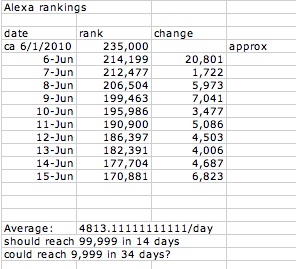
 . It was a study of the type of nonfiction I craved to publish, illuminated by selections from a group of authors that included my favorite role models plus a few up-and-comers.