Lost generation, indeed! Don’t miss this extraordinary video…and be sure to watch it all the way to the amazing end.
We’re told it was created by twenty-year-old Jonathan Reed and submitted to AARP’s “u @ 50” contest, winning second place in 2007.
The only thing necessary for the triumph of evil is for good men to do nothing. ―Edmund Burke

Lost generation, indeed! Don’t miss this extraordinary video…and be sure to watch it all the way to the amazing end.
We’re told it was created by twenty-year-old Jonathan Reed and submitted to AARP’s “u @ 50” contest, winning second place in 2007.
Funny hosts the Carnival of Money Stories next Monday! Don’t forget to send your contributions through this handy link.
Hmmm… Looks like the Carnivals server is down again. If you can’t get through today, keep trying. The deadline is Sunday afternoon.
Looking forward to reading lots of creative money posts!
Getting quit of Arizona State University and the State of Arizona is like trying to pull yourself free of a giant sheet of heavy-duty, extra-sticky flypaper. Below, notes on this morning’s exchanges with a Fidelity 403(b) rep, a Department of Administration rep, and (god help me) another ASU Human Resources rep:
Called Fidelity to find out where the $500 payment is. Reached L— S—.
She said there are two funds, one with $159,000 and a smaller one. She asked which one I wanted to withdraw from. I said I had no idea, having been through several reps, all of whom said they would make this happen.
She said the smaller one is available for any drawdown from me. The larger one requires paperwork proving that I no longer work for the state university system and approval.
She said they did receive the 8-page form from ASU but it is in process at Fidelity. She will e-mail the person in that department and call me back to report what’s going on.
Meanwhile, I haven’t received a bill from COBRA. Called ADOA. Reached a woman who didn’t identify herself. She said
a) I was supposed to have sent a check to HITS (how appropriate!) and I have not. I looked in my notes and discovered I was supposed to have sent a $199.14 check and, in my endless confusion over this f***ing nightmare, failed to do so. But this would not matter, because…
b) ASU has not entered me in the HRIS system, and so as far as ADOA is concerned, I am still employed by ASU and still covered.
LS said I need to call HR again and do battle with them. I have to tell them to enter me in HRIS and then find out from them what date they show me terminated. Then I have to call ADOA back and tell them what the date is. Then they will figure out what to do about COBRA.
I called C— D— at HR. She said I am entered in HRIS as terminated. I said ADOA said I was not entered.
She was mystified about the COBRA prepayment due in December. I said that was what ADOA told me, and that I had failed to make the payment because I was overwhelmed by the paperwork and hoop-jumping, which has now accrued a two-inch thick binder of paperwork and notes. She said there is no such payment; that she couldn’t speak for ADOA but she knows the system, and they have to send me a bill for any amounts owed. I said what I told her was what they told me. Twice.
CD said the termination went into the system on January 6, and it usually takes about 24 hours for it to register. She also said that because I wasn’t canned until the 31st, several days in to the first January pay period, I would have been covered by ASU’s regular plan until the 10th. I pointed out that today is January 12, and so presumably I now have no insurance coverage.
She said well, do I have any health issues? I said I need to go to the dentist. She asked if I have an appointment today.
I said, “Look. I have to get in my car and drive from one end of Hell to the other today. If I get in an accident and end up in the hospital without coverage, I will be bankrupted!”
She said COBRA has a six-month period in which you can enroll, so if I get hurt or sick in that period I can retroactively enroll.
She offered to call ADOA and tell them I was “termed” in their system six days ago and to find out what the story is with the COBRA. I said I will be running around the city all day—I’m now over an hour late in getting started and haven’t even had breakfast!—so she said she would find out what she can and leave word on my voicemail.
Will this horror show never stop????
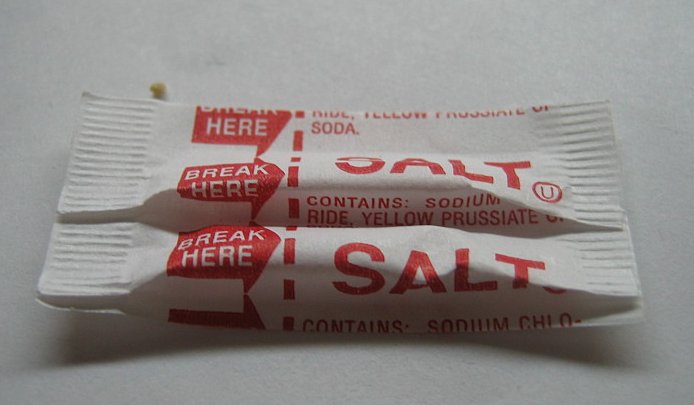
Did you read where the City of New York has decided to save its citizens from the horrors of table salt?
Well, all I can say is thank God someone has realized us saltheads need supervision at the dinner table!
Disclaimer: I don’t cook with salt (well…except for bread, which is pretty bland without it). When I feel something needs a little seasoning, I’ll salt it at the table.
The result is that most processed foods taste horribly oversalted to me. Even Swanson’s and Campbell’s canned chicken and beef broth: mouth-puckering! That’s one of the reasons I cook mostly from scratch, I rarely eat in restaurants, and I never eat fast food: it’s just too salty. Food should taste like food, not like salt.
However… I don’t make a religion out of that. It’s not a freaking moral precept!
And even if it were, IMHO governments have no more business regulating what seasoning will go into food than they do telling individuals what gender persuasion will qualify them as a marital partner or telling women what they can do with their own bodies.
Anyone who’s awake knows that processed foods are not very good for you, and that most of what restaurants serve is processed food. Anyone who’s even faintly conscious knows that fast food is, by definition, a blob of sodium wrapped in artificial flavors.
If you choose to eat in restaurants, if you choose to consume pretend-food from fast-food chains, then you presumably choose to take your chances. Besides, maybe some addicts like salt in their food.
Take French fries, for example. French fries, like pretzels, exist to carry salt to the tongue. Without this key ingredient, there’s exactly zero point to French fries. Or to pretzels. Or to popcorn, for that matter. It’s stuff that you eat because it’s bad for you. You know it’s bad for you, already. You choose to eat it because it’s bad for you.
We’re being protected from our own stupidity and our own fears quite enough, thank you, with adult-proof caps or (god help us!) individual bubble-wrap on every nostrum we swallow, with adult-proof caps on every bottle of household cleanser, with mandated prison bars around every swimming pool, with beepers nagging us every time we open the car door without taking the key out of the ignition, with idiot lights that come on to tell us to wrap the seatbelt around the bag of groceries we set on our car’s passenger seat, with X-rays of our genitalia every time we get on a commuter plane, with spy cameras on every corner, with G-mail filters that make you pass a math quiz to prove you’re rational before you send a message, with flicking password-protected PDF’s, two of which I received today.
You think I’m kidding about the G-mail thing don’t you? Go ahead. Click on that link. It’s real, I tell you, real!!!!
Feed me, Seymour! Feed me some French fries!
Image: Wikipedia Commons

One thing that’s fast becoming clear: when your time is unstructured, lists have their uses. Now that I’ve attained Bumhood, it’s amazing how fast time goes by without much getting done!
In the past, long before Mary Kay Ash started teaching her acolytes to scribble their entrepreneurial tasks in lipstick on the bathroom mirror, I used to write to-do lists every day. In my first job as a publication editor, I would end each day by making a list of the following day’s tasks and leave it on my desk, thereby jump-starting the next day. This pretty much guaranteed the work got done by deadline. Something about checking off accomplishments, no matter how minor, builds momentum.
Lately, though, I’ve found myself killing too much time in cruising the Web and not enough time living, so I decided to revive the list habit, at least in a sporadic way.
Yesterday this quirk gave a hint of its potential power.
Apparently I ate something that made me sick—it left me under the weather all day. I really didn’t feel like doing much. But I had a list. Even though I was dragging around, when the day ended I realized I’d done a surprising number of tasks. Didn’t get out for a long walk with the dog or spend time loafing at the fancy shopping center where Cassie likes to hold forth as the center of everyone’s attention. Never got back to pruning and fertilizing roses. But…
• Did the laundry
• Chlorinated the pool
• Reset the pool equipment
• Watered a few plants
• Wrote a blog post
• Updated Excel spreadsheets
• Set up online bill paying for the S-corp’s Visa card
• Paid the Visa bill online
• Paid the Cox bill online
• Wrote & posted three online quizzes for this spring’s students
• Learned how to use a new feature of BlackBoard, the online teaching software
• Posted syllabi
• Emptied out the binder I use as my mobile “office” for the community colleges
• Used heavy card stock to build new dividers, all printed out and nifty
• Organized binder to accommodate three new classes
• Started decluttering the stuffed file cabinet in the garage
• Cleaned the car windshield again, it not having turned out to be quite pristine the last time I washed the car
• Took the dog for a walk…sort of.
Doubt if I’d have done any of those without a list of things to check off. Think of all the stuff that would’ve gotten done if I’d felt like moving!
You can, I think, get carried away with this strategy. When I was a little kid, a playmate’s parents used to stick a daily list on his bedroom wall—it filled an 8 1/2 x 11 sheet of paper and specified what he would be doing each moment of the day. Literally: they put down when he would brush his teeth and when he would go from the bathroom back to his bedroom to get dressed and when he would appear in the kitchen for breakfast. Poor little guy…can you imagine having your life regimented like that?
It’s not necessary to map out every living, breathing minute to use listing to jump-start your day. Often a rough list of ideas for things to do will get you going, so that once you’re started, you end up accomplishing a great deal more than you would have without the check-it-off impetus. Sometimes I’ll retroactively add to the list activities that I got sidetracked into doing and check them off, just to congratulate myself for getting something done that day. Yesterday, for example, though I never did make the bed, change out of my grubbies, trim the roses, or clean house, I did add things that didn’t require me to move far from the computer: uploaded syllabi as well as quizzes, cleaned last semester’s junk out of the teaching binder and organized it for next semester, and shoveled off the top of my desk.
Next:


A chimney sweep in one of America’s warmest cities: Mark C. Keever is the second in Funny’s series of stories about entrepreneurs who find creative and unusual ways to jump off the treadmill.
I came across Mark and his business, Adirondack Chimney Sweep, in Angie’s List, where a long line of customers had left ecstatic reviews about his work. Not knowing whether the chimney in my 1971 house had ever been cleaned, about the beginning of December I gave him a call, hoping to have the job done before the big Christmas party.
Mais non! The man was booked into the beginning of January! A chimney sweep with personality, it develops, has more work than he can handle. When Mark dropped in the other day to apply his skills to my old fireplace, complete with his broom and old black stovepipe hat, I asked him a few questions.
FaM: Mark, how on earth did you get into the chimney-sweep business?
Keever: Well, I grew up in Queensbury, New York, a small town between Glens Falls and Lake George. Most people didn’t have much, and when you graduated from high school, your career choice was going to work in the paper mills or going to work in the local prison. Because people had to do for themselves, one of the things we learned in our shop class was how to clean potbellied stoves and chimneys.
In my senior year, I got in a motorcycle accident and was seriously hurt: broke my left foot in twelve places, broke my left leg, messed up my knees and elbows. That was the end of my future in the paper mill.
FaM: It must have kept you out of Vietnam, too.
Keever: That’s right. Couldn’t get into the military, either, because the damage to my foot made me unfit for combat.
FaM: So what did you do?
Keever: I came out to Arizona to recuperate and ended up going to work for the Greyhound Corporation. I worked for seven years, and then I went with the Southern Pacific Railroad. That was a good job, but after four years I was laid off—along with about 9,000 other people.
Not knowing what to do next, I looked around and found out that one in four houses in the Phoenix area has a fireplace. Well, that was a natural: I already knew how to sweep chimneys.
I started a business, but by the time we were up and running, it was out of season. Nobody thinks about their fireplaces on a 110-degree summer day. So I was really struggling.
To make ends meet, I decided I’d better take a full-time job with the City of Glendale. I was happy to get the job, but I kept the chimney-sweep business as a sideline.
And I also thought I’d better go to college to learn how to run a business, so I enrolled in a business course at Phoenix College. It only took me 25 years to finish my associate’s degree!
Meanwhile, I kept on working at the city and also kept sweeping chimneys as a side job.
FaM: It’s always a good idea to have a second income stream, isn’t it?
Keever: Yes. I was glad I had it, because last spring the city offered its employees a buy-out deal. I had only just earned the 80 “points” city and state workers need to retire, but there they were: I actually was in a position to retire. I thought it over for a while, and then finally I decided to take it.
So I got a good severance package and plenty of time to make a go of Adirondack.
FaM: That must have been a breathtaking moment!
Keever: I’ve never been happier! No more stress of a day job and a commute, no more working for a big bureaucracy. I’ve got all the work I can do, most of it in the wintertime while the weather’s nice, and the business has really taken off. All told, Adirondack Chimney Sweep has had 2,187 customers.
* * *
Cleaning the fireplace, a two-and-a-half-hour project, entailed climbing on the roof to brush out the chimney and then engaging in some lengthy and vigorous cleanup with a large shop vac. By the time Mark finished, the firebox and the family room were spotless.
He sprinkled a handful of salt at the back of the firebox. “This brings good luck,” he said. Then he set a shiny copper penny in the front right corner of the fireplace. “A penny in the fireplace not only brings more good luck,” he continued, “but because it’s this year’s date, all you have to do is look at it to remember what year you last had the chimney cleaned. This one should be cleaned about once every four or five years.”
After a short demonstration of how to lay a fire and how to use a newspaper torch to warm the cold air seeping down a chimney to make the flue draw better, he was off.
And the next time that thing needs to be cleaned, I know who I’m gonna call!