Coffee heat rising

A little disaster in the backyard

Okay, so the bee dude showed up yesterday noon. He looked at the composter and said the bees had taken up residence in there, and that normally in an object shaped like that, they’ll attach their hive to the top (as in the top of a cave). This meant, in his humble opinion, the bees had built a colony on the backside of the compost lid.

He felt the only thing to do was to exterminate them.

Shit.

One of my quirks is that I hate, loathe, and despise insect sprays. Exterminators are not allowed near my house. Though I’ll use some boric acid and, in extreme cases, traps on ants or roaches, I don’t allow spraying. Instead, I keep attractions away from the living quarters and encourage insectivorous birds to visit frequently. And, except for the mosquitoes from the swamp behind Dave’s Used Car Lot, Marina, and Weed Arboretum, I never have any insect issues.

It took a while to reach that harmony. When I moved in to The House from Hell, Satan and Proserpine’s* pet ants had built an ant metropolis that I’m sure extended all the way down to Satan’s favorite throne in Hades. The place had roaches, too, although not in the gay profusion characteristic of other dwellings I’ve enjoyed. Oddly, there wasn’t a single black widow or scorpion to be found.

The place was barren: no trees except for two young willow acacias, a ridiculous sort of tree whose branches aren’t really strong enough to support the weight of a roosting bird or a bird nest. The one in back was planted directly upwind of the pool, so that summer monsoon gales blow bushels and bushels of Devil Pods (I call the thing the Devil Pod Tree, in honor of the previous homeowner) and stringy, pool-cleaner-clogging leaves directly into the water.

As soon as I got moved in, I planted four new trees in the backyard, buying the largest specimen trees my budget would tolerate. I also cultivated a number of bird-attractive shrubs. Although most birds will eat ants, what I really needed were thrashers, towhees, and woodpeckers, plus a nice tribe of geckos. A mockingbird or two would help, too. I put up two big bird feeders, knowing that insectivorous birds will usually come along for the ride if they see a lot of seed-eaters around. ThenI planted some roses and mulched them with a thick layer of bark chips, a substance much favored by small bug-eating lizards.Before long a pair of towhees took up residence. A woodpecker showed up and made short work ofthe cockroaches residing in the detestable palm trees. It took a year or two, but in time the birds and the geckos brought the ant situation under control—you hardly ever see an ant nest in the yard anymore,and when you do, it’s a normal, healthy ant colony, not a berserk ant empire.

Applying insect spray in the backyard will disrupt that equilibrium, and before you know it, all sorts of problems will arise. No bees, no pollinated flowers. No pollinated flowers, no seeds. No seeds, no birds. No birds: ants, crickets, grasshoppers, and roaches coming out the wazoo!

It’s interesting that even a guy who cultivates bee colonies in his backyard assumes it’s normal for people to be afraid of insects. He very clearly thought I was and should be frightened of the bees foraging for pollen in the acacia tree.

What is it with that? What about something that’s an inch long should scare you? For crying out loud. Yeah, it’s true that some insects will bite you—most annoyingly, fleas and mosquitoes—and that some carry disease. But there are relatively easy ways to deal with that, not the least of which is getting rid of swamplike puddles on the bottom of drained swimming poools.

And yes, bees do sting if you piss them off. Duh! The trick is don’t piss them off!

The term “killer bees” is an obscenity coined by the infotainment media, who sell papers on the “if it bleeds it leads” theory. Long before Africanized bees came along, plain old boring European-style honeybees were known to swarm humans, dogs, and horses, and working together they also can deliver fatal doses of venom. The difference is that the African strain of honeybee is a little crankier than the variety that evolved when the ice ages chilled Europe, cooling the temper of the bee along with the climate. Also, European bees are less likely than African bees to build their nests near the ground, where humans and pets can mess with them.

The bee dude seemed set on eliminating the bees not only from the composter beneath the willow acacia but also from the acacia itself. No amount of explaining that I like bees humming around the puffball blossoms festooning the willow acacia in back seemed to make him understand that I didn’t see a problem with the bees in the acacia, especially since he stated the foragers were not the builders of the hive.

If the new residents had settled into some out-of-the-way spot, I probably would have sent our boy on his way. But the fact is, they had occupied a device I use several times a week, located in a place where the dog and I both move around all the time. Being that they were no doubt Africanized, sooner or later we were going to piss them off.

Well, he said he’d apply a powdered pyrethrin to the composter and this would do in the hive. It also would do in a year’s worth of organic compost. Then he goes on about how the surviving bees will still be clustering around the hive area for three days to a week and I should be careful to keep the dog away from there and stay away from it myself, and so forth.

Unhappily, I agreed to this, since I figured a colony of potentially touchy bees near the ground in an area where the dog and I are likely to disturb them did pose a hazard.
So he went off to do his thing.

Pretty quick he shows up and informs me that he’s finished, and I’ll be pleased to know there was no hive inside the composter.

Huh?

No. They were foraging for something in the composter.

That’s when I remembered I’d dropped some old toast that had a bit of honey in there. Sumbitch. Well, say I, then you didn’t have to kill them?

Oh, no, he said proudly, he had dumped pyrethin powder all over everything and all over the inside of the composter. They’re all dead.

Uhm…so my compost is ruined?

Oh yes. In a few days you’ll want to put on some gloves, get rid of the compost, and scour the composter inside and out first with detergent and then with bleach.

Well…uhm…if there was no hive inside there, why did you dump insecticide all over it?

Because, said he, he didn’t realize they hadn’t built a hive until after he’d already applied the stuff.

Ducky.

Well, this morning there’s not one bee anywhere near the acacia. You’ve heard of Silent Spring? In Arizona, fall is spring. What we have in my backyard is Silent Autumn. It’s dead quiet out there. And I use the word advisedly.

Sometime this weekend I will have to roll the compost barrel out to the alley. Being an old bat, I don’t have the physical strength to scour a thing like that inside and out, first with detergent and then with bleach. So I guess it’s done for, along with 40 pounds of beautifully ripened compost that I was about to use to build a new vegetable garden. I’ll just have to roll it into the alley and leave the whole arrangement for the trash pickup.

Lhudly sing goddam!

*Satan and Proserpine: the previous owners

Gecko: ZooFari
Towhee: Alan D. Wilson
Thrasher: Charles & Clint
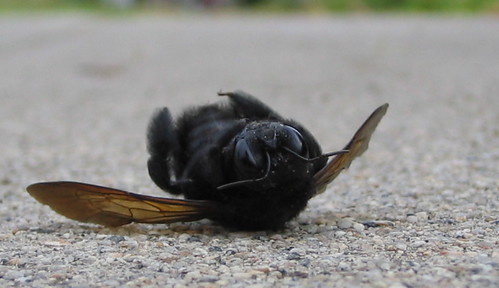
Dead bee: jilldoughtie

Pennies saved…

Sometimes it’s well worth a trip to return small items to a store—or to question a bill—that may seem too minor to be bothered with. A penny saved, after all, is a penny earned…and pennies add up.

For a week or two, I’ve needed to return a jug of Costco’s “environmentally friendly” laundry detergent and trade it in on the “Free & Clear Ultra” version. Stupidly, I imagined that environmentally friendly meant “unadulterated by industrial perfumes.” Wrong! When I opened it I found it stinks of some allegedly “clean-smelling” chemical. I want my sheets to smell of the open air and my clothing to smell washed…not full of an odor that some industrial chemist imagines the Little Woman will imagine smells “clean.” Cheap perfume smells of cover-up, not of cleanliness.

In the interim since I’d bought that stuff, I’d also purchased a bag of scrumptious-looking frozen asparagus spears, proudly branded “organic.” Not until I was about to slice the bag open did I notice the label saying “Product of China.”

No, thank you. Couldn’t pay me to put a product of China in my mouth, not on purpose anyway. This is the country whose food producers poison dogs, cats, and babies in pursuit of profit.

And a couple of days ago I’d picked up a bag of sweet onions, all but one of which, when the bag was opened, proved to be spoiled.

Trekked the rejects back to Costco this noon and came away with a $26.79 credit. Bought a new container of laundry detergent for $15.15, netting $11.64.

Then it was off to Radio Shack, where some time back I’d noticed a double-charge on a receipt. Luckily, the old guy who manages the store—who sold me the goods for which I was accidentally double-billed—happened to be in. He promptly refunded the phantom charge: $16.23.

So: my net refund came to $27.87. For a dollar’s worth of gas and an hour of my time.

Yay! When added back into this month’s budget, it puts me firmly in the black, despite the beekeeper’s bill, which only came to $75, not the $125 he proposed to charge.
A$k and ye shall re¢eive.

Olive Oil: The miracle skin cleanser

Here’s a little discovery I recently blundered upon: plain old olive oil makes a great facial cleanser and skin conditioner.

I know…it’s counterintuitive. Olive oil should make your skin greasy. But it doesn’t. Not at all. In fact, as I write this my skin could use a little face cream. Some people say it’s safe to use on naturally oily skin prone to acne, because your own skin’s native oiliness has nothing to do with what you put on it and everything to do with your hormones. So many people buy into this theory that there’s actually a coterie of folks who have developed an “Oil Cleansing Method”(OCM), which they recommend for acne sufferers.

The other day I stumbled on this when I opened a freebie sample packet of expensive skin cream from L’Occitane. Thinking it was rather nice, I glanced at the ingredients and discovered the stuff is mostly water and olive oil.

Olive oil? I’ve got that in the kitchen, and it sure doesn’t cost what a bottle of fancy goop from L’Occitane costs.

Meanwhile, there’s a backstory here you should know about: Over the past two or three years, I’ve developed a maddeningly itchy spot on my face. It runs along the sides of my nose, especially around the creases where the nose joins the face. One dermatologist decided it was seborrheic dermatitis and prescribed a high-octane cortisone cream. Another dermatologist said it certainly was not that, because there was no visible reddening or rash, but she didn’t know what it is and thought I should leave it alone.

Well, cortisone cream does nothing. After I’d faithfully followed the first specialist’s instructions for about ten days, I learned that cortisone creams can cause your skin to atrophy. That’s just what I need: atrophied skin on my face! Thanks, doc!

Moving on, I tried dandruff shampoo (briefly soothing…for about ten minutes), calamine lotion, insect itch stuff, face creams, Vaseline, witch hazel, Bactine, antibiotic ointments, Myconazole, special soaps, Benadryl cream, oral antihistamines, swearing off caffeine, swearing off alcohol, and on and on and on. NOTHING helped to make it heal up, and only two things would stop the itch for longer than about five or ten minutes: salacylic acid (in Scalpicin) and benzyl alcohol plus pramoxine HCL (in Itchex gel). Both of these sting like the dickens when you apply them—as in hurt so much it makes your eyes water—but they would stop the itching for three to five hours, which was better than anything else did. Meanwhile, I continued to unconsciously paw at my face, because nothing would bring the itch to an end.

When I realized the L’Occitane cream was mostly olive oil, the Still Small Voice whispered, “Olive oil? Try it!”

Why not? Nothing ventured, nothing gained. The OCM enthusiasts are hot to add stuff like castor oil and aloe, but I decided I would restrain myself from running to the drugstore and just use the Costco olive oil I had in the house. Here’s the strategy:

You need

a small amount of olive oil
small dish
warm water
washcloth
a few minutes of undisturbed time

Pour a tablespoon or two of olive into a little dish. Using your fingers, dip up oil and spread it over your face. Rub the oil gently around and into the skin.

Dampen the washcloth well with very warm but NOT scaldingly hot water. Lay the warm washcloth over your well-oiled face and let it set. Relax while allowing the steamy warmth to work on your skin. As the cloth cools, repeat this several times.

Then gently wipe the excess oil from your skin. Rinse and wring out the washcloth, and you’re done! If you like, splash some cold water on your face as an astringent.

Amazingly, as soon as I applied olive oil to the itchy area around my nose, it started to sooth the discomfort! And it didn’t hurt.

After I finished wiping the oil off my face, I dabbed a light film of olive oil onto the itchy area. It worked! It didn’t 100% cure the itching, but it soothed enough that I could keep my hands off my face all day long.

I’ve been using olive oil on my face for several days now, and it’s making a huge difference. Maybe over time the years-old irritation will settle down and go away. BTW, the oil also works really well to remove make-up. It even takes off mascara. It leaves your skin feeling clean, with no trace of greasiness. The olive oil scent dissipates quickly or washes off in the warm water, so you don’t end up smelling like a walking bowl of salad.

Isn’t that the darnedest thing? I can’t imagine why this would work on a stubborn itch. And I’m not asking! I’m just gunna keep using it.

Bees!

beesWhen I got home from work (and junketing all over the Valley) this afternoon, what should I discover in the backyard but a young colony of bees flitting in and out of the compost bin!

Dang! They must have only just moved in, because I tossed some leaves from the pool in there yesterday or the day before.

I love bees. But unfortunately, here in Arizona virtually all wild colonies are now Africanized, and we have had a number of incidents where humans and pets have been seriously injured after annoying some of the little ladies.

So I called a beekeeper. Explained that they’re in my organic compost bin and I really, really don’t want the compost sprayed with some evil chemical. And that’s when I started to learn a lot more about bees than I imagined I already knew.

To start with, over the phone I couldn’t explain what the compost bin looks like clearly enough that he could visualize it. He said normally a beekeeper can remove a colony if it’s still swarming, but once the bees have taken up residence inside a nest, it’s usually too late. However, he added, if they’re in something moveable that you can throw a big plastic bag over, you might get away with it. I think that describes the composter, but my description of it was pretty fuzzy.

Otherwise, he said, the preferred way to eliminate an established colony is soap and water, which should do no harm to the organic compost. Truly evil pesticides are the last resort.

Composter cum bee hive

I said this compost bin has a little hinged hatch you open to drop in vegetable matter, and that’s where the bees were squeezing in to their plastic “cave.” It had occurred to me that if I waited until after dark, when the bees are asleep, I could tape it shut with duct tape. In time, they’d die.

Problem is, said he, bees don’t “sleep” in quite the way we think of sleep. Bees rest. He was afraid that if there was more than one hole to tape up and if I didn’t work very fast, they’d come pouring out of there the minute they were even slightly disturbed. I allowed as to how there were four, not one, slits around the hatchway, and that it would take a few seconds to cover each. He regarded this scheme as risky.

So tomorrow he’s going to come over and see what he can do. I hope he doesn’t have to assassinate the little critters. One way or the other, it’s going to cost me $125…so, good-bye to all those pennies I’ve been pinching by way of storing up for the allegedly pending layoff. Yacan’t win for losin’, eh?

Photo of bees in cereus bloom: Mila Zinkova

A few neat sites…

Check out these new-to-me sites that I’ve been enjoying recently:
.

At the Wall Street Journal, a very active blog run by Mary Pilon, The Wallet, has been chugging along since September. She has a lot of useful and sometimes fun information, and also the occasional thoughtful piece—see, for example, this article on voting and your job.

In the “Now for Something Altogether Different” Department, I have been attracted by this charming online sketch journal, done by an artist and writer in Australia. She and her husband own a horse ranch, and their adventures, revealed in more detail at a second blog, make for stories, photography, and artwork that provide some fascinatingly exotic moments for us Yankee city girls.

I don’t think I’ve mentioned Small Notebook, discovered on a Make It from Scratch carnival. This author, who is on a quest to simplify her family’s life, offers many frugal and clever ideas, also with great charm. I may have highlightedModern Beet somewhere along the line; if so, it’s worth another mention. The thing blows me away every time I visit.

Room Farm is very nice; I like it because the proprietor shares many of my own concerns about the interrelation between money and stress. I also enjoy Simply Forties very much: the story of a youngish (from my point of view, anyway) woman living in a Texas country town.

In Utah, problogger Miranda holds forth on a just-for-her site, This Time It’s Personal, with some interesting reflections on a wide variety of topics. I’m pretty sure I’ve mentioned Mrs. Accountability’s Out of Debt Again: take a look at the beautiful garden produce she’s brought forth on her rural property.

Not all of these are strictly personal finance sites, although most touch on the subject now and again. Interesting…I seem to be drawn to women writers who live in the boondocks. Does this have meaning? Do I or do I not dream of retiring to Yarnell?

jul8yarnell1

Bidding Up House Prices: A new illusion?

111208gavelThe other day I was chatting with the guy who’s painting the former Used Car Lot, Marina, and Weed Arboretum across the street, who has four clients in the business of buying, fixing up, and flipping foreclosures. When I remarked that my friends La Maya and La Bethulia had run into a situation where a rather nice little house in foreclosure was bid up in price by competing speculators, he had an explanation for that.

Ken the Painter says that bottom-feeding investors (of course, “bottom-feeder” is not a term he uses for his customers) don’t want any competition from regular folks. So when they spot someone they think is an amateur at an auction, they’ll deliberately bid up the price on a dog. From experience, they have a good feel for how much it will cost to make a place salable and how much the place realistically will fetch. So they engage a little competition with the newcomer, pushing the price above the amount that would allow for a profit, and then drop out of the bidding. This leaves the wannabe investor paying too much for a piece of junk guaranteed to burn his fingers. And that gets him out of their hair.

Nice folks, eh?

At any rate, this phenomenon represents something, all right, but it ain’t upward motion in the prices of real estate. Unfortunate in two respects, is what it is….