Coffee heat rising

Incredible Cool Weather Roundup

It was 60 degrees on the back porch when Cassie and I stumbled out at five-thirty. Just. Unbelievably. Gorgeous. It’s almost 8:00 now and still cool enough that if I would get off my duff we could go for a walk.

* * *

Incredibly later…

* * *

Yes. A very pretty day. Ambled with the little dog through the beautiful old neighborhood where the rich folks live, nice and quiet and peaceful. Then back to park said dog at the Funny Farm and take off again on a bicycle. Perfect morning for a bicycle ride.

Coveted a house for sale; can’t find it on Zillow or Trulia. Estimated asking price: about $425,000. Oh well.

Back to the Funny Farm: could not stand the dirt one more minute!

Threw a load of laundry in the washer.

Tossed the garbage out of the refrigerator. Hauled all the various hand-crafted and home-made gewgaws out of the desk drawer and two other drawers and moved an old silverware tray into the desk drawer and some little boxes into the other drawers and organized all those necklaces and bracelets and earrings and rings and anklets and tossed the worst of the junk into the craft drawer to be recycled into new home-made gewgaws. Or better, forgotten.

Hung up the clean clothes. Threw another load into the washer.

Picked up the mountains of paper littering the desk. Threw most of it out; filed the rest of it. Wiped the layers of dust off the computer and surrounding surfaces.

Hung up the second load of laundry.

Continued, as above, through four other cluttered rooms.

Cleaned the kitchen counters (stove already cleaned yesterday). Grilled a slab of mahi outside; heated a tinfoil packet of frozen peas with it. Cooked pasta; topped it with fresh tomato, Italian & Thai basil, crumbled feta; whipped butter, fines herbes, and fresh lemon juice together—topped the hot fish with that. Cleaned the outdoor tables. Dined al fresco. Magnificently.

Vacuumed 1860 square feet of extremely hard, foot-flattening tile. Hurt too much to dust-mop and then steam-mop all of said square footage. Mopped the kitchen floor, after scrubbing up stickiest, most grocery-littered spots.

Drew a hot bath. While water was running, dust-mopped house, planning only to hit the worst spots but ended up dust-mopping all the floors. Tomorrow: steam-clean. Now: sink into hot bubble bath. Marvel at the number of places one’s body can hurt at once.

But the house is cleaner than it’s been in months!

Want to know what’s to be done to help America’s kids learn? Read it here. Literacy—true literacy, which means being able to write as well as read, and understanding how language works—is the key to all learning. Too bad educators lost track of that a generation or two ago.

Spare us all from wasted time, no matter what our jobs are. But especially if we’re supposed to be teaching young people.

Holy mackerel! 101 Centavos has been hitting the ball out of the park every day this week. Start with this elaborately thought out discussion of why California’s gasoline costs so much. Then hit the home page and just start scrolling down.

At Budgeting in the Fun Stuff, Crystal & Len have finally made the big move! Yes: they’re into the new house, after the usual round of Contractor Standard Time and closing headaches stacked on top of a trip to the Financial Blogger Conference and running the blogging empire and keeping the business going. Ah, to be young and have that much energy…whew!

At A Gai Shan Life, Doggle is recovering from breathtakingly expensive and challenging surgery and Revanche writes another of those soul-searching posts that are her specialty.

Speaking of cruising a whole series of recent posts (as we were, above), eemusings is back at Musings of an Abstract Aucklander with a whole series of posts describing her travels, complete with adventures and photos. Start here and scroll back through the amazing journey.

What does a strangler fig have to do with personal finance? Mrs. PoP expands on a creative and entertaining trope at Planting our Pennies. She’s got photos, too.

At My Journey to Millions, Evan ponders the hysteria over the new health care tax with some astonishment…for good reason, it appears.

Abigail reflects on her and Tim’s state of NON-poverty at I Pick Up Pennies. Especially considering all those two have had to deal with, they’re doing pretty darned well!

Frugal Scholar and Mr. FS have been in California attending to the difficult job of packing up the worldly goods of his late parents. They came up with an interesting solution to the problem of how to move the stuff all the way across the country, back to Lousiana.

What are hubcaps for? Take a guess. Then go on over to Blue Collar Workman, where TB reveals the real purpose of hubcaps.

Freshly arrived in Alaska, Donna has a decluttering revelation. To wit: Get. Rid. Of. It. All of it! Check it out at Surviving & Thriving.

Well, folks…Mama’s too whipped to read another word, to say nothing of writing any more of ’em. Time to go. Have a good weekend!


Adventures in Physical Therapy

Welp, I dodged out of the physical therapy gig after a week and a day–that would be four sessions. I’ve never been the gymmy type. In fact, it would be fair to say I dislike even visiting a gym, much less messing around in one. My idea of exercise is a mile-long hike up a mountain, a hour of biking, or a spate of yoga. But my foot and back hurt so much, hiking was out of the question. So, I begged a referral from Young Dr. Kildare (who is, it must be said, coming in handy now and again) and went to a sport and physical therapy outfit near my house.

Launching this endeavor just as 89 tons of work were falling on my head did not help the attitude, I’m afraid.

The athletic young(ish) therapist, who seemed to very knowledgeable and was kind and patient, showed me a few stretches that seem to help the plantar fascitis a bit. They were the same things I’d learned off the Internet. Then she taught exercises for the back pain: except for this one, most were basic yoga poses.

I took yoga classes from a certified trainer for 18 months or two years, so I do know how to do those exercises and don’t need to traipse in to a gymnasium for the infirm three times a week to be guided through them. And yes, they do help: many people find a lot of back pain relief from doing a regular yoga routine.

The issue, though, was not that the instruction was so basic. The issue was the usual one that afflicts American medicine: access to care. As a practical matter, it surely is helpful to have the moral support of someone who knows whereof she speaks or even of a group of people who are working toward the same goal: freedom from pain. But that was obviated by the young woman’s workload: at any given time, all day every day, she was trying to deal with three or four people at a time. Even though she had an assistant (a startlingly dumb assistant), about all she could do was tell you what set of exercises to do; then go off and attend to others while you did that routine; then come back and tell you to do another set of exercises.

But you understand: one set of thirty-second hamstring stretches should take you 180 seconds: that’s three minutes. Add another minute or two for resting in between, and you’ve got maybe five minutes to get through those exercises.

Of course, each person she had to coach required more than three minutes. She would be doing well to finish with one person in eight or ten minutes, and some people who were in really bad shape deserved a great deal more time than that.

All told, she had me doing about 10, maybe at the outside 15 minutes of exercises, plus 10 minutes on a very poky, very easy stationary bike. That’s 20 or 25 minutes of work.

On Monday I was there from 9:30 to 11:15: an hour and forty-five minutes to do 20 minutes of exercises! Exercises that I already know how to do. For me it was an incredible waste of time, when I had no time to waste. And I felt that I was absorbing time of hers that would be better used working with other people. The old guy who’d had knee replacements in both legs and was suffering serious pain obviously needed her attention in ways that I did not.

Back here at the Funny Farm, one set of basic yoga exercises, which includes more stretches than she had time to demonstrate, takes about 40 minutes; add the plantar fasciitis stretches, and you’re at 43 minutes. I quickly found that a round of mild yoga (and getting rid of the bone-crushing office chair…) left the back feeling a lot better.

The foot still hurts a lot, though it’s better than it was. If it’s ever going to get better, presumably it will require tincture of time in large doses.

But in the time department, my gawd! Adding two hours for that to the already wacky schedule just about drove me over the edge. Monday it was out the door at quarter to seven, teach a class for an hour and a half, cope with some bureaucracy; race back to town, change clothes, race to the therapist’s; race home, change clothes again, fly to Scottsdale; schmooze for an hour and a half at a Chamber meeting; traipse all the way back into town again; stop by the grocer on the way home; throw off the “professional” rags, plop down in front of the computer, work till 10 or 11 p.m. trying to catch up with all the work I’m missing while I’m batting around the city all day.

Two established clients resurfaced this week with new projects. As fast as I clear the work off the desk, new work materializes—a good eight or ten hours a day of it, all told. Monday I spent seven or eight hours in meetings, class, therapy, and interminable driving. Add it up, and you get a sixteen-hour work day.

So. Any (16-hour) day, I’d rather do 40  minutes of yoga and hamstring exercises on the living-room floor than spend an hour and 45 minutes sitting around a physical therapy gym.


w00t! AWESOME Drop in Power Bill

OMG, to coin a phrase: The power bill that arrived yesterday was only $128.89. That’s down from last month’s of $209.58 and August’s of $218.91. Both of those are below the budgeted high of $225, which the Salt River Project has attained in the past.

This, we might add, is with my turning the thermostat down to 77 degrees at 9:00 p.m. in hopes of sleeping all night long. Forlorn as that hope is, there’s absolutely zero chance that I’ll get to sleep when it’s 80 or 82 in here.

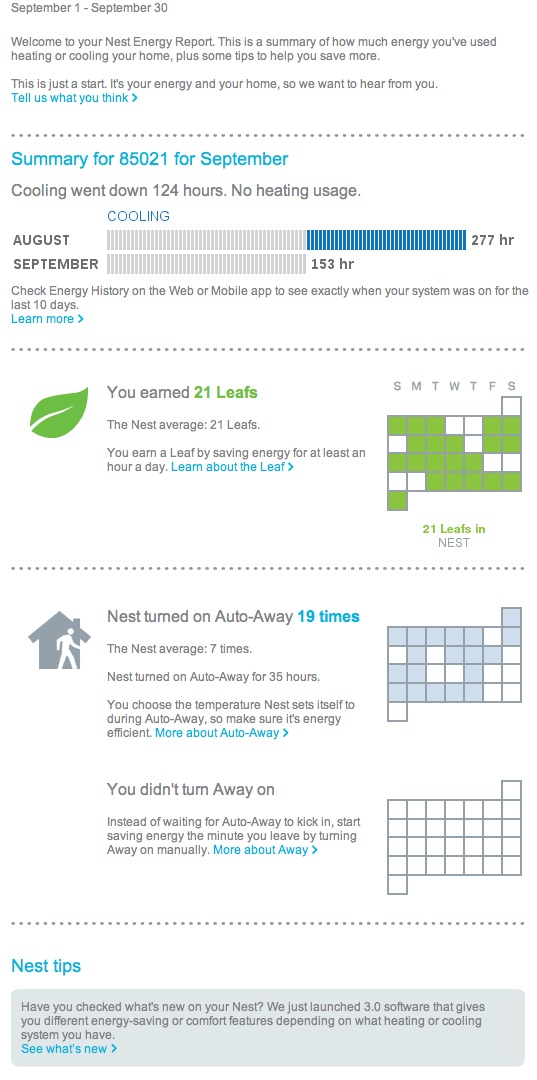
I guess the Nest gadget my son gave me for Christmas last year is working! ♥ It’s attached electronically to the iPad. So in theory, if you have nothing better to do with your time, you can control it remotely.

Check out this report the company generated and sent by email:

How kewl is that?

The “Away” business has to do with an interesting feature on this thing. The thermostat has a sensor that records whether anyone walks past it. If it can’t detect any activity for a while, it turns the system way down. Or “up,” I suppose, in the summer: it gets into the middle 80s in here if I’m gone for a long time. Or not moving: Take a nap and you wake up to an 86-degree sauna.

However, so far I haven’t found that especially inconvenient or annoying. When you walk past the thing or wave your hand at it, the AC immediately comes back on. I’ve never been really uncomfortable, as I have been in the past. When I first learned about this feature, I was worried about the dog, but she insists on laying on the tile floors (even though she has plenty of soft things to lounge on), and the tile stays quite cool even when temps indoors are in the upper 80s or low 90s. She doesn’t seem bothered by warmer temperatures in the house.

Salt River Project provides some monthly usage figures, which show, among other things, the average daily cost of power in your house. In October 2012 it cost me $4.30 per day, on average, to cool the shack. In October 2011, the average daily cost was $5.29: a dollar a day difference. The daily bill in September (which covers the hot and humid month of August) was $6.76. In September 2011, it was $7.62 a day: again, about a $30/month saving. Over the course of a summer, that’s a saving of about $90 to $100.

So. It’s a pricey little doodad. But it works.

Medicated America: Our Brave New World

Have you seen this amazing story in the Times? In short, it reports on the custom of drugging kids who have no attention deficits or psychological disorders in order to make them sit still in class. Says one doctor who advocates this practice: “I don’t have a whole lot of choice. . . . We’ve decided as a society that it’s too expensive to modify the kid’s environment. So we have to modify the kid.”

We already know that rich kids dope themselves with stimulants to enhance already perfectly fine grade averages, so as to up their chances of getting into elite universities. Now, though, as if that weren’t stupid enough, we’re talking about drugging all the rest of the kiddies…why? So they can get into the local community college? Or more to the point, so they’ll sit down and shut up while their teachers try fruitlessly to wrangle “classes” of thirty or more grade-school children?

As a culture, we now drug our citizens from nativity to senility.

What do you take at this point in your life? Dollars to donuts, you’re on something. It’s not surprising: 90 percent of Americans take drugs for one or more ailments, most of them described as “chronic.”

If you’re not swallowing pills every day, you’re an odd duck. I speak from experience. Because of a familial tendency to stay away from doctors unless I’m sick or hurt, I’m not on any medication. And every time I go into a new doctor or dentist’s office or talk to a new insurance agent, where they make me fill out a two-page checklist confessing to any of scores of diagnoses and then list the prescription drugs and OTC nostrums I’m supposedly gulping down, the staff invariably expresses astonishment.

“You’re not taking anything?”

“Uh…no.”

“That’s amazing!”

I’m sure.

Yesterday an insurance agent called to try to talk me into changing my Medicare supplemental carrier. She said I would have to undergo low-level underwriting, since, after your first enrollment period, Medicare supplement insurers do not have to accept Medicare recipients willy-nilly. She explained, as if to a child, that I would be asked to answer several questions about my health problems. What were they, by the way?

“None.”

“None? You don’t take any medications for anything?”

“No.”

“You don’t have diabetes?” (Flabbergasted tone.)

“Well, no.”

Jayzus.

This kind of thing started when I was about 40. At first, no one could believe I wasn’t on hormone replacement therapy. Being a skeptic, I willfully refused, despite my gynecologist’s assurance that if I would just take these nifty little estrogen pills I would be protected against cardiac disease for the rest of my life, I would be able to screw anything that wore pants until I toppled over into the grave, and my face would never get wrinkles.

No joke. He bought the HRT salesman’s pitch, hook, line, and proverbial sinker.

Soon no one could believe I wasn’t on beta blockers, Drano in a pill (that would be the stuff they foist on you to prevent osteoporosis, which of course you’re going to get because you’re a postmenopausal woman), antidepressants, cholesterol meds, blood pressure meds, megavitamin supplements, estrogen, calcium supplements, vitamin D supplements, or any of the myriad woo-woo herbal snake oil concoctions that grace every grocery store and drugstore’s shelves.

Do you realize that Benadryl is routinely used to sedate and “calm” elderly residents of care and nursing homes? I take it myself, on evenings I think I’d like to sleep past 3:00 a.m., when the internal alarm clock goes off. It knocks you out quickly and effectively. But the stuff isn’t used in care homes to help people sleep; it’s used to keep the inmates under control, because when you’re not sleeping after you’ve dropped one of those nifty little pink tablets, you’re in a haze. And it has a particularly dire side effect for the elderly: it can cause cognitive dysfunction (we of an earlier generation call that “senile dementia”) or aggravate it if the person already suffers underlying dysfunction.

It’s used on old people who don’t need it for the same reason Adderall and the like are used on kids who don’t need it: to make them compliant within an institutional setting.

And why is any of that stuff used routinely? To enrich pharmaceutical companies, by and large.

Particularly telling, I think, is the cost of prescription meds in this, the most overmedicated country of a medicated world: U.S. residents pay six times what Canadians pay for the same drugs, and many times more than that for the same drugs sold in in other countries. Big Pharma has a vested interest in seeing to it that every one of us gulps down as many pills as possible. All the time. And Big Pharma has deep enough pockets to make that happen.

I suspect that about 90 percent of the drugs we’re all expected to take—to get on at a certain age and stay on for the rest of our lives—yes, about 90 percent of it is unnecessary. Some of these chemicals no doubt are not even very good for us—witness the late, great miracle of HRT. We have got to be the most overmedicated population in the history of humanity!

Do they keep us alive longer?

I’ll bet not. Not unless you have a truly life-threatening disease such as diabetes or cancer, one that can be treated successfully with long-term pharmaceutical therapy.

My great-aunt and great-grandmother were Christian Scientists, a little wacky in the head about what God would and would not elect to do. Their peculiar religious beliefs led them to abjure doctors and medications—not such a strange idea for a couple of women who grew up in the late 19th century, when the practice of medicine was akin to the practice of voodoo. Neither of them ever took a medication in her life. And they each lived to their mid-90s. Great-Granma hosted a dinner party for a dozen people, scrubbed the kitchen floor at midnight, and then went to bed and died in her sleep. Great-Auntie died a few days after returning from a trip to Hawai’i.

My father, who smoked and drank and had what people in our time would regard as a pretty hard life, lived to 85, as did both of his brothers. They did not take pills. My father’s idea of medication was a dram of Scotch. His brother Ed did not smoke, did not drink, and had a quiet enough life with a quiet enough wife in a quiet enough Dallas suburb. His brother Charles smoked and drank and had what people in our time would regard as a damn hard life. They all lived to exactly the same ripe old age, kicking vigorously right up to the end.

If you needed to take drugs to stay well and alive, then my father, my uncles, my aunt, and my great-grandmother should have croaked over at about 50, no?

It’s a brave new world, my friends, a brave and dystopic one where all of us think we need to gulp down pills to make it through our days to the end of our God-given lives.

If there is a God, may She help us all.

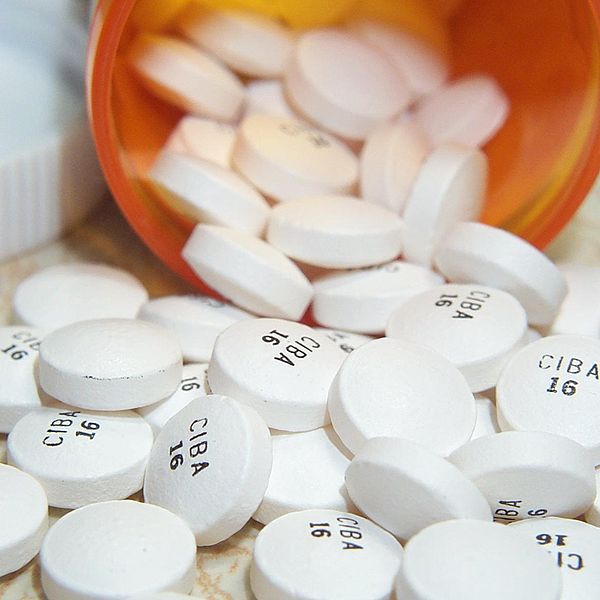
Image: Ritalin. Sponge. GNU Free Documentation License.

Are You Better Off Now Than You Were Four Years Ago?

Various politicos, pundits, and demagogues are asking if we’re better off now than we were four years ago. For moi? The answer his “hell, yes!”

How about yourself?

Four years ago today, I knew my job and the jobs of my four staff members (five, if you counted interns) would end in two and a half months. The nation was heading into the worst recession since the Great Depression, and I was heading into the most difficult financial times of my life.

I was struggling to pay off a $30,000 equity loan on my hugely devalued house, which would soon be worth less than I’d paid for a house with the same floor plan by the same developer in the same tract ten years before.

My life savings were down by about $180,000.

The house I’d helped my son buy at what we thought was near the end of a downtick was sinking below the waves, headed for Davy Jones’s Locker.

To pay off the home equity loan on my house, I was “noon-lighting” by teaching online upper-division writing courses on top of my regular job at the university. The Great Desert University caps its writing courses at 30, or 10 students more than NCTE recommendations allow, but it removes caps for online courses. Each class was double-enrolled, something I didn’t find out until two days before the semester started. I demanded pay for four sections and, to my amazement, got it. But the overload caused by the equivalent of five reasonably populated writing courses (120 students) on top of a full-time job was vast.

Got the loan paid off, though. 😉

As layoff day loomed, most employers didn’t bother to respond to applications. I couldn’t get hired for love nor money, whether in jobs that used my considerable experience and skills or in menial work. I couldn’t even get hired to drive the tourist train at the zoo!

I was forced to start Social Security benefits six years before I’d planned to do so; two years before I reached so-called “full” retirement age. It was that or draw down from my devastated retirement fund, something my financial manager strongly opposed. This resulted in much reduced Social Security payments, leaving me without enough cash flow to live on. There was a real possibility that, if I couldn’t find some kind of menial work, I would lose my paid-off home to county taxes, which I did not know if whether I could cover. Nor did I know whether I would be able to pay the utilities or cover routine maintenance on my home.

At the end of December, 2009, I just squeezed in under the wire to get the reduced rate for COBRA. Without it, I would have had to go bare, since I couldn’t have begun to afford the full freight. At the reduced amount, COBRA cost many times what I paid for the same insurance on the job, though it still was cheaper than Medicare, which mercifully kicked in just as my COBRA eligibility expired.

I finally did have to accept long-term part-time employment in a menial job, teaching junior-college freshman composition on an adjunct basis, despite having sworn, after the last time I taught freshman comp, that I’d never do it again. My classes filled up with scared, unemployed adults whose desperation was so solid you could reach out and touch it. Though I tried to put a bright spin on it—after all, I was grateful to have some income, even though it entailed hours of unpaid labor and paid all of $150/week per course—the truth is it’s exploitive, miserable work. Since then I’ve been living on net pay and $14,000 of emergency savings I had at the time I was laid off. And it hasn’t been easy.

Today things look a great deal better. Business is picking up, a fact reflected in the recent drop in unemployment. The economy is recovering from the real estate bust that dragged us all down: in these parts, real estate values have climbed almost 30% over the past year. The value of M’hijito’s house is now high enough that we would not have to bring an impossible sum to the table if he wanted to move; mine has now recovered enough value that if he got a job in San Francisco, where he would much prefer to live, I could sell my house, pay off the bloated loan on his, and move into it.

Friends in real estate, residential and commercial lending, renovation contracting, and travel report that things are picking up. A few are very busy, indeed.

My savings have recovered to the point where a 4 percent drawdown plus a modest income from freelance editing will support me in the same grand style I’ve enjoyed as an adjunct college instructor. In fact, it may allow me to cobble together a slightly larger income. It won’t be enough to live the life of a publishing magnate, but…neither will it require me to teach freshman comp.

Business is recovering enough that The Copyeditor’s Desk now has a steady flow of clients. Indeed, enough work is already coming in to share it with subcontractors, and it looks like some assiduous marketing will create further growth.

I can’t say everything is sweetness and light. Unless a miracle happens, I’ll never earn what my actual job brought in. In terms of month-to-month cash flow, I never will qualify as a member of the middle class again. And I can’t imagine how I’m going to afford to replace my 12-year-old vehicle, which surely won’t run more than another 40,000 or 50,000 miles. If I live to advanced old age, I probably will run out of cash. But things sure are better than they were four years ago!

How about yourself? Compared to four years ago, are you better off, worse off, or about the same?

Another Day, Another…what? Dollar?

Another hectic day. Woke up at 3:00 a.m., after having turned off the light at 11:00 p.m.: a grand total of four hours’ sleep. Got up, fiddled around for a couple of hours. Went back to bed, the alarm set for 6:00. Gave up on that before the binger went off.

Last night the president of our Thursday networking group e-mailed to remind us of the meeting and say who was next up to do a presentation. Seeing my name in the message, I thought it seemed a little early for a repeat performance; however, a couple people were going out of town, so we had juggled the calendar and I had volunteered to take an earlier than usual date. So it was that along about 6:00 p.m. I realized I had to be ready with a business presentation by 6:45 this morning, when I have to fly out the door.

Spent the evening putting together “Seven Business-Related Jobs That Are Worth Farming Out”—not a bad dog-&-pony show for such short notice. And it’s doing double duty as content for this quarter’s newsletter.

As it developed, one of the other members was slated for today; I was flagged for next week. Luckily, though, for both of us, he hadn’t seen the e-mail and so had nothing to offer. Serendipitously, then, I had something to fill the space and he had a week to come up with something new to entertain us. Win-win!

Thence to campus, where the little 101 McBoingers are turning in drafts for their first researched paper of the semester. Today they reported on their progress, which in some cases was “nil.” After my having explained three times that this 750 “draft” should NOT be draftig but should be “as close to FINAL as you can make it, because I will grade it the same way I grade a final paper so that you can see what to expect when the remaining 200-point papers come your way,” it was clear that some of them still didn’t have the message.

One kid didn’t know how long the paper was supposed to be. This is appears in writing, SIX TIMES, in the syllabus, over which they have all taken a quiz, one of whose questions was “how long are the papers for this class?” Others had not noticed that said paper is expected not to be a “rough” draft but something more like a “final” draft, despite this instruction also having been written out in said syllabus and despite my having explained it repeatedly.

They sleep with their eyes open.

You wonder why I feel teaching freshman composition is a waste of everyone’s time, theirs as well as mine?

Back to the CE Desk office for a round of tasks so mundane and done in such a haze that I can’t even remember what they were. Edited some copy, answered e-mail, thought about editing other copy.

Figured out a way to jam the bedroom Arcadia door open about 9 inches, just too narrow for an adult man to squeeze through (although his girlfriend could get through if she were flat-chested, and surely his kid could slip in). The weather is supposed to cool starting early next week. This will allow me to turn off the air-conditioning, at last, and cool the bedroom with fresh air.

To get in through the nine-inch opening, you’d have to open the relatively sturdy screen, which has a metal border wide enough to block the opening even after the burglar takes a pocket knife to the screen. A couple of squealers glued to the inside of that wide border should give anyone who tries to get in a little surprise. So I don’t think it’ll be excessively unsafe.

I hope.

Speaking of editing copy, it’s only about 8:30 p.m. There’s just about enough time to get through another chapter of one of my fave client’s mystery novels before I can no longer hold my eyes open. And so, to work…