This morning I noticed that the little black base on the beloved Osterizer blender is cracked through.
I use this appliance every single day to whip up my favorite ice-cold breakfast drink, frozen strawberries whipped into orange juice.
{moan!} So now on top of all the other budget-busters I’ve gotta buy a new blender? Not that they’re so expensive: recently Costco had them for around $20 or $25. But after the AC repair, the new thermostat, the dog agility training fee, the pool equipment repair, and the expected astronomical power and water bills, I don’t happen to have $20 or $25 laying around.
You can buy blender parts separately. Lo, you can even find them on Amazon! Yea, verily, here’s the gadget itself. They want six bucks for it. Not bad…if asked, I’d guess it was worth about four dollars. Problem is, they want another $5.00 to ship it, for a total of $11.00!
It is eligible for free shipping, but that would require one to spend a total of $25. Setting aside the fact that I can’t afford $25 right this minute, there’s really nothing that I want that would rack up a $25 bill at Amazon. Don’t need anything. Don’t want anything.
Amazon is trying to get $44 for a new Osterizer. Ugh. I should’ve bought the $25 number when I spotted it at Costco!
So, absent a shopping trip through 110-degree heat, even $11 would be lots cheaper than ordering a new unit.
It frosts my cookies, though. How can I count the ways I resent having to spend eleven bucks for a four-dollar piece of plastic?
Well, I’ve got to buy gas anyway. While I’m out I’ll trudge through the Target and the Costco in search of a cheaper model. Even if one surfaces, though, we’re looking at spending $30 or so (by the time the 10% tax is tacked on) because a $4 part crapped out.
What think you, dear reader?
Better to pay $11 to replace an inexpensive piece of plastic?
Or…better to pony up $25 or $30 for a brand-new unit with a shiny new motor and advertised ice-crushing capacity?
Hurrah! It's time for the 237th Festival of Frugality! With the Fourth of July just past, we're going with an Independence Day theme.Americans are good at beating the odds. Our country was founded 235 years ago with a war in which the colonists were outmatched by the greatest naval force on the planet. Young men who had never been away from home came up against seasoned British troops and German mercenaries under career officers.Today many of us feel the odds against America are pretty high again. With the official unemployment rate stuck at almost 10 percent and the real under- and unemployment rate closer to 20 percent, our country engaged in a war we are unlikely to win (if the situation even allows such a thing as "winning"), widespread debt among our citizens, state economies on the verge of collapse, the federal deficit soaring, and one in every 400 homes going into foreclosure just last month, Americans face daunting challenges. But individuals, families, and communities around the country are rising to those challenges, as they did 1776. In this festival, bloggers report on developments in the revolution against debt, waste, and economic oppression.Editor's choices are flagged with little red hearts: ♥Getting fired up at the Boston Tea Party
PT PT Money 10 Places to Get WiFi for Free
PT reports that all Starbucks are now offering free WiFi and then adds another nine connections for the peripatetic computerist.
♥ Neal Frankle Debt Pilgrim How Much Can I Afford for a House? A Checklist
This unprepossessing title disguises some very savvy advice. If you’re thinking about buying a house—or even vaguely daydreaming of one—don’t miss this article.
♥ Jim Wanderlust Journey Checked Baggage Fees List
If you travel by air, bookmark this post! Jim first clues us to airlines that give you one checked bag free; then provides a list of baggage fees by airline.
Tim Chen NerdWallet 5 Reasons to Avoid AMEX Blue Cash
This review of the AMEX Blue Cash card actually gives some fairly strong pro’s as well as the five cons mentioned in the post title.
Fireworks over Washington Monument. Public domain. Boston Tea Party. National Archives and Records Administration. Public domain.
Washington and Lafayette at Valley Forge. John Ward Dunsmore, 1907. Public domain.
Scan of the cover of Thomas Paine’s Common Sense. 1776. Public domain.
Plan of the Battle of Yorktown. Goodrich, S. G. (1875). A Pictorial History of the United States. Philadelphia: J. H. Butler & Co., 277. George Washington Rallies His Troops at the Battle of Princeton. Artist unknown. Public domain. Washington Crossing the Delaware. Emanuel Leutze. 1851. Public domain.
East Village Fireworks. David Shankbone. Creative Commons Attribution-Share Alike 3.0 Unported license.
It’s six minutes to midnight and the Cassowary and I just came in from a late-night constitutional. Soon’s I finish this, it’s into the pool.
Weirdness in Arizona: the 90 degrees outdoors feels cooler and more comfortable than the 85 degrees inside the house. Just turned the thermostat to 78 for sleeping purposes. The unit’s banging away, cranking chilled air that does little to dispel the sense of oppressive heat inside the building. But oh, it’s lovely outdoors.
In the “good” old days, people here had sleeping porches. Those who couldn’t afford to spend the summer disporting themselves in Prescott, Flagstaff, or Payson, up in the high country, slept en plein aire, with a bit of bug screen between themselves and the scorpions, the black widows, and the (few, in those days) mosquitoes. Burglars and rapists were not an issue.
Sometimes I think it would be worth doing: have someone come and install wrought iron fencing all along the eaves in back, with a deadbolted door or two. Then velcro some nylon bug screen to the inside. This would accomplish three things:
• On a night like this, I could sleep out there on a hammock, reasonably secure against bugs and roaming madmen.
• When the weather’s nice and cool, I could throw open the bedroom’s Arcadia doors and not worry about visits from passing sh**heads.
• It would bring the unfenced pool back up to code. (You didn’t ask, which was wise, but since you wondered: you can substitute massively locking doors to the backyard for prison bars around the pool).
Just imagine how lovely it would be to sleep outdoors this evening, under the quiet stars! Or how sweet to sleep indoors of a winter evening, under a down comforter, with the bedroom doors full open to a 60-degree night.
Lately I’ve been considering where I’m going to live during the next and presumably last stage of my life.
It’s a question that was brought into sharper focus when I fell and hurt myself badly enough that I couldn’t easily take care of my home or myself. The shoulder still isn’t healed—but even though it hurts quite a lot, on and off, all the physical work around this house still has to be done. Caring for the pool (a daily project), dealing with the quarter-acre yard, cleaning and maintaining a four-bedroom house…they all represent physical labor. And there’s no one here to help. Just now I ache all over my body, as though the shoulder pain spread to every other joint all the way down to the toes. But none of the work can be put off just because my back hurts.
Clearly, I’m not going to be able to care for this house for many more years.
Then there’s the issue of the costs. Property taxes can go nowhere but up, and at $2,000 a year they’re already at the border of what I can afford. Because I have retirement savings, I don’t qualify for the cap on taxes for the elderly. Though the new AC repairman clearly was trying to scam me, the truth is that sooner or later the HVAC unit will have to be replaced, to the tune of around $6,000. The interior needs a paint touch-up, and the exterior will have to be repainted sometime in the next five years. There’s a crack in the living-room tiles, an ominous development. In another five years, too, the pool will need to be replastered, a $7,000 job. Power and water bills keep going up and up. With no credible source of steady income, where on earth is the money going to come from to cover those expenses?
And who is going to take care of me when I can no longer care for myself?
This train of thought brings me to consider the best thing my father ever did for me: he moved himself into a life-care community. After my mother died, he sold his house in Sun City, divested himself of his possessions, and used the money to buy into a Baptist-run independent living community. This gave him (and later, his new bride) a garden apartment, access to hobby and meeting rooms, two meals a day in a central dining hall, and guaranteed access to nursing care.
For me as his daughter, it meant I didn’t have to take care of him as he grew older and more infirm. When he had a heart attack and triple-bypass surgery, the institution moved him temporarily to a studio apartment next to the nursing home, where an RN checked on him several times a day to be sure he was taking his meds and to coax him to eat. And after he had a stroke, the only medical practitioners who would care for him and respect the wishes he had expressed in his living will were the staff of nursing home at the life-care community.
It wasn’t ideal. The food was awful. The doctor on the staff was ripping off Medicare right and left. The institutional setting was depressing—at least, I found it so. But it probably was better than the situation he would have faced had he tried to stay in the Sun City house for the rest of his life.
After he died, I discovered the staff had provided him with a lot more care than he had contracted to receive. A woman in the central office spent a fair amount of her time running interference with the various bureaucracies the elderly have to negotiate. As he grew more confused in age, he would occasionally mess up his checkbook; someone at the office went through and corrected his figures, balancing and reconciling them against the bank’s statements. So. He got his money’s worth, and then some.
I wouldn’t care to live where he was. They’ve torn down the garden apartments and replaced them with massive people warrens. I’m not a rabbit or a caged chicken, and I don’t want to live like one. However. There are alternatives.
My great-aunt was the one who turned my father on to life-care communities. She came to Arizona one year to visit several such outfits, which at the time were a new development. She sold her house in Sausalito and ended up in a place in Oakland—I believe it probably was this one. From what I understand, it was very pleasant. One could find worse places than the Bay Area to live out one’s last years.
Interestingly, it’s run by my correligionists, the Episcopals. Not that it matters. The Baptists were no less craven than any for-profit outfit about extracting funds from the inmates where my father lived, and I can’t imagine that would differ according to the proprietors.
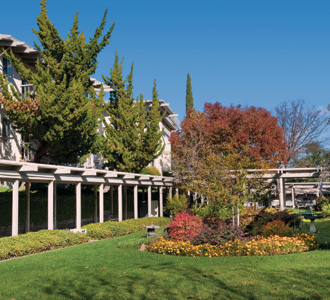
The Episcopals run a number of life-care communities in northern California. There’s this rather amazing place in San Francisco, for example. I’m sure I can’t afford to live in the City, of course…hell, I can barely afford to live in Phoenix! Here’s a place in the Santa Cruz area that might be less extravagant than living in the heart of San Francisco. One in Pacific Grove, which is near Monterey, probably costs no less than the place in the City. More promising, possibly, is this one near Santa Rosa.
My aunt had enough money to be comfortably set. She and my uncle married in middle age, neither of them with children. They both worked for the California Academy of Sciences their entire adult lives, and my uncle invented the precursor to the Kodak Carousel slide projector. As you can imagine, even a small royalty would have allowed them to buy the architect-designed house in the Sausalito hills where they lived all the time I knew them.
Chances are I can’t afford any of these places. My father and his wife were paying, for a three-room apartment and two meals a day, more than my ex- and I paid for a 3,000-square-foot ranch house with a pool on a third of an acre of prime North Central real estate. On the other hand, most of their food, their utilities, transportation (to a degree), property taxes, insurance, semiweekly housecleaning, landscape care, and nursing home insurance were included in the cost.
I already have nursing home insurance, though I suppose I could stop paying on that. But even with the long-term care insurance, my total monthly bills come to less than my father paid for his dim little apartment. And that was for a not-very-appealing place in Phoenix, Arizona. The cost of living in northern California is so much higher that you likely have to be a dot-com millionaire to live in one of those places.
Nothing ventured, nothing gained, though: I’m sending away for their propaganda packages.
LOL! Frugal Scholar has a great story today about finding a pair of Not Your Daughter’s Jeans at a thrift store, discovering they fit pretty well, getting a compliment from DH (!!), and so going in search of similar togs. None of which fit at-tall.
Was going to add my most recent shopping tale in a comment to hers, but Blogger won’t let you post a comment unless you have a specific gmail account open, and since I’m busy with the Festival of Frugality, I’m not logging out of that account, into the FaM account, out of the FaM account, and then back into the FoF account just to scribble a few words.
But this is funny enough to share, anyway. Hence:
Yesterday I wandered into a boutique in the thriving strip mall where Leslie’s swimming pool store resides. This shop always has THE cutest clothes in the window. Highly covetable.
Within those air-conditioned climes I found a cute top, gauzy with nifty crewelwork trim. Dig out the tag: $135.
Moving on…
The sales clerk came bouncing up and offered to sell me anything she could. I asked how to tell the sizes, since the sizing wasn’t obvious. She also had to dig around for a tag and finally came up with one on a chic-looking pair of low-slung pants: Large.
“Uhm… Large? That wouldn’t begin to fit around my rear end,” said I. “How do your sizes run?”
“Oh,” quoth she, “they go up to about a size 10.”
“A size 10 is ‘large’?”
“Yes.”
“How are you able to sell many clothes? The average woman in this country wears a size 14. That is not ‘large.’ That’s average.”
“Actually,” she started in—hang onto your hat: this is where it gets good. “Actually, the reason fashion sizes run small these days is that the Japanese are buying so many clothes, and they’re kind of small.”
“I don’t see any Japanese customers around here,” I observed.
“Well, because of the demand in Asia, manufacturers are all making clothes for Chinese and Japanese women.”
“That explains a lot,” I said. “I hardly ever buy clothes any more, because nothing fits. And you know, at size 12 I don’t think I’m fat.” (Objectively true: I’m well within the normal BMI range for a woman my age and height.)
“Oh, no, nooooo, you’re not fat!”
You don’t think so? “Well, the only place I’m buying clothes these days is Costco, because that’s the only place where I can find things that fit. Maybe American women would like to wear cute clothes, too?”
Exit, pursued by a globalized bear.
Isn’t that the most hilarious thing? Literally, there is no Asian community anywhere near that store. The demographics are mostly white followed closely by Latino and a fast-growing African-American community. Last I saw, few of us looked especially underfed. How do retailers that have absolutely no concern for their customers stay in business?
So, the next time you try on umpteen berjillion outfits and can’t fit into one of them, you’ll know:
Some of you will recall my recent enthusiasm, now a few months old, to renovate the aging face, which was beginning to show the signs one might expect in a survivor of the Pleistocene.
After a fiasco with a product called RoC, I ordered up some Alpha Hydrox AHA Enhanced Lotion from the Internet. This old favorite has about the same concentration of alpha-hydroxy acid as the expensive stuff my dermatologist used to dispense, at a tiny fraction of the cost. The plan was to try to plump out some of the wrinkles and fade the age spots a bit, and then to disguise what remained with liberal application of new-fangled powder mineral makeup.
So, did any of these shenanigans do any good? Well, judge for yourself. Here’s a before:
A bit blurry, but probably just as well. Some things are best not studied with excessive acuity.
Now here’s the after:
Doctored and painted!
Definitely not going to win any beauty contests. But I think it’s better. The hide looks healthier, and the splotches and uneven coloring are smoothed out.
The keys were twice-daily application of Alpha Hydrox (which I could only find at Amazon.com) and various ordinary drugstore face creams or hand lotions; daily application of a sunscreen; weekly exfoliation with plain old baking soda, and artful painting with Kirkland Borghese mineral makeup.
Naturally, sensing that I liked the stuff Costco immediately took the makeup off the shelf. It appears to be out of production altogether—you can’t get it online, either, nor, apparently, can you buy it from Borghese. After traipsing to three Costco outlets, I finally found a few in one store, where I bought two sets for the cost of one small jar of powder from The Body Shop. When it runs out, I guess I’ll try L’Oréal, which is the drugstore version of Lancôme.
Benign sunscreen
Considering that it’s been barely four months since I started this regimen (not to say “experiment,”), the results are not bad. No doubt if I keep it up, by the time I’m 70 I’ll look like I’m 18.







 ; daily application of